

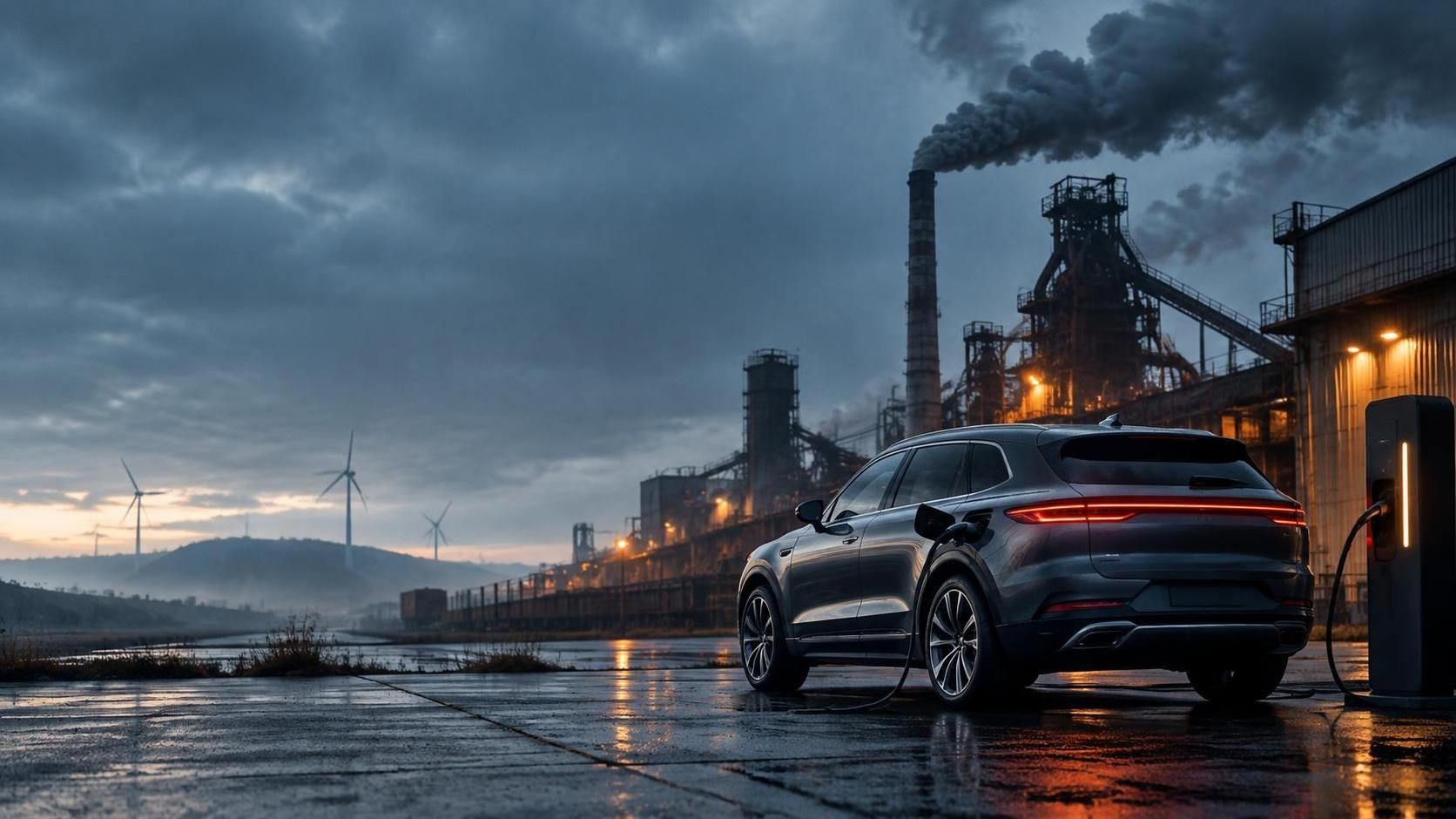
Alongside German Manufacturers Jaguar Land Rover Hits the Net Zero De-Industrialization Wall Alongside German Manufacturers
Jaguar Land Rover is the latest major European automaker to confront the structural pressures of high energy costs, climate mandates, Chinese competition, and expensive domestic production. On 13 November 2026, its parent Tata Motors Passenger Vehicles reported an unexpected consolidated net loss of ₹5,531 crore (approximately $587 million) for the second quarter of FY27. Analysts had expected a profit. The swing from a large year-ago profit was driven primarily by exceptional charges of roughly ₹6,738 crore linked to JLR restructuring, including employee separation costs and asset impairments.
Consolidated revenue rose about 34% year-on-year to ₹96,920 crore, supported by recovery at JLR after the previous year’s cyberattack disruption and strong domestic Indian volumes. However, margins faced pressure from adverse mix and commodity costs. JLR itself reported stronger revenue in the quarter but revised its full-year profitability outlook downward amid ongoing market challenges, geopolitical risks, and the restructuring charges. Earlier in 2026, JLR announced plans to cut around 4,000 jobs (nearly 10% of its global workforce, mainly salaried and management roles) over two years as part of a £1.7 billion savings programme aimed at lowering its break-even volume toward 300,000 vehicles.
These moves come as JLR continues investing heavily in electrification while navigating tariffs, competition, and the aftermath of the cyber incident that halted production for weeks.
Volkswagen and Mercedes Signal Broader Retreat from High-Cost German Production
The pattern is repeating across the German auto industry. Volkswagen has scrapped its “Gamechanger” advanced manufacturing concept for the Wolfsburg headquarters plant, including plans for a large-scale mega-casting center whose construction was imminent. The company cited its strained financial position and said all investments are under review. Development of its next-generation Scalable Systems Platform for electric vehicles continues, but future models will rely more on conventional processes. This follows earlier decisions to suspend certain development work, including on the all-electric Golf at Wolfsburg.
Under CEO Oliver Blume, Volkswagen is pursuing one of the largest restructurings in its history, with plans involving up to 100,000 job cuts globally, capacity reductions, a sharply narrowed model lineup, and the phased wind-down of production at multiple German sites (including Emden, Zwickau, Hanover, and Audi’s Neckarsulm in various reports). Excess European capacity and intense competition from Chinese EV makers have been cited as key factors. Labour representatives have criticized the Gamechanger cancellation as a breach of prior agreements that traded earlier job cuts for investment commitments.
Mercedes-Benz has taken an even more explicit stance. Production leadership has stated that the board has halted all further investments at German sites while negotiations over labor costs continue with the works council and IG Metall. Management has warned that without productivity gains and cost reductions—German production labor costs can be several times higher than at Eastern European sites—new models may be allocated exclusively abroad, and plant closures are now under closer examination. Mercedes has also pointed to weaker China demand, tariffs, and competitive pressure.
These are not isolated efficiency measures. They reflect a structural challenge to high-cost European manufacturing bases.
High Energy Costs, Mandates, and the Environmental Paradox
European industrial energy costs remain elevated relative to the United States and parts of Asia. This stems from the long-term effects of renewable expansion, carbon pricing, grid levies, intermittency management, and reduced fossil-fuel flexibility. Energy-intensive sectors that supply the auto industry (chemicals, metals, and related materials) have seen significant output declines in recent years.
These costs sit alongside EU and UK climate rules that accelerate the shift away from internal-combustion engines through zero-emission vehicle mandates, fines, and related requirements. Automakers must fund the capital-intensive EV transition while facing Chinese competitors that benefit from scale, lower domestic costs, extensive state support in batteries and EVs, and a different energy mix. The result has been margin compression, overcapacity in Europe, and deferred or redirected investment.
On the environmental question: territorial emissions in Europe can fall when factories close, output drops, or production relocates. That is arithmetic, not necessarily a reduction in global atmospheric concentrations. When manufacturing moves to China—still reliant on a coal-heavy power system for much industrial and battery/EV supply-chain activity—or other locations, emissions are often displaced rather than eliminated (carbon leakage). EV production itself carries a substantial upstream footprint from mining, refining, and manufacturing. Policies that raise energy and compliance costs in high-regulation jurisdictions without matching industrial competitiveness have accelerated offshoring and import dependence rather than creating a clean domestic manufacturing renaissance. Chinese brands have gained rapid European market share in part because they can deliver lower-priced vehicles against Europe’s rising cost base.
JLR’s restructuring charges and guidance cuts, Volkswagen’s cancelled projects and capacity plans, and Mercedes’ investment freeze illustrate the same pressures. Net Zero targets as currently implemented have prioritize rapid territorial decarbonisation through regulation and energy-system redesign. The economic costs—job losses, supplier-chain erosion, and lost industrial capacity—are now visible in company results and announcements. Whether the climate accounting ultimately justifies those costs depends on whether one measures only domestic numbers or the full global picture, including where displaced production occurs and on what energy mix.
Europe’s automakers are confronting an operating environment that has made domestic production increasingly uncompetitive. The results and restructuring decisions at JLR and the German majors show the practical consequences.
Appendix: Key Sources and Links
Tata Motors / Jaguar Land Rover Q2 results and restructuring
- Bloomberg: Tata Motors Swings to Unexpected Loss, Pares Back JLR Outlook (13 Nov 2026) — https://www.bloomberg.com/news/articles/2026-11-13/tata-motors-swings-to-unexpected-loss-pares-back-jlr-outlook
- CNBC TV18: Tata Motors PV Q2 Results: Net loss at ₹5,531 crore on JLR restructuring costs — https://www.cnbctv18.com/market/stocks/tata-motors-pv-share-price-q2-results-net-loss-at-rs-5531-crore-on-jlr-restructuring-costs-asset-impairment-20033595.htm
- The Economic Times / related coverage of the ₹5,531 crore loss and exceptional items
- Reuters / Business Recorder reporting on the quarterly loss and JLR charges
JLR job cuts
- Reuters: UK’s Jaguar Land Rover to cut nearly 10% of workforce (7 Sep 2026) — https://www.reuters.com/business/world-at-work/jaguar-land-rover-cut-4000-jobs-globally-over-next-two-years-2026-09-07/
- Bloomberg: Jaguar Land Rover Plans to Cut 4,000 Jobs to Tackle Costs (7 Sep 2026)
- BBC News coverage of the voluntary redundancy programme and £1.7 billion savings target
Volkswagen Gamechanger and restructuring
- Reuters: VW drops ‘Gamechanger’ production at main plant (11 Nov 2026) — https://www.reuters.com/business/world-at-work/vw-drops-gamechanger-production-main-plant-risking-escalation-with-workers-2026-11-11/
- Bloomberg: VW Scraps Advanced Factory Plan in Blow to Made in Germany (11 Nov 2026) — https://www.bloomberg.com/news/articles/2026-11-11/vw-scraps-advanced-factory-plan-in-blow-to-made-in-germany
- Deutsche Welle, electrive.com, and related reporting on the cancelled mega-casting centre and broader capacity/job plans (up to 100,000 cuts, potential German plant wind-downs)
Mercedes-Benz investment freeze
- Reuters: Mercedes-Benz halts German investments as plant closures loom (12 Nov 2026) — https://www.reuters.com/world/mercedes-benz-halts-german-investments-plant-closures-loom-2026-11-12/
- Bloomberg (German coverage): Mercedes stoppt neue Investitionen in deutsche Werke wegen hoher Arbeitskosten
- WELT, tagesschau, and electrive.com reporting on the board decision, labour-cost talks, and potential site closures
Broader context on European auto sector, energy costs, and competition
- Reporting from Reuters, Bloomberg, and industry sources on Chinese EV competition, excess European capacity (~500,000 vehicles in some estimates), and high German production costs
- Coverage of energy-intensive industrial output declines in Germany and the effects of carbon pricing, renewables policy, and the EV transition
These sources form the basis for the company-specific developments described above. Broader energy-cost and carbon-leakage observations draw on established patterns in European industrial data and policy analysis.

