The green-steel project was sold as the industrial proof of Net Zero: replace coking coal with hydrogen, swap blast furnaces for electric arc furnaces, keep the mills, cut emissions, and lead the world. In Germany, the United Kingdom, and across the EU, that story is colliding with energy prices, missing hydrogen, cheap imported steel, and the stubborn physics of making high-quality metal.ArcelorMittal’s retreat is the clearest signal yet.
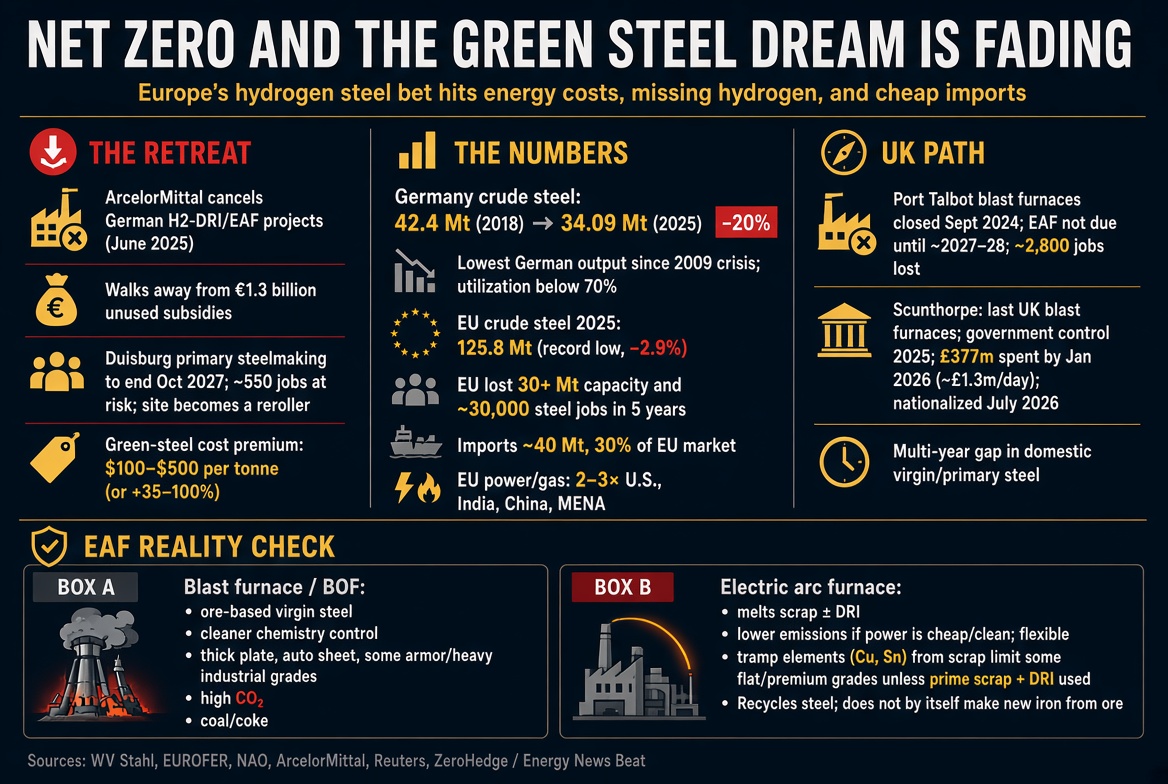
In June 2025, the company canceled planned hydrogen-ready direct-reduced-iron (DRI) and electric-arc-furnace (EAF) conversions at Bremen and Eisenhüttenstadt, walking away from about €1.3 billion in German subsidies that were never drawn. In early September 2026, it went further: primary steelmaking at Duisburg will end, with the steelworks and billet mill shutting down from October 2027. Around 550 jobs are at risk. Only the wire-rod mill stays, fed by semis from other ArcelorMittal sites and outside producers. The company had already considered an EAF conversion at Duisburg and judged it uneconomic.
Green steel—hydrogen instead of carbon as the reducing agent—adds roughly $100 to $500 per tonne, or 35–100 percent extra cost for European low-carbon conversion, depending on the route and power price. That gap does not close when electricity in Europe is two to three times the price paid by competitors in the United States, India, China, and the Middle East, and when commercial green hydrogen remains scarce.
Germany’s crude-steel output tells the same story. Production fell from 42.4 million tonnes in 2018 to 34.09 million tonnes in 2025—about 20 percent—the lowest level since the 2009 financial crisis except for that crisis year itself. Capacity utilization dropped below 70 percent, the danger zone for energy-intensive mills. Oxygen-route (blast-furnace) steel fell harder than EAF output. Demand in Germany was around 30 million tonnes. Thyssenkrupp Steel is cutting capacity from 11.5 million tonnes toward 8.7–9 million and planning up to 11,000 job cuts from a workforce near 26,000–27,000. Direct steel employment in Germany has already fallen from about 97,000 in 2015 to roughly 80,000 in 2025. Salzgitter delayed later stages of its SALCOS hydrogen project by about three years; phase one (DRI + EAF, targeting ~30 percent CO₂ cut on ~2 million tonnes) still aims at 2027, but the 95-percent path is pushed to a 2028–29 decision. Thyssenkrupp has been renegotiating subsidy terms so its Duisburg DRI plant can run on gas if hydrogen is not there.
The UK is further down the same road. Tata Steel closed Port Talbot’s last blast furnace in September 2024, ending more than a century of primary steelmaking in Wales. An EAF is planned, with government support of £500 million toward a larger package; commissioning is not expected before 2027–28. Thousands of jobs went with the furnaces. That left British Steel’s Scunthorpe works as the last operational blast-furnace site in the country. After talks on an EAF conversion failed and daily losses were reported around £700,000, the government seized operational control in April 2025, spent £377 million by late January 2026 (about £1.3 million a day), and nationalized the company in July 2026. The UK now sits in a strategic gap: primary output has collapsed while replacement EAFs are years away. Critics warned of a multi-year stretch in which most virgin steel would have to be imported.
This is not a uniquely British or German problem. EU crude-steel production fell to a record low of 125.8 million tonnes in 2025, down 2.9 percent, nearly 20 million tonnes below pre-pandemic levels and almost 60 million below the pre-2008 peak. Over five years, the EU industry has lost more than 30 million tonnes of capacity and about 30,000 direct jobs. Imports hit nearly 40 million tonnes and 30 percent of the market. In June 2026 Brussels slashed tariff-free import quotas by 47 percent to 18.3 million tonnes and imposed a 50 percent out-of-quota duty. CBAM costs on carbon-intensive imports started in 2026. None of that restores cheap power or cheap hydrogen. EUROFER’s message is blunt: weak manufacturing demand, high energy costs, and global overcapacity—especially from Asia—keep the sector under pressure.
What EAFs can and cannot do
Electric arc furnaces melt scrap (and, if available, DRI or hot-briquetted iron). They emit far less CO₂ than the blast-furnace/basic-oxygen route when the power is clean, they start and stop more easily, and capital cost per tonne of capacity is much lower. The United States already makes about 70 percent of its steel in EAFs. Italy is heavily EAF-based. Specialty UK plants—Sheffield Forgemasters and Rotherham—have long made demanding grades, including nuclear and some defense-related steels, in electric furnaces with tight scrap control and secondary refining. Armor plate has been produced from EAF melts plus ladle metallurgy and vacuum degassing.
The limitations are real and they matter for military and heavy industrial kit.
Scrap carries tramp elements—copper, tin, residual alloys—that accumulate through recycling. Those residuals damage surface quality, formability, and toughness in the most demanding flat products: exposed automotive sheet, some electrical steels, tinplate, and certain ultra-low-carbon grades. Thick, consistent plate for ships, heavy machinery, pressure vessels, and some armor applications is easier to control from ore-based iron, because the chemistry starts cleaner. EAFs can reach high quality if they are fed prime scrap plus DRI and then refined; they struggle when the only feed is mixed obsolete scrap. Heat sizes are typically smaller than integrated blast-furnace shops. Plant wastes that an integrated mill recycles through sinter are harder to handle in a scrap-EAF shop. Without a domestic DRI or pig-iron source, an EAF-only country is recycling old steel, not making new metal from ore. Global scrap cannot cover growing demand; primary iron units still dominate world output, and most new blast-furnace capacity is still being built in Asia.
UK officials have said the defense impact of leaving blast furnaces is “low,” pointing to existing EAF specialty capacity and future DRI. Others note that high-end submarine and heavy-plate work has historically depended on tightly controlled primary routes or imported semis, and that a five-year hole in domestic primary output is a strategic risk no peer economy of similar size has accepted. Heavy industrial equipment—turbines, machine tools, rail, offshore structures, tanks of steel for chemicals and energy—sits in the same quality and volume band. You can import slabs. You then import the industrial base that used to sit on top of those slabs.
How many countries lose the ability to make “new” steel?
Almost every country that never had an integrated mill already “cannot create new steel from ore.” The relevant shift is among industrial powers that are shutting the ore-to-steel route and becoming rerollers or scrap recyclers. The UK is the leading Western example: last blast furnaces under state control, Port Talbot converted to scrap-EAF, primary capacity in a multi-year trough. Germany is not there yet, but Duisburg’s move to a rerolling model, canceled hydrogen projects, and shrinking BF output point the same way. Across the EU, more sites will survive as finishers of imported semis if primary ironmaking leaves. New Zealand and a number of smaller economies already live on EAF or imports. G20-scale economies that keep blast furnaces or large DRI plants—China, India, Japan, South Korea, the United States (hybrid), Russia—will remain the sources of virgin units. Europe is choosing to buy more of those units rather than make them.
Deindustrialization in Germany, the EU, and the UK
Steel is not a standalone sector. It feeds autos, machinery, construction, shipbuilding, energy hardware, and defense. When primary steel leaves, the next question is whether the rolling mills, fabricators, and OEMs stay. Germany has already seen steel demand slump with weak autos, construction, and mechanical engineering. Energy-intensive chemicals and glass face the same power-price problem. Surveys have shown large shares of German industrial firms considering cuts or relocation. Europe lost more than a million industrial jobs between 2019 and 2023; Germany continued to shed manufacturing employment into 2025. High carbon and electricity costs, plus CBAM complexity, raise the price of EU-made steel-containing goods relative to imports that never paid those costs at the mill. Quotas and CBAM can slow the flood; they do not rebuild a cost-competitive energy system.
The UK’s path is sharper: lose primary steel, lose thousands of mill jobs, then discover that EAF jobs are fewer and that grid connections and power prices still have to be solved. Nationalization of Scunthorpe buys time. It does not invent cheap firm electricity or a hydrogen network. A country that cannot make virgin steel at scale becomes a customer of whoever still can—often the same jurisdictions that never accepted Europe’s energy-price experiment.
The fading green-steel dream is not a failure of metallurgy. DRI-EAF works where gas or hydrogen is cheap and power is abundant and predictable. It fails as a political timetable imposed on the highest-cost industrial electricity market in the developed world, with hydrogen that has not arrived and customers who will not pay a 30–100 percent green premium while Chinese and Indian BF-BOF metal remains available. Capital leaves. Furnaces go cold. The mills that remain increasingly roll other people’s iron. That is deindustrialization with a climate label attached.Net Zero did not invent Europe’s steel problem. Overcapacity, weak demand, and aging plants were already there. What Net Zero did was add a conversion cost and a power-price penalty that the rest of the world declined to match—then call the resulting retreat a transition.
Check out the World’s Greatest Podcast Show Notes at EnergyNewsBeat.co or EnergyNewsBeat.com.
Appendix: Sources and links – At Energy News Beat, we make appendices great again.
ArcelorMittal green-steel pullback and Duisburg
- ZeroHedge: Green Steel: ArcelorMittal Finally Pulls The Plug — https://www.zerohedge.com/markets/green-steel-arcelormittal-finally-pulls-plug
- EUROMETAL: ArcelorMittal to end primary steelmaking at Duisburg — https://eurometal.net/arcelormittal-to-end-primary-steelmaking-at-duisburg-site-retain-rerolling-operations/
- SteelRadar: ArcelorMittal cancels green steel plans in Germany — https://www.steelradar.com/en/arcelormittal-cancels-green-steel-plans-in-germany-due-to-high-energy-costs/
- Industrial Info: ArcelorMittal Stops German Green Steel Projects — https://www.industrialinfo.com/iirenergy/industry-news/article/arcelormittal-stops-german-green-steel-projects–343213
- DW: ArcelorMittal’s pullout plunges German green steel in doubt — https://www.dw.com/en/arcelormittal-s-pullout-plunges-german-green-steel-in-doubt/a-73303680
- FAZ: Arcelor Mittal streicht Pläne für grünen Stahl — https://www.faz.net/aktuell/wirtschaft/unternehmen/keine-umstellung-arcelor-mittal-streicht-plaene-fuer-gruenen-stahl-zusammen-110546841.html
- Reuters (via SteelRadar and related): green-steel project delays across Europe — https://www.steelradar.com/en/green-steel-projects-in-europe-are-being-postponed-to-2025-due-to-ongoing-uncertainties/
- Reuters: EU pushes barely available green steel as auto emissions fix — https://www.reuters.com/sustainability/climate-energy/eu-pushes-barely-available-green-steel-auto-emissions-fix-2026-03-04/
Germany production and industry crisis
- Industrial Production / WV Stahl: Steel production slumps in 2025 — https://www.industrial-production.de/economy—business/steel-production-slumps-in-2025—rippel—2026-must-be-the-year-to-secure-the-location-.htm
- SteelRadar: Germany’s crude steel output at 2009 crisis levels — https://www.steelradar.com/en/haber/germanys-crude-steel-output-has-fallen-to-2009-crisis-levels
- EUROMETAL: Germany sees another year of declining steel production — https://eurometal.net/germany-sees-another-year-of-declining-steel-production/
- Der Spiegel: Stahlproduktion 2025 auf niedrigstem Stand seit Finanzkrise — https://www.spiegel.de/wirtschaft/industrie-stahlproduktion-2025-auf-niedrigstem-stand-seit-finanzkrise-a-9303989e-b157-4b2c-9ed5-70e31bffa858
- n-tv: Stahlindustrie in Deutschland in Zahlen — https://www.n-tv.de/wirtschaft/Stahlindustrie-in-Deutschland-in-Zahlen-id30958428.html
- OSW: A fragile future: decarbonisation of Germany’s steel sector — https://www.osw.waw.pl/en/publikacje/osw-commentary/2025-09-17/a-fragile-future-decarbonisation-germanys-steel-sector
- Reuters: Salzgitter delays later stages of green steel project — https://www.reuters.com/sustainability/climate-energy/salzgitter-delays-later-stages-green-steel-project-due-economic-regulatory-2025-09-18/
- EUROMETAL: Salzgitter delays green steel plan — https://eurometal.net/salzgitter-delays-green-steel-plan-amid-economic-regulatory-headwinds/
- Reuters: Thyssenkrupp nears deal on green steel site funding — https://www.reuters.com/business/thyssenkrupp-raises-lower-end-profit-outlook-steel-materials-demand-2026-08-13/
United Kingdom
- BBC: Traditional steelmaking ends as Tata’s Port Talbot blast furnace closes — https://www.bbc.co.uk/news/articles/c70zxjldqnxo
- NAO: Investigation into the government’s intervention in British Steel’s Scunthorpe site — https://www.nao.org.uk/reports/investigation-into-the-governments-intervention-in-british-steels-scunthorpe-site/
- NAO PDF: https://www.nao.org.uk/wp-content/uploads/2026/03/investigation-into-the-governments-intervention-in-british-steels-Scunthorpe-site.pdf
- NYT: U.K. Nationalizes British Steel — https://www.nytimes.com/2026/07/16/business/britain-nationalizes-steel-mill.html
- The Times: Scunthorpe is England’s last steel town — https://www.thetimes.com/uk/society/article/can-englands-last-steel-town-survive-net-zero-vv0wvl6jd
- Wikipedia: British Steel (2016–present); Scunthorpe Steelworks — https://en.wikipedia.org/wiki/British_Steel_(2016%E2%80%93present) ; https://en.wikipedia.org/wiki/Scunthorpe_Steelworks
- Senedd Research: One year on, Port Talbot blast furnaces — https://research.senedd.wales/research-articles/one-year-on-how-has-the-blast-furnaces-closing-affected-port-talbot
- Army Technology: Steel sector changes and UK defence — https://www.army-technology.com/news/steel-sector-changes-have-low-impact-on-uk-defence-says-minister-of-state/
- Sky News (background): British steel on the brink — https://news.sky.com/story/why-the-british-steel-industry-is-on-the-brink-of-extinction-or-a-green-resurrection-12850386
- Hansard: Steel Industry debate — https://hansard.parliament.uk/commons/2024-10-16/debates/696BDED9-004C-478F-9EF8-DE7D7B7802DB/SteelIndustry
EAF vs blast furnace, quality, military/industrial uses
- Wikipedia: Electric arc furnace — https://en.wikipedia.org/wiki/Electric_arc_furnace
- SteelWatch: Why the auto industry doesn’t need blast furnace steel — https://steelwatch.org/steelwatch-explainers/eaf-auto/
- McKinsey: EAF steel: Beyond the blast furnace — https://www.mckinsey.com/mgi/our-research/eaf-steel-beyond-the-blast-furnace
- Ed Conway: Does it really matter if we can’t produce “virgin steel”? — https://edconway.substack.com/p/does-it-really-matter-if-we-cant
- Steel Market Update: Blast furnaces aren’t necessary to make most advanced steels — https://www.steelmarketupdate.com/2024/06/07/price-blast-furnaces-arent-necessary-to-make-most-advanced-steel-products/
- ZB Metal Tech: Electric ARC Furnace Vs Blast Furnace — https://www.zbmetaltech.com/electric-arc-furnace-vs-blast-furnace.html
- Hatch / AIST paper: Applications of Advanced Smelting Furnace Technology — https://www.hatchkiosk.com/events/ironsteel/wp-content/uploads/2023/06/Applications-of-Advanced-Smelting-Furnace-Technology-for-Sustainable-Steelmaking.pdf
- Net Zero Stratford explainer: Electric Arc Furnaces — https://netzerostratford.org.uk/you-asked-electric-arc-furnaces/
- Science Media Centre: expert reaction to Scunthorpe — https://www.sciencemediacentre.org/expert-reaction-to-the-scunthorpe-british-steel-factory-situation/
- SteelOnTheNet: Do G7 Countries Need Virgin Steelmaking? — https://www.steelonthenet.com/insights/g7-virgin-steelmaking-requirements.html
EU market, trade, energy costs, deindustrialization
- EUROFER Economic and Steel Market Outlook 2026–2027 — https://www.eurofer.eu/publications/economic-market-outlook/economic-and-steel-market-outlook-2026-2027-report-european-steel-market-faces-another-difficult-year-despite-modest-demand-growth
- EUROFER Annual Report 2026 (Steel in action) — https://www.eurofer.eu/assets/new-publication-page-2/Annual-Report-Steel-in-action-2026_Final_light.pdf
- Reuters: EU unveils new steel import quotas — https://www.reuters.com/world/china/eu-unveils-new-steel-import-quotas-protect-its-industry-from-overcapacity-2026-06-30/
- POLITICO: Steel and chemicals giants demand freeze to ETS — https://www.politico.eu/article/steel-and-chemicals-giants-demand-freeze-to-eus-flagship-climate-policy/
- POLITICO: Saving Europe’s steel — https://www.politico.eu/article/saving-europe-steel-has-strained-its-friendships/
- Reuters commentary: Europe’s energy transition is now an economic security race — https://www.reuters.com/commentary/reuters-open-interest/europes-energy-transition-is-now-an-economic-security-race-martin-vladimirov-2026-07-29/
- Energy News Beat: Europe’s Industrial Death Spiral due to Net Zero Energy — https://energynewsbeat.co/manufacturing/europes-industrial-death-spiral-due-to-net-zero-energy-may-not-be-recoverable/
- OECD Steel Outlook 2026 — https://www.oecd.org/content/dam/oecd/en/publications/reports/2026/06/oecd-steel-outlook-2026_a79fb861/99ab9b0c-en.pdf
- Global Energy Monitor: Pedal to the Metal 2026 — https://globalenergymonitor.org/sites/default/files/2026-05/Pedal%20to%20the%20Metal%202026.pdf
- Carbon Brief: Significant shift toward EAF in new capacity — https://www.carbonbrief.org/significant-shift-away-from-coal-as-most-new-steelmaking-is-now-electric
- worldsteel / production rankings (historical context) — https://worldpopulationreview.com/country-rankings/steel-production-by-country
Related Energy News Beat context