


ENB Pub Note: This article is from Guy Massey on LinkedIn. I have reached out and will try to get him on the Podcast to discuss his viewpoints.
In the previous decade data centres have gone from background infrastructure to a primary driver of electricity demand. AI has turned that curve almost vertical. Hyperscalers have responded with huge renewable portfolios and “100% renewable” headlines, but the real constraint is no longer the volume of green contracts. Now it is about whether stressed grids can actually deliver more power to the right places at the right times.
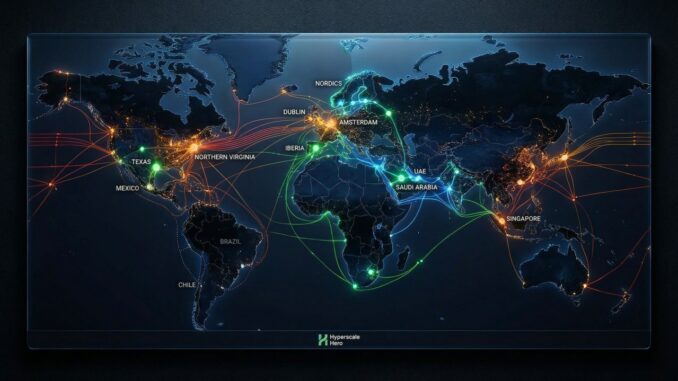
The result is a new geography. Traditional hubs such as ‘Data Center Alley’ in Northern Virginia, Dublin, Amsterdam and Singapore have hit limits in the form of moratoria, de facto bans and long connection queues as local grids and communities push back. At the same time regions such as Texas, Iberia, the Nordics and parts of the Middle East and North Africa (MENA) are positioning themselves as future AI engines, backed by large‑scale renewables, grid‑scale storage and targeted transmission investment. In contrast, many Latin America (CALA) markets remain underbuilt, with strong resource potential but slower grid and policy development.
In this article we will look at how energy resourcing for data centres has evolved from “just plug into the grid” to a complex system problem that now drives where and how hyperscalers build. We will trace the shift from the recent past to today’s grid‑tight reality, examining cases where development stalled and then resumed under new rules, describe the “power wars” between metros and regions, highlight how hyperscalers are moving towards carbon‑free energy with concrete investments, and explore how AI, liquid cooling and other technologies both increase and help manage power demands for the next generation of data centre markets.
1. From Easy Power to Hard Limits
Past: Power as a checkbox
Until recently power for new data centres in most mature markets was treated as a hurdle, not a constraint. Developers and hyperscalers:
- Selected land in established metros
- Secured indicative grid capacity from local utilities
- Assumed reinforcement would follow demand
Power was largely a pricing and scheduling input with the expectation that grids would quietly expand in the background.
Today: AI, electrification and a stressed grid
All previous assumptions are now invalid.
- The IEA projects that global data centre electricity demand could more than double to around 900 to 950 TWh by 2030, with AI as the dominant driver
- In the US, data centre load is expected to rise from around 22% in 2025 to nearly triple that by 2030
- European demand is on a similar trajectory as AI, cloud and connectivity roll out across the region
Now, power systems are:
- Connecting large volumes of wind and solar
- Electrifying transport and heating.
- Retiring legacy thermal plants.
Transmission and distribution upgrades have long planning and construction cycles. The combined result is a world where not every substation can grow indefinitely just because a data centre wants to connect.
Power has moved from being a background utility to being one of the primary strategic constraints.
2. Traditional Hubs Hit the Wall
Northern Virginia: ‘Data Center Alley’ meets transmission reality
Northern Virginia’s ‘Data Center Alley’ remains the largest concentration of data centres globally, but transmission limits have become binding.
- In 2022, Dominion Energy paused new high‑density connections at several Loudoun County substations after identifying constraints on multiple 230 kV lines
- Reports indicated that constraints affected two‑thirds of Loudoun’s substations and most projected growth, with full relief expected only after major line upgrades planned for later in 2026
- Subsequent analysis suggested some new hyperscale projects could face wait times of up to seven years for full power, forcing phased roll‑outs or relocation
Connections have partly resumed, but the episode underlines that transmission, not just land and planning, now determines the pace of growth.
Dublin: Moratorium and new conditions
Dublin experienced a similar shock:
- By the early 2020s, data centres were consuming more than 10 percent of Ireland’s electricity, with projections of up to 30 percent by 2030
- EirGrid announced that it would not accept new data centre connection applications in the Greater Dublin Area until at least 2028, effectively creating a moratorium
- New guidelines require large users to demonstrate demand‑side flexibility and, in some cases, the ability to export power back to the grid to secure approvals
Only under these tighter frameworks, alongside increased renewable ambition, have limited new projects started to move again.
Amsterdam: Pause, then heat‑reuse with stricter rules
Amsterdam and Haarlemmermeer introduced a temporary halt on new data centre permits in 2019, driven by concerns around power, land use and urban planning.
The pause was later lifted, but only with more stringent rules:
- Caps on maximum power and floor area per data centre
- Siting constraints to avoid overloading specific substations
- Strong emphasis on heat reuse with some projects required to supply residual heat to district heating networks
A new Dutch facility (Caransa Group’s new data centre in Amsterdam’s Western Docklands) now actively heats neighbouring homes, illustrating how integrating into local energy systems became a path back to acceptance.
Singapore: Moratorium to green regime
Singapore, with limited land and a tightly balanced grid, imposed a moratorium on new data centres in 2019 after the sector reached around 7% of national electricity demand.
The city state lifted the moratorium in 2022, but under a highly selective programme:
- A “call for applications” model awards limited MW allotments to projects that now achieve some of the lowest PUEs in Asia and commit to high shares of renewable or low‑carbon energy
- Initial rounds granted around 60MW, with later rounds (DC‑CFA2) allocating roughly 200MW under conditions including a 50% green energy mandate
Singapore’s case shows how a hub can reopen, but only when energy performance and sourcing are treated as first‑class design constraints.
3. The New Power Wars: Metros, Regions and a Global Map
As legacy hubs hit constraints, other regions are competing to capture the next wave of AI‑driven demand. The emerging map spans North America, Europe, MENA and CALA.
North America: Texas vs Northern Virginia
Texas is the clearest North American challenger to Northern Virginia:
- JLL’s year‑end 2025 report notes that Texas has around 7GW of data centre capacity under construction and is on course to overtake Virginia as the world’s largest data centre market by 2030
- Texas offers a combination of abundant wind and solar, rapidly expanding grid‑scale batteries and major ERCOT transmission projects, including a $9.4 billion upgrade plan partly justified by data centre demand
Where Northern Virginia must retrofit its grid around existing load, Texas is trying to build generation and wires with data centres explicitly in mind.
Europe: Rebalancing from FLAPD to Iberia and Nordics
Within Europe the FLAPD markets (Frankfurt, London, Amsterdam, Paris, Dublin) still dominate installed capacity but are increasingly constrained by urban planning and grid issues.
- Iberia (Spain and Portugal) combines high solar and wind potential, improving interconnections and relatively more headroom for large sites, making it attractive for new hyperscale and AI‑heavy builds
- The Nordics offer very high CFE shares (hydro, nuclear, wind), cooler climates and a positive support policy making them natural candidates for low‑carbon data centre clusters
MENA: Resource‑rich, grid‑shaping opportunity
MENA brings a different profile:
- Gulf states, such as Saudi Arabia and the UAE, have some of the world’s best solar resources, rapidly falling solar LCOEs and ambitious clean‑energy targets (e.g. NEOM, Dubai clean energy strategy), creating an opportunity to power data centres with very high shares of local renewables
- Grid architectures historically optimised for oil and gas economies are now being re-tooled with major interconnection and solar programmes, allowing data centres to be integrated into national diversification plans rather than seen solely as loads
At the same time, MENA markets must address water constraints, heat stress and resilience to make large-scale data centre build-out sustainable, pushing innovation towards seawater-cooled facilities, desert solar‑plus-storage and potentially advanced nuclear.
CALA: underbuilt potential and looming constraints
In Latin America:
- Markets such as Brazil, Chile and Mexico combine strong wind, solar and hydro resources with growing cloud demand, but grid and policy frameworks are less mature, and large‑scale data centre clusters remain limited
- Grid expansion, regulatory certainty and local community engagement will determine whether CALA can turn its resource potential into a competitive edge or faces a similar moratorium-driven path once demand rises
In short: some regions (Texas, Iberia, the Nordics, selected MENA states) are leaning into power as a lure, while others (CALA markets) have the raw resources but must build policy and grid capacity ahead of the coming wave to avoid repeating the FLAPD story.
4. Going Carbon‑Free: More Than a Badging Exercise
Despite grid tensions, hyperscalers have become key actors in decarbonising power systems, going from “100% renewable” to more nuanced carbon‑free strategies.
Microsoft:
- Matches 100% of its 2025 electricity consumption with renewables via ~40 GW of contracted capacity, 19 GW online, across 26 countries
- Uses long‑term PPAs for over 90% of this volume and explicitly excludes spot RECs from its 100% metric
- Estimates cumulative reductions of about 25 million tonnes of CO₂ (Scope 2) between FY20 and FY25
- Microsoft’s PPAs with Sol Systems, Brookfield, ENGIE, FRV and EDP combine hundreds of MW of new wind and solar with community funds, habitat restoration, repowering of older sites and, in some cases, heat reuse and grid services
Amazon:
- They claim they have matched 100% of electricity for their operations in 2023, seven years ahead of their 2030 milestone
- Consistently named top or leading corporate purchaser of carbon‑free energy globally, with more than 500 projects totalling tens of GW of wind and solar across North America, Europe and beyond
- Amazon’s European renewable portfolio has underpinned wind and solar projects in countries where AWS regions operate, helping to de‑risk projects and support grid decarbonisation trajectories
Google:
- Achieved annual 100% renewable matching in 2017
- Now focusing on 24/7 CFE in each region by 2030, publishing regional CFE scores and targeting ~90% CFE or higher in select grids through tailored procurement
- Google’s approach in markets such as the Netherlands and Finland pairs offshore wind PPAs, hydro and storage to raise hourly CFE levels, demonstrating what region‑level decarbonisation can look like
These strategies are increasingly tied to local grid outcomes, not just global accounting. The common pattern has seen a shift from generic “green energy” to grid‑aware, region‑specific and carbon‑free portfolios.
5. Alternate Energy Sourcing: Nuclear, Heat, Water and Beyond
As various renewables grow, new and revived options are entering the mix.
Nuclear and firm low‑carbon capacity
Firm low‑carbon power is attractive for AI‑heavy data centres:
- Microsoft’s 20‑year deal with Constellation tied to restarting the Crane Clean Energy Center (formerly Three Mile Island Unit 1) aims to secure around 835 MW of nuclear‑sourced, carbon‑free power for data centre load
- Other hyperscalers have explored and are pursuing co‑location with nuclear‑powered facilities in the US and Europe as a way to anchor long‑term, firm CFE supply
Over time, small modular reactors may become part of this conversation, particularly in MENA and some CALA markets where grid stability and heat management could be aligned with nuclear design.
Heat reuse and water stewardship
Energy integration at a local level is becoming part of the licence to operate:
- In the Netherlands and the Nordics multiple facilities now feed waste heat into urban or industrial district heating networks, converting an externality into a community asset
- Amsterdam’s post‑moratorium regime explicitly expects new data centres to contribute to heat networks and comply with strict power and space limits
- In water‑stressed regions (e.g. KSA, UAE and the Southwest of USA) regulators are pushing for designs that minimise freshwater use through seawater systems, closed‑loop liquids and advanced cooling strategies
These approaches do not generate new electrons, but they reduce the overall environmental impact per MW of IT load, which matters for both policy and public acceptance.
6. AI, Liquid Cooling and the Next Efficiency Wave
AI is both the driver of higher densities and a tool for better efficiency.
AI as a demand amplifier
Recent analyses suggest global data centre electricity use will more than likely double by 2030, approaching 945 TWh, with AI‑driven workloads accounting for a growing share.
Over the same period, we expect to see a more than fourfold increase in power draw from AI-optimised data centres. This is visible in hardware roadmaps where high‑density AI racks already exceed 100t to 130 kW, with designs targeting 200 to 250 kW per rack in upcoming generations.
Without changes in cooling and power distribution, this would further compound grid stress and cap density.
Liquid cooling and intelligent control
Cooling technologies are evolving to manage this. Direct‑to‑chip and immersion liquid cooling can drastically cut fan energy and support higher rack densities, improving the ratio of compute to facility power.
Predictive, AI‑driven liquid cooling systems have demonstrated 25 to 30% reductions in pump energy and 5 to 10% reductions in chiller energy, while keeping GPU temperatures tightly controlled and allowing safe over‑provisioning.
Beyond cooling, AI is being applied to:
- Optimise power and cooling set‑points in real time
- Forecast workloads and align them with low‑carbon or low‑price hours
- Detect anomalies and reduce downtime, indirectly improving energy productivity
These innovations do not remove the need for more power, but they could help ensure each megawatt supports more useful compute and that some fraction of load can be shifted or modulated in ways that benefit the grid.
7. Planning the Next Wave of Data Centre Markets
Looking to the future, data centre markets will emerge where three sets of constraints can be satisfied together:
- Power and Energy: access to large volumes of low‑carbon power (renewables, firm low‑carbon sources, storage and efficiency) within timelines that match AI and cloud roadmaps
- Grid and Permitting: credible plans to reinforce and operate networks so they can host new loads, plus regulatory frameworks that reward flexibility, heat reuse and grid‑supportive operations, rather than block growth
- Sovereignty and Policy: jurisdictions where data, control planes and power can align with national security, digital sovereignty and industrial policy
Regions likely to succeed, whether in North America, Europe, MENA or CALA, will need to:
- Publish transparent grid and renewables roadmaps linked to data centre zoning and climate targets
- Embrace flexible connections, storage and microgrids as standard tools to integrate hyperscale loads
- Attract operators willing to co‑plan with system operators and communities, not just purchase power
AI will continue to increase the power requirement per campus, but it will also enable more intelligent infrastructure and grid operation. Liquid cooling, advanced power electronics and AI‑driven control loops offer ways to push more useful compute through each megawatt.
“Power‑hungry, grid‑tight” is now the design brief. The next generation of data centres will be built where engineering, policy and community expectations converge. They are turning energy strategy from a background consideration into a central determinant of who can safely and credibly scale AI.
Key Takeaways
- Data centre electricity demand is set to more than double by 2030, driven by AI, while grids simultaneously integrate renewables and electrify other sectors
- Traditional hubs such as Northern Virginia, Dublin, Amsterdam and Singapore have faced moratoria or hard constraints, reopening only under stricter energy and sustainability regimes
- Regions like Texas, Iberia, the Nordics and parts of MENA are emerging as future AI hubs by combining strong renewables, storage and proactive grid investment; some CALA markets have similar resource potential but must move faster on grids and policy
- Hyperscalers’ carbon‑free strategies (Microsoft’s GW of PPAs, Amazon’s leadership in renewable buying, Google’s 24/7 CFE push) are reshaping generation portfolios and enabling bolder grid and policy responses
- Alternate and “natural” energy strategies (nuclear PPAs, heat reuse, strict water stewardship) are increasingly part of the licence to build in constrained markets
- AI and high-density hardware raise power demand per rack, but liquid cooling and AI-optimised operations materially reduce wasted energy and increase compute per megawatt
- Future data centre markets will be determined by how well power, grid capacity, policy and local acceptance are integrated, making energy and grid strategy central to where and how hyperscalers expand.
Sources
Global Demand, AI and Energy
- Renewables 2024 (PDF) | International Energy Agency | 2024
- AI set to drive doubling of electricity demand from data centres | IIR / IEA summary | May 26, 2025
- Energy and AI: AI is set to drive surging electricity demand from data centres| IEA | April 10, 2025
- Data center grid-power demand to rise 22% in 2025, nearly triple by 2030 | S&P Global / 451 Research | October 13, 2025
- S&P Global: US data centers to require 22% more grid-based power| S&P Global (summary) | October 17, 2025
- Predictive Liquid Cooling for AI Data Centers| ProphetStor | June 16, 2025
Microsoft, Amazon, Google, Oracle: Renewable and CFE Strategies
- How hyperscalers are fueling the race for 24/7 clean power | McKinsey & Company | December 17, 2024
- Microsoft matches 100% of 2025 power use with renewables, with more than 40GW of contracted capacity | DataCenterDynamics | February 19, 2026
- A milestone achievement in our journey to carbon negative | Microsoft Official Blog | February 18, 2026
- 6 projects that helped Microsoft meet its renewable energy goal | Microsoft Source | February 17, 2026
- 2025 Microsoft Environmental Data Fact Sheet (PDF)| Microsoft | May 28, 2025
- Amazon meets 100% renewable energy goal seven years early | Amazon | July 9, 2024
- How Amazon achieved its 100 percent renewable energy goal | Amazon Science | July 14, 2024
- Carbon-free energy | Amazon Sustainability | November 2, 2025
- Amazon is named top corporate purchaser of renewable energy in Europe | Amazon Europe | February 6, 2025
- Amazon Is Top Green Energy Buyer in a Market Dominated by US | BloombergNEF | February 25, 2024
- Amazon.com continues to be one of the world’s leading corporate purchasers of carbon-free energy| MarketScreener | February 18, 2026
- Operating sustainably | Google | 2022
- Sustainable & Efficient Operations| Google | November 30, 2024
- Green Cloud | Oracle | December 16, 2025
Grid Congestion and Curtailment
- Grid congestion remains key issue as data center load growth accelerates | S&P Global Market Intelligence | October 15, 2025
- Datacenters amplify grid congestion challenges as renewable curtailment rises| S&P Global | October 16, 2024
Constraints and Responses (Northern Virginia, Dublin, Amsterdam, Singapore)
- Dominion Resumes New Connections, But Loudoun Faces Lengthy Power Constraints | Data Center Frontier | September 25, 2022
- Data Centers Face Seven-Year Wait for Dominion Power Hookups | Bloomberg | August 29, 2024
- EirGrid says no new applications for data centers in Dublin until 2028 – report | DataCenterDynamics | January 10, 2022
- New Irish data centres must generate power back into the grid, regulator says | Pinsent Masons | December 15, 2025
- Ireland sets out Large Energy User Action Plan| GridBeyond | January 15, 2026
- The impact of the temporary halt of new data centers in the Amsterdam Metropolitan Area | Dutch Data Center Association | December 4, 2024
- New Dutch data centre will heat people’s homes| Data Centre Magazine | November 25, 2020
- Management of Data Centres in Singapore – Key Legal Issues (Part 2: ESG) | Bird & Bird | May 28, 2023
- Singapore Lifts Data Centre Moratorium, Caps Capacity | Mingtiandi | January 17, 2022
- Singapore announces at least 300 megawatts increase in data centre capacity | Linklaters Sustainable Futures | June 24, 2024
Global Market Shifts (Texas)
- North America Data Center Report – Year-End 2025 | JLL | February 16, 2026
- Data center sector enters hyperdrive as Texas prepares to dethrone Virginia as top data center market | JLL | February 16, 2026
- Texas to edge out Virginia as world’s largest data center market, JLL report says | CoStar | October 6, 2025
- Texas Poised to Become Global Leader in Booming Data Center Market | Facilities Management Advisor | February 16, 2026
- ERCOT approves $9.4B project to meet data center demand| EnergyCapitalHTX | December 11, 2025
AI and Grids (Europe, Nordics, Iberia)
- Grids for data centres in Europe (PDF) | Ember | June 18, 2025
- Grids for data centres: ambitious grid planning can win Europe’s AI race | Ember | June 30, 2025
- Nordics and southern Europe to see 110% data center demand growth by 2030 – report | BeBeez / Ember | June 22, 2025
- Are European Grids Ready for AI Boom?| REGlobal | August 10, 2025
- Data Centre Impact Study (PDF) | National Grid DSO (UK) | October 31, 2025
- Data centre development gains traction in NGED’s licence areas| Regen / NGED | November 2, 2025
MENA: Energy‑Rich AI and Data Centre Build‑Out
- From Crude to Compute: Building the GCC AI Stack | Middle East Institute | December 9, 2025
- The Gulf bets big on AI as it seeks the ‘new oil’ | BBC News | July 30, 2025
- The Middle East’s trillion-dollar bet on AI infrastructure | Introl | November 2, 2025
- Scaling Data Centers & AI Infrastructure: Lessons from Saudi & UAE | VLink | December 30, 2025
- Why Gulf cities are strongly positioned to scale in the AI value chain| Oxford Economics | February 9, 2026
CALA: Latin America Demand and Constraints
- Powering Latin America’s data center boom responsibly | Atlas Renewable Energy | March 4, 2023
- Latin America Data Center Market Value Analysis | Next Move Strategy Consulting | January 21, 2026
- Global Data Center Trends 2025| CBRE | June 23, 2025
Flexibility, Storage and Microgrids
- Grid congestion challenges? 10 strategic solutions for data centers with large power demand | Dutch Data Center Association | January 21, 2026
- Stability through flexibility: Data centers and grid resilience | Schneider Electric | October 7, 2025
- Fast, Flexible Solutions for Data Centers (PDF) | RMI | July 2025
- Analyzing Data Center Flexibility to Meet Growing Power Demands | GridForward / RMI | September 2, 2025
- How are Data Centres Breaking Free from the Grid?| DataCentre Magazine | October 17, 2025
PPAs and Corporate Clean Energy Buying
- Corporate Clean Power Buying Grew 12% to New Record in 2023, According to BloombergNEF | BloombergNEF | May 21, 2025
- Corporations Brush Aside Energy Crisis, Buy Record Clean Power | BloombergNEF | 2025
- Corporate PPAs: An International Perspective 2025–26 | Bird & Bird | December 3, 2025 PPA Index (PDF)| EY | June 2024
Connection Reforms and Policy
- NESO implements electricity grid connection reforms to unlock investment in Great Britain | NESO | December 7, 2025
- National Grid to accelerate up to 20GW of grid connections across its transmission and distribution networks| National Grid | November 5, 2023
Sovereignty and Jurisdiction
- Establishing a European trust service provider for the AWS European Sovereign Cloud | AWS Security Blog | July 10, 2025
- Microsoft completes EU Data Boundary for Microsoft Cloud | Microsoft On the Issues | February 26, 2025
- AI Factories Systems | EuroHPC Joint Undertaking | 2025
Get your CEO on the #1 Energy Podcast in the United States: https://sandstoneassetmgmt.com/media/
Is oil and gas right for your portfolio? https://sandstoneassetmgmt.com/invest-in-oil-and-gas/

