


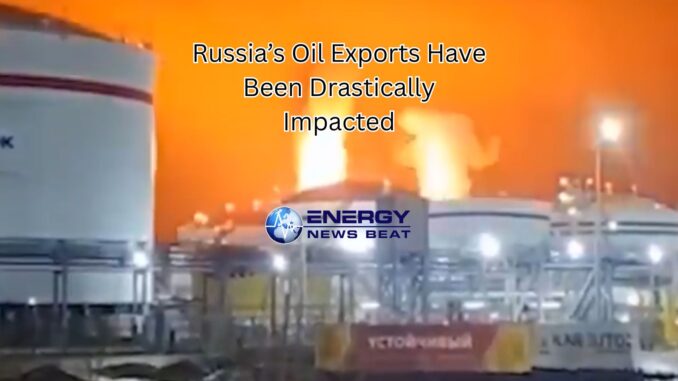
Russia’s oil export machine—once the backbone of its war economy—is reeling under a sustained Ukrainian drone offensive that has targeted refineries, export terminals, and critical pipeline infrastructure for over two years. What began as sporadic strikes in 2024 has escalated into a systematic campaign, with Ukrainian forces conducting more than 120 strikes on energy targets in 2025 alone and continuing aggressively into 2026.
The result? Russian refining throughput has dropped sharply, product exports have hit multi-year lows, crude rerouting has strained logistics, and overall oil and fuel export revenues have fallen to their lowest levels since the full-scale invasion began in 2022.
The Ukrainian Drone Campaign: From Border Hits to Deep Strikes
Ukraine launched its first major wave of long-range drone attacks on Russian oil refineries in early 2024. By late 2025 the pace had accelerated dramatically. Ukrainian forces carried out at least 81 documented strikes on refineries and fuel depots in 2024, followed by over 120 more in 2025—81 of them on refineries.
Key 2025–2026 targets include: Volgograd Refinery (Lukoil) – hit multiple times, including a complete shutdown of its primary processing unit in February 2026.
Saratov Refinery (Rosneft) – struck March 21, 2026, forcing crude distillation unit offline.
Ilsky and Slavyansk Eco refineries (Krasnodar Krai) – repeated attacks disrupting southern supply lines.
Ukhta Refinery (Komi Republic) and Afipsky Refinery (Krasnodar) – fires and production halts.
Bashkortostan (Salavat), Ryazan, Kirishi (Leningrad Oblast), and facilities in Tatarstan and Samara regions.
Beyond refineries, Ukraine has hammered export infrastructure: Port of Primorsk (Leningrad Oblast) – Russia’s largest Baltic Sea oil export terminal—devastated by a massive March 22–23, 2026 drone swarm that ignited fuel tanks and halted loadings.
Ust-Luga, Novorossiysk, Tuapse, and Temryuk terminals – repeated strikes disrupting Black Sea and Baltic loadings.
Druzhba pipeline pumping stations inside Russia (Tambov region’s Nikolskoye and Tatarstan’s Kaleykino) – deliberately targeted to choke flows to Europe.
These attacks have struck facilities across at least a dozen Russian regions and occupied territories: Krasnodar Krai, Volgograd Oblast, Saratov Oblast, Leningrad Oblast, Tatarstan, Komi Republic, Bashkortostan, and others, plus fuel depots in occupied Crimea and Luhansk.
Export Capabilities Slashed: Numbers Don’t Lie
Refining capacity – Ukrainian strikes have temporarily disabled 10–17% of Russia’s total refining capacity at peak periods (up to 1.1 million barrels per day offline). Overall 2025 refining volumes fell 1.7% to 262.3 million tons—the lowest in 12 years in some metrics.
Product exports – Gasoline and diesel exports plunged to wartime lows. In September 2025 alone, fossil-fuel export revenues dropped 26% year-over-year. February 2026 saw total oil and fuel exports hit their lowest level since 2022.
Crude rerouting – With domestic refining crippled, Russia has tried to export more raw crude, but terminal attacks (Primorsk, Novorossiysk) and sanctions on shadow-fleet tankers have limited gains. Seaborne crude shipments recently fell below 3 million bpd in some weeks.
Financial toll – Russian insurers estimate over $13 billion in direct and indirect losses to the oil sector in 2025 alone.
Moscow has responded with export bans on gasoline and diesel, forced production cuts, and appeals to Belarus for fuel imports—measures that signal the campaign is biting hard.
The Druzhba Pipeline Crisis: No Oil to Hungary
A flashpoint has been the Druzhba (“Friendship”) pipeline, which carries Russian crude through Ukraine to Hungary and Slovakia. Ukrainian strikes on Russian sections of the Druzhba system (pumping stations in Tambov and Tatarstan) and damage from earlier Russian attacks on the Ukrainian segment at Brody (Lviv region) have repeatedly halted flows. Since late January 2026 the southern branch has been offline, cutting off Russian oil deliveries to Hungary and Slovakia.
Hungarian Prime Minister Viktor Orbán has accused Ukraine of an “oil blockade” and retaliated by announcing a phased cutoff of natural gas supplies to Ukraine until Russian oil flows resume. “As long as Ukraine does not supply oil, it will not receive gas from Hungary,” Orbán stated this week. The standoff has escalated political tensions in Central Europe and highlighted how Ukraine’s energy strikes are rippling far beyond Russia’s borders.
Ukrainian Drones and NATO Airspace
During strikes on northwestern Russian targets such as the Primorsk and Ust-Luga terminals, Ukrainian long-range drones have—on multiple occasions—entered the airspace of NATO member states Estonia, Latvia, and Lithuania due to Russian electronic warfare jamming. Stray drones have crashed or been reported in these countries, including one incident that damaged a power station chimney in Estonia. While the incursions appear unintentional and non-hostile, they mark rare cases of Ukrainian drones crossing NATO territory en route to Russian energy infrastructure.
Bottom Line for Global Energy Markets
Ukraine’s drone campaign has achieved what Western sanctions struggled to do: physically constrain Russia’s ability to refine and export fuel profitably. While Russia still ships crude (often at discounts to Asia), the loss of high-value refined product exports, repeated terminal outages, and pipeline disruptions are eroding revenues and forcing painful domestic adjustments.As one insurance executive put it, the cumulative damage is already measured in billions—and the campaign shows no signs of slowing. For energy traders, refiners, and policymakers worldwide, the message is clear: Ukraine’s asymmetric strikes on Russian oil and gas infrastructure are reshaping supply flows, tightening product markets, and adding a new layer of geopolitical risk to an already volatile global energy picture.
Energy News Beat will continue monitoring developments at Russian export terminals and the Druzhba situation. Stay tuned for updates.
Sources: cbsnews.com, ca.news.yahoo.com, apnews.com, lansinginstitute.org, nypost.com, reuters.com , united24media.com,energynewsbeat.co, bloomberg.com
Get your CEO on the #1 Energy Podcast in the United States: https://energynewsbeat.co/energy-news-beat-media-kit/
Is oil and gas right for your portfolio? https://energynewsbeat.co/invest/




Be the first to comment