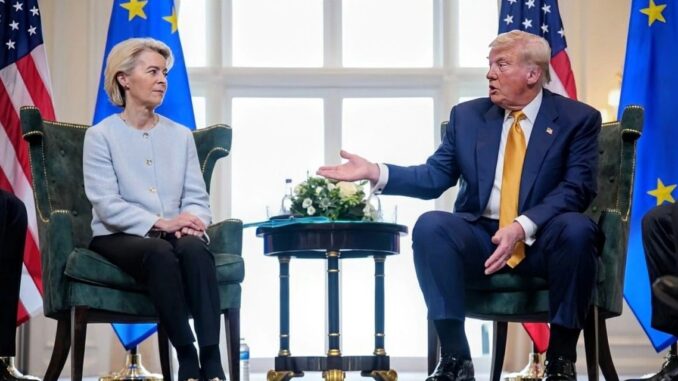
ENB Pub Note: This article is from Doug Sheridan’s LinkedIn account. We highly recommend following and connecting with him there. The bottom line from Davos this week is a slap in the face: if they do not stand on their own, reindustrialize, close their borders, and get control of their finances, they will fail. But they will no longer be in a position to take the United States down with them if we can get our election systems fixed before the midterms.
John Thornhill writes in the FT, one day Europe may thank Trump for forcing it to do what it should have done long ago. For years, Europe has hoped for the best and prepared for the best. But Trump’s message could not have been blunter in Davos—Europe must now prepare for the worst.
Trump may have backed off military action against Greenland and punitive tariffs against its European supporters, but his mocking antipathy towards Europe was overpowering. It is way beyond time for Europe to absorb that message, rip up eight decades of dependency and go it alone wherever it can.
It won’t be easy. Europe must rebuild its hard power to support Ukraine and counter a revanchist Russia. It must also wrestle with the US and China, which have been weaponising tariffs, financial infrastructure and supply chains. But European sovereignty must be made real.
But for Europe to wean itself off the US is a wicked challenge. Many would say it’s impossible given the depth of economic, financial, technological and military interconnections. Still, the effort must be made. “It is time to seize this opportunity and build a new independent Europe,” Ursula von der Leyen, EU commission president, said in Davos.
Yes, many of Europe’s Nato members are now promising to lift defence spending to 5% of GDP, albeit more slowly than the moment demands. But the region’s reliance on US defence companies looks reckless given Washington’s unreliability as a partner.
Meanwhile, US companies control most of Europe’s cloud computing market. US firms also dominate AI foundation models, semiconductors, search engines, social media and messaging apps in Europe. Europe can go further in promoting its own tech sector.
Luis Garicano, a professor at the London School of Economics, argues the EU is too cumbersome to respond to the urgency of the situation. “Europe desperately needed an external shock,” Garicano says. “I have lost count of the number of wake-up calls we have snoozed through. But if Trump succeeds in uniting Europe around some hard-headed and pragmatic reforms, the region will be in a stronger place in 20 years’ time.”
Our Take 1: We’re no fan of the European mindset that’s gotten the Continent to this point. Nor do we support the gratuitously insulting manner in which Trump has brought things to a head. But the truth is Europe has long taken for granted America’s security commitment, using money it would otherwise deploy towards defense to build out—and claim as superior—the very welfare system causing its rot. Something had to give, and let’s pray it’s the European welfare state.
Our Take 2: Although global net zero was never going to happen, the EU still pretends it will in Europe. But climate change and the energy transition have now fallen too far down the list of priorities. Either Europe abandons the flawed green dream that’s killing its ability to compete, or it faces a very bleak future. Full stop.