


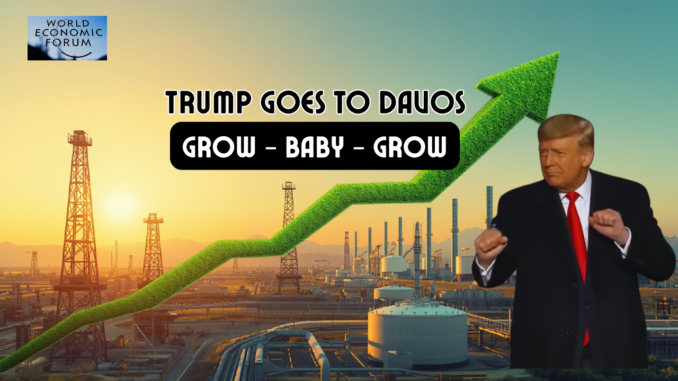
In a riveting address at the World Economic Forum in Davos on January 21, 2026, President Donald Trump laid out a stark binary for global leaders: embrace America’s model of explosive economic growth through deregulation, tariffs, and energy dominance—or stick with the status quo of high taxes, green energy mandates, and stagnant progress. Drawing from his administration’s first-year achievements, Trump touted a booming U.S. economy with low inflation, surging investments, and record energy production. But the speech wasn’t just a victory lap; it wove in pointed critiques of European policies, NATO commitments, and even a persistent push for U.S. control over Greenland—all framed against the backdrop of countering Chinese influence.
The Energy News Beat dives into the key takeaways from Trump’s speech, pulling in direct quotes on energy, Greenland, and NATO. We’ll also incorporate insights from energy analyst David Blackmon’s recent X post, which ties these threads to a broader geopolitical strategy.
Finally, we’ll explore international reactions and ponder a cheeky branding idea for the Greenland saga.
Trump’s Energy Vision: “Grow Baby Grow” Through Fossil Fuels and Nuclear
Trump’s speech hammered home America’s energy renaissance, contrasting it sharply with what he called Europe’s self-inflicted wounds from over-reliance on renewables. He celebrated the U.S. as an energy superpower, crediting policies that ramped up oil, gas, and nuclear output while slashing regulations.
Key quotes on energy include:
“I’ve stopped the nation-wrecking energy policies that drive up prices while sending jobs in factories to the world’s worst polluters.”
“Under my leadership, U.S. natural gas production is at an all-time high. By far. U.S. oil production is up by 730,000 barrels a day.”
“The price of gasoline is now below $2.50 a gallon in many states, $2.30 a gallon in most states. Then we’ll soon be averaging less than $2 a gallon in many places, it’s already down even lower $1.95 a gallon.”
“I’ve signed an order directing the approval of many new nuclear reactors. We’re going heavy into nuclear.”
Trump lambasted the “Green New Scam,” arguing it has crippled economies like Germany’s, where he claimed electricity generation is down 22% since 2013 due to wind and solar mandates.
He positioned U.S. energy independence as a blueprint for global growth, emphasizing how cheap, abundant fuel powers AI data centers and manufacturing booms. This “grow baby grow” mantra isn’t just rhetoric—it’s backed by actions like acquiring 50 million barrels from Venezuela and approving private power plants for tech giants.
Energy watchers will note Trump’s subtle nod to critical minerals and Arctic resources, which dovetail with his Greenland ambitions. As rare earths become vital for batteries and tech, Trump’s push for domestic dominance resonates in the energy sector.
Greenland and NATO: Security, Strategy, and a “Framework” Deal
Trump’s Davos remarks on Greenland sparked headlines, blending national security with economic leverage. He ruled out military force but insisted U.S. control is essential to counter threats from China and Russia, describing it as a “very small ask” for allies.
Notably, he referred to Greenland as “cold and poorly located” but vital for Arctic dominance—though he confusingly mixed it up with Iceland multiple times, raising eyebrows about the gaffe.
On NATO, Trump revived familiar grievances, claiming the U.S. foots “virtually 100%” of the bill—a statement fact-checked as misleading, since NATO’s 2% GDP defense spending target is met by only about a third of members.
He speculated on whether allies would defend America, overlooking NATO’s invocation of Article 5 after 9/11.
Yet, the speech ended on a conciliatory note: after meeting NATO Secretary General Mark Rutte, Trump announced a “framework” for a future Greenland deal focused on Arctic security, prompting him to cancel planned tariffs on European imports.
This pivot eased immediate tensions but underscored Trump’s use of tariffs as a bargaining chip.
David Blackmon’s Take: It’s All About China
Energy journalist David Blackmon (@EnergyAbsurdity) nailed the subtext in a viral X post, arguing Trump’s Davos messaging on energy, Greenland, and even Venezuela isn’t isolated—it’s a unified front against Chinese expansion.
Blackmon wrote: “#Greenland isn’t about Greenland or Denmark: It’s about #China… What @RealDonaldTrump just told the @wef today in #Davos on #Energy and #climate isn’t about energy or climate or the WEF: It’s about China.” He emphasized removing Chinese influence from the Western Hemisphere as Trump’s core strategy.
Blackmon’s video clip from the speech reinforces this, showing Trump railing against foreign polluters (a veiled jab at China) while touting U.S. production highs. In an energy context, this means securing Greenland’s critical mineral supply chains, which China has eyed for years, and bolstering U.S. oil/gas production to undercut Beijing’s global leverage.
For those who still don’t grasp what is happening all around us in real time, here are some simple explanations:
– #Greenland isn’t about Greenland or Denmark: It’s about #China.
– #Venezuela isn’t about Venezuela or #Maduro: It’s about China.
– The #PanamaCanal isn’t about… pic.twitter.com/x24RT0PRIq
— ⚡️David Blackmon⚡️ (@EnergyAbsurdity) January 21, 2026
🚨 LIVE FROM DAVOS: President Donald J. Trump announces framework for a future deal with Greenland.
MUST WATCH ⬇️ pic.twitter.com/FmIE0dV0Fj
— The White House (@WhiteHouse) January 21, 2026
On the Crude Truth Podcast
Last week, Rey Trevino, Host of the Crude Truth Podcast, had David Blackmon, Stu Turley, and Karr Ingham, and Stu predicted that Greenland would be the 51st state. The world is healing, and we have a bit of a bumpy road till then.
International Feedback: Relief, Worry, and Pushback
Reactions from other countries were mixed, blending relief over de-escalation with concern over Trump’s tone.EU Response: European leaders hit back at tariff threats, suspending ratification of a U.S.-EU trade deal and preparing retaliatory measures via the Anti-Coercion Instrument.
One Davos participant told Reuters: “I’m worried about NATO. I’m worried about truth and trust.”
NATO Allies: Secretary General Rutte affirmed the alliance would defend the U.S. if attacked, while stressing collective Arctic security.
Greenland’s prime minister warned an attack “cannot be ruled out,” highlighting heightened tensions.
Market and Broader Views: Stocks surged after the tariff cancellation, with the Dow up 1.21%.
However, critics like Denmark’s media fact-checked Trump’s WWII claims on Greenland as false.
Some X users raised alarms about Trump’s Iceland-Greenland mix-up, questioning his sharpness.
Overall, allies sighed in relief at no force on Greenland but remain wary of Trump’s “America First” disrupting transatlantic ties.
Should Trump Call Greenland’s Acquisition “The New Green Deal”?
Absolutely—for the laughs alone. Trump’s penchant for trolling could turn this into gold: rebranding U.S. control of Greenland as “The New Green Deal” would flip the script on progressive climate policies he derides as a “scam.” Imagine the irony—securing “green” land rich in minerals for energy security, all while jabbing at AOC’s original Green New Deal. It’d energize his base, dominate headlines, and underscore his growth-over-regulation ethos. In Davos’ elite circles, it’d be a mic-drop moment.
Trump’s Davos speech crystallizes the energy debate: drill, build, and grow, or regulate and stagnate. As Blackmon points out, it’s bigger than policy—it’s about outmaneuvering China. For energy pros, the message is clear: America’s playbook is open, but will the world follow?


Be the first to comment