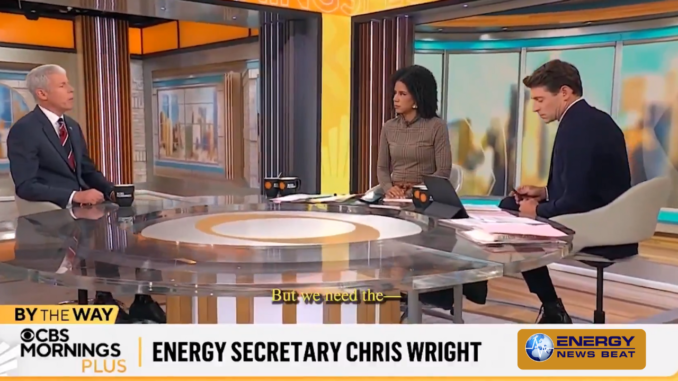
This is an excellent interview by Secretary Chris Wright on CBS, and he has some wild points. When the CBS reporter asks, “I thought that all the above included Green Energy”, Secretary Wright’s response is spot on. What we are facing is a realignment of the definition of green energy. Green energy must be sustainable both financially and technologically, and current wind and solar technologies are incapable of achieving that.
🚨 UPDATE: In a jaw-dropping announcement, Energy Secretary Chris Wright has declared the Department of Energy is returning over $13 BILLION in unobligated American taxpayer funds to the U.S. Treasury, initially appropriated to fuel the Joe Biden’s wasteful green new scam agenda. pic.twitter.com/Qtx6QZSZ9v
— FAN TRUMP ARMY (@TRUMP_ARMY_) December 21, 2025
Here are the most interesting and impactful quotes from the transcript:
1. The Secretary said: “So my Department of Energy has announced we’re going to return over $13 billion to the taxpayers. That’s over $100 per American family.”
2. The Secretary stated: “With green energy, and again I don’t agree with the name, but with solar and wind and electric vehicles, which is where most of the money has gone, they’ve just barely gotten to 3% of United States energy and 2.5% of global energy. So it’s just been a massive malinvestment.”
3. The Secretary characterized green energy subsidies as “a scam”, saying: “It has been, as the president said, I think he rightfully characterizes it as a scam.”
When Secretary Wright points out that wind and solar have accounted for only 3% of the US grid, at what cost? We also have to look at the technology, as the grid we have today was built on AC technology, and wind and solar are DC, which have to be converted and maintained with additional resources, let alone the cost, production, and mining.
Precise definitions of “Green Energy” need to be developed that adhere to the laws of physics, are fiscally responsible, and minimize environmental impact. Nuclear without the overburden of regulatory overreach is a start.
Ballpark investment in Wind and Solar to achieve a 3% increase to the grid.
The US has invested heavily in grid upgrades to support the integration of wind and solar energy, driven by the need to connect remote renewable resources, manage intermittency, enhance resilience, and expand capacity. These investments encompass transmission lines, offshore cables, substations, distribution enhancements, and other infrastructure. While exact figures specifically earmarked for wind and solar (versus general grid improvements) are not always segregated in public data, a substantial portion of recent spending is attributed to renewable integration, as renewables have been a primary driver of grid modernization since the 2010s. Below is a breakdown based on available data from government and industry sources.
Overall Utility and Grid Spending Trends
Total annual utility spending on electricity infrastructure (including production, transmission, distribution, and other categories) rose from $287 billion in 2003 to $320 billion in 2023 (in real 2023 dollars), with capital investments more than doubling over this period.
This growth is largely due to replacing aging assets, adding renewable-connected lines, and deploying technologies like smart meters and battery storage to handle variable wind and solar output.
Investor-owned electric companies invested a record $178 billion in energy infrastructure in 2024, contributing to over $1.3 trillion in the past decade (roughly 2015–2024).
Projections estimate $1.4 trillion in power sector investments from 2025 to 2030, with similar levels through 2050, focusing on grid modernization and renewables.
Transmission Lines and Related Investments
Transmission spending has seen the most dramatic growth, as new and upgraded lines are essential for transporting power from often-remote wind and solar farms to population centers. Key details: Annual transmission investment nearly tripled from about $9 billion in 2003 to $27.7 billion in 2023, with an 11% ($2.7 billion) increase in that year alone for equipment, poles, software, and lines tied to renewables.
Recent annual figures have hovered around $25–30 billion, with 90% directed toward upgrades (e.g., reconductoring existing lines) rather than new construction, much of it to accommodate renewables.
Cumulative transmission investment from roughly 2010–2024 is estimated at $300–350 billion based on escalating annual trends (e.g., averaging $15–20 billion in the early 2010s, rising to $25–30 billion by the 2020s). Investor-owned utilities plan to invest $158 billion in transmission from 2024–2027 ($40 billion/year on average).
For 2025 specifically, US grid investment (including transmission) is forecast at $115 billion.
A significant share (estimated 60–80% in high-clean-energy scenarios) supports renewable integration, including wind and solar, as these sources require expanded capacity to reduce curtailment and lower system costs by $270–490 billion through 2050 if accelerated.
Federal funding, such as $2.2 billion in 2024 for eight projects across 18 states, targets renewable transmission enhancements.
|
Year Range
|
Estimated Annual Transmission Spending
|
Key Drivers for Wind/Solar Upgrades
|
|---|---|---|
|
2010–2015
|
$15–20 billion
|
Early renewable buildout; initial interconnections for onshore wind farms.
|
|
2016–2020
|
$20–25 billion
|
Solar boom; grid resilience for intermittency; new lines in Midwest and Southwest.
|
|
2021–2025
|
$25–30 billion
|
IRA incentives; rapid solar/wind additions; upgrades for extreme weather and variable output.
|
Offshore Cables and Related Costs. Offshore wind infrastructure spending is smaller due to the nascent stage of US offshore wind (total installed capacity ~1 GW as of late 2025, mostly from projects like Vineyard Wind and South Fork).
Costs focus on export cables (to shore), inter-array cables (between turbines), and substations.
Based on 2023 data: Per-MW costs: Array cables ~$250–300/kW; export cables ~$170–230/kW; offshore substations ~$240/kW.
For ~1 GW installed, this equates to ~$500–800 million in transmission-related spending to date. Intercabling costs ~$0.5 million/km; longer transmission/HVDC cables ~$1–2 million/km.
Planned expansions (e.g., up to 22 GW by 2030) could add $3.6–8 billion in regional connections, with proactive planning saving $20 billion long-term.
Other Key Cost Structures
Distribution Upgrades: Rose 160% to $50.9 billion in 2023, including $17.4 billion for overhead lines/poles, $11.8 billion for underground lines, and $6.1 billion for substations—much to handle distributed solar and wind variability.
Energy storage spending jumped from $97 million in 2022 to $723 million in 2023 for grid stability.
Soft Costs and Installation: For offshore wind, ~$1,000–1,300/kW (development, financing, contingencies); installation ~$800–1,100/kW.
Resilience and Adaptation: 34% of transmission and 37% of distribution investments in 2022 focused on hardening against weather, indirectly supporting renewables.
The math ain’t mathing up
The bottom line is that we have found that electricity prices have been going up, not because of data centers, but because of the forced migration to DC wind and solar without a plan. We can remain hopeful that they will get there someday, but the new plasma and nuclear technologies may come online before then.