ENB Pub Note: This was written by Ronald Stein and Yoshihiro Muronaka, on America Outloud. We highly recommend subscribing and reading their publications!
Two hundred years ago, the world had about 1 billion people, roughly 7 billion fewer than today. Life expectancy at birth was under 30 years, and more than four in ten children died before their fifth birthday. Apart from coal in Britain and a few other places, it was essentially a hydrocarbon-free economy.
Hydrocarbons were never missing
Yet the world of 1800 was not hydrocarbon-free because hydrocarbons were unknown. People had known and used them for thousands of years. In ancient Mesopotamia, bitumen seeping from the ground was used as mortar and waterproofing; the Greek historian Herodotus described its use in the walls of Babylon. In China, by the Han dynasty some two thousand years ago, wells drilled in Sichuan brought up natural gas, which was carried through bamboo pipes to boil brine for salt. Around the Caspian Sea, where natural gas burned from the ground, fire became an object of reverence, and Marco Polo described an oil spring in the region whose oil was burned in lamps and used to treat camels. In Japan, the ancient chronicle Nihon Shoki records that in the year 668, “burning earth and burning water” were presented to the emperor from the province of Koshi, which extended along the Sea of Japan coast across what is now the Hokuriku region, including Niigata Prefecture, where oil still seeps naturally from the ground.
What was missing was not hydrocarbons, but the ability to unlock them. For thousands of years, people could use only the small amounts that seeped to the surface, as glue, lamp oil, medicine, or sacred flame. The vast store of carbon underground stayed dormant, and its latent value remained untouched.
What the world ran on instead
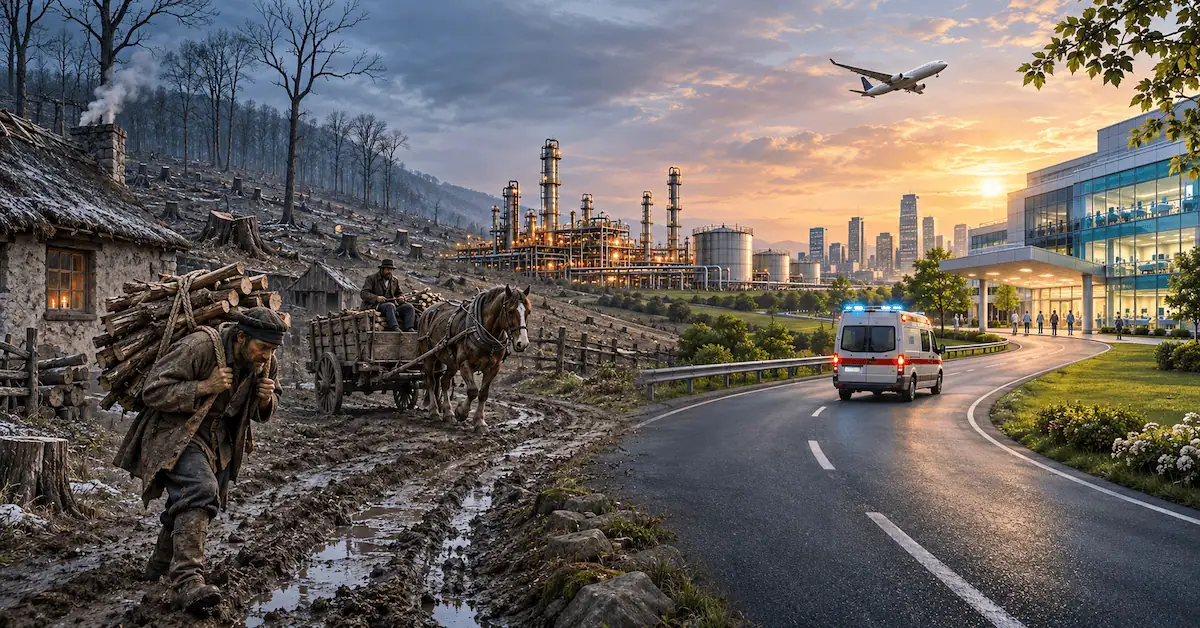
So the early 1800s were not a carbon-free economy. It ran on carbon taken from living things. Heat for cooking and warmth came from burning wood, charcoal, straw, and dung. Light came from tallow candles and whale oil. Mechanical power came from human muscle, horses, and oxen, all of which had to be fed from the land. Clothing came from wool, cotton, flax, and leather. Nearly everything people ate, wore, built with, and burned was taken directly from forests, fields, and animals.
Life was hard and dirty, with many deaths from weather and disease, and the burden fell on nature as well as on people. Britain had cut down so much of its forests that it was forced to import timber and turn to coal. Whales were hunted to the point of collapse to keep lamps burning, and it was kerosene refined from crude oil, not a conservation treaty, that largely ended the demand for whale oil for lighting in the second half of the 19th century.
When people depend on living things for life, materials, and energy all at once, humanity and nature compete for the same land. Unlocking the latent value of carbon stored underground for hundreds of millions of years is what ended much of that competition.
Even today, about 2.1 billion people still cook with polluting fuels such as wood, charcoal, dung, crop waste, kerosene, or raw coal, on open fires or simple stoves. The World Health Organization links household air pollution to an estimated 2.9 million premature deaths a year. For a quarter of humanity, the hydrocarbon-free economy of 1800 is not history. It is daily life.
More than 6,000 products that did not exist in 1800
Today, crude oil, natural gas, and coal supply more than 80% of the world’s energy, and they are also the raw materials for more than 6,000 products that did not exist in 1800.
- Transportation fuels: Gasoline, diesel, jet fuel, and bunker fuel refined from crude oil power cars, trucks, planes, ships, and rockets for space travel.
- Industrial raw materials: Ethylene and other petrochemicals, made from natural gas liquids and crude oil, are the building blocks of plastics, synthetic fibers, rubber, solvents, and lubricants.
- Everyday products: Propane for gas grills, butane in lighters, paraffin wax, asphalt for roads, and the plastics in medical devices all come from hydrocarbons.
- Heat and power: Natural gas and coal heat homes, run power plants, and deliver the extremely high temperatures needed to make cement, steel, and glass.
In fact, crude oil was a staple of the U.S. economy long before automobiles became popular. From the 1860s, kerosene refined from crude oil lit homes across America and around the world.
Energy is not the same as electricity
Many people use “energy” and “electricity” as if they meant the same thing. They do not. Electricity accounts for only about one-fifth of the world’s final energy consumption. Wind turbines and solar panels generate electricity only. They cannot make any of the products or transportation fuels that come from hydrocarbons.
Electricity itself is a child of the hydrocarbon age. One of the world’s first central power stations, Thomas Edison’s Pearl Street Station in New York, opened in 1882 and ran on coal. Today, every method of generating electricity, whether coal, natural gas, hydro, nuclear, wind, or solar, is built with products, components, and equipment made from hydrocarbons. So are electric vehicles, and so is everything that runs on electricity, from smartphones and computers to data centers and X-ray machines. Without hydrocarbons, there would be no renewables, and nothing for electricity to power.
From 1 billion to 8 billion
The products made from hydrocarbons made today’s world possible. They allowed us to create modern transportation, a medical industry, and electronics and communications systems. They reduced infant mortality, more than doubled life expectancy to over 70 years, and gave people the ability to travel anywhere in the world by plane, train, ship, and vehicle. The risk of dying from floods, storms, droughts, and extreme heat or cold has fallen dramatically over the past century, thanks to sturdier buildings, warning systems, transportation, and emergency response that all depend on hydrocarbons.
Nearly half the world’s population is fed by crops grown with synthetic nitrogen fertilizer made from natural gas or coal. Without it, global food production could not support today’s 8 billion people.
None of the following infrastructure existed 200 years ago in a hydrocarbon-free economy, and none of it can operate today without the products and transportation fuels made from hydrocarbons:
- Hospitals
- Airports
- Militaries
- Medical equipment
- Telecommunications
- Space programs
- Appliances and electronics
- Sanitation systems
- Heating and ventilating systems
- Transportation — vehicles, rail, ocean, and air
- Construction — roads and buildings
Refining unlocked the latent value
Hydrocarbons like oil, coal, and natural gas took hundreds of millions of years to form underground. As the ancient world showed, simply having them was never enough. On their own, they do not serve people well. No one burns raw crude oil, and as noted above, burning raw solid fuels indoors remains one of the world’s leading causes of premature death.
It takes a multi-billion-dollar refinery, a gasification plant, or a processing facility to convert Earth’s dormant resources into the transportation fuels and the more than 6,000 products that modern life depends on. Planes, ships, trucks, and cars do not run on raw crude oil. They run on fuels manufactured from crude oil in refineries built for that purpose. Refining, gasification, and processing are not something to apologize for. They are the necessary step that turns a long-buried resource into something usable and safe, the same way a seed buried in soil needs water, sunlight, and carbon dioxide from the air before it becomes anything at all.
Seen this way, the story of the past two centuries is not one of humanity becoming “addicted” to hydrocarbons. It is the story of learning to unlock their latent value. Carbon is the element that builds our bodies and the food that sustains them, that supplies the materials for nearly every product we use, and that provides the energy that powers civilization. Before refining, all three, life, materials, and energy, had to come from the same forests, fields, and animals. Refining changed that. Carbon from underground now provides most of our energy and materials, and through fertilizer it helps grow the food that sustains life, easing the pressure on forests and wildlife.
What we really need from hydrocarbons
What we need is not hydrocarbons for their own sake, but the PRODUCTS and TRANSPORTATION FUELS they provide. By all means, let us continue to develop renewables for electricity and explore new technologies and plant-based alternatives, which are, after all, made of carbon too. But none of them is anywhere near replacing the products and fuels that support 8 billion lives.
Much of the rhetoric heard from representatives of wealthy nations at global gatherings focuses on a single goal: lowering global CO2 emissions. That singular focus ignores the multidimensional realities of the environment and, more importantly, ignores energy poverty and the central need for access to a sufficient supply of affordable energy, the only way to raise well-being everywhere and reduce global disparity. For the foreseeable future, much of that energy will come from hydrocarbons.
No one who looks honestly at the early 1800s would want to go back. A hydrocarbon-free economy is not a cleaner future. It is a past we have already lived: shorter lives, children lost before the age of five, and constant pressure on forests and wildlife.
Modern life depends on the products and transportation fuels made from hydrocarbons, the same products and transportation fuels that wind and solar electricity CANNOT make.
Please share this information with teachers, students, and friends to encourage Energy Literacy conversations at the family dinner table.
Click this Link to Sign up for Energy Literacy from Ronald Stein.