In a bold escalation of its campaign against illicit oil trading, the United States has seized yet another vessel from the shadowy “dark fleet” — a network of aging tankers that evade international sanctions to transport crude from rogue regimes. The latest capture, the MT Veronica, marks the sixth such interdiction in recent weeks under Operation Southern Spear, a Trump Administration initiative aimed at choking off revenue streams to Venezuelan President Nicolás Maduro’s government. This move underscores Washington’s renewed determination to dominate global energy security and prevent adversaries from profiting from sanctioned resources.
The Seizure: Details of the Operation
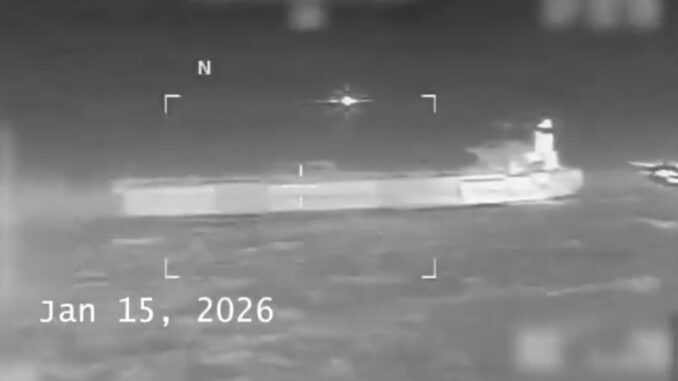
The MT Veronica, a crude oil tanker flying the Guyanese flag, was boarded in a pre-dawn raid on January 16, 2026, in the Caribbean Sea.
U.S. Marines and sailors conducted the operation “without incident,” according to U.S. Southern Command (USSOUTHCOM), as the vessel defied the U.S.-imposed quarantine on sanctioned ships.
Video footage released by the military shows troops swiftly securing the tanker, highlighting the precision of these high-seas enforcements.
The Veronica had departed empty from Venezuelan waters in early January, per tracking data from TankerTrackers.com.
While it wasn’t carrying cargo at the time of seizure, intelligence suggests it was en route to load Venezuelan crude for illicit export. This fits the dark fleet’s modus operandi: vessels often sail empty to sanctioned ports, load up under the radar, and employ tactics like ship-to-ship transfers, flag-switching, and AIS (Automatic Identification System) spoofing to dodge detection.
This seizure follows a string of similar actions, including the dramatic capture of the Russian-flagged Marinera (formerly Bella 1) on January 7 in the North Atlantic near Iceland after a weeks-long pursuit, and the M/T Sophia in the Caribbean on the same day.
These operations have involved U.S. Coast Guard cutters, helicopters, and even AC-130 gunships, demonstrating the military’s commitment to disrupting the fleet.
US seizes another tanker in the Caribbean.
* * * pic.twitter.com/nFqSB2rr0I
— Professor Iratus Genium (@PGenium) January 16, 2026
Ownership and the Shadowy Web Behind It
Ownership of dark fleet tankers is notoriously opaque, designed to shield true beneficiaries through layers of shell companies, anonymous registries, and frequent re-flaggings. The Veronica, with an IMO number not specified in initial reports, was registered under the Guyanese flag but linked to Venezuelan oil operations.
Experts believe it operates within a network controlled by intermediaries tied to PDVSA, Venezuela’s state-owned oil company, which has been under U.S. sanctions since 2019 for supporting Maduro’s regime.
Broader dark fleet vessels, including those recently seized, often trace back to entities in Russia, Iran, or China. For instance, the Marinera switched to a Russian flag after evading earlier blockades, part of a trend where at least 26 ships have adopted Russian registration since December 2025 to seek protection amid U.S. crackdowns.
These owners exploit lax maritime regulations, employing crews from countries like India or the Philippines, and sometimes arming vessels with irregular guards, raising alarms among NATO allies in the Baltic region.
The fleet, estimated at over 1,000 vessels, primarily hauls oil from sanctioned producers like Venezuela, Russia, and Iran, generating billions in off-the-books revenue that funds authoritarian regimes and undermines global energy markets.
Potential Destination of the Oil and Countries Involved
Had the Veronica loaded cargo, its oil would likely have been destined for buyers in Asia, particularly China or India, which have become major importers of discounted sanctioned crude.
Venezuelan oil, heavy and sour in grade, is often refined in these markets or blended with lighter crudes. Ship-tracking data shows similar tankers routing through the Cape of Good Hope or Suez Canal to avoid scrutiny, with final discharges at ports like Qingdao in China or Jamnagar in India.
Key countries involved include:
United States: Leading the interdictions to enforce sanctions and assert control over Western Hemisphere energy flows.
Venezuela: The source of the oil, with Maduro’s government relying on dark fleet exports for survival amid economic collapse. Interestingly, recent seizures like the M/T Olina involved cooperation from elements within Venezuela, possibly aligned with U.S.-recognized opposition figures.
Russia: Providing flags and potential naval shadowing (e.g., a submarine trailed the Marinera), escalating tensions as Moscow supports Caracas.
Guyana: Flag state for the Veronica, though likely a convenience registry with minimal oversight.
Potential Buyers (China, India): End-users of the oil, facing U.S. threats of secondary sanctions under Trump’s aggressive trade policies.
This web highlights how sanctions evasion intertwines geopolitics, with the U.S. aiming to redirect Venezuelan oil sales through legitimate channels under its influence.
Trump Administration’s Stance: Will They Keep the Tanker?
The Trump Administration has signaled a hardline approach, viewing these seizures as part of a broader strategy to “crush illicit activity” and restore U.S. dominance in energy.
President Trump has personally emphasized controlling Venezuelan oil, stating that “enemies are not allowed to control large oil reserves.”
His energy team, including advisors, has discussed U.S. oversight of Venezuelan sales, potentially routing proceeds to humanitarian aid or opposition-led initiatives. Regarding the tankers themselves, the administration has not explicitly stated plans to “keep” them in the sense of integrating into a U.S. fleet. Instead, seized vessels like the Veronica are being escorted to U.S. ports for “final disposition,” which typically involves offloading any cargo for sale or storage, followed by auctioning the ship.
Past precedents under Trump 1.0 saw Iranian tankers’ oil sold off, netting millions for U.S. victims of terrorism. With six tankers now in possession, experts predict similar outcomes: the oil could be sold to fund Venezuelan reconstruction under U.S.-backed governance, while the aging hulls — often uninsured and unseaworthy — might be scrapped or repurposed.
Trump’s rhetoric suggests continuity: no retreat from sanctions, with potential expansion to Iranian tankers amid threats of tariffs on buyers.
This could flood the market with seized crude, pressuring prices and bolstering U.S. producers.
Implications for Global Energy Markets
These seizures are rippling through the tanker industry, with freight rates spiking and dark fleet operators scrambling for Russian protection.
For energy consumers, it means potential disruptions in sanctioned oil supplies, but also a push toward transparent markets. As the Trump Administration ramps up, expect more high-seas drama in the battle for oil dominance.
Stay tuned to Energy News Beat for updates on this unfolding story. What do you think — is this the end of the dark fleet, or just the beginning of a new energy cold war? Drop your thoughts below.
Stuart Turley is the host of the Energy News Beat podcast, delivering unfiltered insights into the world’s energy landscape. Check out the Energy News Beat Substack.