


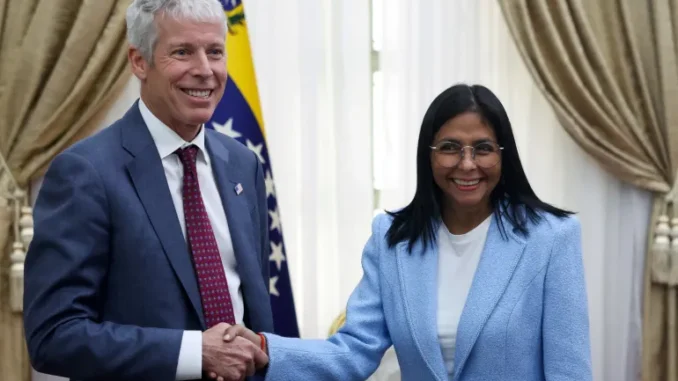
In a landmark visit marking the highest-level U.S. energy-focused trip to Venezuela in nearly three decades, U.S. Energy Secretary Chris Wright met with interim President Delcy Rodríguez and oil executives in Caracas. The February 2026 trip comes amid the Trump administration’s efforts to revitalize Venezuela’s beleaguered oil sector following the capture of former President Nicolás Maduro. Wright’s optimistic outlook highlighted potential surges in oil, natural gas, and electricity production as early as this year, positioning Venezuela as a key opportunity for investors amid global energy shifts.
But what exactly should investors monitor in the wake of this development? From production boosts and investment licensing to the role of Chinese firms and cash flow improvements, here’s a breakdown of the critical factors.
Potential Surge in Oil Production and Its Implications
Secretary Wright expressed confidence that Venezuela could experience a “dramatic increase” in oil production, potentially reaching beyond its current output of around 1 million barrels per day (bpd).
He emphasized that this growth would not only create jobs and raise wages for Venezuelans but also benefit the U.S. and the Western Hemisphere by enhancing energy security and reducing reliance on adversarial suppliers.
Analysts project a gradual ramp-up, with production possibly hitting 1.5 million bpd in the short term if investments flow in, though full recovery to pre-sanctions levels of 2.5-3 million bpd could take a decade and require $183 billion in capital.
Investors should watch for operational metrics from state-owned PDVSA and joint ventures. Recent U.S. actions, including the easing of sanctions, have already enabled sales of 50 million barrels of crude, with proceeds flowing back into Venezuela’s economy.
Key indicators include monthly OPEC reports on Venezuelan output and announcements from companies like Chevron, which has received expanded licenses to resume and scale operations.
A stable political environment will be crucial, as any volatility could deter long-term commitments.
Investments Moving Forward: Licensing and Legal Reforms
Wright praised Venezuela’s recent overhaul of its hydrocarbons law, which grants private companies greater control over production, sales, and pricing, ending PDVSA’s monopoly.
This reform caps royalty rates at 30% and allows firms to manage operations at their own risk after government approval of business plans.
While Wright noted it’s a “meaningful step,” he cautioned it’s not yet sufficient for massive capital inflows, emphasizing the need for debt restructuring to compensate for past expropriations—though this won’t happen “overnight.”
On the U.S. side, the Treasury’s Office of Foreign Assets Control (OFAC) has issued General Licenses 46 and 47, authorizing established U.S. entities to engage in oil trade, export, and diluent supply.
These licenses facilitate exploration, production, and sales but exclude entities tied to China, Russia, Iran, North Korea, or Cuba in certain contexts.
Wright has been “deluged” with interest from American oil companies, who are eager to invest without needing U.S. financial guarantees or security provisions.
For investors, focus on upcoming debt negotiations, as Venezuela’s $150 billion external liabilities pose a significant overhang.
Monitor IMF reengagement signals and U.S.-controlled oil revenue accounts, which safeguard funds for stabilization rather than creditor payouts.
Positive developments here could lower risk premiums and attract more foreign direct investment.
The Role of Chinese Companies: Inclusion or Exclusion?
A key question for investors is the involvement of Chinese firms, which have historically dominated Venezuelan oil amid U.S. sanctions. Wright clarified that “legitimate deals by legitimate Chinese companies will be fine,” but the U.S. aims to prevent “damaging” agreements that have harmed other nations in South America and Africa.
He positioned U.S. partnerships as a counter to non-mutually beneficial Chinese practices.
However, OFAC licenses explicitly exclude U.S. or Venezuelan affiliates of Chinese companies from certain oil activities, reflecting an “America First” policy.
China’s share of Venezuelan oil jumped to 89% after U.S. license revocations in 2025, but recent shifts could reduce this dominance.
Venezuela has assured Beijing that its investments remain secure and oil pricing won’t be U.S.-dictated.
Investors should track joint ventures involving China National Petroleum Corporation and others, as exclusions could create opportunities for Western firms but also spark geopolitical tensions. If Chinese entities are sidelined, it might accelerate U.S.-led recovery but risk retaliatory moves affecting global oil markets.
Stabilizing Cash Flow: Oil Revenues and Economic Recovery
Venezuela’s cash flow is showing signs of stabilization, with $300 million from recent U.S.-brokered oil sales injected into the economy via banks and the Central Bank.
This has helped ease exchange rate volatility and inflation, which hit 565% annually in 2025.
Interim President Rodríguez stated these funds will protect workers’ purchasing power and support social programs.
Under Executive Order 14373, U.S. Treasury accounts hold Venezuelan oil proceeds indefinitely, with oversight ensuring funds benefit stabilization efforts like policing and healthcare.
Secretary of State Marco Rubio outlined monthly budgets submitted by Venezuelan leaders, with U.S. control over disbursements.
Government revenues are projected to rebound from $12 billion in 2025, supporting expenditures of around $17.5 billion.
Investors should eye foreign currency inflows, inflation trends, and social safety net distributions like CLAP boxes, as these indicate broader economic health. Improved cash flow could reduce migration pressures and enhance market stability, making Venezuela more attractive for energy investments.
Final Thoughts for Investors
Secretary Wright’s trip signals a thawing in U.S.-Venezuela energy ties, with production surges, reformed laws, and targeted licenses paving the way for investments. However, challenges like debt restructuring, geopolitical rivalries with China, and sustained cash flow improvements remain pivotal. Investors should prioritize monitoring OFAC updates, OPEC production data, and bilateral agreements for signals of long-term viability. While risks persist, the potential for a revitalized Venezuelan oil sector—holding the world’s largest reserves—could reshape global energy dynamics if stability holds.
Stu Turley will be covering this on the Energy News Beat Stand Up Today.
Sources: apnews.com, cnbc.com, oilprice.com
Get your CEO on the podcast: https://sandstoneassetmgmt.com/media/
Is oil and gas right for your portfolio? https://sandstoneassetmgmt.com/invest-in-oil-and-gas/



Be the first to comment