
ENB Pub Note: This excellent article is from Cfact.org and David Wojick. Stu Turley and Michael Tanner will be covering this on the next Energy News Beat Stand Up. If you don’t see the correlation between high energy costs and Democrat policies, you are not doing your own research and listening only to the mainstream media. We will be reaching out to David to get him on the podcast—hat tip to the Energy and Security Freedom Substack for alerting us to this great article. The hilarious part about New York, New Jersey, Delaware, and California is that High Tax earners all know about investments with tax deductions, and they are among our top states for viewers. Just saying.
I think Thomas J Shepstone’s cartoon on the Security Freedom Substack is more accurate than the article picture.
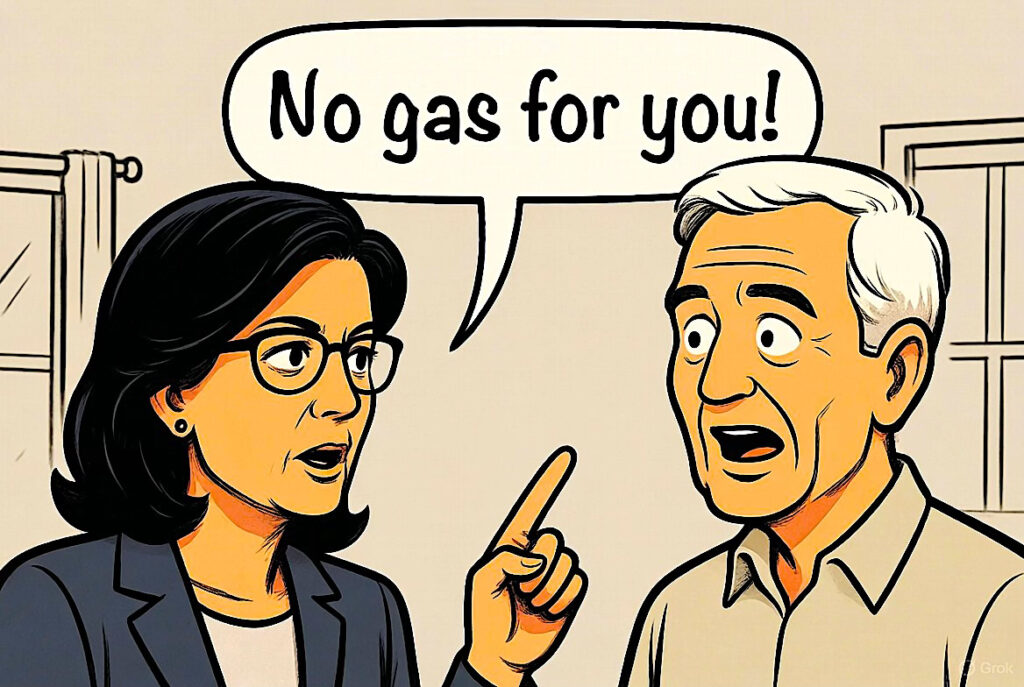
New York Governor Hochul says the emission reduction regulations required by the Climate Act are infeasible and ruinously expensive. She has yet to explain this, so here is my simple assessment.
The regulatory program has two very different mechanisms. First, they ration your fossil fuels. Then, they tax you heavily on the ration you get. The rationing is infeasible; the tax is ruinous.
The program is called “cap and invest,” which sounds good. Note the missing word: “tax.” You need the tax to get the money to “invest.” An honest name is “cap, tax, and spend.”
The cap is the amount of each type of fossil fuel that can be sold to consumers during a given period. Permissions to sell this amount are called allowances and they cost money.
Here is how the Cap and Invest website explains it. (There is almost no other information.)
“The Department of Environmental Conservation (DEC) and New York State Energy Research and Development Authority (NYSERDA) are designing a program that sets an annual cap on the amount of greenhouse gas pollution that is permitted to be emitted in New York. Under the program, large-scale greenhouse gas emissions sources and distributors of heating and transportation fuels will be required to purchase or obtain allowances for the emissions associated with their activities.”
The cap is the ration, and the allowances are the ration tickets that have to be bought. Note that for heating and transportation fuels the distributor, not the consumer, buys the allowances. Of course, these costs will be passed on to the consumers. We are mostly talking about gasoline and diesel for transportation, fuel oil for heating, and gas for heating and cooking.
Let’s just look at the cap. These fuels are all essential for living, which make rationing a very bad plan. The rationing cap has to quickly come down and a lot under the Climate Act. Statewide emissions have to come down by a whopping 30% by 2030, just four years away.
Fuel use may have to come down even more because other emissions cannot be reduced that much. New York has provided no information about this looming threat, and there is no time to implement new technologies.
Rationing by definition creates shortages, because it means people get less than they would otherwise use. Let’s take home heating fuel oil as a simple case. About 20% of New York homes heat with fuel oil.
Say you live in one of these homes. Your fuel oil supplier has bought allowances for the coming year, and you get a share of that oil. But thanks to the cap, it is less than you burned keeping warm last year. How low will you have to turn your thermostat in order to get through the year on that much oil?
There is no way to know, because it depends on how cold it gets. If it is cold, you might run out of your allowed share in mid-December. Then what? The program is silent on this life-threatening question.
Moreover, if it is a cold year, then most people might run out of heating oil in winter. Heck of a Christmas that would be.
The same is true for gas heat but at a much larger scale, since most New York buildings are heated with natural gas. You cannot just suddenly use a lot less gas with a fixed amount allowed. It is a prescription for running out of heat in winter. This fiasco also applies in more complex ways to cars, trucks, and electricity.
Clearly capping fuel use is infeasible. Energy is fundamental to our way of life.
Got Questions on investing in oil and gas?

If you would like to advertise on Energy News Beat, we offer ad programs starting at $500 per month, and we use a program that gets around ad blockers. When you go to Energynewsbeat.co on your phone, or even on Brave, our ads are still seen. The traffic ranges from 50K to 210K daily visitors, and 5 to 7K or more pull the RSS feeds daily.
https://energynewsbeat.co/request-media-kit/