The European Union’s decision to indefinitely freeze approximately €210 billion ($246 billion) in Russian central bank assets, announced on December 12, 2025, marks a significant escalation in the bloc’s response to Russia’s ongoing war in Ukraine.
These assets, primarily held in Belgium through the Euroclear clearinghouse, have been immobilized since early 2022, generating billions in interest that the EU plans to redirect toward supporting Ukraine’s defense and reconstruction efforts.
While this move aims to provide Ukraine with much-needed financial aid—potentially up to €105 billion in loans—it carries profound risks for the EU itself. From legal precedents and economic fallout to geopolitical retaliation and internal divisions, seizing or repurposing these assets could undermine the bloc’s stability and global standing. This article explores the frozen assets in question, the potential negative impacts on the EU, and whether such actions might accelerate disintegration trends, including countries like Italy reconsidering their ties or repatriating gold reserves. We’ll also analyze a recent X post highlighting opposition within the EU and assess if this could be a tipping point toward broader failure.
The Frozen Russian Assets: Scope and Status
As of late 2025, the EU holds around €210 billion in frozen Russian sovereign assets, representing the bulk of the global total of approximately $300 billion immobilized worldwide.
The vast majority—about €194 billion—is managed by Euroclear in Belgium, with the remainder scattered across other EU financial institutions.
These funds, largely in the form of bonds and securities, were frozen in response to Russia’s invasion of Ukraine as part of a broader sanctions regime outlined in 19 EU packages.
The recent indefinite freeze bypasses the need for periodic unanimous renewals, which had allowed countries like Hungary and Slovakia to threaten vetoes.
Instead, the EU invoked emergency powers under its founding treaties to lock the assets until sanctions are lifted or reparations are paid.
Interest from these assets has already generated over €6 billion in 2024 alone, with plans to use 90% for military aid to Ukraine.
However, full seizure—going beyond interest to principal—remains contentious, with the European Commission proposing a “reparations loan” scheme that could expose EU taxpayers to repayment risks if Russia contests the move legally.
Potential Negative Impacts on the EUWhile the freeze strengthens Ukraine’s position, the negative repercussions for the EU could be severe and multifaceted.
Economic Risks and Financial Instability
Seizing Russian assets risks eroding trust in the euro and the EU’s financial system.
Experts warn that it could trigger capital flight, as global investors—particularly from the Global South—view Europe as an unreliable safe haven.
This might lead to higher borrowing costs for EU governments, as bonds become riskier, potentially sparking a liquidity crisis comparable to the Great Depression.
Euroclear itself has highlighted that confiscation could damage the bloc’s attractiveness, with foreign sovereign funds pulling out reserves to avoid similar fates.
In a worst-case scenario, the EU could face billions in legal claims from Russia, shifting burdens to member states’ budgets.
Legal and Rule-of-Law Challenges
The move sets a “toxic legal precedent” by undermining property rights and international law, potentially inviting lawsuits and weakening the EU’s credibility.
Critics argue it violates sovereign immunity, complicating future peace negotiations with Russia.
Bypassing unanimity also fractures EU decision-making, creating a “dangerous pattern” for other policies.
Geopolitical Retaliation
Russia has vowed swift responses, including seizing EU assets in Russia (estimated at $800-1,000 billion) and viewing the action as tantamount to war.
This could escalate to cyber attacks, energy disruptions, or military threats, further straining Europe’s economy amid ongoing energy crises.
Moscow’s propaganda would portray the EU as “lawless,” bolstering BRICS alternatives and accelerating global de-dollarization/de-euroization trends.
Potential Impact
Description
Estimated Scale
Capital Flight
Investors withdraw funds from EU markets
Could reduce foreign reserves by billions, raising bond yields
Legal Claims
Russia sues for restitution
Potential liabilities of €210B+ shared among EU states
Retaliation
Russia seizes EU assets
Up to $1T in European investments at risk
Internal Division
Veto bypass erodes unity
Risks policy paralysis on future issues
Could This Accelerate Countries Leaving the EU or Repatriating Gold Reserves?
The seizure debate exacerbates existing EU tensions, potentially hastening exits or asset repatriations. While no major “Italexit” movement has gained traction in 2025, Italy’s recent push to assert control over its gold reserves—valued at around $300 billion—signals growing Euroskepticism.
Prime Minister Giorgia Meloni’s party has proposed legislation to declare gold as state property, limiting foreign (including ECB) influence, amid disputes resolved just days ago on December 11.
This echoes broader concerns over EU overreach, with critics fearing it could politicize monetary policy.
Countries like Hungary and Slovakia, already vocal against the freeze, might amplify calls for reform or exit if risks materialize.
Post-Brexit, such actions could inspire “copycat” movements, especially if economic fallout hits peripheral economies hardest. However, outright exits remain unlikely without a catalyst like a recession triggered by asset seizure consequences.
Analysis of the X Post: A Tipping Point for EU Failure?The X post from
@Alex_Oloyede2
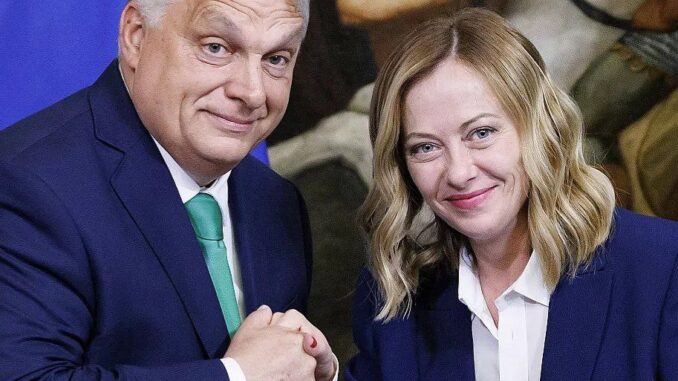
(December 13, 2025) highlights Italy joining Hungary, Belgium, Bulgaria, Czech Republic, and Slovakia in opposing the “theft” of Russian assets.
Accompanied by an image of Hungarian Prime Minister Viktor Orban and Italian Prime Minister Giorgia Meloni fist-bumping—symbolizing defiance against Brussels—the post frames this as resistance to “globalists,” emphasizing risks to rule of law, financial credibility, and national budgets.
Replies amplify concerns: some praise the “growing bloc” for prudence over ideology, while others warn of irreversible fractures.
This opposition isn’t pro-Russia but pragmatic, fearing systemic collapse.
Could it be a tipping point?
Yes, if the bloc expands—potentially including more nations wary of shared liabilities—it could paralyze EU foreign policy, deepen east-west divides, and accelerate deindustrialization amid energy woes. Combined with gold repatriation debates and economic strains, this risks portraying the EU as fragmented and unreliable, hastening a slide toward irrelevance rather than outright dissolution.
Conclusion: A Double-Edged Sword for the EU
The EU’s handling of Russian assets underscores a high-stakes gamble: bolstering Ukraine at the potential cost of its own cohesion and prosperity. While short-term gains for Kyiv are clear, the long-term negatives—economic instability, legal backlash, and internal rifts—could outweigh them, especially if Russia retaliates forcefully. For nations like Italy, this might fuel asset sovereignty pushes, but full exits seem improbable without broader crises. As the X post suggests, this moment tests the EU’s resilience; mishandled, it could indeed tip the scales toward failure, underscoring the need for cautious, unified action in a multipolar world.
Want to get your story in front of our massive audience? Get a media Kit Here. Please help us help you grow your business in Energy.
Authored by Simon Watkins via OilPrice.com, Moscow signed 10 new cooperation agreements with Iran for the oil sector alone on 18 May. China waited for the dust to settle before it too signed new cooperation […]
ENB Pub Note: This article is from the Energy Reminations Substack and was written by Doug Sandridge, who is a friend of the ENB Podcast. He has extensive international energy knowledge, and I interviewed Doug […]
Slovakia’s coalition government will discuss retaliatory measures to take against Ukraine after it halted the flow of Russian gas through its territory to Slovakia, Slovak Prime Minister Robert Fico said on Thursday (2 December). […]
We use cookies to ensure that we give you the best experience on our website. If you continue to use this site we will assume that you are happy with it.