


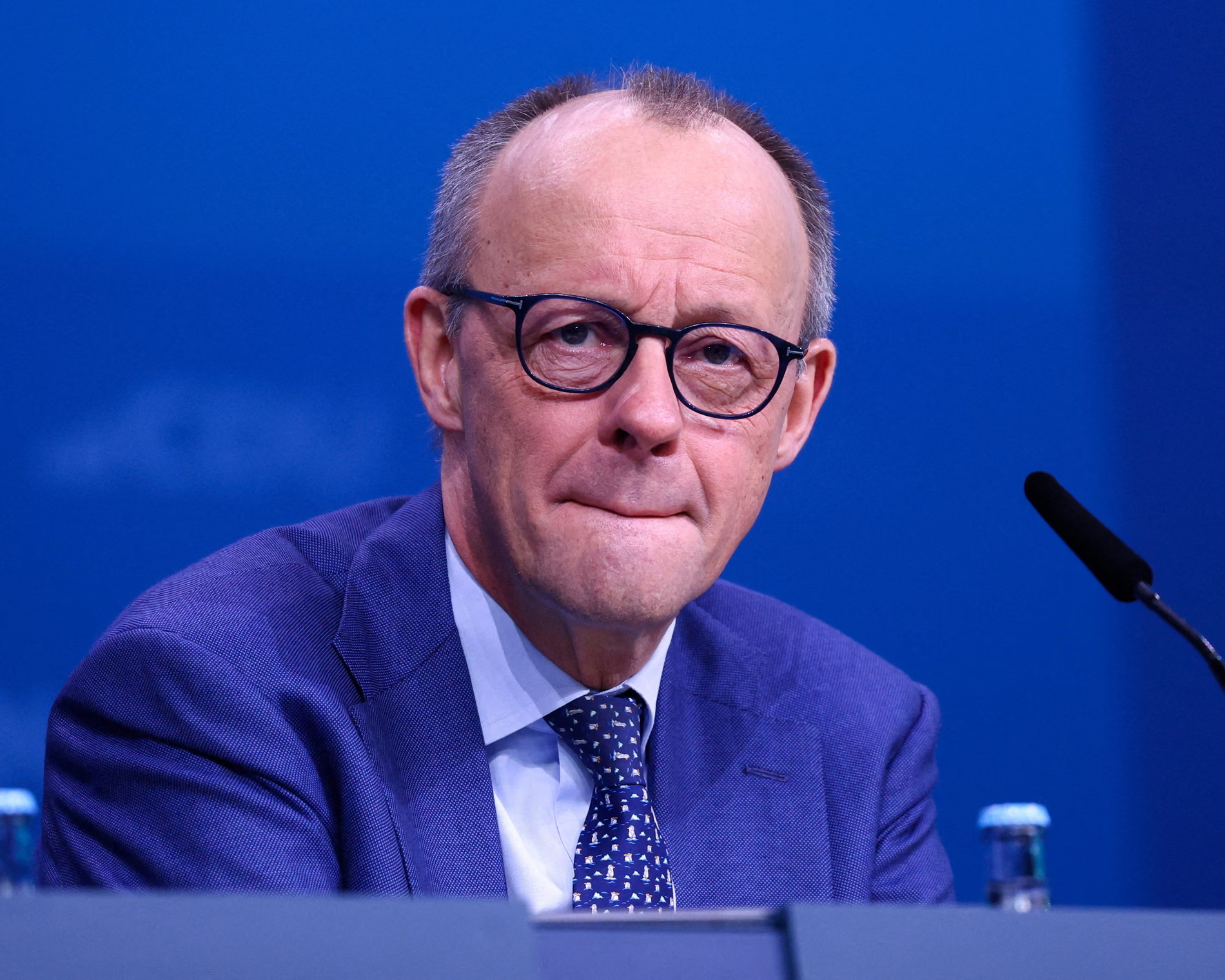
The energy realities have finally caught up to the Net Zero movement. Germany’s coalition government, under Chancellor Friedrich Merz, has agreed to overhaul a contentious heating law that previously mandated at least 65% renewable energy for new heating systems. This reform, announced in February 2026, allows homeowners to continue using oil and gas, drawing sharp criticism from environmental groups who accuse the administration of abandoning the country’s ambitious climate goals, including net-zero emissions by 2045.
Critics, including the German Environmental Aid Association (DUH), have labeled the move “an unconditional fulfilment of all the wishes of the fossil fuel lobby,” warning that it jeopardizes Germany’s climate neutrality targets.
The government counters that the changes provide households with more flexibility while maintaining emission reductions through a phased increase in “green” fossil fuels, starting at 10% by 2029 and rising progressively to 2040.
This policy shift comes amid broader economic pressures, where high energy costs, deindustrialization, and the fallout from the nuclear phase-out have exposed the limitations of Germany’s Energiewende—the country’s long-standing transition to renewable energy. Once hailed as a global model, the Energiewende has contributed to economic stagnation, prompting reforms aimed at balancing climate ambitions with affordability and competitiveness.
Germany’s GDP Over the Last Decade: Stagnation Amid Energy Challenges
Germany’s economy, Europe’s largest, has struggled in recent years, with GDP growth reflecting the strain of energy policies and external shocks like the 2022 energy crisis following Russia’s invasion of Ukraine. The table below summarizes nominal GDP (in USD trillions) and annual growth rates from 2015 to 2025, based on data from official sources and economic trackers. Growth has been erratic, with a sharp contraction in 2020 due to the COVID-19 pandemic, followed by recovery and then renewed weakness amid rising energy prices and industrial slowdowns.
|
Year
|
Nominal GDP (USD Trillions)
|
Annual Growth Rate (%)
|
|---|---|---|
|
2015
|
3.424
|
1.65
|
|
2016
|
3.538
|
2.29
|
|
2017
|
3.763
|
2.72
|
|
2018
|
4.052
|
1.12
|
|
2019
|
3.957
|
0.99
|
|
2020
|
3.940
|
-4.10
|
|
2021
|
4.348
|
3.67
|
|
2022
|
4.164
|
1.37
|
|
2023
|
4.526
|
-0.27
|
|
2024
|
~4.329 (est.)
|
-0.50
|
|
2025
|
~4.470 (est.)
|
0.20
|
Data compiled from World Bank, IMF, and Macrotrends estimates.
After two years of contraction, the economy is projected to stabilize with modest growth of around 0.3% in 2026, driven by public investment and falling energy costs, though risks from trade tensions persist.
Deindustrialization: The High Cost of Energy Policies
Germany’s industrial sector, which accounts for 21% of GDP, has been hit hard by soaring energy prices, leading to warnings of “creeping deindustrialization.”
A 2024 survey by the German Chamber of Commerce and Industry (DIHK) found that 51% of large companies and 45% of high-energy users are considering relocating production abroad due to unreliable and expensive energy supplies.
The chemical and heavy industries, once global leaders, are in rapid decline, with factories facing closure and reduced hours.
High energy costs—Germany has some of the world’s highest electricity prices, averaging 38 euro cents per kWh for households in 2025—have eroded competitiveness, with EU industrial prices twice those in the US and 50% above China’s.
Over the last decade, electricity prices have risen sharply, from around 16 euros/MWh pre-crisis to peaks of 235 euros/MWh in 2022, stabilizing at higher levels (about 100 euros/MWh in 2025).
This has fueled a “factory exodus,” with companies like Volkswagen signaling potential plant closures amid overcapacity and competition from China.
The Nuclear Phase-Out: A Costly Legacy
Germany’s decision to phase out nuclear power, completed in 2023, has exacerbated these issues. The shutdown of 17 reactors between 2011 and 2023 removed 800 TWh of zero-carbon electricity—equivalent to two years of national demand—leading to increased reliance on coal and gas.
This has resulted in 733 million tonnes of additional CO₂ emissions, 19,200 premature deaths from air pollution, and €57 billion in financial costs.
Studies estimate the phase-out added 36.2 megatons of CO₂ annually and caused 1,100 pollution-related deaths per year, as fossil fuels filled the gap.
One analysis found that postponing the phase-out in 2023 reduced European gas-fired generation by 2.9 TWh and German power prices by €9/MWh.
Public opinion has shifted; polls show support for extending nuclear operations amid energy security concerns, but the phase-out remains a point of pride for some, rooted in safety fears post-Fukushima.
However, it has left Germany importing electricity and facing higher emissions, contradicting Net Zero goals.
At the Bottom? Reforms and the Path Forward
By early 2026, Germany’s economy is at a low point, with growth at just 0.2% in 2025 and projections of 0.3-1.0% for 2026.
Unemployment hovers above 6%, and inflation eases to around 2%.
The rise of the far-right AfD in eastern states, fueled by economic malaise and anti-green sentiment, underscores the political fallout.
The Merz government is pivoting with reforms: dropping the renewable heating mandate, introducing a “green oil and gas quota,” ending subsidies for small solar systems, and allocating €100 billion from a €500 billion fund for energy infrastructure.
A 10-point plan emphasizes market-oriented renewables support, grid modernization, and affordable energy to halt deindustrialization.
Offshore wind auctions will shift to Contracts for Difference in 2026 to attract investment.
These changes signal a pragmatic turn, prioritizing economic recovery over strict green mandates. While emissions reductions continue—renewables hit 55% of electricity in 2025—Germany aims for 80% by 2030, though some targets, like 100% by 2035, may be scaled back.
As one X post noted, “Germany is done committing economic suicide to impress Brussels,” reflecting a sentiment echoed in public discourse.
Whether these reforms mark a bottom and lead to recovery remains uncertain, but they highlight the Net Zero movement’s collision with economic realities in one of the world’s industrial powerhouses.
The once poster child for the green movement is possibly becoming the poster child in the energy security movement, which is now a major political rallying call around the world.
As Stu Turley, the Energy News Beat host, has often said, “Energy Security starts at home, but your Energy Dominance comes through your exports,” and Germany won’t be exporting any time soon. Do you think California, New York, and the other Blue States will learn from Germany this time around?
Sources: @MarioNawfal on X, cleanenergywire.org, aoshearman.com, gleisslutz.com, cleanenergywire.org, iris-france.org
Get your CEO on the #1 Energy Podcast in the United States: https://sandstoneassetmgmt.com/media/
Is oil and gas right for your portfolio? https://sandstoneassetmgmt.com/invest-in-oil-and-gas/


Be the first to comment