

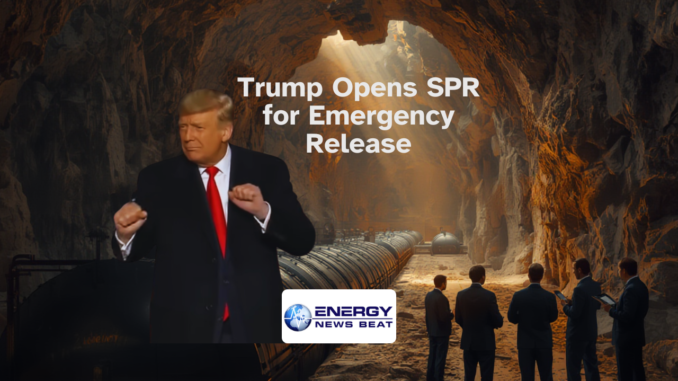
In a decisive response to skyrocketing oil prices triggered by the ongoing U.S.-Iran conflict, President Donald Trump has authorized the release of 172 million barrels from the Strategic Petroleum Reserve (SPR). This marks the largest drawdown under his administration and is part of a historic international effort coordinated by the International Energy Agency (IEA) to stabilize global energy markets. As energy costs surge due to disruptions in key supply routes, this action aims to provide immediate relief to American consumers and the economy.
Details of the Release
The Department of Energy (DOE) confirmed that the release will begin next week, with the 172 million barrels distributed over approximately 120 days at planned discharge rates.
This equates to roughly 1.43 million barrels per day entering the market, helping to offset the loss of global supply. The U.S. contribution represents about 43% of the IEA\’s total coordinated release of 400 million barrels from member nations\’ reserves—the largest such action in the agency\’s history.
Energy Secretary Chris Wright emphasized that the move is designed to \”tide the world over\” while U.S. military operations work to resolve the crisis.
The administration has also pledged to replenish the SPR with up to 200 million barrels within the next year, potentially at no additional cost to taxpayers through strategic acquisitions when prices stabilize.
Current SPR inventory stands at around 415 million barrels, or about 58% of its maximum capacity of 714 million barrels.
This release will draw it down further, but officials argue it\’s a necessary step given the severity of the supply shock.
Quotes from President Trump
President Trump has been vocal about the decision, framing it as a temporary measure to combat inflated prices while promising to refill the reserve soon after. During a visit to Ohio, he told local media: \”I filled it up once, and I’ll fill it up again, but right now, we’ll reduce it a little bit, and that brings the prices down.\”
At a rally in Kentucky, Trump elaborated: \”We’ll do that, and then we’ll fill it up. I filled it up once, and I’ll fill it up again. Right now, we’ll reduce it a little bit, and that brings the prices down.\”
He highlighted the IEA\’s unanimous agreement, calling it a \”record\” effort to \”substantially reduce the oil prices as we end this threat to America and this threat to the world.\”
These statements underscore Trump\’s long-standing emphasis on energy independence, contrasting with his criticisms of previous administrations for mismanaging the reserve.
Status of the SPR Over the Last 10 Years
The SPR, established in the 1970s as a buffer against oil shocks, has seen significant fluctuations in the past decade due to policy decisions, market dynamics, and geopolitical events. Here\’s a summary of annual average inventory levels from 2016 to 2026, based on U.S. Energy Information Administration (EIA) data:
|
Year
|
Average Inventory (Million Barrels)
|
Key Events
|
|---|---|---|
|
2016
|
695
|
Stable levels post-Obama era; minor sales for modernization.
|
|
2017
|
663
|
Trump administration begins efforts to fill amid low prices.
|
|
2018
|
649
|
Continued drawdowns for infrastructure upgrades.
|
|
2019
|
645
|
Sales mandated by Congress to fund other programs.
|
|
2020
|
638
|
Trump pushes to buy oil cheaply during COVID-19 price crash.
|
|
2021
|
593
|
Transition to Biden; initial releases amid pandemic recovery.
|
|
2022
|
416
|
Massive Biden-era drawdowns (over 180M barrels) following Russia-Ukraine war.
|
|
2023
|
352
|
Lowest in 40 years; replenishment efforts stalled by high prices.
|
|
2024
|
395
|
Slow refills under Biden; congressional mandates limit sales.
|
|
2025
|
400
|
Trump returns; declares \”national energy emergency\” and vows to refill.
|
|
2026
|
415
|
Current level before release; modest gains from prior purchases. |
The reserve peaked at 727 million barrels in 2009 but has trended downward due to mandated sales and emergency uses. By 2023, it hit a 40-year low of 352 million barrels, equivalent to just 57 days of import protection—down from over 99 days in 2021.
How Biden Drained the SPR to Influence an Election
Critics, including Trump, have long accused the Biden administration of politicizing the SPR. In 2022, amid soaring gas prices following Russia\’s invasion of Ukraine, Biden authorized the release of 180 million barrels over six months—the largest in SPR history.
This was coordinated with IEA partners for an additional 60 million barrels, lowering U.S. gas prices by an estimated 17 to 42 cents per gallon.
However, Republicans argued the move was timed to suppress prices ahead of the 2022 midterm elections rather than a true supply emergency.
Senator Tom Cotton called it a \”deliberate political act\” to shield Democrats from backlash over their energy policies.
The drawdown depleted the SPR to 352 million barrels by late 2023, its lowest since 1983, leaving the U.S. vulnerable to future shocks.
Biden\’s team later canceled further replenishments due to rising oil prices, exacerbating the shortfall.
While the releases provided short-term relief, they drew down the reserve by over 200 million barrels total (including 2021 actions), prompting accusations of electioneering over national security.
Professor St. Onge is a classic.
He mentions the U.S. Oil and Gas Association, where we just interviewed Tim Stewart, their President.
The Strategic Petroleum Reserve was built so we’d never be caught flat-footed by a Middle East war.
It took 30 years to fill.
Then Biden drained it by half to buy an election. pic.twitter.com/oiSNHCUnR4
— Peter St Onge, Ph.D. (@profstonge) March 12, 2026
Why President Trump Is Releasing Oil Now
The current release comes amid a severe global oil supply disruption caused by the U.S.-Iran war, which has effectively shut down the Strait of Hormuz—a chokepoint for 20% of the world\’s oil transit.
Iranian attacks on vessels have driven crude prices above $100 per barrel, pushing U.S. gas prices up 20% to an average of $3.58 per gallon.
Trump\’s administration views this as a genuine emergency, unlike what they describe as Biden\’s politically motivated actions. The goal is to prevent economic fallout from prolonged high prices, with Wright noting it will \”ease surging crude and fuel prices.\”
By coordinating with the IEA, the U.S. aims to amplify the impact, potentially lowering prices more effectively than a unilateral move.
Experts warn that without resolution in the Strait, the relief may be temporary, but Trump insists U.S. military dominance will restore flows soon.
We have all the confidence in the world in our great Secretary of Energy, Chris Wright, to fill the SPR. We have absolutely zero confidence in Congress. They are blocking President Trump at every turn and you have to wonder who\’s side are they on? As Stu Turley has said on the Energy News Beat podcast, \”Either back President Trump or get out of the way\”. Primaries are soon. We, the American People, are tired of Congress, graft, and Greed.
This strategy aligns with his \”energy dominance\” agenda, prioritizing American production while using the SPR as a tool against adversarial blackmail.
As the Energy News Beat Channel continues to track this story, the release highlights the SPR\’s enduring role in navigating geopolitical energy crises. Stay tuned for updates on market impacts and replenishment plans.
Sources: foxnews.com, cnn.com, bloomberg.com
Get your CEO on the #1 Energy Podcast in the United States: http://energynewsbeat.co/energy-news-beat-media-kit/
Is oil and gas right for your portfolio? http://energynewsbeat.co/invest/