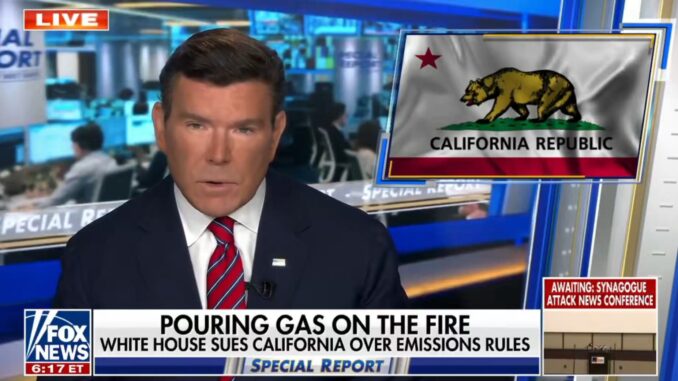
In a move that underscores the escalating tensions between federal authority and state-level environmental ambitions, the Trump administration has filed a lawsuit against California, targeting the state’s aggressive zero-emission vehicle (ZEV) mandates and greenhouse gas emissions rules. The suit, lodged by the U.S. Department of Transportation against the California Air Resources Board (CARB), argues that these regulations are illegal, preempted by federal law, and represent an overreach that burdens the national economy. This legal battle comes on the heels of President Trump’s signing of congressional resolutions in 2025 that rescinded EPA waivers allowing California to enforce stricter standards than federal ones. As of March 2026, the case is progressing through federal courts, with motions to dismiss and hearings scheduled, highlighting a fundamental clash over who controls America’s energy future.
The Energy News Beat has several podcasts about the refinery, lawsuits, and energy policy overreach coming out in the next few days.
The lawsuit isn’t just about cars—it’s a broader assault on California’s environmental playbook under Governor Gavin Newsom. Critics argue that Newsom’s policies exemplify regulatory excess, driving up costs for consumers and businesses while failing to deliver proportional environmental benefits. Meanwhile, the economic fallout from these rules isn’t confined to California’s borders; surrounding states feel the ripple effects through shared energy markets, relocated industries, and inflated regional prices. Let’s break it down.
The Lawsuit: Federal Preemption vs. State Autonomy
The core of the White House’s legal challenge revolves around California’s Advanced Clean Cars II (ACC II) rules, which aim to phase out new gasoline-powered vehicle sales by 2035, mandating that 35% of new cars sold in 2026 be zero-emission, escalating to 100% by 2035.
Similar mandates apply to heavy-duty trucks under the Advanced Clean Trucks rule and nitrogen oxide reductions via the Omnibus Low NOx rule. The administration contends these are unlawful because the Clean Air Act preempts state regulation of vehicle emissions unless the EPA grants a waiver, which Trump revoked using the Congressional Review Act (CRA) in 2025.
Filed in U.S. District Court in California, the suit seeks a declaration that all ZEV mandates are unenforceable, citing conflicts with federal energy policy that prioritizes consumer choice and fossil fuel development.
This follows earlier actions, including a 2025 Justice Department complaint against CARB’s “Clean Truck Partnership,” which enforced emissions standards on truck manufacturers despite federal preemption.
California, joined by 10 other states that adopted similar rules, countered with its own lawsuit, arguing the CRA was misused to target state regulations and violates separation of powers.
As of late 2025, the case saw an amended complaint from California, with a hearing set for January 2026.
The stakes are high: If California prevails, automakers could face dual regulatory regimes—federal leniency versus California’s EV push—potentially disrupting supply chains and raising costs nationwide.
Trump officials frame this as ending “regulatory overreach,” while Newsom vows to fight, positioning California as a climate leader against federal rollback.
Newsom’s Regulatory Overreach: From EVs to Gas Bans
Under Governor Newsom, California has pursued an ambitious zero-emissions agenda, aiming for carbon neutrality by 2045. This includes extending the cap-and-trade program, which caps greenhouse gas emissions and allows trading of permits, funding clean energy initiatives but imposing costs on polluters.
Proposed amendments to the Cap-and-Invest program would tighten limits on refineries, potentially forcing shutdowns or relocations.
Newsom has also signed laws boosting carbon capture and storage, while paradoxically easing some oil drilling to stabilize supply amid high prices.
Critics, including industry leaders like Chevron, decry this as overreach that undermines energy reliability. For instance, bans on natural gas in new buildings in cities like Petaluma and Morgan Hill drew federal lawsuits in 2026, with the Justice Department arguing they inflate costs and clash with national policy.
Trump’s April 2025 executive order, “Protecting American Energy From State Overreach,” explicitly targets California’s cap-and-trade and ESG initiatives, directing the Attorney General to challenge laws burdening domestic energy production.
arnoldporter.com X posts from users like @BizUpCoachRob echo this sentiment, accusing Newsom of driving out companies with “regulatory overreach” and union mandates.
Even Democratic lawmakers have reconsidered refinery rules, warning of gas price hikes and supply shortages.
Nevada’s governor joined the opposition, citing cross-border impacts.
Newsom’s push for a Western regional electricity market could integrate renewables but risks exporting California’s high costs to neighbors.
NEW: The Trump administration has SUED California, asserting that the state’s zero-emission vehicle mandates and tailpipe greenhouse gas emission standards are ILLEGAL and preempted by federal law.
This action targets California’s Advanced Clean Cars II program, which aims to… pic.twitter.com/od5iZU6feR
The Price Tag: Billions in Costs for California and Beyond
Newsom’s policies have exacted a steep economic toll. California’s gas prices are double the national average—over $1 per gallon in state taxes alone—due to regulations that have chased refineries out, reducing supply and spiking costs.
The state faces a $73 billion budget deficit for 2024-25, exacerbated by surging revenues from capital gains taxes that mask underlying volatility.
Homelessness spending has ballooned to tens of billions with little progress, while the high-speed rail project remains underfunded and delayed.
Broader economic strains include a 11% higher cost of living than the national average, with half of residents reporting financial hardship from price increases.
Businesses like Chevron warn that Cap-and-Invest changes could threaten jobs and fuel reliability, potentially adding billions in costs.
California’s film tax credit expansion and utility rebates aim to offset this, but critics argue they’re band-aids on self-inflicted wounds.
Surrounding states aren’t immune. Arizona, Nevada, and Oregon, which share energy grids and markets, could see higher electricity costs if California’s regional market expansion proceeds, integrating zero-carbon mandates.
Relocating refineries and manufacturers benefits neighbors like Texas, which receives $71 billion more in federal funds than it pays, contrasting California’s $83 billion net contribution.
However, supply chain disruptions from California’s rules could inflate regional fuel prices, as seen in Nevada’s opposition to refinery regs.X users like @aci6869smokey blame Newsom for bankrupting businesses, while highlighting how his green push punishes oil producers, leading to “rising costs” across the West.
A Cautionary Tale for National Energy Policy
This lawsuit isn’t just litigation—it’s a referendum on whether states like California can dictate energy policy amid federal pushback. Newsom’s vision of a green utopia has come at a premium, with regulatory burdens accelerating corporate exodus and economic strain. As surrounding states grapple with the fallout, the broader question looms: Can America afford California’s model, or is it time to prioritize affordability over ambition? The courts will decide the immediate fate, but voters and markets may render the final verdict.
We are reaching out to see if this will be tied ot the full refinery closure and the federal government takeover of the refineries. We will keep you posted as this is a National Security Issue.
ENB Pub Note: This is a follow-up story to the one that was run yesterday: “Trump allows Equinor to resume work on wind project off New York.” I added the power mix for the New […]
Parts of the Northeast are gearing up for what could be very heavy snow Tuesday, after tornadoes and other powerful winds swept through parts of the Southern Plains and the Midwest, killing at least one […]
In an era where headlines are dominated by stock market volatility, housing bubbles, and geopolitical tensions, a quieter but potentially devastating economic threat is brewing: electricity inflation. Over the past five years, electricity prices have […]
We use cookies to ensure that we give you the best experience on our website. If you continue to use this site we will assume that you are happy with it.








Be the first to comment