


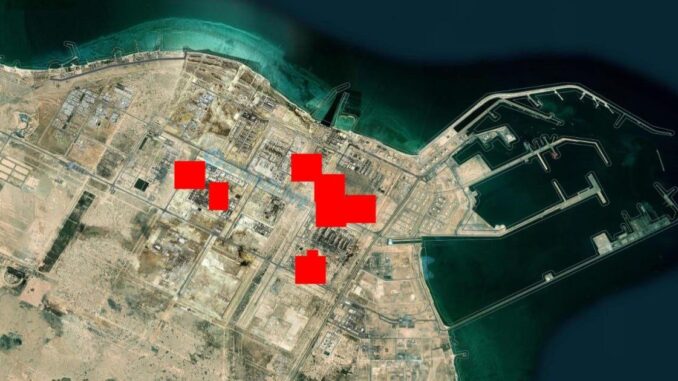
Ras Laffan Industrial City, Qatar
In a dramatic escalation of the Iran-Israel conflict spilling into the Persian Gulf, QatarEnergy’s flagship Pearl Gas-to-Liquids (GTL) complex — the world’s largest — has been struck and is burning. Satellite thermal imaging from FIRMS (Fire Information for Resource Management System) shows multiple active hot spots across Ras Laffan’s industrial zone, with red-highlighted anomalies directly overlaying sections of the Pearl GTL plant and nearby condensate refinery facilities.
The joint venture between QatarEnergy and Shell (operational since 2012) processes ~1.6 billion cubic feet per day of natural gas into 140,000 barrels per day of ultra-clean GTL products, including Group III base oils, diesel, naphtha, and kerosene. Reports from social media analysis and on-the-ground confirmations indicate the strike — attributed to Iranian missiles or drones amid retaliatory actions following an earlier hit on Iran’s South Pars field — has caused significant fires.
Equipment on Fire: The Critical Air Separation Units (ASUs)
The most likely target or hardest-hit area, per detailed analysis of the satellite data and process engineering knowledge, is Pearl GTL’s massive Air Separation Unit (ASU) complex. Pearl GTL relies on eight identical Linde-engineered ASUs, each capable of producing 3,800 tonnes per day (tpd) of oxygen — totaling ~30,000 tpd of pure O₂. These cryogenic plants supply the oxygen essential for autothermal reforming in the syngas production step of the Shell GTL process.
Each ASU features enormous cold boxes (470 tonnes each, standing 60 meters tall) manufactured primarily in Europe and China. The red boxes in the FIRMS imagery align precisely with the industrial footprint where these units and associated cryogenic infrastructure are clustered near the coastal process area of Ras Laffan.
Replacement Cost and Timeline: Years, Not Months
Rebuilding these specialized ASUs will be extraordinarily expensive and time-consuming. Original contract costs (awarded to Linde in 2006) were already massive; at today’s inflated prices for cryogenic equipment, specialized fabrication, and global supply-chain pressures, each unit is estimated at approximately $1 billion (versus ~$400 million at the time of original construction). For all eight units, that alone could exceed $8 billion — before installation, integration, civil works, and full plant recommissioning.
Manufacturing lead time for such mega-ASUs is 3–4 years per unit under normal conditions. Key components (cold boxes, heat exchangers, distillation columns) must be precision-fabricated by specialists like Linde or SIAD Macchine Impianti. Delivery, on-site erection, testing, and integration with the broader GTL facility push the full outage timeline to multiple years before Pearl GTL can return to even partial production. No official QatarEnergy or Shell damage assessment has been released yet, but the destruction of oxygen supply would render the entire syngas-to-liquids chain inoperable until replacement.
This comes on top of earlier drone attacks in early March that already forced QatarEnergy to declare force majeure and halt all LNG and associated product output across Ras Laffan and Mesaieed.
What This Means for the Global LNG Market
Pearl GTL itself does not produce LNG — it converts gas into liquids. However, its gas feedstock draw (~1.6 bcf/d) represents a meaningful slice of Qatar’s total production. A prolonged outage could theoretically free up molecules for LNG, but the broader Ras Laffan complex (home to Qatar’s core LNG trains) is under direct attack and already shut down.QatarEnergy — the world’s largest LNG exporter with ~77+ million tonnes per annum capacity post-expansion — has completely halted production following strikes on its LNG facilities, power infrastructure, and now the GTL zone. This is a historic supply shock:Immediate price surge: European and Asian spot LNG prices have already rocketed (reports indicate sharp spikes in JKM and TTF benchmarks).
Global ripple effects: Europe (still recovering from Russian gas cuts) and Asia (China, Japan, Korea, India) face tighter supply, higher winter heating/power costs, and renewed calls for U.S./Australian/Qatar restart urgency.
Longer-term: Other exporters (U.S., Australia, Russia via Arctic) may ramp up, but new liquefaction trains take years. Strait of Hormuz shipping risks compound the crisis.
GTL side impact: Loss of Pearl’s high-value synthetic fuels tightens the global diesel and premium base-oil markets, indirectly supporting crude prices.
Qatar’s defense ministry reported no casualties so far, but the strategic blow to the Gulf energy heartland is severe. Emergency response teams are battling fires, yet full restart timelines remain uncertain amid ongoing regional hostilities.
Energy News Beat Takeaway: This is not a temporary glitch. The targeted destruction of Pearl GTL’s irreplaceable ASUs means the complex could be offline for years, compounding an already catastrophic LNG supply disruption. Global energy markets are in for prolonged volatility — watch LNG futures, crude, and shipping rates closely. We will update as official assessments from QatarEnergy and Shell emerge.
Source: argusmedia.com, aljazeera.com, linde-engineering.com




Be the first to comment