


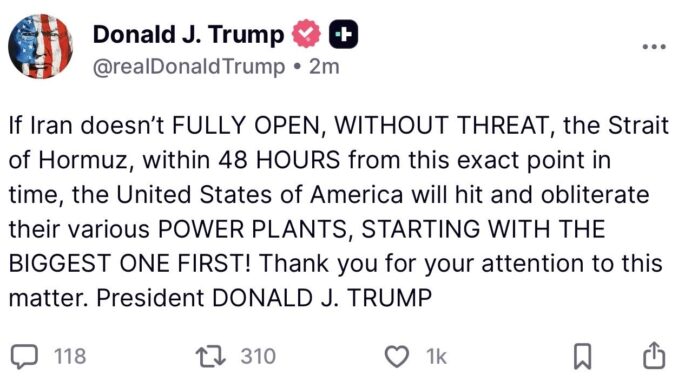
President Donald Trump delivered a blunt ultimatum to Iran late Saturday, March 21, 2026: fully reopen the Strait of Hormuz – without threats or interference – within 48 hours, or the United States will “hit and obliterate” Iran’s power plants, “starting with the biggest one first.”
The message, posted on Truth Social while Trump was at his Florida home, comes as the ongoing U.S.-Israel conflict with Iran has shut down tanker traffic through the Strait, the chokepoint for roughly one-fifth of global oil supply. Oil prices have spiked, European natural gas futures surged as much as 35%, and the world is watching a high-stakes energy showdown unfold in real time.
Damage Report: Iran’s Natural Gas Fields Already Bleeding
The backdrop to Trump’s threat is fresh, severe damage to Iran’s energy heart. On or around March 17-18, Israeli strikes hit the South Pars gas field – the world’s largest natural gas reserve, shared with Qatar – along with processing infrastructure at the Asaluyeh complex.
South Pars supplies 70-75% (some reports say up to 80%) of Iran’s total natural gas production. Multiple explosions damaged gas-treatment plants and halted output at two refineries that normally process about 100 million cubic meters of gas per day. Iranian state media and the Oil Ministry confirmed infrastructure hits with no immediate casualties reported, but the long-term repair timeline is unclear and likely measured in months to years.
Iran retaliated by missile-striking Qatar’s Ras Laffan LNG complex – the planet’s largest LNG export hub – destroying two trains and knocking out 17% of Qatar’s LNG capacity (roughly 12.8 million tonnes per year) for the next three to five years. QatarEnergy has already declared force majeure on long-term contracts.
Because Iran burns the vast majority of its gas domestically, these hits have already triggered domestic power shortages and cut exports. The damage directly threatens the fuel supply for Iran’s electricity grid.
Iran’s Power Plants: The Next Target?
Iran generates ~85% of its electricity from natural gas-fired plants (combined-cycle and gas turbines), according to the International Energy Agency and U.S. Energy Information Administration data. The country operates hundreds of power-plant units with total installed capacity well above 70,000 MW (older public figures; exact 2026 totals are closely guarded).
Trump’s wording – “various POWER PLANTS, STARTING WITH THE BIGGEST ONE FIRST” – leaves little ambiguity. Every major gas-fired facility now sits in the crosshairs, especially those tied to South Pars feedstock in the southwest (Bushehr and Khuzestan provinces). Even a limited strike campaign would plunge Iran into nationwide blackouts, cripple industry, and collapse what remains of its grid stability.
Amphibious Ships: Arrival Timeline and What It Signals
The U.S. is reinforcing the region fast:
The USS Tripoli Amphibious Ready Group (America-class assault ship + escorts, carrying elements of the 31st Marine Expeditionary Unit) transited the Malacca Strait March 17-18 and is expected in the Strait of Hormuz area between March 23 and 25 – literally days from now.
The USS Boxer Amphibious Ready Group (Wasp-class + escorts, 11th MEU, ~2,500 Marines) left San Diego ahead of schedule this week and is at least three weeks out (mid-to-late April).
Together, these two ARG/MEU packages will add roughly 5,000-8,000 Marines and sailors. Their mission: maritime security, possible shore operations near Kharg Island (Iran’s main oil export terminal), or support for reopening the Strait.
The rapid timeline shows Washington is prepared for sustained presence – not a quick in-and-out.
What This Means for Consumers, Investors, and Iraq
Consumers: Expect pain at the pump and on utility bills. Global oil and LNG markets are already reacting violently. If the Strait stays closed even a few more days, gasoline, diesel, and heating costs will climb sharply worldwide. European households and Asian importers are most exposed after the Ras Laffan hit. U.S. consumers will feel it indirectly through higher crude and refined-product prices.
Investors: Energy equities, oil futures, and LNG-related plays are in the spotlight. Volatility is extreme; companies with non-Middle East supply chains or U.S. shale/LNG exposure stand to gain. Downstream refiners, utilities, and renewables may see mixed pressure. The “doomsday gas scenario” analysts warned about is no longer theoretical – it’s here.
Iraq – the silent victim: Iraq has long depended on Iranian natural gas for roughly 30-40% of its power generation and a smaller but still critical share of direct electricity imports. The South Pars damage has already disrupted those flows, knocking gigawatts offline and forcing blackouts. If Trump follows through on power-plant strikes, Iran’s ability to export gas or electricity will evaporate. Iraq’s grid – already strained – faces a potential collapse. Baghdad has been trying to diversify (Turkmenistan, GCC links, floating LNG), but those projects won’t fill the gap overnight. Iraqi consumers and industries are staring at prolonged outages and economic fallout.
Bottom line: Trump’s 48-hour clock is ticking. The Strait, Iran’s battered gas fields, and its gas-dependent power grid are now the epicenter of the global energy story. Energy News Beat will keep you updated as developments unfold – because when the Middle East sneezes, the world’s lights flicker. Stay tuned.
Sources: oilprice.com, finance.yahoo.com, en.defence-ua.com, investing.com




Be the first to comment