

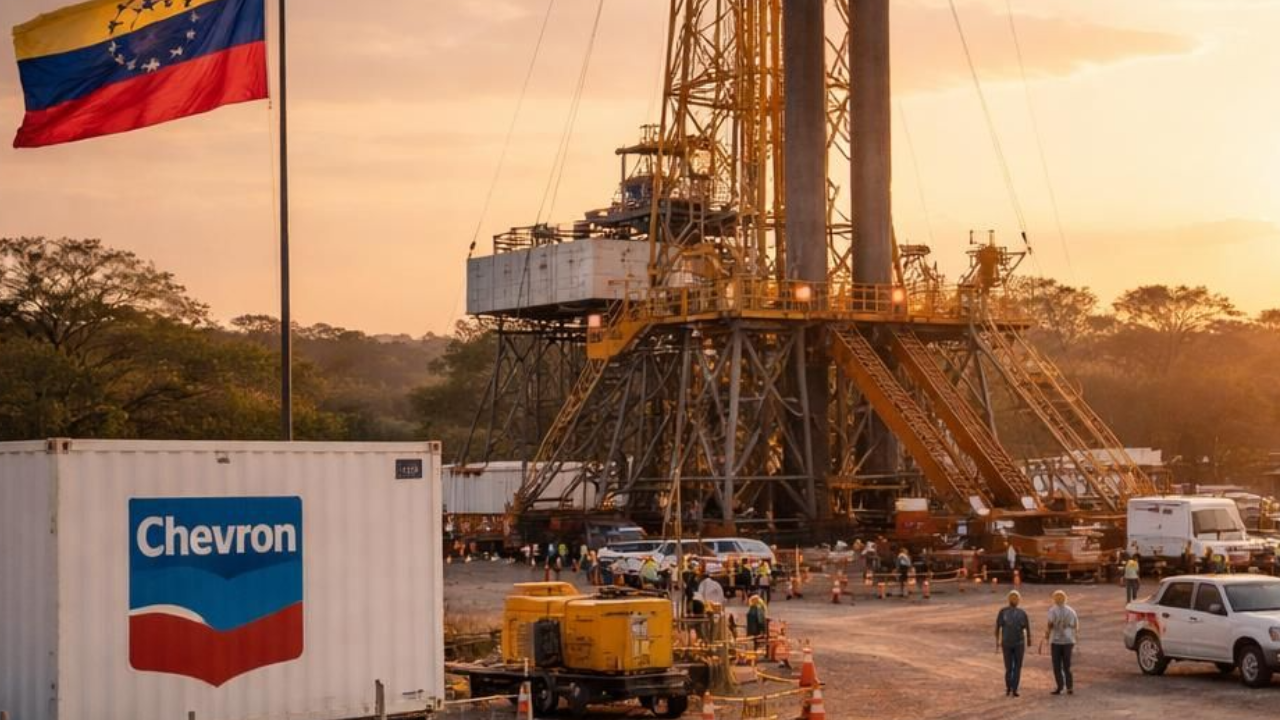
Houston-based Chevron Corporation remains the leading Western oil major active in Venezuela, but CEO Mike Wirth is calling for deeper reforms from Caracas if the country’s vast oil sector is to achieve meaningful revival. In comments reported by Bloomberg on April 26, 2026, Wirth acknowledged recent positive policy moves under Venezuela’s Hydrocarbons Law but stressed that “it’s probably not enough to bring in the level of investment that would be desirable.”
Venezuela holds the world’s largest proven oil reserves, yet decades of mismanagement, sanctions, and underinvestment have left output hovering around 1 million to 1.1 million barrels per day (bpd). Chevron, operating through joint ventures with state-owned Petróleos de Venezuela S.A. (PDVSA), currently produces roughly 250,000–260,000 bpd—about one-quarter of the country’s total output.
Chevron’s Track Record and Recent Performance
Chevron has steadily ramped up output in its existing joint ventures (including Petroboscán, Petropiar, and Petroindependencia) through a venture-funded model that recovers outstanding debts while boosting production. The company has already delivered significant gains, and Wirth stated in January 2026 that Chevron could lift its Venezuelan volumes by up to 50% within the next 18–24 months using its current footprint—if U.S. government authorizations and partner cooperation remain in place.
A major strategic move came just two weeks ago. On April 13, 2026, Chevron finalized an asset swap with PDVSA that consolidates its position in the Orinoco Belt’s heavy-oil resources. Chevron increased its stake in the Petroindependencia joint venture (now at 49%) and secured additional rights in the Ayacucho 8 block for Petropiar. In exchange, it transferred its operated interests in the offshore Plataforma Deltana Blocks 2 and 3 (gas-focused) plus a minor stake elsewhere. The deal sharpens Chevron’s focus on the high-value heavy crude that matches its U.S. Gulf Coast refining complex.
What Chevron Can Do to Increase Production
Within its existing joint-venture footprint, Chevron can accelerate output through:
Rehabilitation of aging wells, pipelines, and facilities that have suffered from years of under-maintenance.
Deployment of enhanced oil-recovery techniques suited to extra-heavy Orinoco crude.
Expanded drilling and workover programs funded via the debt-recovery model already in use.
Longer-term expansion would require new acreage, additional capital (tens of billions of dollars industry-wide), and greater operational autonomy. Chevron executives have signaled they are “working with the U.S. government and the Venezuelan government to create circumstances that would enable that.”
Regulatory Burdens That Need Lifting
Wirth and industry analysts point to several key hurdles in Venezuela’s current framework:
Hydrocarbons Law reforms (January 2026) introduced positive changes—greater autonomy for operators, the right to sell crude independently, flexible royalty and tax structures, and improved arbitration mechanisms. However, Wirth and others say legal certainty remains insufficient for the massive investments required.
Fiscal and contractual clarity: Operators need predictable terms on profit repatriation, debt repayment, and tax/royalty stability.
Bureaucratic and permitting delays: Streamlined approvals for new projects and outsourcing would accelerate activity.
U.S. sanctions and licensing: While the Trump administration issued general licenses in February 2026, allowing Chevron (and others) to resume and expand operations, further clarity on long-term licensing would unlock bigger commitments.
Without these adjustments, the “tens of billions” needed to restore output toward historic peaks (nearly 4 million bpd a decade ago) will stay on the sidelines.
What Other Operators Are Doing
The February 2026 general licenses opened the door for BP, Eni, Shell, and Repsol to resume oil-and-gas activities and negotiate new contracts. Shell has shown particular interest in gas projects, while the others are assessing rehabilitation opportunities. ExxonMobil, which exited Venezuela years ago after nationalizations, remains more cautious and is “waiting to see” the investment climate before committing fresh capital.
Private operators and smaller players are also circling, but most agree that political and contractual stability must improve before large-scale commitments flow.
Role for the Trump Administration
The Trump administration has already taken concrete steps—issuing general licenses, facilitating high-level visits to joint-venture sites, and signaling a desire to revive Venezuela’s oil sector as part of broader regional energy security goals. Industry observers suggest the White House could go further by:
Providing investment-protection guarantees or political-risk insurance for U.S. companies.
Encouraging bilateral agreements that lock in long-term licensing and sanctions relief tied to measurable production and governance improvements.
Supporting arbitration enforcement and rule-of-law mechanisms to rebuild investor confidence after past expropriations.
With Chevron already delivering a quarter of Venezuela’s oil and positioned for rapid growth, targeted U.S. policy support could accelerate the country’s return as a reliable heavy-crude supplier to American refineries.
Outlook
Venezuela’s revival won’t happen overnight. Billions in investment and years of steady work are required. But Chevron’s recent asset swap, rising production, and clear roadmap show that progress is possible when governments and operators align. As Mike Wirth made clear on April 26, Caracas still has work to do—and the rewards for getting it right could be enormous for Venezuela, the United States, and global energy markets.
Appendix: Sources and Links
- Bloomberg original article (April 26, 2026): https://www.bloomberg.com/news/articles/2026-04-26/chevron-ceo-venezuela-needs-to-do-more-for-oil-industry-revival
- CNBC – Chevron CEO on 50% production increase potential (Jan 30, 2026): https://www.cnbc.com/2026/01/30/chevron-ceo-says-venezuela-taking-positive-steps-to-protect-oil-investment.html
- Reuters – Chevron on hydrocarbons law changes (Mar 23, 2026): https://www.reuters.com/business/energy/ceraweek-chevron-ceo-says-it-will-take-time-energy-recover-middle-east-2026-03-23/
- OilNOW – Chevron production boost details (Jan 30, 2026): https://oilnow.gy/news/chevron-says-it-can-boost-venezuela-production-up-to-50-in-24-months/
- Reuters – Chevron-PDVS asset swap (Apr 13, 2026): https://www.reuters.com/business/energy/chevron-shell-sign-agreements-oil-gas-areas-venezuela-sources-say-2026-04-13/
- World Oil – Asset swap confirmation (Apr 13, 2026): https://worldoil.com/news/2026/4/13/chevron-expands-venezuela-heavy-oil-position-in-pdvsa-asset-swap/
- Bloomberg – U.S. general licenses to operators (Feb 13, 2026): https://www.bloomberg.com/news/articles/2026-02-13/us-allows-some-oil-companies-to-produce-oil-gas-in-venezuela
- Additional context from WSJ, NYT, Forbes, and congressional records (various dates Jan–Apr 2026) as cited inline.
All data drawn from publicly reported industry statements, earnings calls, and official announcements as of April 27, 2026. Production figures are approximate based on company disclosures and third-party estimates.