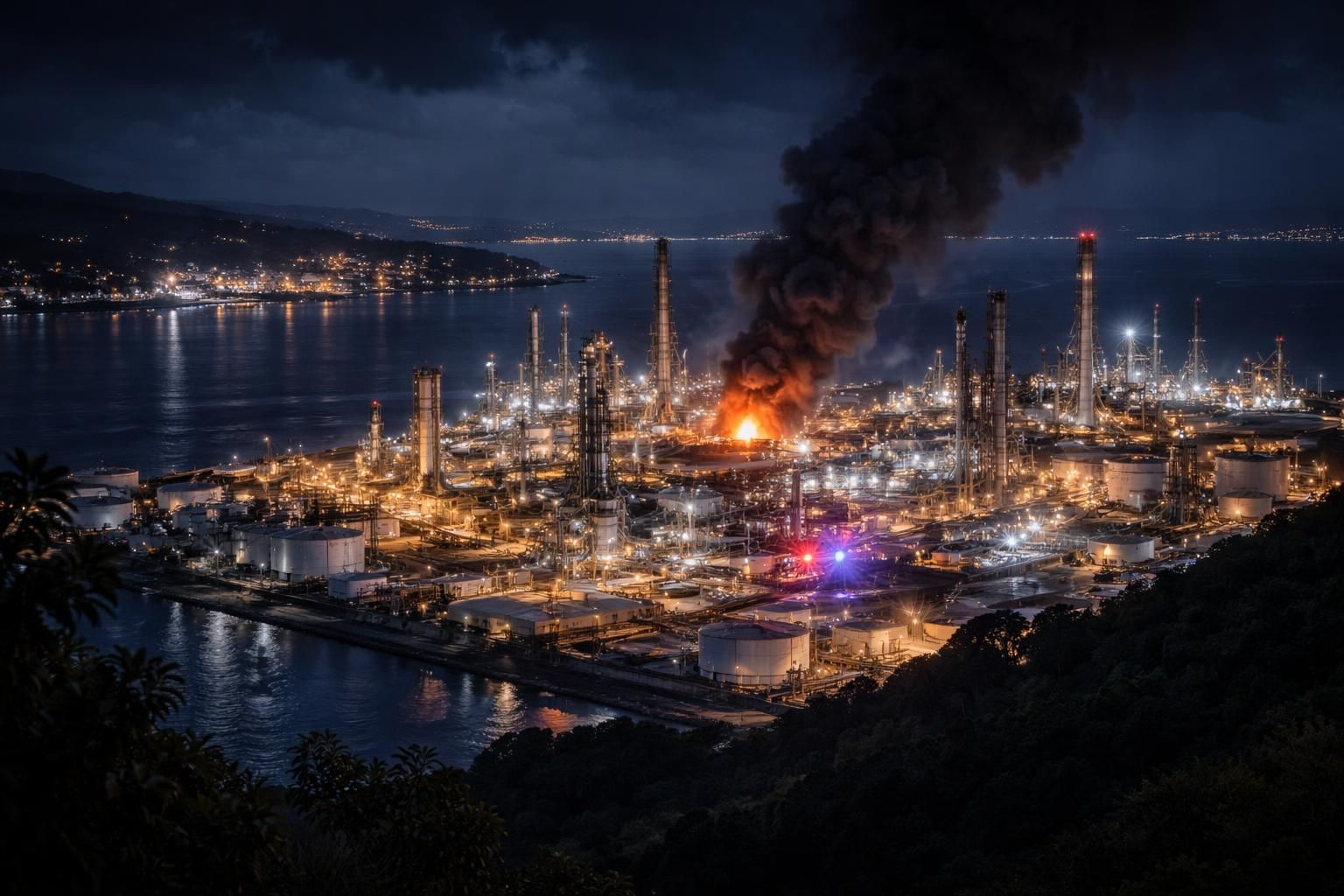
Ukrainian drone strikes continue to hammer Russian oil infrastructure, with the latest assault on the Tuapse Oil Refinery in Krasnodar Krai marking the third hit on the facility in April alone. Overnight on April 27-28, 2026, drones ignited fires and damaged additional storage tanks, triggering a state of emergency, an oil spill, and direct Kremlin attention from President Vladimir Putin.
The Tuapse refinery, operated by Rosneft as Russia’s primary Black Sea export-focused plant, has been largely offline since mid-April due to cumulative damage. These strikes are part of a broader Ukrainian campaign targeting Russian energy assets to disrupt war funding. At the same time, a separate conflict in the Middle East — the 2026 U.S.-Israeli war on Iran and Iranian retaliation — has taken a heavy toll on Gulf refining capacity. Together, these geopolitical flashpoints have knocked significant volumes of global refining offline.
Details on the Tuapse Refinery and the April Strikes
The Tuapse refinery is Rosneft’s only major facility on the Black Sea coast and one of Russia’s key export hubs. It has a processing capacity of approximately 12 million metric tons per year, or roughly 240,000 barrels per day (bpd).
It primarily produces naphtha, diesel, fuel oil, and vacuum gasoil, with ~90% of output exported through the adjacent RN-Tuapse Marine Terminal (transshipment capacity ~17 million tons/year).
Key customer markets have included Turkey, China, Malaysia, and Singapore.April 16 strike: Initial damage to tanks and infrastructure; operations began to falter.
April 20 strike: Major escalation — 24 oil storage tanks destroyed and 4 more damaged; the sole crude distillation unit was suspended.
April 27-28 strike: Fires in the northern section of the refinery (previously untouched), additional tank damage, and confirmed oil spill. Satellite imagery and NASA FIRMS data verified multiple heat anomalies.
The cumulative effect has halted refining and export operations, compounding damage to nearby port and terminal facilities. Russian officials initially downplayed the strikes but later acknowledged their severity, with Putin dispatching emergency officials to the site.
Broader Ukrainian Campaign Against Russian Refineries
Ukraine has conducted dozens of drone strikes on Russian oil infrastructure since 2024, with a sharp escalation in 2026. Targets have included major refineries (NORSI, Kirishi, Saratov, Volgograd, Yaroslavl, Ilsky, Ukhta, Afipsky, Bashneft-Novoil, Novokuibyshevsk, Syzran, and others) plus export terminals in the Baltic and Black Sea regions.
Estimates of the impact vary by source and timeframe, but Ukrainian strikes have:
Reduced Russian refining throughput by 10-17% (~0.6–1.1 million bpd) at various points, with some periods seeing up to 20% of capacity impaired.
Disrupted up to 40% of Russia’s oil export capacity (peaking in March 2026), though current sustained losses are closer to 20%.
Many facilities have been repaired only to be hit again; specialized equipment shortages (due to sanctions) prolong outages.
Gulf Refineries Hit in the 2026 Iran Conflict
Parallel to the Russia-Ukraine energy war, the escalation in the Middle East has devastated Gulf refining. Iranian drone and missile strikes (plus related disruptions) have shut down capacity across Saudi Arabia, UAE, Bahrain, Kuwait, Qatar, and others.
Key examples include:
Ras Tanura (Saudi Arabia) — 550,000 bpd temporarily halted.
Satorp (Saudi Arabia) — 460,000 bpd units offline.
Ruwais (UAE), Sitra/Bapco (Bahrain, ~400–448k bpd), Mina Al-Ahmadi (Kuwait), and others.
Reports indicate ~1.9–2.4 million bpd of Gulf refining capacity has been taken offline, with broader war-related disruptions (including feedstock constraints) pushing the global figure above 5 million bpd, according to some analysts.
How Much Refinery Capacity Is Offline Worldwide?
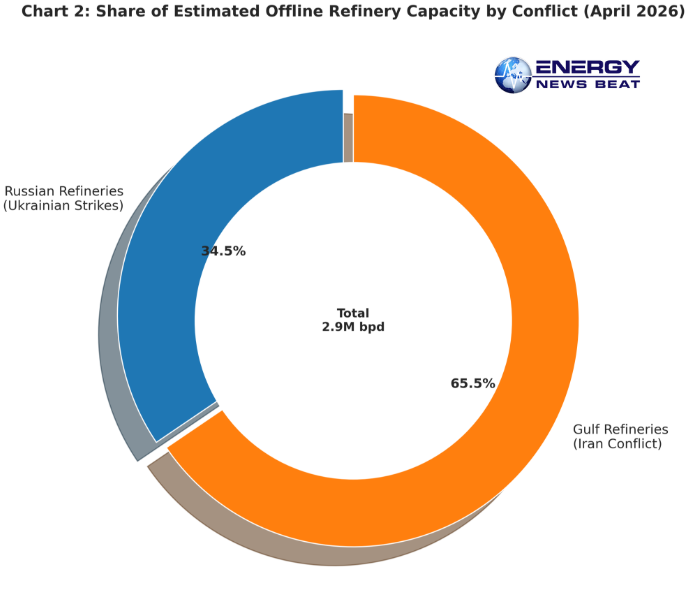
Combining the two major conflict zones, roughly 2.9 million bpd of refining capacity is estimated offline due to direct attacks (conservative aggregate of sustained Russian and Gulf losses). This represents ~2.8% of global nameplate capacity (~104–105 million bpd). Broader war effects (supply issues, precautionary shutdowns) push the total higher — some estimates exceed 5 million bpd.
Chart 1: Estimated Refinery Capacity Offline Due to Geopolitical Attacks (April 2026)
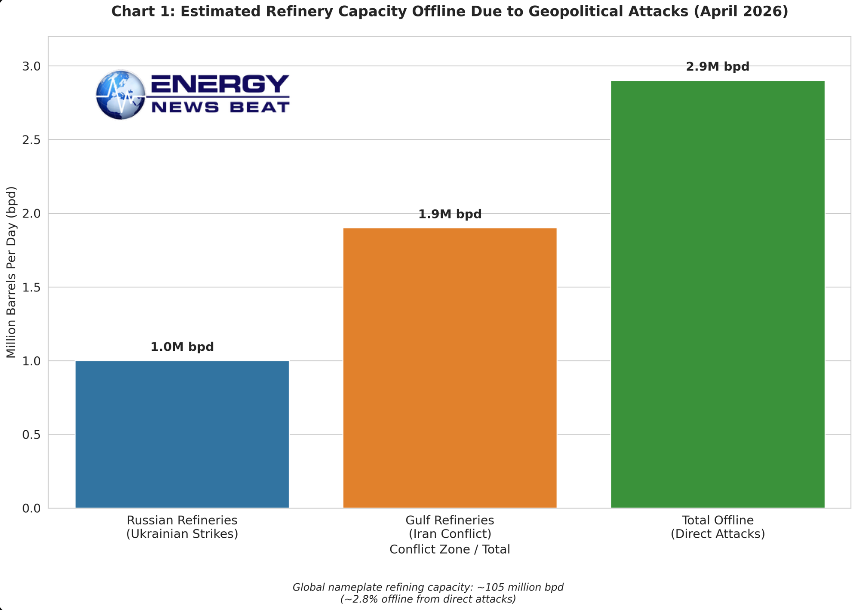
Chart 2: Share of Estimated Offline Refinery Capacity by Conflict Note on Ukrainian refineries: Pre-war Ukrainian capacity was already limited; many facilities (e.g., Kremenchuk, Lysychansk) were heavily damaged or destroyed by Russian strikes early in the war. Ukraine now relies almost entirely on imported refined products.
Market and Strategic Implications
These outages tighten global product markets (gasoline, diesel, jet fuel) and add upward pressure on prices amid already volatile geopolitics. Russia faces domestic fuel shortages and export revenue losses critical to its war effort. The Gulf disruptions ripple through Asian and European supply chains. Repairs in both theaters will take months — in some cases years — due to the complexity of distillation units and sanctions/export controls.The Tuapse strikes underscore Ukraine’s growing long-range strike capability and determination to target Russia’s economic lifelines. Combined with Gulf losses, they highlight how refinery attacks have become a defining feature of modern hybrid warfare.
- Russian Offensive Campaign Assessment, April 28, 2026 (ISW) – Detailed Tuapse strike timeline.
- Reuters: “Ukraine strikes Russia’s Tuapse refinery” (April 28, 2026).
- Reuters reports on Russian refinery hits and capacity impacts (multiple 2026 articles).
- Reuters on Gulf refining outages due to Iran war (March 2026).
- Rosneft official site and industry sources on Tuapse capacity/customers.
- Additional context from Al Jazeera, BBC Russian Service, and open-source satellite analysis.
All data is based on publicly available reporting as of April 29, 2026. Estimates of offline capacity are aggregates from industry and media sources and subject to ongoing battle damage assessments and repairs.