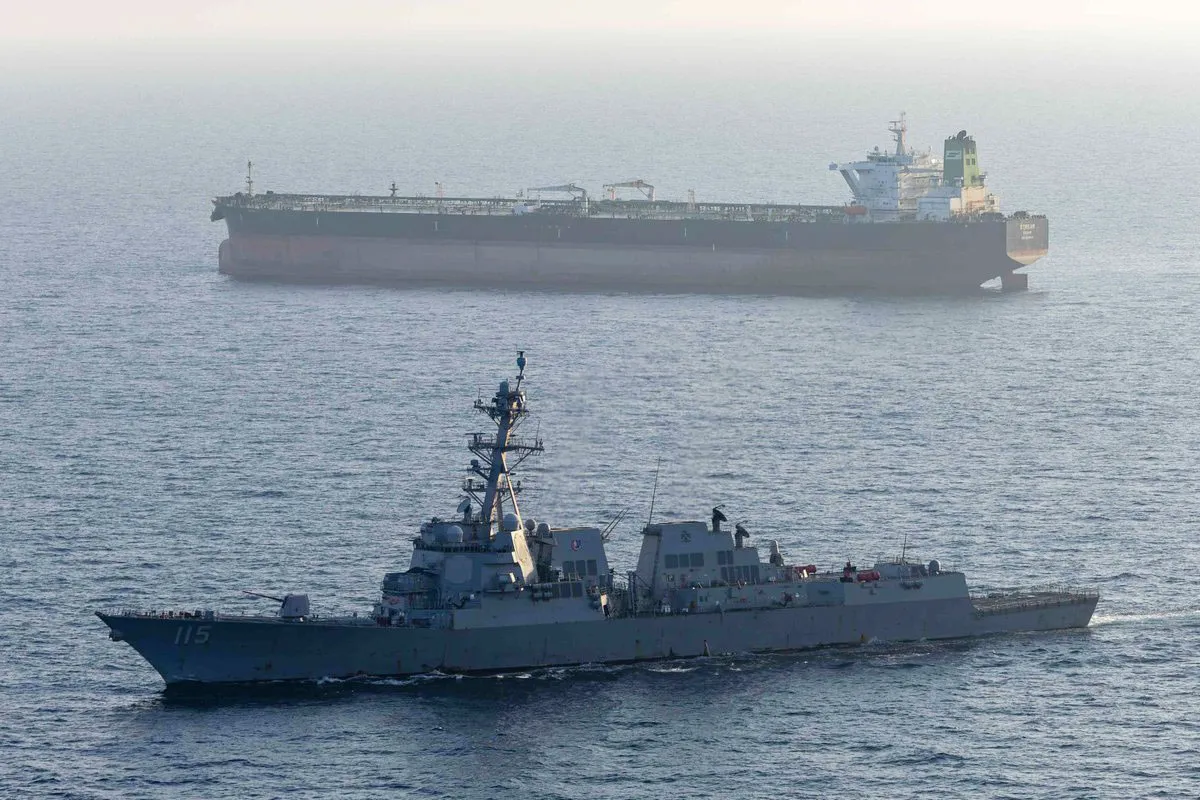
President Donald Trump stated Tuesday that Iran is eager to reopen the Strait of Hormuz “as soon as possible” as Tehran grapples with its leadership situation and internal “State of Collapse” amid ongoing U.S.-Iran negotiations to end the two-month war. In a Truth Social post, Trump noted that Iran has proposed the U.S. lift its naval blockade of the critical waterway, which has upended global energy supplies. He said he has convened his security team to discuss the proposal.
The Strait of Hormuz, through which roughly 20% of the world’s seaborne oil and liquefied natural gas typically flows, has been under a U.S. naval blockade since the conflict escalated. Iran has retaliated with ship seizures and other disruptions, effectively turning the narrow chokepoint into a flashpoint that has stranded thousands of vessels and slashed exports from Gulf producers.
Tanker Traffic Remains Near Standstill
Shipping data confirms the severe disruption. Pre-war, 125–140 vessels crossed the strait daily. In recent days, traffic has plummeted to a handful of ships—often just 3–7 transits in 24 hours, with throughput at roughly 5% of normal levels.
A notable recent attempt involved the U.S.-sanctioned supertanker Yuri, which was carrying approximately 2 million barrels of Iranian crude loaded from Kharg Island. The vessel reappeared on tracking platforms earlier this month after going dark, and began heading toward Hormuz on April 23–24, but halted near Larak Island. Traffic through the waterway was otherwise at a virtual standstill at the time.
Limited transits have occurred sporadically during brief ceasefire windows—such as convoys of VLCCs (very large crude carriers) each capable of hauling 2 million barrels—but the overall picture remains one of paralysis. Reports indicate around 2,000 ships remain stranded in the Gulf, with insurers wary and risks elevated from Iranian “mosquito fleet” activity and U.S. interdictions.
Just for fun.
Markets Eye Potential Reopening with Caution
Oil markets have been highly sensitive to any signals about the strait. Brent crude has climbed above $108–$110 per barrel in recent sessions, with West Texas Intermediate near $96–$97, as traders price in prolonged disruption.
Past hints of de-escalation or reopening have triggered sharp sell-offs—double-digit percentage drops in a single session—reflecting relief over restored supply flows. A full reopening could normalize roughly 13–20 million barrels per day of combined oil and gas transit (pre-war Gulf exports), easing the “billion-barrel oil shock” and pressuring prices lower over time. However, analysts caution that even if talks advance, logistical hurdles (mines, damaged infrastructure, backlog of vessels) mean a gradual restart, potentially stretching into May or June.
Current uncertainty—Trump has signaled he is unhappy with aspects of Iran’s proposal—keeps a risk premium in prices. Markets are watching for any U.S. response today or tomorrow.
What If Venezuelan-Style Controls Were Imposed on Iran Instead?
An alternative scenario floating in policy discussions is tighter “Venezuelan-style” controls on Iranian oil exports. Under heavy U.S. sanctions in recent years, Venezuela’s PDVSA saw its production and exports crater. China emerged as the dominant buyer, snapping up barrels at deep discounts ($5–$15+ below Brent) via shadow fleet tankers, blending, and rerouting—often paying in renminbi through CIPS to bypass Western finance.
Iran has followed a similar playbook: China already accounts for the vast majority of its discounted crude exports (roughly 13% of China’s total seaborne imports pre-war, versus Venezuela’s ~4%). Beijing has built strategic reserves at bargain prices while Iranian revenue was curtailed.
If the U.S. imposed Venezuela-style secondary sanctions aggressively on Iranian shadow fleets, buyers, and enablers (as it has begun doing with recent designations), the market impact would differ markedly from a full Hormuz reopening:
Supply and Pricing: Discounted Iranian barrels would continue flowing to China (and a few teapot refiners), but at potentially narrower spreads as evasion costs rise. Global benchmark supply would tighten more than under current shadow exports, supporting firmer oil prices versus the sharp drop expected from unrestricted reopening.
China’s Role: Beijing benefits from cheap feedstock and has proven resilient to enforcement (relabeling as “Malaysian blended,” etc.). However, heightened U.S. pressure could force China to source more from higher-priced markets (Canada, Brazil, Middle East), eroding its cost advantage without causing outright shortages.
Iranian Revenue and Global Markets: Tehran would see even lower net revenue per barrel, further straining its economy in a “State of Collapse.” For the broader market, this scenario means less immediate oversupply risk and more sustained geopolitical premium—potentially keeping Brent in the $100+ range longer than a clean Hormuz deal.
In short, Venezuelan-style controls would blunt Iran’s ability to monetize exports on open markets while allowing China to keep importing at a discount—stabilizing prices higher than a full reopening but lower than total cutoff.
Lingering Questions
Trump’s comments highlight Iran’s desperation for relief, yet key obstacles remain: nuclear issues, enforcement of any deal, and Tehran’s internal turmoil. Markets will react swiftly to any concrete U.S. response or further Iranian moves. Until then, energy traders are braced for volatility.
Appendix: Sources and Links
- Bloomberg original article (April 28, 2026): https://www.bloomberg.com/news/articles/2026-04-28/trump-says-iran-wants-hormuz-open-amid-efforts-to-end-war?srnd=homepage-americas
- Yuri tanker reports (Bloomberg/Yahoo Finance, April 24, 2026): https://www.bloomberg.com/news/articles/2026-04-24/us-sanctioned-supertanker-with-iranian-oil-tries-hormuz-transit
- Reuters on sparse traffic and Iranian tankers turned back (April 27, 2026): https://www.reuters.com/world/middle-east/shipping-traffic-through-hormuz-remains-muted-with-no-us-iran-deal-sight-data-2026-04-27/
- Hormuz traffic dashboards and live trackers (various April 2026 data): https://hormuzstraitmonitor.com/
- Oil price reactions (Bloomberg, NYT, Fortune, April 26–28, 2026): Multiple reports on Brent/WTI moves amid proposal news.
- China-sanctioned oil evasion (House Select Committee report, March 31, 2026): http://chinaselectcommittee.house.gov/media/press-releases/select-committee-investigation-uncovers-how-china-evades-sanctions-to-buy-crude-from-iran-venezuela-and-russia
- Venezuela/Iran discount comparisons (Reuters, substack analyses, 2025–2026): Various trader and policy reports.
Energy News Beat will continue monitoring developments in real time.