

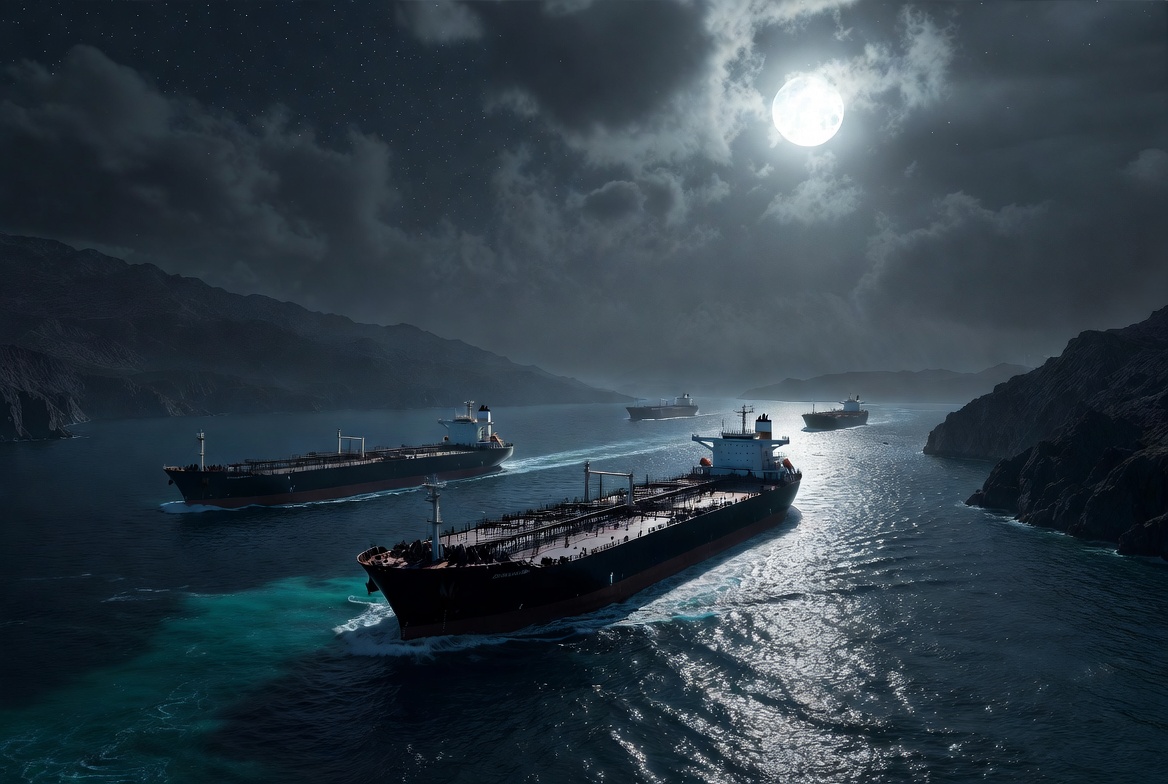
Three Very Large Crude Carriers (VLCCs) carrying a combined roughly 6 million barrels of crude oil slipped out of the Persian Gulf through the Strait of Hormuz in the past 24 hours, according to ship-tracking data compiled by Bloomberg. The vessels began transmitting automated position (AIS) signals as they entered the Gulf of Oman on Thursday morning, July 23, 2026, after previously operating inside the Persian Gulf. They ran the gauntlet of potential Iranian attack in one of the world’s most critical energy chokepoints.
A standard VLCC carries about 2 million barrels, consistent with the aggregate volume reported. Before the current conflict phase, roughly 20 tankers crossed the strait daily carrying around 20 million barrels—about one-fifth of global seaborne oil trade. Traffic has remained far below normal levels for months, with many operators using “dark” tactics (AIS disabled, often night transits or hugging the Omani coast) and occasional ship-to-ship transfers outside the waterway.
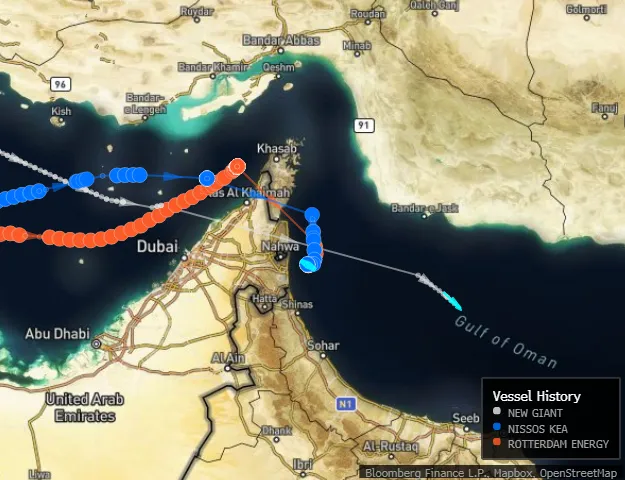
Origins and destinations: limited public details
The Bloomberg report does not name the three vessels, their flags, owners, loading ports, crude origins (producing countries), or final destinations. Cross-checks against available open-source maritime intelligence as of early July 24 (including Windward daily updates, recent Kpler/LSEG references in secondary reports, and real-time social tracking) did not identify these specific tankers or provide destination/loading country details. In the current environment, vessels frequently go dark for security reasons, which restricts public visibility of cargo provenance and discharge plans. Historical patterns during the crisis have included cargoes from UAE, Kuwait, Iraq, Saudi Arabia, and Iranian (often sanctioned/dark-fleet) sources bound primarily for Asian markets, but those patterns cannot be confirmed for this particular transit.
Context of today’s attacks and military activity
The successful exits occurred amid continued hostilities. Windward maritime intelligence (data as of July 22–23) reported three tankers struck in the strait’s southern corridor over a recent 24-hour window. These included the Kuwait-flagged state-owned tanker KAIFAN (struck July 21 near Limah, Oman; crew abandoned ship), the Malta-flagged products tanker KAVOMALEAS, and the Liberia-flagged VLCC ACHELOOS (both struck July 20 near Kumzar while AIS-dark). Earlier, on July 14, the Liberia-flagged tankers MOMBASA B and AL BAHYAH were hit by Iranian cruise missiles in Omani waters, causing casualties and damage. Traffic has largely shifted toward the northern corridor under greater Iranian oversight.
U.S. forces conducted their 13th consecutive nightly round of strikes on July 23, targeting Islamic Revolutionary Guard Corps (IRGC) sites linked to threats against commercial shipping. Operations have focused on degrading anti-ship capabilities, coastal radars, missile sites, and small-boat forces. President Trump has publicly warned of further “major military punishment” and indicated he is considering a larger-scale response, while stating that seized Iranian assets could be used to cover ship and cargo damages. Iran has countered with claims of control over the waterway and accusations of U.S. aggression.
Oil markets remain elevated. Brent crude futures traded near or above the $100-per-barrel level on July 23–24, reflecting persistent chokepoint risk, related Red Sea disruptions, and higher insurance/freight costs.
While three laden VLCCs successfully cleared the strait, overall tanker flows stay constrained. Energy markets, Gulf producers, and Asian refiners continue to watch for any sustained increase in safe transits or further escalation. Energy News Beat will monitor ship-tracking updates and official statements closely.
- Bloomberg: “Three Crude Supertankers Slip Out Through the Strait of Hormuz” (July 23, 2026) — https://www.bloomberg.com/news/articles/2026-07-23/three-crude-supertankers-slip-out-through-the-strait-of-hormuz
- Windward Daily Intelligence / Strait of Hormuz updates (July 23, 2026 data) — https://insights.windward.ai/
- Bloomberg / X (
@business
) post summarizing the VLCC transit (July 23, 2026)
- Drop Site News / X post on the Bloomberg VLCC report and pre-war traffic baselines (July 23, 2026)
- Hormuz Watch / X posts tracking the Bloomberg report (July 24, 2026)
- Reports on recent tanker strikes (KAIFAN, KAVOMALEAS, ACHELOOS, MOMBASA B, AL BAHYAH) via Windward and secondary coverage of July 14–21 incidents
- U.S. Central Command-related reporting on consecutive nightly strikes (including 13th night on July 23 targeting IRGC maritime threat capabilities)
- Brent crude price data references (Investing.com, MarketWatch, Fortune, ICE futures around $100 on July 23–24)
- Contextual background on the 2026 Strait of Hormuz crisis and US-Iran exchanges from Britannica, Wikipedia summaries, Reuters, Axios, and AP reporting on ship attacks and retaliatory strikes
All information is drawn from publicly available reporting and tracking data as of approximately 02:20 UTC on July 24, 2026. Vessel identities and full voyage details may become clearer in subsequent commercial tracking releases.