


Indian state-controlled refiners Hindustan Petroleum Corporation Limited (HPCL) and Mangalore Refinery and Petrochemicals Limited (MRPL) are in the market for a combined up to 6 million barrels of spot crude, according to tender documents reviewed by Reuters and reported on August 12, 2026.
HPCL is seeking up to 4 million barrels for delivery in September and October. MRPL is looking for supply in the October 10-20 window and has specifically asked potential suppliers to avoid cargoes that would transit the Strait of Hormuz or the Red Sea. This follows similar restrictions MRPL imposed earlier amid renewed hostilities and threats to shipping.
The tenders highlight ongoing constraints on term (contracted) deliveries from traditional Middle Eastern suppliers due to the protracted crisis affecting the Strait of Hormuz, a critical chokepoint. Indian refiners have responded by accelerating spot purchases from alternative sources, including West Africa (Angola, Congo grades), Oman, and farther afield such as Venezuela. Recent examples include MRPL’s purchase of about 1 million barrels of Omani crude and Indian Oil Corporation’s acquisition of 4 million barrels of West African grades from Chevron.
India as the Global Swing Refiner
India has emerged as the primary global swing refiner with significant available capacity and operational flexibility. With installed refining capacity of approximately 258 million tonnes per annum (roughly 5.2 million barrels per day), India ranks as the world’s fourth-largest refining nation after the United States and China. Its highly complex refineries can process a wide range of crudes—including discounted heavy, high-sulfur, and sanctioned grades—into high-value products such as diesel, gasoline, and aviation turbine fuel.
This capability has proven highly beneficial. Amid global refined product shortages triggered by disruptions in the Middle East, reduced Russian product exports, and lower Chinese runs, Indian refiners have ramped up exports. July 2026 clean product exports reached multi-year highs around 1.5 million barrels per day (up more than 20% year-on-year in some estimates), directed toward Europe, Latin America, and other markets offering strong premiums. Diesel cracks in the $45–50 per barrel range (and higher in some periods) have supported healthy gross refining margins (GRMs), helping offset earlier losses and generating strong cash flows for both public-sector and private refiners such as Reliance.
Capacity expansions underway further strengthen this position. Indian Oil Corporation alone is adding roughly 17.3 million tonnes per annum across Panipat, Koyali/Vadodara, and Barauni by the end of 2026, with additional projects from other operators expected to lift national capacity toward 290 million tonnes in the near term. This surplus capacity—after meeting domestic demand of around 240–245 million tonnes of products—positions India to act as a reliable swing supplier of refined fuels while enhancing energy security through diversified crude sourcing.
Crude Import Patterns: 2025 and 2026
India imports nearly 90% of its crude requirements (import dependency around 88.7% in FY 2025-26). Total crude imports in FY 2025-26 (April 2025–March 2026) reached approximately 245–246 million metric tonnes, averaging roughly 4.9 million barrels per day.
2025 / FY 2025-26 composition (approximate shares based on Kpler and trade data):
- Russia: ~33–35% (largest supplier for multiple years)
- Iraq: ~17–20%
- Saudi Arabia: ~13–15%
- UAE: ~9–11%
- United States: rose notably, reaching peaks above 500,000 bpd in late 2025 (share around 6–8%)
- Nigeria and other West African countries, Brazil, and others made up the balance.
Diversification accelerated even before the acute 2026 crisis, with rising volumes from the US, UAE, Nigeria, Egypt, Libya, and Brazil partially offsetting adjustments in Russian and some Middle Eastern flows.
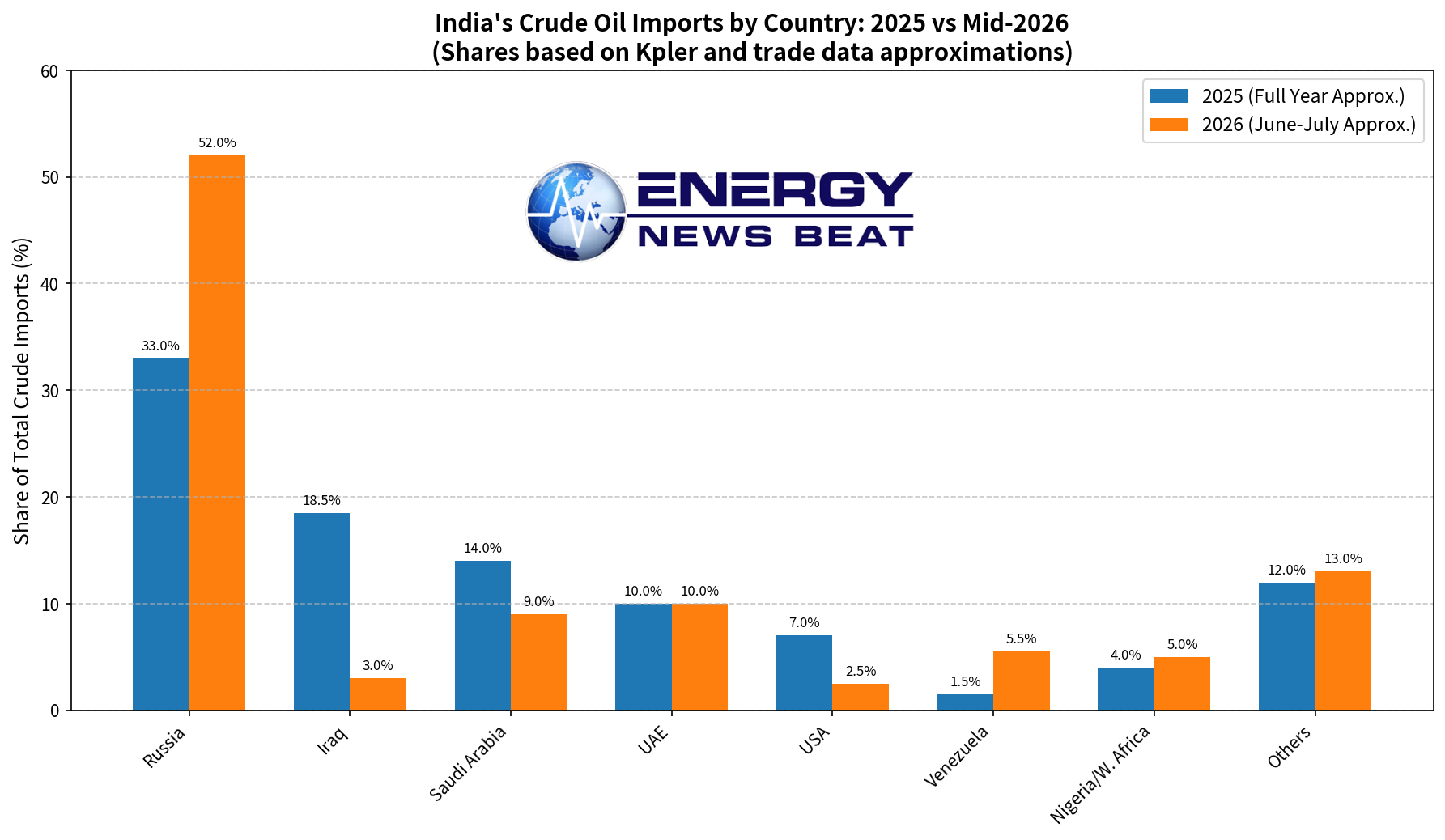
2026 shifts (post-February escalation of Middle East hostilities):
Russian volumes surged dramatically, reaching records of 2.6–2.8 million barrels per day in June–July and accounting for over 50–55% of total imports in those months. Total Indian crude imports recovered to around 5 million barrels per day or higher. UAE, Venezuela (re-emerging strongly after earlier constraints), Oman, West Africa (including Angola and Nigerian grades), and Brazil filled gaps left by reduced or delayed Hormuz-dependent cargoes from Iraq, Kuwait, and parts of Saudi supply. US volumes, after peaking in late 2025, declined sharply into mid-2026.
These adjustments demonstrate refiners’ agility: they have maintained high utilization, protected domestic supplies, and continued exporting refined products while navigating higher freight, insurance, and war-risk premiums.
Strategic Benefits of India’s Refining Complex
India’s refining sector converts a structural vulnerability (heavy crude import dependence) into a strategic strength. Complex configurations allow processing of cheaper or discounted barrels into premium products that command strong international margins. Exports generate foreign exchange, support the balance of payments, and provide flexibility as a swing supplier—redirecting cargoes to the highest-value markets (Europe one month, Asia or Latin America the next).
Domestic consumers benefit from supply security and moderated price volatility relative to more constrained importers. Capacity growth and petrochemical integration further enhance value addition. While challenges remain—including the need for larger strategic reserves, logistics resilience, and ongoing geopolitical risks—the combination of scale, complexity, and commercial agility has made Indian refiners central players in global oil product markets in 2025–2026.
The current 6-million-barrel spot search is a tactical response to immediate constraints, but it sits within a broader success story of diversification, high utilization, and value creation that positions India as the key global swing refining power with available capacity.
Appendix: Sources and Links
- OilPrice.com: “Indian Refiners Seek 6 Million Barrels of Spot Crude” (August 12, 2026) – https://oilprice.com/Latest-Energy-News/World-News/Indian-Refiners-Seek-6-Million-Barrels-of-Spot-Crude.html
- Reuters: “India’s HPCL, MRPL seek up to six million barrels crude, documents show” (August 12, 2026) – https://www.reuters.com/business/energy/indias-hpcl-mrpl-seek-up-six-million-barrels-crude-documents-show-2026-08-12/
- Petroleum Planning & Analysis Cell (PPAC), Government of India – Import/Export data and monthly reports: https://ppac.gov.in/import-export
- Kpler data cited across multiple reports (e.g., Economic Times, Financial Express, Business Standard, CNBC-TV18) on monthly import shares and volumes by origin for 2025–2026.
- Economic Times, Financial Express, Business Standard, Hindu Business Line, and related coverage of Russian, Venezuelan, West African, and Middle Eastern flows (June–August 2026).
- Reports on refining capacity, exports, and margins: Financial Express (July–August 2026 product export highs), Business Standard (capacity additions), YES Securities / Fortune India analysis of complex refining advantages.
- Additional context on FY 2025-26 totals and dependency from PPAC-derived summaries.
