

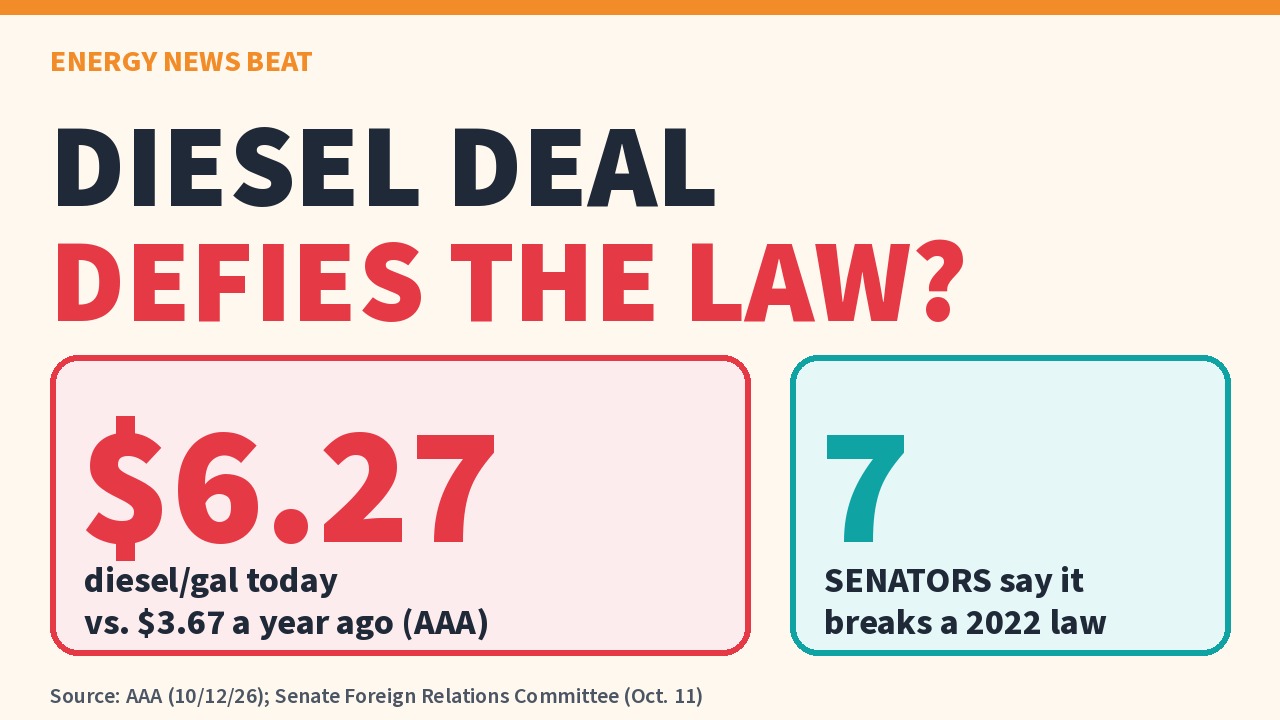
Diesel costs $2.60 a gallon more than it did a year ago, and Election Day is three weeks out. The White House wants Ukraine to stop hitting Russian refineries so Russia can sell diesel again. Moscow has not confirmed the truce, a Kharkiv power plant was hit within hours, and a bipartisan group of senators says the diesel imports break the law. Here is what it means at the pump.
By Stuart Turley, host of the Energy News Beat podcast • Published Oct. 12, 2026 • Prices and news as of 6:30 a.m. CT, Mon., Oct. 12, 2026 • Analysis and opinion: Stu’s views are labeled • Not legal advice
As of 6:29 a.m. CT Monday (AAA “Price as of 10/12/26”)
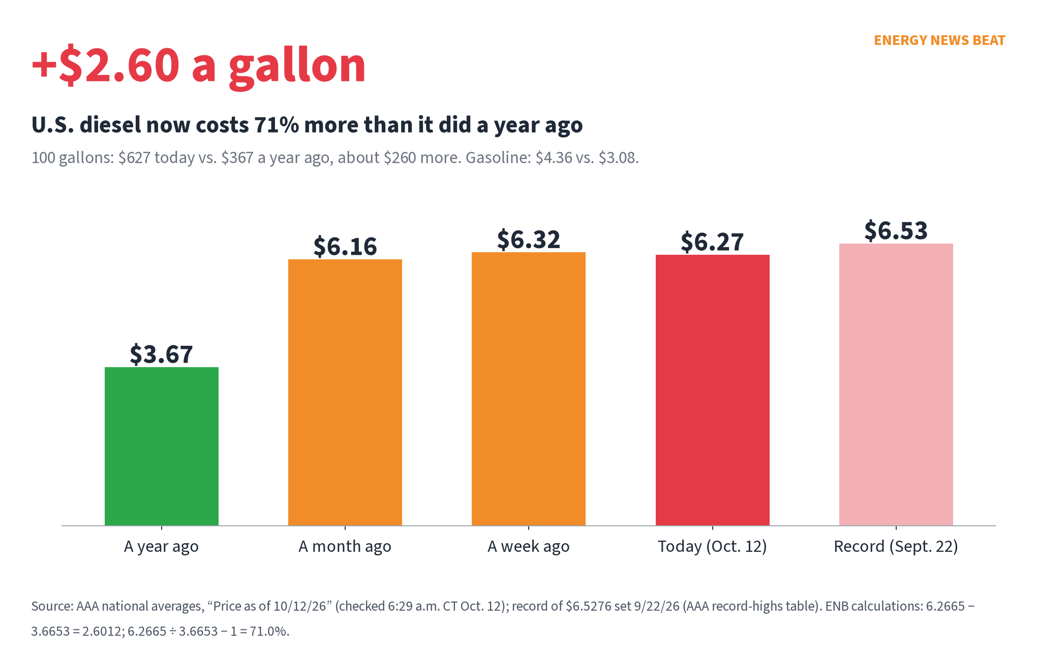
If you drive a pickup, run a farm or haul freight, you already know this number. A gallon of diesel costs $6.27 this morning, against $3.67 a year ago (AAA). That is $2.60 more on every gallon, up 71%. A 100-gallon fill on a big rig that cost $367 last October costs $627 today (ENB calculations). Gasoline is up too, to $4.36 from $3.08 (AAA). And every truckload of groceries carries part of that diesel bill to the checkout line.
Election Day is Nov. 3, three weeks from Tuesday. On Sunday morning, President Trump posted that the war between Russia and Ukraine now has an “ENERGY CEASEFIRE.” “Both parties have agreed,” he wrote. “Do not break it!” (Truth Social). Two days earlier he had announced that Russia would supply diesel to “the American and Global Marketplace,” and Treasury issued a license allowing Russian diesel into U.S. ports (Truth Social; OFAC GL 135).
Put those together and you get the real story. The truce and the diesel deal are one plan, and it runs through Russian refineries. Ukraine’s drones have knocked Russian diesel exports down to almost nothing (The National, citing Kpler). Trump wants the drones to stop so those refineries can run and ship fuel. The trouble is that Moscow has not confirmed the truce, Ukraine says Russia kept hitting its power grid within hours, and seven senators from both parties say the imports “run directly counter” to a law Congress passed in 2022 (Senate Foreign Relations Committee).
| The 60-second version
What Trump announced: An “ENERGY CEASEFIRE,” effective immediately, posted at 9:16 a.m. CT Sunday. No terms were released (Truth Social; NBC News). What happened next: About noon CT Sunday, Zelensky said Russia struck Kharkiv’s CHP-5 power plant (Kyiv Independent). The Kremlin says “contacts are ongoing” and has not said what the truce covers (CBC/AP). The deal: 300,000 tons of Russian diesel “immediately,” 500,000 in November and 1 million “immediately thereafter” (Truth Social). That is about 564 million gallons, or less than four days of U.S. diesel use (ENB calculation from EIA and EIA). The legal fight: The 2022 Ending Importation of Russian Oil Act bans Russian energy imports until the president certifies Russia has met three conditions, including a withdrawal agreement Ukraine accepts (Pub. L. 117-109). Seven senators say the deal breaks it; Treasury Secretary Scott Bessent says they are “wrong” (Reuters via Astro Awani). Your wallet: Analysts expect little relief from the volumes alone (CNBC). The bigger question is whether the truce keeps refineries on both sides running. |
What Trump announced, and what he did not
The Sunday post was four sentences long. It said the ceasefire was effective immediately and that both sides had agreed (Truth Social). It did not say what counts as an energy target, how long the truce lasts, or who would check it. NBC News reported that the post gave no details (NBC News), and the BBC said the same (BBC).
Many early reports said the truce covers refineries. ENB could not confirm that. Asked whether it would apply only to oil refineries, Kremlin spokesman Dmitry Peskov declined to comment and said more would come “in due course.” He also repeated that “we do not want a ceasefire,” adding, “We want long-term peace” (CBC, citing AP). Volodymyr Zelensky first called the deal “news to me.” He then said that if Trump negotiated it with Putin, “please tell us when the ceasefire begins. We are ready and we will accept it” (The Guardian). On Monday he set his terms. “We have one refinery,” he said, and a truce has to cover Ukraine’s power grid, not just Russian oil (Kyiv Independent).
The pressure came first. On Saturday Trump said Zelensky had “better damn well stop” attacking Russian refineries (Reuters via Investing.com). He also said Ukraine should “get a new leader who can make a deal” (NBC News). A person familiar with the situation told Reuters that the U.S. had threatened to cut off intelligence sharing and weapons bought through the PURL program (Reuters via Investing.com). ENB could not independently confirm that threat.
What happened next
As of 6:30 a.m. CT Monday. Casualty counts are from Ukrainian officials and may change.
Trump’s post went up at 9:16 a.m. CT Sunday (Truth Social). At about 8 p.m. Kyiv time, which is about noon in Chicago, Zelensky said: “Just now, there was a strike on CHP-5 in Kharkiv — on Kharkiv’s energy infrastructure” (Kyiv Independent). That was less than three hours after the post (ENB calculation). A Kharkiv mother told Reuters: “Ten minutes had passed since they promised they wouldn’t target energy facilities, and there have already been five strikes” (Reuters via Investing.com).
- Sunday night: A Russian missile hit a grocery store outside Kharkiv, killing three people and injuring at least 22 (Kyiv Independent). Russian attacks killed six people in two cities on Sunday, Ukrainian officials said (Reuters).
- Overnight: Ukraine’s air force said Russia launched 121 drones and one Kh-59 missile. Naftogaz said its gas production sites in the Kharkiv region were hit (CBC/AP). The BBC reported blackouts in several regions (BBC).
- Monday morning: At least 12 more people were wounded in Kharkiv, Mayor Ihor Terekhov said (Reuters). Zelensky told a Warsaw conference: “There were Russian violations of the energy ceasefire announced by President Trump” (CBC/AP). He said Ukraine carried out no attacks on Russian refineries overnight (Reuters).
- The other side of the line: Russia’s Defense Ministry said it intercepted 151 Ukrainian drones overnight (CBC/AP). It did not say what they targeted.
Europe answered with sanctions. EU ministers adopted nearly 1,600 new sanctions listings aimed at Russia’s military-industrial complex. “More than half are connected to the production chain for ballistic missiles,” foreign policy chief Kaja Kallas said. She would prefer a ceasefire “which includes people not being killed,” and it is not clear Russia will stick to this one (Reuters via Investing.com). French President Emmanuel Macron said he had seen no sign in 48 hours that Russia was respecting it (Reuters). These new EU measures target weapons supply chains, not energy.
We have seen this movie before
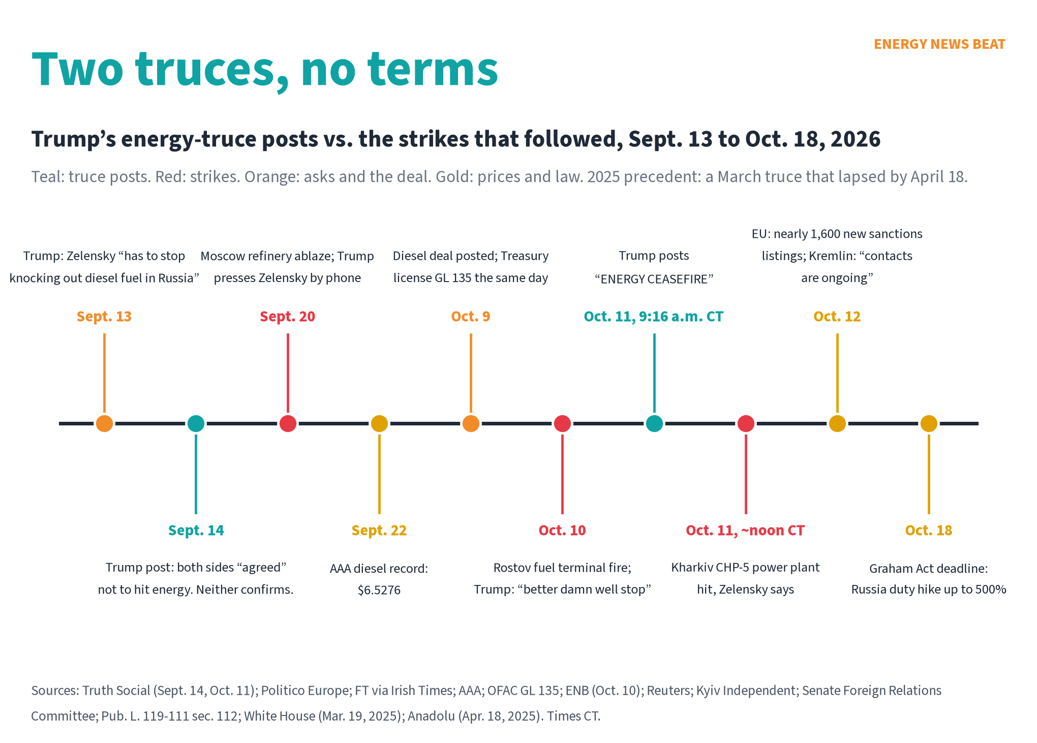
On Sept. 14, Trump posted that “Ukraine has agreed not to hit Russian Energy targets. Russia has agreed to do, likewise!” (Truth Social archive). Reuters says neither side ever confirmed it (Reuters). The AP says “nothing came of the purported agreement” (CBC/AP). Six days later a Moscow refinery was burning after a drone attack, and Trump was again pressing Zelensky to stop (Irish Times, from the FT). The record diesel price came two days after that, on Sept. 22 (AAA).
The 2025 version lasted about a month. In March 2025, after Trump’s calls with Putin and Zelensky, the White House said the leaders had “agreed on a partial ceasefire” against energy targets (White House). By April 18, the Kremlin said the 30-day moratorium had expired (Anadolu). ENB tracked the run-up to this weekend in our Oct. 10 report on the Rostov fuel terminal fire and our first take on the ceasefire Sunday.
Why Russian refineries are the whole deal
Read Trump’s Oct. 9 post closely. Russia would supply “over 300,000 Tons of Diesel Fuel” immediately, “another 500,000 Tons during the month of November, and 1,000,000 Tons immediately thereafter.” Then, “based on the condition of their Diesel Refineries,” 3 million tons more (Truth Social). Russia’s deputy prime minister, Alexander Novak, described the same tranches in metric tons, as ENB reported (ENB).
That condition is the key. Kpler data show Russian diesel exports fell from about 706,000 barrels a day in January to 47,000 in August and almost nothing in September, as Ukrainian drones damaged refineries (The National). A refinery under drone attack does not export diesel. So the energy truce is the supply chain for the diesel deal.
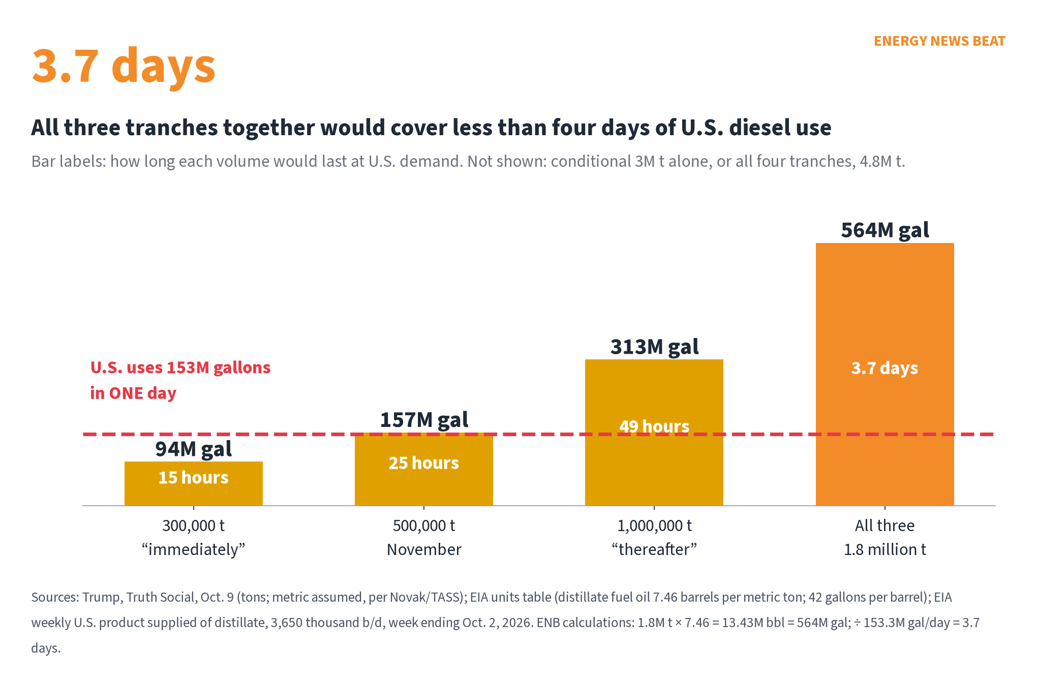
Now the size. Tons are hard to picture, so we converted them. EIA uses 7.46 barrels per metric ton for distillate fuel oil (EIA), and a barrel holds 42 gallons. Americans used 3.65 million barrels a day of distillate in the week ending Oct. 2, about 153 million gallons a day (EIA).
| Tranche | Barrels | Gallons | How long it covers U.S. use |
| 300,000 t “immediately” | 2.24 million | 94 million | About 15 hours |
| 500,000 t in November | 3.73 million | 157 million | About 1 day |
| 1,000,000 t “thereafter” | 7.46 million | 313 million | About 2 days |
| All three: 1.8 million t | 13.4 million | 564 million | About 3.7 days |
| Conditional 3M t alone | 22.38 million | 940 million | About 6.1 days |
| All four tranches, 4.8M t | 35.81 million | 1,504 million | About 9.8 days |
Sources: Truth Social; EIA units; EIA product supplied. ENB calculations: tons × 7.46 = barrels; × 42 = gallons; ÷ 3,650,000 barrels a day = days. Using the four-week average of 3.77 million barrels a day gives 3.6 days for the first three tranches.
Even if every ton came to the United States, which the post does not promise, all three tranches would run the country for less than four days. All four tranches, 4.8M t including the conditional 3 million, would cover under 10 days. UBS analyst Giovanni Staunovo says the first 300,000 tons works out to about 100,000 barrels a day for the rest of October, against a drop of about 1.3 million barrels a day in Russia’s seaborne diesel exports since the start of the year (The National).
The legal fight, in plain words
There are two layers of law, and the deal treats them differently.
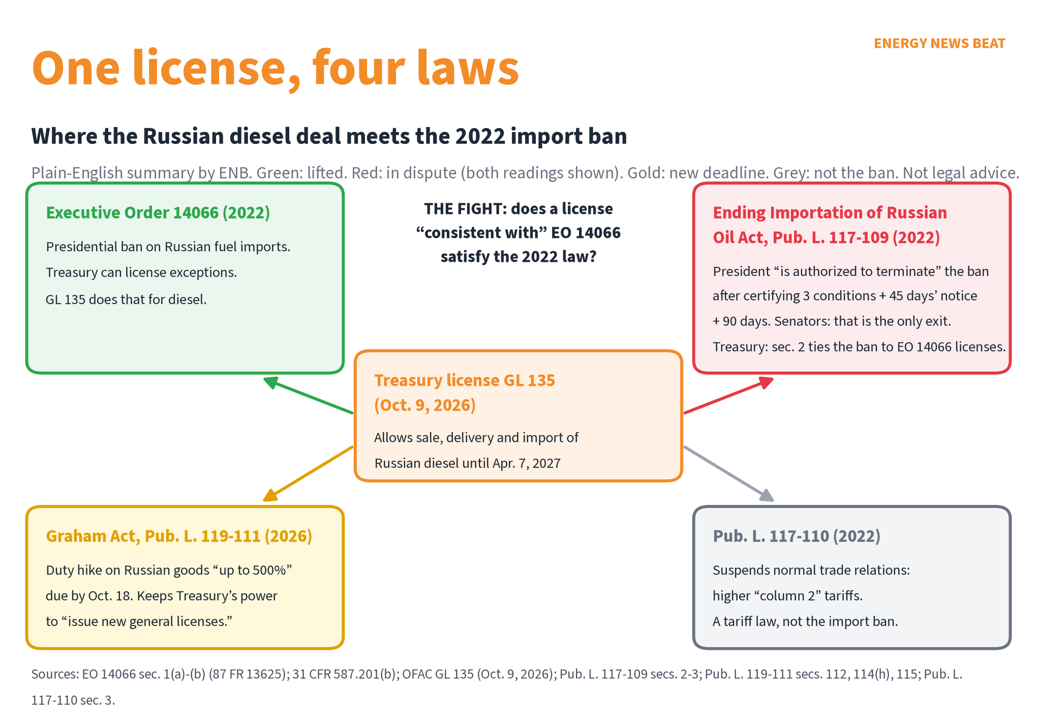
Layer one is the president’s own order. In March 2022, Executive Order 14066 banned imports of Russian “crude oil; petroleum; petroleum fuels, oils, and products of their distillation,” along with LNG and coal. It also lets Treasury carve out exceptions through “licenses that may be issued pursuant to this order” (EO 14066). On Oct. 9, Treasury did that. General License 135 allows the “sale, delivery, offloading, or importation, including importation into the United States, of diesel fuel of Russian Federation origin” until 12:01 a.m. EDT on April 7, 2027 (OFAC). The license is written under the Russia sanctions rules, which cover orders issued under the same national emergency, EO 14066 included (31 CFR 587.201). A president can loosen his own order. That part is not really in dispute.
Layer two is the law Congress passed. A month later, Congress wrote the ban into statute. The Ending Importation of Russian Oil Act says Russian energy products “shall be banned from importation into the United States, in a manner consistent with any implementation actions issued under Executive Order 14066” (Pub. L. 117-109, sec. 2). Section 3 says the president “is authorized to terminate” the ban if he certifies that Russia has reached an agreement to withdraw its forces and end hostilities that Ukraine accepts, poses no immediate threat to any NATO member, and recognizes Ukraine’s right to choose its own government. He must consult four congressional committees and report to them at least 45 days before certifying. The termination then takes effect 90 days after the certification, unless a joint resolution of disapproval is enacted into law in that window (sec. 3). No such certification has been made.
The senators’ reading: Section 3 is the only way out of the ban, and none of its steps has happened. “Congress explicitly banned Russian energy imports in 2022,” wrote Jeanne Shaheen, Susan Collins, Richard Blumenthal, Lisa Murkowski, Ron Wyden, Thom Tillis and John Curtis. “President Trump’s decision to allow Russian diesel imports to the U.S. runs directly counter to that law.” They added that the administration “failed to consult with Congress or submit any explanation to justify its decision as required by statute” (SFRC; Collins). Tillis told NBC’s Meet the Press, “I do believe there’s a legitimate case for saying the president’s not following the law” (NBC News).
Treasury’s reading: the license is lawful. Bessent told Fox & Friends Weekend, “We’re going to do it with all the legal authorities we have.” Anyone in Congress “who says whether it’s an old bill or the current Lindsey Graham bill (that) prohibits us from doing it is wrong” (Reuters via Astro Awani). The statutory hook for that view is Section 2 itself: the ban applies “in a manner consistent with any implementation actions issued under Executive Order 14066,” and a Treasury license under that order, such as GL 135, is one of those actions. Treasury has not published a legal memo spelling this out, and GL 135 does not mention the 2022 law (Business Upturn; Diplomacy & Law). Critics answer that a six-month blanket license for a whole fuel works like a termination without the certification, consultation or waiting period. Both readings rest on the same statute; no court has picked one.
Two more laws sit nearby. The Suspending Normal Trade Relations Act passed the same day in 2022 and is often confused with the ban. It is a tariff law that put Russian goods on higher “column 2” duty rates (Pub. L. 117-110). The new Graham Act, signed Sept. 18, requires duties of “up to 500 percent” on Russian goods, petroleum products included, within 30 days. That puts the deadline around Oct. 18 (Pub. L. 119-111, sec. 112; Business Upturn). The same act keeps Treasury’s power to “issue new general licenses” (sec. 114(h)). A Congressional Research Service analysis dated Sept. 3, written about the bill before it was signed on Sept. 18, said it “would not appear to repeal the 2022 legislation” and that imports of certain Russian energy products “would continue to be prohibited” (CRS). So the Graham Act may not stop GL 135, but a big new tariff could make Russian diesel too costly to bring in.
Who decides? A court, if someone with standing sues. Congress, through funding fights or a new bill. Tillis, who retires in January, mentioned spending leverage (NBC News). And Customs and Border Protection at the dock, when a cargo actually shows up. No court has ruled, and ENB is not offering a legal opinion.
Can Russia deliver?
This is the part nobody has answered. Neil Atkinson, who used to run the International Energy Agency’s oil division, put it bluntly: “Where the volumes to supply the Trump deal come from is a mystery, unless it comes from domestic supply, which will cripple the Russian economy” (CNBC). Lombard Odier warned that “announced shipments are not equivalent to delivered supply” (CNBC). As of Monday morning, ENB found no report of a buyer, a price, a tanker or a U.S. port for the first cargo.
The refineries have to run first, and that depends on the drones stopping. Zelensky says Ukraine held off on refineries overnight, but he tied any lasting pause to Russia leaving Ukraine’s grid alone (Reuters; Kyiv Independent). ENB laid out the domestic alternative, building more U.S. refining, in our piece on the Defense Production Act.
The market
As of 6:21 a.m. CT Monday for futures; EIA weekly data through Oct. 5
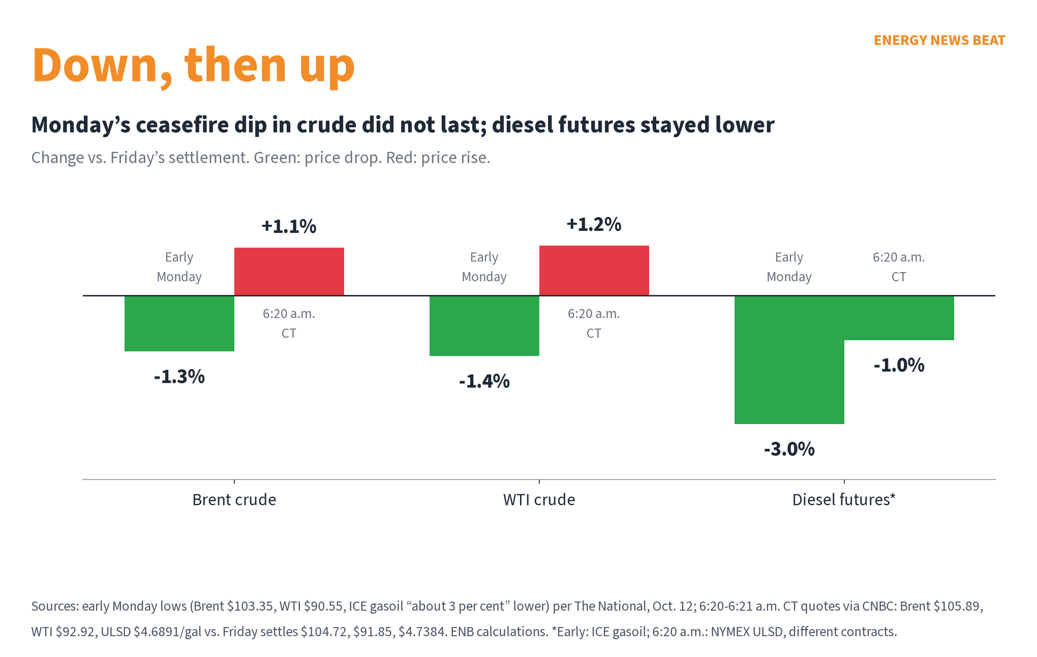
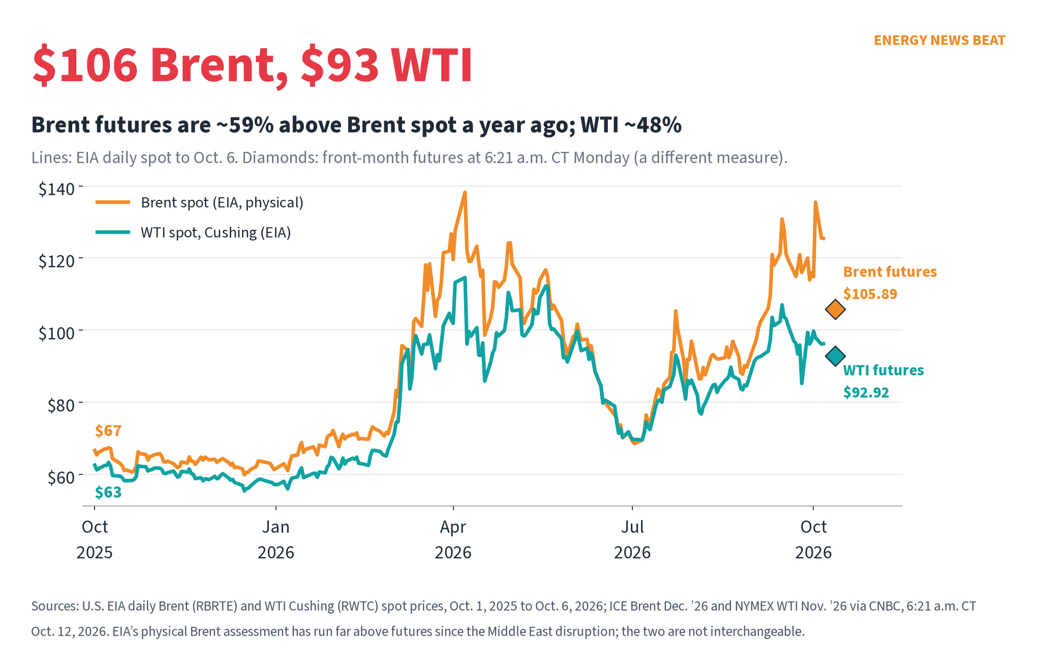
Oil traders bought the truce for a few hours. Early Monday, Brent crude fell 1.3% to $103.35 and U.S. crude (WTI) to $90.55, while ICE gasoil, Europe’s diesel benchmark, dropped about 3% (The National). It did not stick. By 6:21 a.m. CT, Brent was at $105.89, up $1.17, and WTI at $92.92, up $1.07 (CNBC; CNBC). U.S. diesel futures held a smaller loss, down about 5 cents at $4.69 a gallon (CNBC).
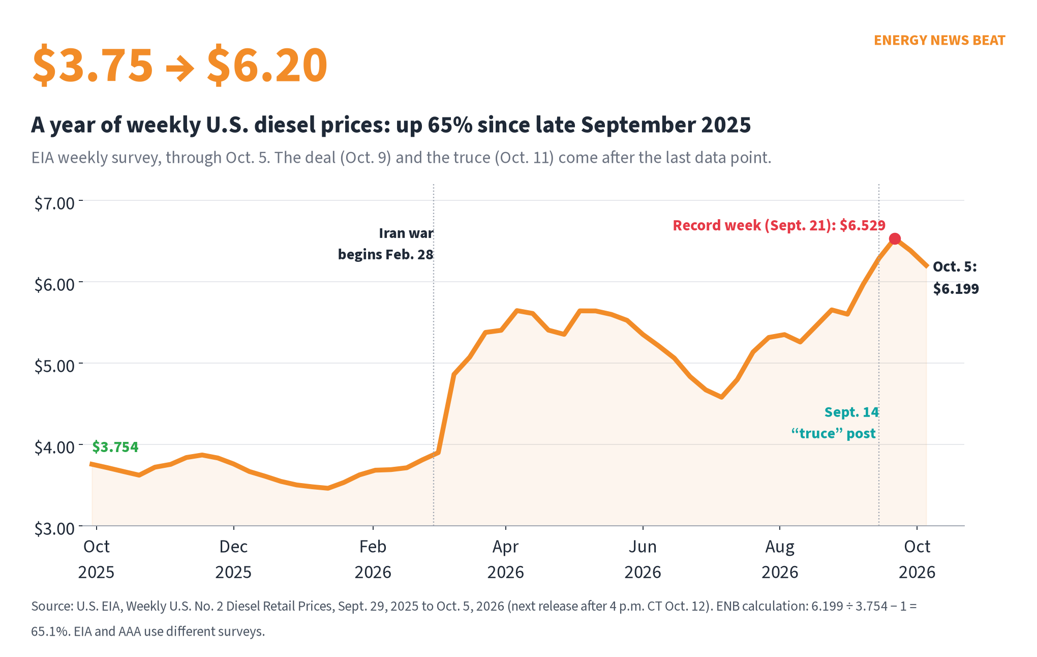
At the pump, things are easing a little. AAA’s diesel average is down 5 cents from a week ago and 26 cents below the Sept. 22 record of $6.53 (AAA). EIA’s weekly survey shows the same turn: $6.53 in the week of Sept. 21, $6.20 on Oct. 5 (EIA). EIA’s next weekly reading is due Monday afternoon.
How consumers and investors see it
As of 6:30 a.m. CT Monday
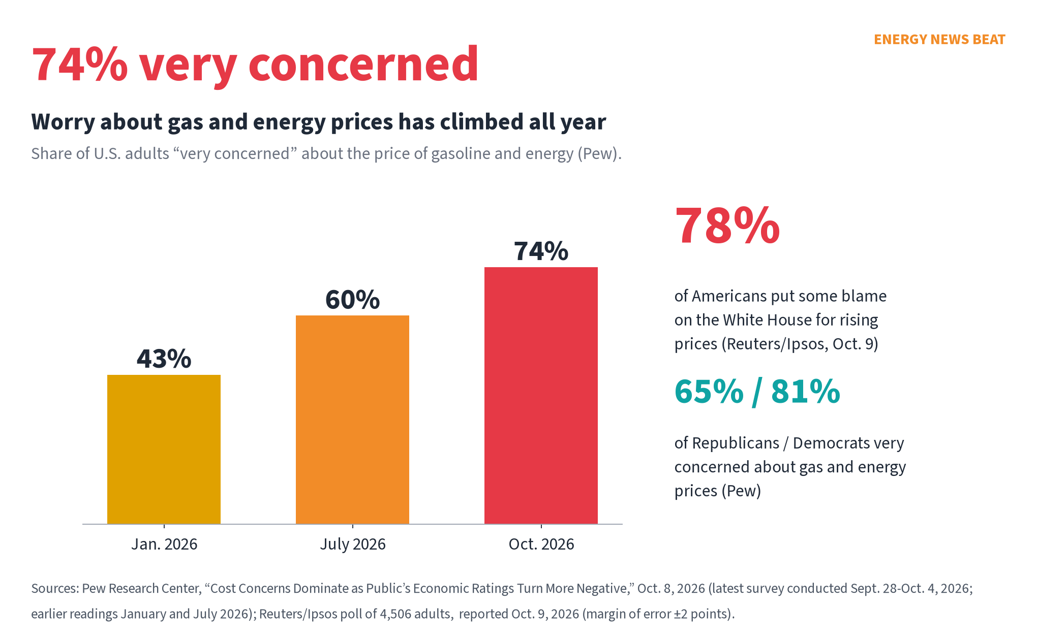
Consumers are worried, and it is bipartisan. In Pew’s survey taken Sept. 28 to Oct. 4, 74% of Americans said they were very concerned about the price of gasoline and energy. That is up from 60% in July and 43% in January, before the war with Iran. It includes 65% of Republicans and 81% of Democrats (Pew). A Reuters/Ipsos poll released Oct. 9 found 78% of Americans put at least some blame on the White House for rising prices, including 64% of Republicans (Reuters/Ipsos). One voter in that story, Herman Sims, 67, of Dallas, works for a trucking company “hit hard by high diesel prices.” He disagreed with the war with Iran but still plans to vote Republican (Reuters/Ipsos).
Truckers feel it first. “Every $1 increase per gallon in fuel costs our members around $400 more per week,” Todd Spencer, president and CEO of the Owner-Operator Independent Drivers Association, told Truckers News. The group called the administration’s red-dyed-diesel order “minimal relief” (Truckers News). Farm groups welcomed that same order (White House).
Investors mostly see a small deal and a political one. “Trump is exploring all avenues to bring down diesel prices before the mid-terms,” said Mohit Kumar of Jefferies, but “the volumes agreed are unlikely to make a substantial difference” (CNBC). S&P Global analysts said, “We see the immediate market impact as limited” (The National). ING said the deal “is not going to solve the tightness in the middle distillate market” but was putting some pressure on diesel margins Monday (ING via TMGM). Reuters columnist Ron Bousso said everything Trump listed “totals 12 hours of global supply” (ABC News). Quantum Strategy in Singapore was the most bearish: “We expect this deal to fail economically. We remain long distillates and crude” (CNBC). UBS’s Staunovo was skeptical about the truce itself: “We have seen similar commitments in the past that ultimately failed to hold” (The National).
Stu’s Take: you cannot borrow your way out of a refining shortage
As of 6:30 a.m. CT Monday
| Stu’s Take
I have said it on the podcast and I will keep saying it: there are only two ways to bring down the price of gasoline, diesel and jet fuel. Demand destruction, or more refining capacity (ENB). Demand destruction means families and truckers doing without. I would rather build. This weekend the White House tried a third way: borrow somebody else’s refineries. I understand why. Diesel is $6.27 this morning against $3.67 a year ago (AAA), and OOIDA’s Todd Spencer told Truckers News every $1 costs its members about $400 a week (Truckers News). That pain is real, and the midterms are next month (Reuters). But look at the math. The first 300,000 tons is about 94 million gallons (EIA conversion), and this country burns about 153 million gallons of distillate a day (EIA). All three announced tranches add up to less than four days of U.S. use (our math, from EIA). Russia’s diesel exports were close to zero last month (Kpler via The National). And the whole plan depends on a truce that Moscow has not confirmed and that lasted less than three hours before a Kharkiv power plant was hit (Kyiv Independent). Then there is the law. Seven senators, four of them Republicans, say a 2022 statute blocks these imports (SFRC). Whatever you think of the deal, that question will be settled by Congress or a court, not by a social media post. Here is what lasts: American refineries, running at home, on American crude. We have written about how diesel and refining capacity are feeding inflation the Fed cannot fix (ENB). A truce can help. A Russian cargo can help a little. Neither one is a refinery. |
Corrections to early reports
Some details that circulated early on Sunday and Monday did not hold up, or need more context:
- Oil prices. Early reports put Brent near $103 and WTI near $90. Those were Monday’s early lows (The National). By 6:21 a.m. CT both were higher than Friday’s settlement: Brent $105.89 and WTI $92.92 (CNBC; CNBC).
- “The truce covers refineries.” No terms have been released. The Kremlin declined to say whether it covers only refineries (CBC/AP), and Zelensky says it must cover the power grid (Kyiv Independent). It is fair to say Trump wants refinery strikes to stop. It is not confirmed that this is what both sides agreed.
- The senators. The group is seven: Republicans Collins, Murkowski, Tillis and Curtis, and Democrats Shaheen, Blumenthal and Wyden (SFRC). An early AP count said six (AP).
- Which law. The import ban is the Ending Importation of Russian Oil Act, Pub. L. 117-109 (GovInfo). The Suspending Normal Trade Relations Act, Pub. L. 117-110, is a tariff law, not the ban (GovInfo).
- EU sanctions. The nearly 1,600 new sanctions listings target Russia’s military-industrial complex, mostly ballistic-missile supply chains, not energy (Reuters).
Confirmed as reported: the AAA prices, the Kharkiv strike within hours of the post, the Sept. 14 truce that went nowhere, the tranche sizes and Bessent’s vow to go ahead.
What to watch
- This week: whether Moscow states what it agreed to, and whether strikes on Ukraine’s grid and Russia’s refineries stop. EIA’s weekly diesel price comes out Monday afternoon (EIA).
- About Oct. 18: the Graham Act’s deadline for duties of up to 500% on Russian goods ( L. 119-111).
- The first cargo: who buys it, where it lands, and whether CBP clears it under GL 135 (OFAC).
- Congress: any move to cut funding or force a vote, as Tillis suggested (NBC News).
- 3: Election Day. April 7, 2027: GL 135 expires unless it is renewed (OFAC).
The bottom line
The energy truce and the diesel deal are one bet: that Ukraine will stop hitting Russian refineries, Russia will stop hitting Ukraine’s grid, and Russian diesel will flow fast enough to matter before Nov. 3. So far, Russia has not confirmed it and a power plant in Kharkiv was hit around lunchtime in Chicago. The volumes would cover less than four days of U.S. demand, and a bipartisan group of senators says the imports break a 2022 law. If you are paying $6.27 a gallon, the honest answer is that relief from this deal is likely to be small and slow. The lasting fix is still the one Stu keeps coming back to: more refining capacity. For background, see ENB on the diesel deal and the Rostov terminal fire.
Appendices
At Energy News Beat we Make Appendices Great Again. Times are U.S. Central (CDT, UTC−5) unless noted. Fast-moving items (prices, strikes, statements) are current as of 6:30 a.m. CT, Mon., Oct. 12, 2026. Labels: [VERIFIED] = matched to a primary or independent source; [ENB CALC] = arithmetic by ENB from cited figures; [UNCONFIRMED] = reported but not independently confirmed; [OPINION] = Stu’s view.
Download the data. Every number behind the charts and tables is in the companion spreadsheet, “Trump’s Energy Truce Hinges on Russian Refineries and Seven Senators Say the Diesel Deal Defies a 2022 Law – Data.xlsx,” available with this article.
Appendix A. Sources (titled and dated)
The Wall Street Journal article is paywalled; ENB used it only for its headline. Where a Reuters story is linked through a syndication partner (Investing.com, WTVB, Astro Awani, U.S. News), the text matched Reuters’ byline and dateline.
Appendix B. Key figures
| Item | Figure | Source |
| AAA diesel, national average | $6.2665 today; $6.2771 yesterday; $6.3207 a week ago; $6.1602 a month ago; $3.6653 a year ago; record $6.5276 (9/22/26) | AAA |
| AAA regular gasoline | $4.3556 today; $3.0833 a year ago; record $5.0165 (6/14/22) | AAA |
| Change from a year ago [ENB CALC] | Diesel +$2.6012 (+71.0%); regular +$1.2723 (+41.3%); 100 gal diesel $626.65 vs. $366.53 | AAA |
| EIA weekly diesel retail | $6.199 (Oct. 5); $6.382 (Sept. 28); $6.529 (Sept. 21, series high in this window); $3.754 (Sept. 29, 2025) | EIA |
| U.S. distillate product supplied | 3,650 kb/d (week ending Oct. 2); 4-week average 3,768.5 kb/d; = 153.3 million gal/day [ENB CALC] | EIA |
| Conversion factor | Distillate fuel oil: 7.46 barrels per metric ton; 42 gallons per barrel | EIA |
| Tranches (Trump, Oct. 9) | 300,000 t “immediately”; 500,000 t November; 1,000,000 t “immediately thereafter”; 3,000,000 t “based on the condition of their Diesel Refineries” | Truth Social |
| Tranches converted [ENB CALC] | 1.8 million t = 13.43 million bbl = 564 million gal = 3.7 days of U.S. use; conditional 3M t alone = 22.38 million bbl = 6.1 days; all four tranches, 4.8M t = 35.81 million bbl = 9.8 days | EIA; EIA |
| Russian diesel exports (Kpler) | ~706,000 b/d January; 47,000 b/d August; “almost nothing” September | The National |
| Futures, 6:20-6:21 a.m. CT Oct. 12 | Brent Dec. $105.89 (+1.17; prior settle $104.72); WTI Nov. $92.92 (+1.07; $91.85); ULSD Nov. $4.6891/gal (−0.0493; $4.7384); RBOB $3.3181 | CNBC; CNBC; CNBC |
| Monday early lows | Brent $103.35 (−1.3%); WTI $90.55 (−1.4%); ICE gasoil about −3% | The National |
| EIA spot (physical) | Brent $125.44, WTI $96.24 (Oct. 6); Brent $66.67, WTI $62.59 (Oct. 1, 2025) | EIA; EIA |
| GL 135 term | Through 12:01 a.m. EDT, April 7, 2027; issued Oct. 9, 2026 | OFAC |
| Senators’ statement (Oct. 11) | Shaheen, Collins, Blumenthal, Murkowski, Wyden, Tillis, Curtis (4 R, 3 D) | SFRC; Collins |
| Graham Act | Signed Sept. 18, 2026; duties “up to 500 percent,” not later than 30 days (~Oct. 18) [ENB CALC] | Pub. L. 119-111 |
| EU sanctions listings (Oct. 12) | Nearly 1,600 new sanctions listings; more than half tied to ballistic-missile supply chains | Reuters |
| Strikes reported Oct. 11-12 | Kharkiv CHP-5 hit ~8 p.m. Kyiv (~noon CT) Oct. 11; grocery store strike, 3 killed, 22+ injured; 6 killed in two cities Sunday; 12+ wounded Monday in Kharkiv; 121 Russian drones + 1 Kh-59 overnight; Russia says it intercepted 151 Ukrainian drones | Kyiv Independent; Reuters; CBC/AP |
| Pew (Sept. 28-Oct. 4) | 74% very concerned about gas and energy prices (65% R, 81% D); 60% July; 43% January | Pew |
| Reuters/Ipsos (released Oct. 9) | 78% put some blame on the White House for rising prices (64% R, 76% independents); n=4,506; ±2 pts | Reuters/Ipsos |
| Election Day | Nov. 3, 2026 (22 days after Oct. 12) [ENB CALC] | Reuters |
Appendix C. Timeline
| Date | Event | Source |
| Mar. 19, 2025 | White House: Trump and Zelensky “agreed on a partial ceasefire” against energy (2025) | link |
| Apr. 18, 2025 | Kremlin says 30-day energy-strike moratorium has expired | link |
| Feb. 28, 2026 | U.S.-Iran war begins; diesel climbs | link |
| Sep. 13, 2026 | Trump: Zelensky “has to stop knocking out diesel fuel in Russia” | link |
| Sep. 14, 2026 | Trump post: both sides “agreed” not to hit energy; neither confirms | link |
| Sep. 20, 2026 | Moscow refinery ablaze after drone attack; Trump presses Zelensky by phone | link |
| Sep. 22, 2026 | AAA diesel record: $6.5276 | link |
| Oct. 9, 2026 | Diesel deal posted; Treasury issues GL 135 | link |
| Oct. 10, 2026 | Fire at Rostov fuel terminal; Trump: Zelensky “better damn well stop” | link |
| Oct. 11, 2026 | 9:16 a.m. CT: Trump posts “ENERGY CEASEFIRE” | link |
| Oct. 11, 2026 | Seven senators: deal “runs directly counter” to 2022 law; Bessent: going ahead | link |
| Oct. 11, 2026 | About noon CT: Kharkiv CHP-5 power plant hit, Zelensky says | link |
| Oct. 12, 2026 | EU adopts nearly 1,600 new sanctions listings; Kremlin: “contacts are ongoing” | link |
| Oct. 18, 2026 | Graham Act deadline for Russia duty hike (up to 500%) | link |
| Nov. 3, 2026 | Election Day | link |
| Apr. 7, 2027 | GL 135 expires, 12:01 a.m. EDT | link |
Appendix D. Legal text excerpts
Executive Order 14066, sec. 1(a)(i) (Mar. 8, 2022): prohibits “the importation into the United States of the following products of Russian Federation origin: crude oil; petroleum; petroleum fuels, oils, and products of their distillation; liquefied natural gas; coal; and coal products.” Sec. 1(b): applies “except to the extent provided by statutes, or in regulations, orders, directives, or licenses that may be issued pursuant to this order.” (Federal Register)
Ending Importation of Russian Oil Act, Pub. L. 117-109, sec. 2 (Apr. 8, 2022): “All products of the Russian Federation classified under chapter 27 of the Harmonized Tariff Schedule of the United States shall be banned from importation into the United States, in a manner consistent with any implementation actions issued under Executive Order 14066.” (GovInfo)
Sec. 3(a)-(c), termination: the President “is authorized to terminate the prohibition … if the President submits to Congress a certification” that the Russian Federation “(A) has reached an agreement to withdraw Russian forces and for the cessation of military hostilities that is accepted by the free and independent government of Ukraine; (B) poses no immediate military threat of aggression to any North Atlantic Treaty Organization member; and (C) recognizes the right of the people of Ukraine to independently and freely choose their own government.” The termination takes effect “90 calendar days after the date of submission of such certification, unless there is enacted into law during such 90-day period a joint resolution of disapproval,” and the president must consult the House Ways and Means and Foreign Affairs committees and the Senate Finance and Foreign Relations committees and submit a report not later than 45 days before. (GovInfo) [3(a) and 3(c) quoted; 3(b) summarized]
Two readings. The seven senators read sec. 3 as the only way to end the ban, so a license without a certification “runs directly counter to that law” (SFRC). Treasury’s position, in Bessent’s words, is that the administration is acting “with all the legal authorities we have” (Reuters via Astro Awani); the textual basis for that view is sec. 2, which applies the ban “in a manner consistent with any implementation actions issued under Executive Order 14066,” such as an OFAC license. Treasury has published no legal memo. No court has ruled. [ENB summary of both positions]
OFAC General License 135 (Oct. 9, 2026): authorizes transactions prohibited by 31 CFR parts 587 and 589 “related to the sale, delivery, offloading, or importation, including importation into the United States, of diesel fuel of Russian Federation origin” through “12:01 a.m. eastern daylight time, April 7, 2027,” with exclusions for debits to accounts of the Central Bank, the National Wealth Fund and the Ministry of Finance of the Russian Federation. (OFAC)
31 CFR 587.201(b): “All transactions prohibited pursuant to any further Executive orders issued pursuant to the national emergency declared in E.O. 14024 are prohibited pursuant to this part.” EO 14066 was issued under that national emergency, so a license under part 587 reaches the EO 14066 import ban. (eCFR) [ENB reading]
Graham Act, Pub. L. 119-111 (Sept. 18, 2026): sec. 112 requires duties “up to 500 percent ad valorem” on Russian goods including petroleum products, “not later than 30 days” after enactment; sec. 114(h)(2) preserves “the authority of the Secretary of the Treasury to extend or issue new general licenses”; sec. 115 sets written national-interest waiver certifications. CRS Legal Sidebar LSB11474, dated Sept. 3, 2026, analyzed the bill before it was signed on Sept. 18 and said the act “would not appear to repeal the 2022 legislation,” so imports of certain Russian energy products “would continue to be prohibited.” (GovInfo; CRS)
Suspending Normal Trade Relations with Russia and Belarus Act, Pub. L. 117-110 (Apr. 8, 2022): applies column 2 tariff rates to Russian and Belarusian products. It is a tariff law, not the import ban. (GovInfo)
Senators’ joint statement (Oct. 11, 2026): “Congress explicitly banned Russian energy imports in 2022 to prevent American dollars from financing Putin’s brutal war against Ukraine. Congress was clear: the U.S. should not import oil from Russia until it ends its aggression against Ukraine and ceases threats against our NATO Allies. President Trump’s decision to allow Russian diesel imports to the U.S. runs directly counter to that law. The Administration has also failed to consult with Congress or submit any explanation to justify its decision as required by statute… The Administration must immediately reverse course.” (SFRC)
Treasury Secretary Bessent (Fox & Friends Weekend, Oct. 11): “We’re going to do it with all the legal authorities we have. So, you know, anyone in Congress who says whether it’s an old bill or the current Lindsey Graham bill (that) prohibits us from doing it is wrong.” (Reuters via Astro Awani)
Appendix E. Conversions and methodology
- Tons to barrels: EIA’s factor for distillate fuel oil is 7.46 barrels per metric ton (EIA). Trump’s post says “Tons” without specifying; Novak’s figures were in metric tons (ENB). Diesel density varies; a factor of 7.3-7.5 would change the results by about 2%.
- Barrels to gallons: 42 U.S. gallons per barrel.
- S. use: EIA weekly “product supplied” of distillate fuel oil is the best weekly proxy for U.S. consumption. It includes heating oil and other distillates as well as on-road diesel. Latest week (ending Oct. 2): 3,650 kb/d. Four-week average: 3,768.5 kb/d. Days covered = barrels ÷ (kb/d × 1,000).
- Price changes: AAA national averages (all to four decimals) are compared with AAA’s own “year ago” column, checked at 6:29 a.m. CT Oct. 12.
- Futures vs. spot: Futures quotes are front-month contracts (ICE Brent December, NYMEX WTI and ULSD November) at the times shown. EIA’s Brent series is a daily physical spot assessment, which has run well above futures recently. The two are shown together but are not interchangeable.
- Times: Truth Social post time is from the platform record (14:16:38 UTC = 9:16 a.m. CT). Kyiv time is UTC+3, eight hours ahead of CT.
- Pew trend: “very concerned about the price of gasoline and energy”; January and July readings as published by Pew in the Oct. 8 report.
Appendix F. Glossary
Distillate fuel oil: The EIA category that includes on-road diesel, heating oil and off-road diesel.
Ultra-low sulfur diesel (ULSD): The on-road diesel standard in the U.S.; also the NYMEX heating-oil/diesel futures contract (HO).
Gasoil: The European and Asian name for diesel-range fuel; ICE gasoil is Europe’s benchmark futures contract.
Crack spread: The gap between the price of a refined product and crude oil; a rough measure of refining margins.
Brent / WTI: The global (North Sea) and U.S. (Cushing, Oklahoma) crude oil benchmarks.
General license (GL): A Treasury (OFAC) authorization that lets anyone do something sanctions would otherwise block, without applying individually.
OFAC: The Office of Foreign Assets Control, the Treasury office that runs U.S. sanctions.
Executive order (EO): A presidential directive; EO 14066 is the 2022 ban on Russian energy imports.
Column 2 tariffs: The higher tariff rates applied to countries without normal trade relations.
PURL: Prioritized Ukraine Requirements List, the program under which European countries buy U.S. weapons for Ukraine.
CHP plant: Combined heat and power plant; Kharkiv’s CHP-5 supplies electricity and city heat.
Product supplied: EIA’s measure of fuel leaving primary supply, used as a proxy for U.S. consumption.
Appendix G. What ENB could not confirm
- The truce’s terms, and whether Russia agreed to anything. The Kremlin says “contacts are ongoing” (CBC/AP).
- Whether the truce covers refineries, power plants or both.
- Any actual purchase, tanker or U.S. delivery of Russian diesel under GL 135.
- The administration’s legal rationale under Pub. L. 117-109. ENB found no published Justice Department or Treasury legal memo.
- Whether Congress received any notice or report, including any review under CAATSA sec. 216 raised by Diplomacy & Law.
- How and when the Graham Act’s sec. 112 duties will be applied to Russian petroleum products.
- The reported U.S. threat to cut intelligence sharing and PURL weapons, which rests on one unnamed source (Reuters).
The basis for the “12 hours of global supply” estimate (ABC News). ENB’s own math, using a world figure of 29 million b/d cited by Atkinson (CNBC), gives about 11 hours for the first three tranches