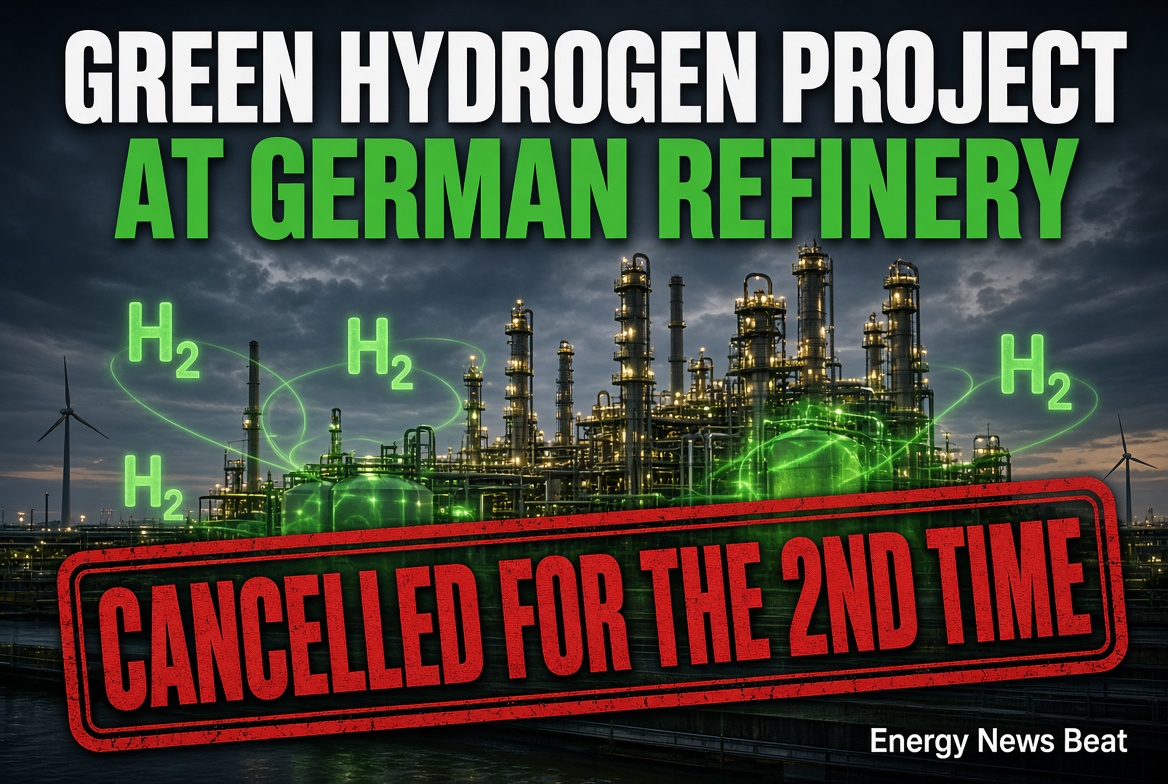
The elusive hydrogen economy continues to face setbacks as another high-profile green hydrogen initiative collapses under the weight of economic and regulatory uncertainties. The HyScale 100 project at Raffinerie Heide in Schleswig-Holstein, northern Germany, has been canceled for the second time, highlighting the persistent difficulties in scaling clean hydrogen production and the broader challenges of the so-called hydrogen migration—the transition from fossil-based energy systems to a hydrogen-powered future.
The HyScale 100 Cancellation
HyScale 100 aimed to install 500 MW of electrolyzers by 2030, with potential expansion to 2.1 GW. The project would have produced green hydrogen via renewable-powered electrolysis and combined it with carbon dioxide captured from a nearby Holcim cement facility to create e-methanol. This synthetic fuel would then supply an olefin plant at the refinery site, supporting decarbonization of both petrochemical and cement applications.
The consortium included Raffinerie Heide (owned by the Klesch Group), Danish renewable energy major Ørsted, Swiss building materials firm Holcim, and Hynamics (the hydrogen arm of France’s EDF). Recognized as a European Project of Common Interest, it was lined up for nearly €900 million ($1.04 billion) in combined federal and state funding, including €194 million ($224 million) in state support allocated in April 2022.
Partners cited a lack of planning certainty as the reason for the latest cancellation. This follows the earlier abandonment of its predecessor, Westküste 100, in 2023, which was derailed primarily by high costs despite earlier funding awards. A spokesperson for Schleswig-Holstein’s Ministry for Energy Transition confirmed that the state incurred no financial losses, as no funds had been disbursed. Local officials in the Dithmarschen district expressed regret, noting further delays in regional green hydrogen production and storage plans.
This is not an isolated incident. Across Europe, green hydrogen projects have faced cancellations and postponements amid elevated costs, weak demand signals, and shifting policies. Ørsted itself has scaled back several green fuels initiatives, and similar setbacks have hit steel and other industrial applications.
The Difficulties of the Elusive Hydrogen Migration
Hydrogen is often promoted as a versatile clean energy carrier capable of decarbonizing hard-to-electrify sectors such as heavy industry, long-haul transport, shipping, and aviation. In theory, it stores energy from intermittent renewables, produces only water when combusted or used in fuel cells, and can serve as a feedstock for chemicals and synthetic fuels. Yet the migration from today’s predominantly grey hydrogen (produced from natural gas via steam methane reforming) to low-carbon alternatives has proven far more challenging than early projections suggested.
Production costs remain high: green hydrogen is typically two to four times more expensive than grey hydrogen. Electrolyzers require massive capital outlays, abundant cheap renewable electricity, and reliable water supplies. Demand has not materialized at the scale needed to justify investments, creating a classic chicken-and-egg problem. Policy support, while substantial in places like Germany and the EU, often lacks the long-term certainty required for multi-billion-euro projects. Infrastructure lags far behind ambitions, and technological scale-up risks persist.
The result is a growing list of canceled or delayed projects worldwide, from Europe to North America and beyond. Germany’s own 10 GW electrolyzer target by 2030 appears increasingly unrealistic, with far fewer projects reaching final investment decision.
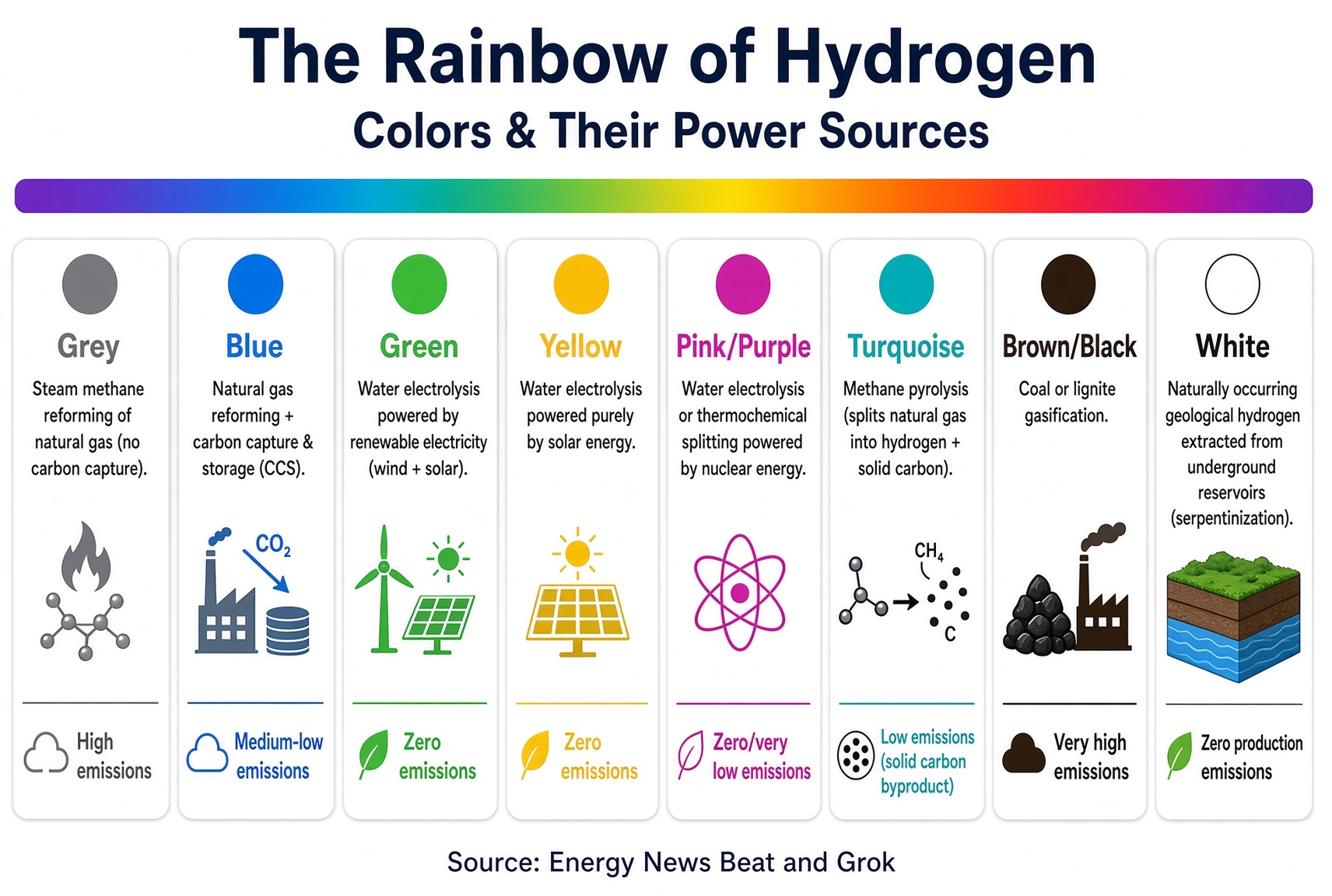
The Rainbow of Hydrogen: Including White Hydrogen
- Hydrogen itself is colorless, but industry uses a color code to distinguish production methods based on feedstock, energy source, and emissions profile:
- Grey hydrogen: Produced from natural gas or other fossil fuels without carbon capture; dominant today and high-emitting.
- Blue hydrogen: Grey production paired with carbon capture and storage (CCS); lower but not zero emissions.
- Green hydrogen: Electrolysis of water powered by renewables (wind, solar); near-zero operational emissions but energy- and capital-intensive.
- Pink/purple/red: Electrolysis or thermochemical processes powered by nuclear energy.
- Turquoise: Methane pyrolysis yielding solid carbon as a byproduct.
- Black/brown: From coal gasification; highly polluting.
- Yellow: Sometimes used for solar-powered electrolysis (a subset of green).
- White hydrogen (also called natural or geological hydrogen): Naturally occurring hydrogen generated within the Earth’s crust through processes such as serpentinization (water reacting with iron-rich rocks), radiolysis, or other geological activity. It accumulates in underground reservoirs and can be extracted similarly to natural gas.
White hydrogen stands out because it requires no energy-intensive production process. It is essentially “mined” rather than manufactured. Estimates suggest vast global resources—potentially enough, if even a small fraction is recoverable, to meet projected demand for centuries and containing energy equivalent to multiple times proven natural gas reserves. Advantages include near-zero carbon intensity at the point of extraction (no production emissions), potentially much lower costs once extraction techniques mature, and the ability to leverage existing drilling and reservoir knowledge from the oil and gas industry. Early finds, such as in Mali where a well powers a local village, demonstrate practical potential. Exploration is accelerating in places like France, Australia, the US, and elsewhere, though commercial-scale extraction faces geological, regulatory, and technological hurdles, and pure deposits are not yet proven at massive scale.
If white hydrogen can be developed economically and sustainably, it could bypass many of the cost and energy penalties of manufactured green hydrogen, offering a more straightforward path for certain applications.
The Challenges of Transporting Hydrogen
Even if production scales, moving hydrogen remains a major bottleneck. As the lightest element, hydrogen has excellent energy density by mass (roughly three times that of gasoline) but extremely low volumetric density. At ambient conditions, large volumes are needed to carry meaningful energy.
Options include:
- Compression: High-pressure storage (350–700 bar or more) for trucks or pipelines. This requires specialized materials to resist hydrogen embrittlement (which weakens metals) and raises leakage risks due to the molecule’s small size. More compressor stations are needed than for natural gas.
- Liquefaction: Cooling to –253°C. This boosts density but consumes 25–40% of the hydrogen’s energy content and demands advanced cryogenic infrastructure with boil-off losses.
- Chemical carriers: Converting to ammonia, methanol, or liquid organic hydrogen carriers (LOHC) for easier shipping, then reforming at the destination. These add conversion losses and complexity.
- Pipelines: The most efficient long-term solution for large volumes, but existing natural gas networks need costly upgrades or new dedicated lines. Blending is limited, and full conversion faces technical and safety issues.
These factors drive up delivered costs significantly, especially over long distances, and create infrastructure investment risks when demand remains uncertain.
Why Hydrogen Projects Are So Hard to Implement and Monetize for Investors.
Investors face a formidable combination of barriers:High capital intensity and costs: Electrolyzers, renewables integration, and supporting infrastructure demand billions upfront. Green hydrogen’s production cost premium makes projects uncompetitive without sustained subsidies or high carbon prices.
Demand and offtake risk: Few long-term, bankable purchase agreements exist. Potential buyers (industry, transport) hesitate without guaranteed supply and competitive pricing, while producers cannot finance without committed buyers.
Policy and regulatory uncertainty: Funding schemes change, permitting delays stretch timelines, and evolving certification standards (e.g., for “renewable fuels of non-biological origin”) add complexity. Shifting political priorities can undermine planning certainty, as seen with HyScale 100.
Infrastructure and execution risks: Missing pipelines, storage, and grid connections create bottlenecks. Technology scale-up, supply-chain constraints, and operational performance shortfalls (e.g., lower-than-expected utilization) erode returns.
Market immaturity: No deep, liquid trading markets or transparent price benchmarks exist for clean hydrogen. Revenue models rely on bilateral deals or optimistic future assumptions, which lenders view as high-risk. Equity investors absorb residual risks after debt service, making returns fragile.
Competition and alternatives: Direct electrification, efficiency gains, or other fuels often prove cheaper or simpler for many end-uses.
These factors explain the high rate of project attrition. While subsidies help bridge the gap in early stages, they cannot indefinitely substitute for underlying commercial viability. Successful projects tend to feature secured offtake, realistic cost assumptions, strong delivery teams, and alignment with hard-to-abate demand centers.
The cancellation of HyScale 100 is a sobering reminder that hydrogen’s promise remains real for specific niches, but the path to scale is steeper and slower than once hoped. White hydrogen exploration and continued cost reductions in green production, paired with targeted infrastructure and clearer demand signals, will be essential if the hydrogen migration is to gain meaningful traction. For investors, selectivity and rigorous due diligence have never been more important.
- H2Invest.io original article: https://h2invest.io/green-hydrogen-project-at-german-refinery-cancelled-for-the-second-time-refining/
- Gasworld coverage: https://www.gasworld.com/story/green-hydrogen-project-at-german-refinery-cancelled-for-the-second-time/2257231.article/
- NDR (German public broadcaster) report: https://www.ndr.de/nachrichten/schleswig-holstein/dithmarschen_steinburg/raffinerie-heide-wasserstoff-grossprojekt-gescheitert,regionheidenews-3454.html
- Hydrogen Insight on related cancellations and earlier Westküste 100: various reports including https://www.hydrogeninsight.com/
- Reuters on global cancelled/postponed green hydrogen projects: https://www.reuters.com/sustainability/climate-energy/cancelled-postponed-green-hydrogen-projects-2025-07-23/
- Clean Energy Wire on German refinery hydrogen stalls: https://www.cleanenergywire.org/news/green-hydrogen-production-german-refineries-stalls-due-lack-incentives
- Belfer Center on colors of hydrogen: https://www.belfercenter.org/research-analysis/colors-hydrogen
- BBC Future on white/natural hydrogen: https://www.bbc.co.uk/future/article/20250723-the-worlds-race-to-drill-for-natural-white-hydrogen
- National Grid on hydrogen colour spectrum: https://www.nationalgrid.com/stories/energy-explained/hydrogen-colour-spectrum
- ChemEngConsulting and related analyses on storage/transport challenges: https://www.chemengconsulting.com/blog/2025/02/25/biggest-challenges-hydrogen-storage-transportation/1124/
- MIT News on hydrogen transport: https://news.mit.edu/2026/hydrogen-clean-fuel-of-the-future-if-we-can-ship-it-0707
- Arup on viable hydrogen projects: https://www.arup.com/insights/article-beyond-the-hype–what-makes-a-viable-hydrogen-energy-project/
- World Bank and EIB reports on financing gaps and investment barriers (open knowledge and publications portals)
- Additional context from IEEFA, Wood Mackenzie, and industry analyses on costs, demand, and bankability.
All facts drawn from publicly reported sources as of mid-August 2026.