

Tankers are burning in the Strait of Hormuz, visible traffic through the waterway has collapsed to a fraction of normal levels, and U.S. Energy Secretary Chris Wright says he is “highly confident” Europe will draw down emergency diesel stocks to ease a global shortage. The combination is keeping a firm geopolitical premium in crude while diesel remains the tighter, more politically charged product.
Prices and the diesel squeeze
As of early October 1, 2026, prompt crude was volatile but elevated. Midday assessments had December ICE Brent around $101–102 a barrel and November WTI near $92–93, after the expiring November Brent contract settled the prior session at $103.50. Spot assessments earlier in the week had been higher still, with Brent prints above $110 in late September. Ultra-low-sulfur diesel futures traded near $4.65 a gallon; New York Harbor spot diesel was around $5 a gallon. U.S. retail diesel averaged $6.39 a gallon. In Britain, diesel had climbed to 200 pence a litre—near the post-2022 record—pushing a typical family-car fill-up to almost £110, roughly £31 above pre-Iran-war levels.
European diesel refining margins hit an all-time high near $95 a barrel on September 23 and were still around $78 a barrel on October 1. Asia’s gasoline margin also set a record after Chinese refiners suspended product exports beyond Hong Kong and Macau. U.S. distillate inventories fell 2.3 million barrels in the latest EIA week to 105.2 million barrels, below the five-year average, while gasoline stocks dropped 1.7 million barrels.
The shortage traces to the Middle East conflict, repeated attacks on refining and shipping, and the loss of reliable Hormuz flows. Britain imports more than half its diesel, with roughly a third of that historically coming from the United States. The Fawley refinery, which supplies about a fifth of UK diesel and jet fuel for Heathrow, is scheduled for a 10-week maintenance shutdown, adding a domestic layer to the import risk.
Hormuz traffic and burning tankers
AIS-visible commercial traffic through the Strait of Hormuz is running at roughly 5 percent of pre-crisis levels—about 4.3 vessels a day over the past week versus 84.8 before the fighting, according to live tracking. Crossings continue under U.S. naval coordination while Iran asserts control and transit-permit requirements. The official threat level is severe.
This week brought a fresh cluster of attacks. UKMTO and shipping intelligence firms reported three tankers struck by unknown projectiles while transiting the strait on Monday–Wednesday, including a fire that was later extinguished with the crew safe. Vessels identified in reports included the product tanker Al Ruwais and VLCC Mersin Prosperity (both linked to ADNOC Logistics & Services) and the Aframax Sinbad. Separate incidents involved the Qatari LNG carrier Al Rekayyat (fire in the engine room) and the Saudi-flagged crude tanker Wedyan. JMIC raised the Hormuz threat assessment from “substantial” to “severe,” warning that deliberate hostile action against commercial shipping is now considered likely. Earlier waves of strikes had already left tankers ablaze and forced owners to darken AIS or divert.
Yanbu and the East-West bypass
Saudi Arabia has restarted loadings at the Red Sea port of Yanbu after the East-West Pipeline resumed following a September 11 drone attack that Riyadh blamed on Iraqi militias. Trade sources put recent Yanbu crude loadings near 2 million barrels a day. Kpler estimates pipeline throughput around 2.65 million b/d, with flows expected to rise toward 3–4 million b/d in the coming days—still well short of the line’s 7 million b/d nameplate and the roughly 5.5 million b/d pre-attack operating rate. A full recovery could take another month.
European Space Agency imagery from September 27 showed nearly 10 million barrels of crude being loaded at Yanbu and nearby Al Muajjiz, plus refined-product activity, with roughly 40 tankers visible in the area. Aramco has issued an October loading program. TankerTrackers data cited in market reports put Saudi crude exports averaging nearly 9 million b/d over a recent seven-day window once Yanbu volumes returned—above pre-war levels in that snapshot, though August shipments had collapsed to about 2.4 million b/d. J.P. Morgan analysts put the broader Middle East crude-export 10-day average at 17.5 million b/d, or 98 percent of pre-war levels, supported by the restored pipeline and alternative routes. The bypass reduces the volume that must move through Hormuz, but Red Sea risk has not disappeared.
Wright, emergency stocks, and the U.S. leverage
Secretary Wright told Fox News on October 1 he is “highly confident” Europe will help by releasing diesel inventories. “This is a time for a coordinated release of diesel stores as we go into harvest season and we go into winter heating oil season. Now’s the time to bring more diesel to the market, and that diesel is available. I think we have some positive news coming.”
The administration has told Germany and France to draw down emergency diesel stocks or face a potential U.S. diesel export ban, according to people familiar with the discussions. A proposal circulated by Wright’s team would have EU governments release 120 million barrels of diesel over 180 days—well over a third of the roughly 315 million barrels the bloc held in reserve as of June. France and Germany together hold about 35 percent of EU strategic gasoil/diesel stocks (Eurostat). Washington has expressed frustration that some European members released only a fraction of earlier IEA-coordinated pledges tied to the March stock release (global target around 400 million barrels, U.S. share 172 million). UK Energy Secretary Miatta Fahnbulleh is in direct contact with Wright; Energy Minister Martin McCluskey joined an EU commissioners’ call. A U.S. official told Reuters it is in Europe’s interest to work with Washington on refined-product supply. Chancellor John Healey has called UK diesel prices “extreme” and pointed to a diplomatic end to the Iran fighting as the real solution.
Third carrier group
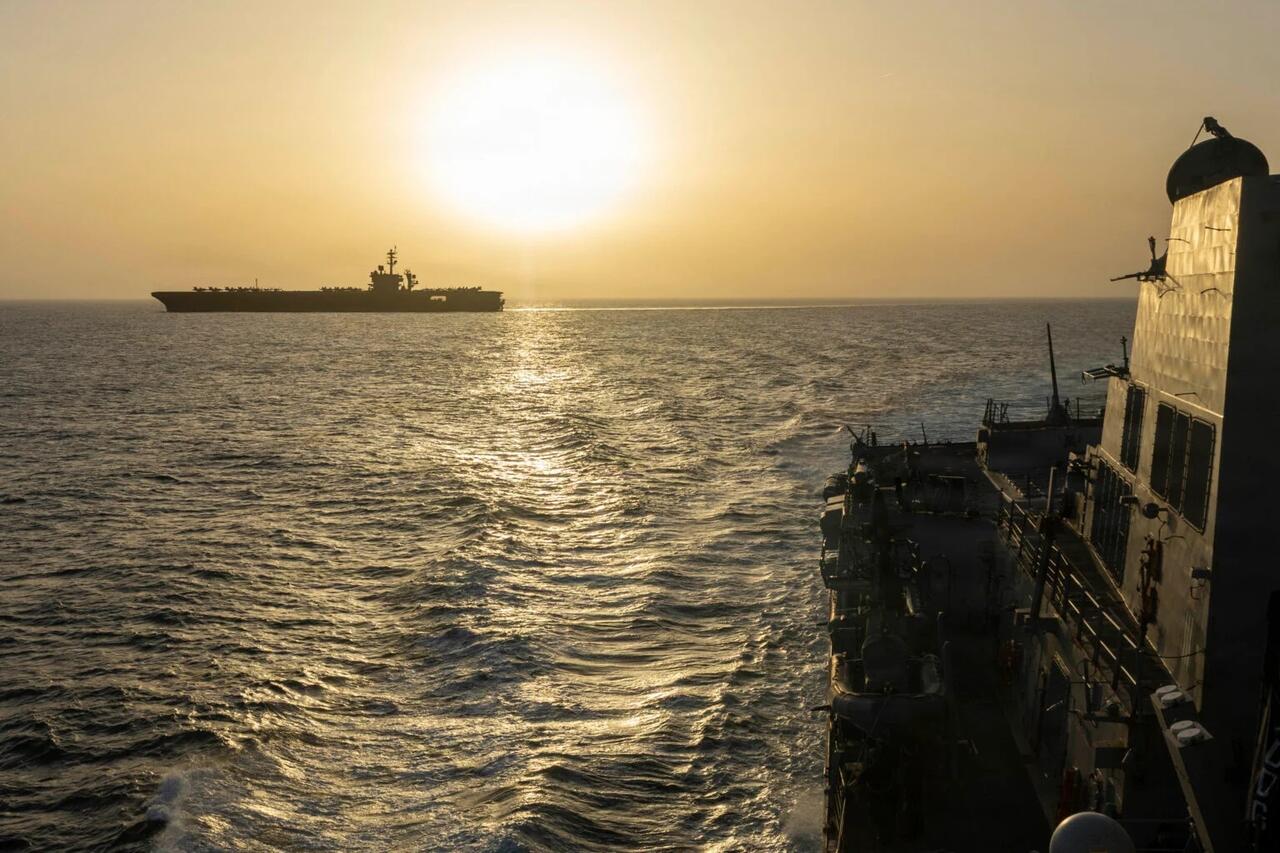
The United States is sending a third aircraft-carrier strike group to the region. A U.S. official said the USS Theodore Roosevelt and its escorts are en route to Central Command’s area and are expected by the end of November (some reporting suggests three carriers could be on station as early as late October). The group joins the USS George H.W. Bush and USS George Washington already in theater. An amphibious readiness group (USS Makin Island, with more than 2,000 Marines) is also deploying. Officials have described the posture as more than 20,000 sailors and Marines and hundreds of aircraft once fully assembled—the largest concentration since a three-carrier presence in April. The move comes as President Trump has publicly weighed further pressure on Iran versus a negotiated reopening of Hormuz, with U.S. midterm elections on November 3 in the background.
What it means for prices
Physical crude availability has partially recovered via Yanbu and other workarounds, which is why Brent has not simply exploded higher despite tankers on fire. The market is still pricing a persistent risk premium: insurance, dark-AIS transit, and the chance that attacks widen again. Diesel is the binding constraint. Refinery outages, Chinese export curbs, low inventories, and the threat of a U.S. export ban if Europe does not release stocks are keeping cracks wide. A coordinated European diesel release would add prompt barrels into the harvest and early heating season and could narrow margins; refusal raises the odds of U.S. export restrictions that would tighten Europe further while potentially backing up U.S. product and weighing on domestic crude runs. Analysts note that Middle East export volumes are close to pre-war on a 10-day basis, but the quality of that flow—route, insurance, and product yield—remains impaired. The third carrier arrival in November adds another layer of event risk into winter.
Making Appendices Great Again
Check out the World’s Greatest Podcast Show Notes at EnergyNewsBeat.co or EnergyNewsBeat.com.
Appendix: Sources
- OilPrice.com / City A.M., “UK Holds Emergency Talks With U.S. as Diesel Crisis Escalates,” Oct. 1, 2026: https://oilprice.com/Energy/Energy-General/UK-Holds-Emergency-Talks-With-US-as-Diesel-Crisis-Escalates.html
- Reuters, “US Energy Secretary Wright ‘highly confident’ Europe will release diesel stocks,” Oct. 1, 2026: https://www.reuters.com/business/us-energy-secretary-wright-highly-confident-europe-will-release-diesel-stocks-2026-10-01/
- Reuters, “White House urges EU to draw down diesel inventories, sources say,” Sept. 29, 2026: https://www.reuters.com/legal/government/white-house-urges-eu-draw-down-diesel-inventories-sources-say-2026-09-29/
- Reuters, “EU’s emergency diesel stocks are mainly in Germany and France,” Sept. 30, 2026: https://www.reuters.com/business/energy/eus-emergency-diesel-stocks-are-mainly-germany-france-2026-09-30/
- POLITICO, “Trump’s energy chief asked Europe to release more than a third of its diesel reserves,” Oct. 1, 2026: https://www.politico.eu/article/trumps-energy-chief-asked-europe-to-release-more-than-a-third-of-its-diesel-reserves/
- OilPrice.com, “Three Tankers Struck by Unknown Projectiles in Strait of Hormuz,” Oct. 1, 2026: https://oilprice.com/Latest-Energy-News/World-News/Three-Tankers-Struck-by-Unknown-Projectiles-in-Strait-of-Hormuz.html
- hormuz.now live status (AIS traffic ~5% of normal, restricted/severe): https://hormuz.now/
- EIA Today in Energy daily prices (Sept. 30 assessments): https://www.eia.gov/todayinenergy/prices.php
- EIA spot price series: https://www.eia.gov/dnav/pet/pet_pri_spt_s1_d.htm
- OPIS / Dow Jones, “NYMEX Overview: Oil Futures Rise as Middle East Supply Risks Persist,” Oct. 1, 2026 (J.P. Morgan 17.5 mb/d export figure): https://www.morningstar.com/news/dow-jones/202610016603/nymex-overview-oil-futures-rise-as-middle-east-supply-risks-persist-opis
- Business Day, “Oil jumps $3 as China halts fuel exports,” Oct. 1, 2026: https://www.businessday.co.za/markets/2026-10-01-oil-jumps-3-as-china-halts-fuel-exports/
- World Ports Organization / trade reporting on Yanbu restart and East-West Pipeline (~2–2.65 mb/d, Kpler 3–4 mb/d outlook): https://www.worldports.org/yanbu-oil-loadings-resume-after-pipeline-restarts/ and https://www.shipuniverse.com/news/saudi-arabia-resumes-yanbu-crude-loadings-as-east-west-pipeline-recovery-accelerates/
- TankerTrackers satellite note (Sept. 27 imagery, ~10 million barrels at Yanbu/Al Muajjiz): referenced via market posts citing @TankerTrackers
- The National, “US sends third aircraft carrier to Middle East,” Oct. 1, 2026: https://www.thenationalnews.com/news/us/2026/10/01/us-sends-third-aircraft-carrier-to-middle-east/
- Associated Press reporting on Theodore Roosevelt CSG and Makin Island ARG (via KSTP and others), Oct. 1, 2026: https://kstp.com/politics/third-aircraft-carrier-and-thousands-of-troops-head-to-mideast-as-trump-weighs-new-iran-strikes/
- Newsquawk summary of Al Jazeera report on three carriers and two landing groups by end of November: https://www.newsquawk.com/headlines/a-us-official-says-by-the-end-of-november-three-aircraft-carriers-and-two-landing-groups-will-be-deployed-around-iran-al-jazeera-reports
Prices and ship counts move quickly; figures above reflect reporting available on October 1, 2026.
