

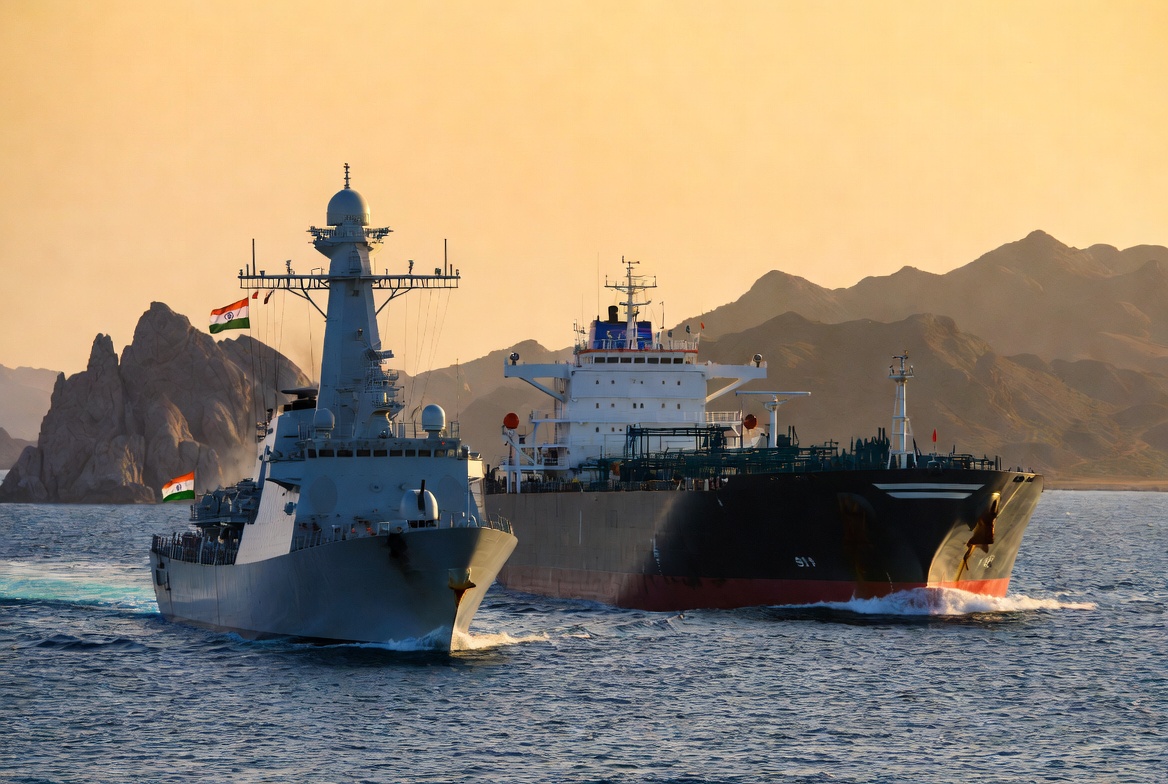
Saudi Arabia is offering to sell crude oil cargoes on a ship-to-ship basis from locations off the coast of Oman, including near Sohar in the Gulf of Oman. This move signals that the kingdom may be ramping up the practice of shuttling barrels through the Strait of Hormuz—often with transponders switched off—mirroring tactics already used extensively by the United Arab Emirates and other Gulf producers.
State oil giant Saudi Aramco is marketing Arab Medium and Arab Heavy grades this way, according to people familiar with the matter.
Those grades strongly suggest the oil originated inside the Persian Gulf rather than from the kingdom’s Red Sea facilities. Aramco declined to comment.
Middle Eastern producers have been ferrying large volumes of crude out of the Persian Gulf undetected, transferring it onto waiting tankers in the Gulf of Oman. This “dark” shuttle trade has helped keep global oil prices in check and limited fears of an energy-driven inflation spike even as the Iran conflict continues. Pre-war, roughly 20 million barrels per day—about one-fifth of world supply—crossed Hormuz. Visible commercial traffic has collapsed far below that level, yet actual flows appear substantially higher than many market trackers initially assumed.
U.S. Energy Secretary Chris Wright stated that around 9 million barrels per day crossed the strait over a recent seven-day period—nearly half of pre-conflict volumes and well above the roughly 4 million barrels per day some traders had been using as a working estimate. Bloomberg and other sources have reported flows considerably higher than the more conservative figures derived solely from AIS-visible vessels. Signal Ocean data showed that 62% of oil and product tankers crossed Hormuz with AIS switched off after the U.S. reinstated its maritime blockade of Iran on July 14 (up from around half previously). For crude tankers specifically, the dark share has been even higher in some periods.
The operational model is a two-tier system. Risk-tolerant owners (often employing vessels that go dark for hours or even days to weeks) transit the strait, load at Gulf terminals, and conduct ship-to-ship transfers off Oman. Mainstream operators then take the long-haul leg. European Union Sentinel-1 satellite data indicate roughly 150 ships are now waiting off Oman for such transfers, up from about 40 in January. Smaller tankers and shuttle vessels have been part of these operations, allowing more agile movements through the waterway before consolidating cargoes onto larger vessels outside the high-risk zone.
Saudi Arabia had been slower to expand Hormuz shuttling because of its East-West pipeline to the Red Sea port of Yanbu. That alternative route has faced growing pressure after Yemen’s Houthi militants declared a maritime blockade on Saudi Arabia. Recent satellite imagery shows vessels with at least 9 million barrels of transport capacity loading at or near the giant Ras Tanura export terminals over the past week. Saudi tanker company Bahri has positioned a large cluster of supertankers just outside the Persian Gulf—16 VLCCs already off Oman with three more en route, collectively capable of hauling about 38 million barrels—consistent with preparation for transfers.
Attacks on shipping have continued. In the past week, multiple vessels linked to Abu Dhabi National Oil Company (ADNOC) were struck while transiting the strait. Reports include a missile attack around August 8, two vessels targeted on or about August 13, drone strikes on the ADNOC-linked Navig8 Messi and Aframax Tarif on August 14, and an additional incident involving a bulk carrier (identified in some reports as ADNOC-linked) around the same period. ADNOC has reported roughly 19–23 of its vessels attacked since the conflict began, with one crew member killed and about 20 injured overall. These incidents contributed to a sharp slowdown in tracked traffic over the weekend of August 15–16: Kpler data showed five commodity vessels on Saturday and none on Sunday, versus 31 the prior weekend. Some vessels continue to pass with transponders off, so official counts understate activity.
Despite the attacks and stalled U.S.-Iran talks, the combination of dark shuttling, pipeline workarounds, stockpile releases, and softer demand has kept Brent crude largely in the $80–$90 range through much of August. As of August 17, Brent was trading near $89 per barrel. Analysts note that the covert flows have prevented the much higher prices (some had feared levels approaching $150) that a more complete shutdown would have produced. The U.S. Energy Information Administration recently raised its 2026 Brent average forecast to around $87 per barrel, citing ongoing Hormuz constraints and associated production shut-ins, while projecting gradual improvement later. Other recent commentary from banks and research firms has emphasized that while geopolitical risk remains supportive near current levels, sustained higher dark and shuttle volumes continue to cap upside and reduce the likelihood of a severe supply shock.
The Saudi offers near Oman represent a notable expansion of these adaptive logistics. If the pattern continues, more Saudi medium and heavy crude could reach the market via the same dark-to-transfer route already keeping barrels flowing from the UAE, Iraq, Qatar, and Kuwait—further illustrating how the industry has adapted to prolonged disruption in the world’s most critical energy chokepoint.
- Bloomberg: “Saudis Offer Oil From Near Oman in Possible Sign of Shuttling” (August 17, 2026) – https://www.bloomberg.com/news/articles/2026-08-17/saudis-offer-oil-from-near-oman-in-possible-sign-of-shuttling
- The Edge Malaysia / Bloomberg syndication: “Saudis offer oil from near Oman in possible sign of shuttling” – https://theedgemalaysia.com/node/814842
- The Japan Times / Bloomberg: “Covert Mideast oil flows are keeping global prices in check” (August 17, 2026) – https://www.japantimes.co.jp/business/2026/08/17/markets/mideast-oil-global-prices/
- Splash247: “Dark transits keep Hormuz oil flowing” (August 17, 2026) – https://splash247.com/dark-transits-keep-hormuz-oil-flowing/
- Bloomberg / TT News: “Tankers go dark for longer to get oil out of Middle East” (August 14, 2026) – https://www.ttnews.com/articles/tankers-go-dark-longer-oil and related Bloomberg reporting
- OilPrice.com: “Middle East Oil Tankers Are Going Dark for Longer” (August 14, 2026) – https://oilprice.com/Latest-Energy-News/World-News/Middle-East-Oil-Tankers-Are-Going-Dark-for-Longer.html
- Reuters: Shipping slows through Strait of Hormuz after tanker attacks (multiple reports, August 16–17, 2026) – e.g., https://www.usnews.com/news/world/articles/2026-08-16/shipping-slows-through-strait-of-hormuz-after-tanker-attacks-data-shows
- Windward and related maritime intelligence: Reports on ADNOC vessel attacks and dark transits (August 2026)
- U.S. Energy Information Administration Short-Term Energy Outlook (August 2026) and related S&P Global coverage
- ING analysts commentary via FXStreet (August 17, 2026) on Brent near $90
- Additional context from Signal Ocean, Kpler, MarineTraffic, EU Sentinel-1 satellite data, and U.S. Energy Secretary Chris Wright statements as reported across Bloomberg, Reuters, and secondary outlets in August 2026.
