Yemen’s Iran-aligned Houthi movement claimed on Tuesday, August 18, 2026, that its forces targeted Saudi Aramco’s Jazan (also spelled Jizan) oil refinery on the Red Sea coast in southwest Saudi Arabia with “a number of drones.” A Houthi military source told the group’s Saba news agency the strike was “precise” and conducted in response to alleged Saudi violations of Yemeni airspace over Saada and Hajjah governorates.
Saudi Arabia issued no immediate confirmation or comment on the latest claim. If verified, it would mark the third Houthi-claimed attack on the facility in roughly two weeks.
Sequence of Recent Attacks and Damage Reports
The Jazan complex, a modern 400,000-barrels-per-day (bpd) refinery that began operations in recent years and produces gasoline, ultra-low-sulfur diesel, jet fuel, benzene, and other products, has been under repeated pressure:
Late July 2026 (around July 25–27): Houthis claimed missile and drone strikes on Aramco sites in Jazan and Yanbu. Satellite imagery (including EU Sentinel-2) and thermal data showed fires, including at least one tank. Consultancy IIR reported damage to the Integrated Gasification Combined Cycle (IGCC) complex and tank farm area. Aramco shut the refinery on July 27. Initial restart was targeted for around August 15.
August 9: Houthis claimed a drone strike. Saudi Energy Ministry confirmed a fire at a facility within the complex that was extinguished with no injuries reported. Sources indicated one crude storage tank was impacted.
August 13: Houthis claimed two drones struck the refinery, describing a “precise hit.” Reports indicated negligible damage to a tank; no official Saudi confirmation of significant new impact.
August 18: Latest claim of multiple drones. No independent verification of additional damage available at the time of writing.
The refinery has remained offline since the late-July shutdown. After the August 9 incident, IIR indicated the restart was postponed to approximately August 30. Aramco CEO Amin Nasser previously stated that attacks had caused some production interruptions but expressed confidence in rapid restoration and said there was no material operational or financial impact overall for the company.
Refinery Capacity Impacted
Jazan represents 400,000 bpd of capacity. Saudi Aramco’s overall net refining capacity stood at approximately 4.2 million bpd (gross capacity around 7.8 million bpd) as of end-2025, encompassing domestic plants (including Ras Tanura ~550,000 bpd, Yanbu, and others) and international affiliates. The prolonged Jazan outage therefore removes roughly 9–10% of Aramco’s net refining capacity on a temporary basis.
This comes amid broader regional refining strains linked to the wider Iran-related conflict earlier in 2026, which had already tightened global diesel and product markets. Jazan’s exports had averaged over 200,000 bpd in the months prior to the shutdown (mainly diesel/gasoil and naphtha).Gulf Oil Producers: Total Exports by CountryGulf producers (Saudi Arabia, UAE, Iraq, Kuwait, Qatar, Bahrain, Iran, and Neutral Zone) historically account for a major share of global seaborne oil trade. Pre-escalation 2025 IEA data for volumes transiting the Strait of Hormuz (the primary route for most) showed approximately 19.87 million bpd total oil (nearly 15 mb/d crude/condensates + ~5 mb/d products):
- Saudi Arabia: 6.23 mb/d (5.43 crude + 0.80 products)
- UAE: 3.24 mb/d (2.02 crude + 1.22 products)
- Iraq: 3.63 mb/d (3.32 crude + 0.31 products)
- Kuwait: 2.37 mb/d (1.40 crude + 0.97 products)
- Iran: 2.41 mb/d
- Qatar: 1.43 mb/d
- Others (Bahrain, Neutral Zone): smaller volumes.
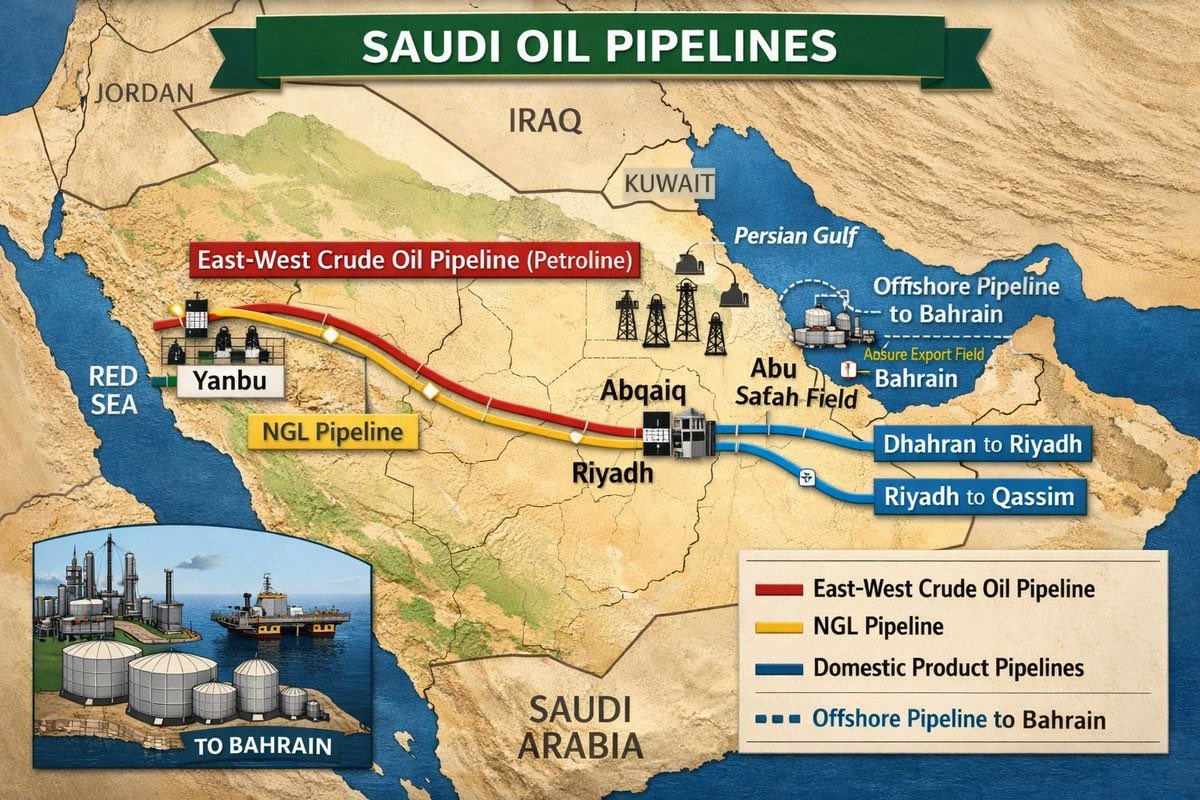
Alternative routes provide limited bypass capacity (estimated 3.5–5.5 mb/d crude), primarily Saudi’s East-West Petroline to Yanbu on the Red Sea (design capacity up to ~5–7 mb/d) and UAE’s Habshan-Fujairah pipeline.
In 2026, the Iran conflict and subsequent Houthi actions caused sharp disruptions. Gulf crude exports fell dramatically early in the year (e.g., reports of an 82% drop from January peaks near 18–19 mb/d to lows around 3.4 mb/d in some June assessments for certain tracked flows). Recovery has been uneven: Saudi Arabia shifted heavily to Yanbu (peaking near 4 mb/d in March before moderating), UAE maintained stronger flows via Fujairah, while Iraq, Kuwait, and Qatar faced severe constraints at times (near-zero seaborne exports in some periods). By mid-2026, combined exports showed partial rebounds (e.g., reports of ~10+ mb/d in June periods including bypasses), still below pre-conflict baselines. Saudi crude exports have fluctuated in the 4–6+ mb/d range in recent months depending on routing and conditions.
Houthi threats in the Red Sea/Bab el-Mandeb have further complicated Saudi Red Sea loadings, prompting some re-routing toward Suez/Sidi Kerir and making Asian buyers prefer alternative pickup points.
“Dark” Traffic (AIS Transponders Off)A substantial and growing share of tanker traffic in the region has operated with Automatic Identification System (AIS) transponders switched off—“going dark”—to reduce detection risk amid threats in the Strait of Hormuz and Bab el-Mandeb.In Hormuz, data from periods in 2026 showed 50–62%+ of certain tanker/cargo flows (including many India-bound vessels) going dark, with the practice spreading beyond traditional sanctioned “dark fleet” operators to mainstream commercial tankers. Dark periods have lengthened from hours to days or even 10+ consecutive days in some cases.
In the Red Sea/Bab el-Mandeb and at Yanbu, satellite and tracking reports indicated sustained fully dark postures for weeks (e.g., all or nearly all vessels at Yanbu AIS-dark in mid-August assessments). Ship-to-ship transfers and shuttle operations have also occurred under dark conditions.
Overall, prolonged dark activity events surged dramatically in Q2 2026 (multi-fold increases reported by maritime intelligence firms). This opacity complicates precise volume tracking but has allowed some continued flows under elevated risk.
The repeated claims against Jazan underscore ongoing risks to Red Sea energy infrastructure and shipping lanes at a time when Gulf export patterns remain altered by conflict-related constraints. Markets continue to monitor for official Saudi assessments of any new damage and the planned late-August restart.
Appendix: Sources and Links
- OilPrice.com – “Houthis Claim Third Attack on Saudi Aramco Refinery in Two Weeks” (Aug 18, 2026): https://oilprice.com/Latest-Energy-News/World-News/Houthis-Claim-Third-Attack-on-Saudi-Aramco-Refinery-in-Two-Weeks.html
- Reuters / US News – Reports on Aug 9 Jazan fire and Houthi claim: https://www.usnews.com/news/world/articles/2026-08-08/yemens-houthis-say-they-attacked-saudi-aramco-jazan-refinery-fire-extinguished
- Reuters – Aug 13 two-drone claim: https://www.reuters.com/world/middle-east/yemens-houthis-say-they-attacked-saudi-aramco-refinery-jazan-with-two-drones-2026-08-13/
- Al Jazeera – Aug 9 coverage: https://www.aljazeera.com/news/2026/8/9/saudi-arabia-says-fire-extinguished-at-aramco-facility-in-jizan
- Bloomberg / Energy Connects – Restart delay to Aug 30 and tank fire details: https://www.energyconnects.com/news/oil/2026/august/saudis-delay-restart-of-jazan-plant-to-late-august-iir-says/
- Reuters (via multiple outlets) – July shutdown and IIR damage assessment (IGCC and tank farm): Various reports citing IIR, e.g., https://www.reuters.com (searchable archives for July 27–28, 2026 Jazan)
- IEA – Strait of Hormuz oil flows by country (2025 baseline): https://www.iea.org/about/oil-security-and-emergency-reserve/strait-of-hormuz
- IEA charts – Gulf producer exports Feb–June 2026 (Kpler-based): https://www.iea.org/data-and-statistics/charts/oil-producer-exports-from-gulf-countries-february-2026-june-2026
- Wood Mackenzie / vessel tracking summaries – Gulf export declines and Yanbu peaks: Reports referenced in July 2026 analyses (e.g., 82% drop figures).
- Bloomberg / OilPrice / Signal Ocean / Windward / Kpler – Dark AIS activity reports (62% India-bound, prolonged dark periods, Yanbu dark posture): https://www.bloomberg.com/news/articles/2026-08-14/tankers-are-going-dark-for-longer-to-get-oil-out-of-middle-east; Windward Q2 2026 Maritime Risk Report and related analyses.
- Aramco reports / secondary summaries – Net refining capacity ~4.2 mmbpd (end-2025): Aramco annual/financial disclosures.
- Additional context: Saba (Houthi agency) statements; Saudi Energy Ministry X posts on fires; satellite imagery reports (Sentinel-2, NASA FIRMS).
All figures on recent 2026 flows and damage are drawn from contemporaneous reporting by Reuters, Bloomberg, IIR, Kpler, and maritime trackers and remain subject to official updates.