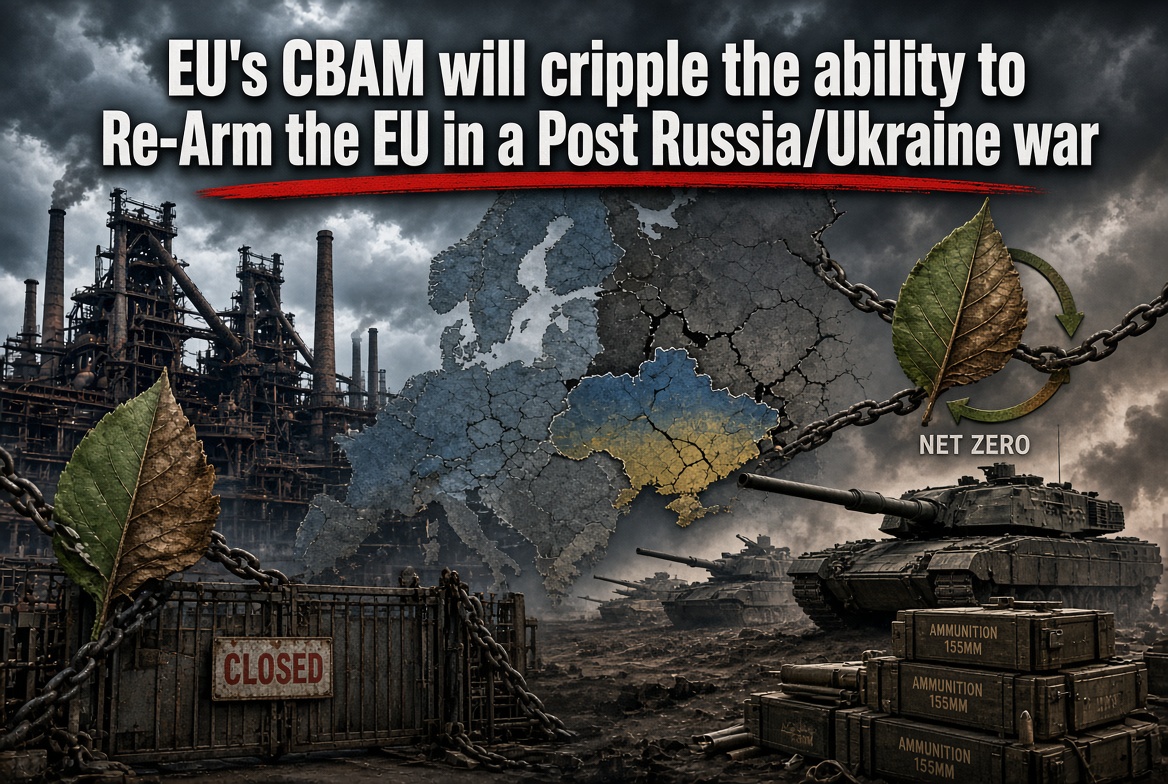
As Europe contemplates a post-Russia/Ukraine war landscape, the imperative to re-arm and rebuild credible conventional deterrence has never been clearer. Tanks, artillery systems, armored vehicles, munitions, and supporting infrastructure all demand vast quantities of high-quality steel—often 50–60 tonnes for a main battle tank and up to 100 tonnes for certain self-propelled artillery pieces. Yet the European Union’s Carbon Border Adjustment Mechanism (CBAM), combined with aggressive Net Zero policies, is systematically undermining the industrial base required for that rearmament. Far from securing Europe’s future, these climate-driven measures are accelerating deindustrialization, raising costs for critical materials, and weakening the very supply chains needed for military readiness.
CBAM, which entered its definitive phase on 1 January 2026, imposes a carbon price on imports of steel, aluminum, cement, fertilizers, electricity, and hydrogen (with planned expansion to downstream steel- and aluminum-intensive products). It is designed to match the costs borne by EU producers under the Emissions Trading System (ETS) as free allowances are phased out through 2034. In theory, this levels the playing field against carbon leakage. In practice, it is driving up costs across energy-intensive industries at precisely the moment Europe needs to expand production capacity for defense.
Steel sits at the heart of the problem. Iron and steel production accounts for a large share of industrial emissions, and CBAM certificates—tied to embedded emissions and the prevailing ETS price—add significant levies to imports. Foreign offers for hot-rolled coil, for example, have already incorporated CBAM costs that eliminate traditional price advantages, while EU producers face rising ETS burdens as free allocations shrink. Studies of technology and metal-working sectors show production cost increases exceeding 5% for many products and reaching nearly 50% in some cases, with three-quarters of examined products at risk of carbon leakage by full phase-in. The result is margin compression, delayed investment in capacity, and heightened risk that production migrates outside Europe.
An under-appreciated flaw compounds the damage for defense. CBAM includes an exemption for goods imported for military use. This creates a perverse incentive: carbon-intensive steel and materials destined for military applications can enter the EU without the border carbon price, while EU-based producers of the same materials must still pay under the ETS. Military-grade steel is produced by a limited number of specialized firms; disadvantaging them relative to external suppliers risks greater dependence on foreign supply chains precisely when security of supply is paramount. Analysts have warned that this disconnect between climate and defense policy undermines both industrial decarbonization goals and the resilience of Europe’s defense technological and industrial base.
The broader Net Zero framework has already hollowed out manufacturing capacity across the EU and especially the United Kingdom. High industrial electricity prices—among the highest in the developed world—combined with carbon taxes, levies, and regulatory burdens have made energy-intensive production uneconomic. In the UK, manufacturing’s share of GDP has roughly halved since 1990. Steel output has collapsed; blast furnaces at Port Talbot closed, Scunthorpe required effective nationalization to keep primary steelmaking alive, and Liberty Steel operations failed. Refineries have shut (Britain dropped from six to four major ones), chemical plants and olefin crackers have closed, brick production has fallen sharply, and aluminum primary production has largely vanished. Estimates attribute 150,000–200,000 industrial job losses in recent years to high energy costs and deindustrialization pressures linked to these policies. Similar stresses appear across continental Europe, where energy costs for industry remain multiples of those in the United States or China, and ETS-driven cost increases threaten further contraction in steel and downstream manufacturing.
Ukraine, a key wartime supplier of steel and a potential long-term partner in European security, is being hit particularly hard. Ukrainian steel is relatively carbon-intensive (often around 2.1–2.3 t CO₂ per tonne, versus lower EU averages for certain routes), so CBAM adds estimated costs of $60–90 (or more) per tonne. In early 2026, major producers such as ArcelorMittal Kryvyi Rih reported the abrupt loss of hundreds of thousands of tonnes of European orders as customers balked at the extra duty. Combined with tightened EU safeguard quotas (halved tariff-free volumes and a 50% out-of-quota tariff), the measures threaten large swathes of Ukraine’s long-product and other exports. Industry analyses project export losses potentially exceeding $1 billion in the near term and cumulative GDP impacts of 0.6–1% short-term rising toward 2–3% by 2030, with billions in potential lost investment and output. Steel remains one of Ukraine’s most important export earners and a critical revenue source for its war economy and eventual reconstruction; making it uncompetitive in its primary remaining market undermines both Ukraine’s resilience and Europe’s access to a nearby supplier of a strategic material. Talks about possible exemptions have occurred, but as of mid-2026 the full regime continues to apply.
The strategic contradiction is stark. Europe is simultaneously increasing defense spending, expanding ammunition and systems production, and recognizing steel’s centrality to rearmament, while climate policies raise the cost of the very industrial inputs required and erode domestic capacity. Goldman Sachs and others have noted that a substantial share of rising European defense outlays will flow into metal-intensive equipment, lifting regional demand for steel and other metals. Yet without competitive, resilient primary production and processing capacity inside Europe (or reliably accessible from partners such as Ukraine), that demand will increasingly be met by external sources—exposing the continent to the same supply-chain vulnerabilities that Net Zero and CBAM were ostensibly meant to manage in the climate domain.
In a post-Russia/Ukraine war environment, the ability to re-arm rapidly and sustainably will depend on industrial depth, not just budgets. CBAM and the surrounding Net Zero architecture are not neutral climate tools; they function as de facto industrial policy that raises costs, accelerates offshoring of manufacturing, disadvantages domestic producers (including for defense), and inflicts collateral damage on a key ally’s steel sector. Unless the EU recalibrates—through targeted exemptions for strategic materials and defense supply chains, meaningful support for competitive low-carbon production, and recognition that energy affordability is a prerequisite for both prosperity and security—these policies risk leaving Europe with ambitious climate targets but a crippled capacity to defend itself.
Appendix: Sources and Links
- Germanwatch discussion paper on CBAM and steel: https://www.germanwatch.org/sites/default/files/2026-02/Germanwatch_Trade-and-Transformation_Stahlindustrie_CBAM_staerken_Produktion_schuetzen.pdf
- Euronews on defense spending and metals demand: https://es.euronews.com/business/2026/05/29/cinco-sectores-que-se-benefician-del-auge-del-gasto-en-defensa-en-europa
- CEOBS analysis of CBAM military exemption: https://ceobs.org/how-the-eus-new-carbon-border-undermines-military-decarbonisation/
- Orgalim CBAM impact study on technology industries: https://www.cielffa.org/images/downloads/Orgalim_CBAM_IA_Study.pdf
- S&P Global on Europe’s steel industry and CBAM 2026: https://www.spglobal.com/energy/en/news-research/latest-news/metals/010726-europes-steel-industry-faces-its-2026-reckoning-with-cbam
- POLITICO on EU clean steel and defense: https://www.politico.eu/article/industry-steel-eu-bets-clean-future-brussels-belgium-industrial-coal/
- Nature Communications / ResearchGate on green steel markets and CBAM: https://www.nature.com/articles/s41467-025-64440-9 and https://www.researchgate.net/publication/396457227_Emerging_green_steel_markets_surrounding_the_EU_emissions_trading_system_and_carbon_border_adjustment_mechanism
- European Commission materials on CBAM expansion: https://ec.europa.eu/commission/presscorner/api/files/document/print/en/ip_25_3088/IP_25_3088_EN.pdf
- Financial Times on CBAM as tariff equivalent: https://www.ft.com/content/99bbb4e9-32de-40cb-aa15-537937d70889
- Fastmarkets on CBAM costs for steel/aluminium: https://www.fastmarkets.com/insights/cbam-is-coming-can-steel-and-aluminium-supply-chains-bear-the-costs/
- CRU Group on EU steel production path: https://www.crugroup.com/en/communities/thought-leadership/2026/from-carbon-cost-to-competitive-reset-the-path-back-to-equilibrium-for-EU-steel-production-by-2032/
- Prosperity Institute report “Destroying the Foundations”: https://www.prosperity.com/wp-content/uploads/2025/12/PI-Destroying-the-Foundations-Final.pdf
- GBBC Report 2026 on UK deindustrialisation: https://gbbc.uk/uk-deindustrialisation-energy-policy/
- OilPrice on UK chemical industry and Net Zero: https://oilprice.com/Energy/Energy-General/Britains-Net-Zero-Policy-Is-Killing-Its-Chemical-Industry.html
- Telegraph on brick industry and Net Zero: https://www.telegraph.co.uk/news/2026/06/28/savebrick-net-zero-britain-quintessential-material-risk/
- New Statesman on Net Zero and industrial Britain: https://www.newstatesman.com/spotlight/2025/04/who-killed-industrial-britain
- RealClearWorld on green policies and British steel: https://www.realclearworld.com/articles/2025/04/04/green_policies_not_trump_tariffs_killing_british_steel_1102129.html
- FT on EU ETS and industry: https://www.ft.com/content/59ea85a0-355e-4f5c-a3d4-5c3c9df27892
- GMK Center interviews and analyses on Ukraine steel and CBAM: https://gmk.center/en/interview/yulia-proskurova-the-combined-impact-of-the-new-quotas-and-the-cbam-could-destroy-ukraine-s-steel-industry/; https://gmk.center/en/analitycs/cbam-impact-on-iron-steel-industry-of-ukraine/; https://gmk.center/en/infographic/the-impact-of-the-cbam-on-the-mining-and-metallurgical-sector-and-the-ukrainian-economy/; https://gmk.center/en/posts/a-deadly-combination-why-2026-could-be-a-turning-point-for-the-ukrainian-steel-industry/
- Fastmarkets on EU demand for Ukrainian steel: https://www.fastmarkets.com/insights/eu-demand-for-ukrainian-steel-cbam-pressure-wartime-supply-challenge/
- The Guardian on EU quotas and Ukrainian steel: https://www.theguardian.com/business/2026/jun/09/eu-quota-ukrainian-steel-industry-metinvest
- POLITICO on CBAM blow to Ukrainian steel and exemption talks: https://www.politico.eu/article/new-eu-climate-law-deals-instant-blow-ukraine-steel-exports-says-industry/; https://www.politico.eu/article/kyiv-in-talks-with-brussels-over-steel-exemption-from-carbon-border-tax/
- S&P Global on Ukraine CBAM export losses: https://www.spglobal.com/energy/en/news-research/latest-news/energy-transition/031325-ukraine-could-face-47-billion-export-losses-due-to-cbam-study
- Metal Expert on CBAM and Ukrainian metallurgy: https://metalexpert.com/en/news/htmlinetnewsbusen?head=CBAM-hits-Ukrainian-metallurgy-at-the-worst-time&unid=54E5C6626FD5AF96C2258DD500479428Q
- European Commission Q&A materials referencing Ukraine impact modelling
- DEHSt and official EU guidance on CBAM military exemptions and scope
- Additional supporting analyses from IISD, Energy Community CBAM reports, and industry associations (EUROFER, etc.) as referenced in the body.