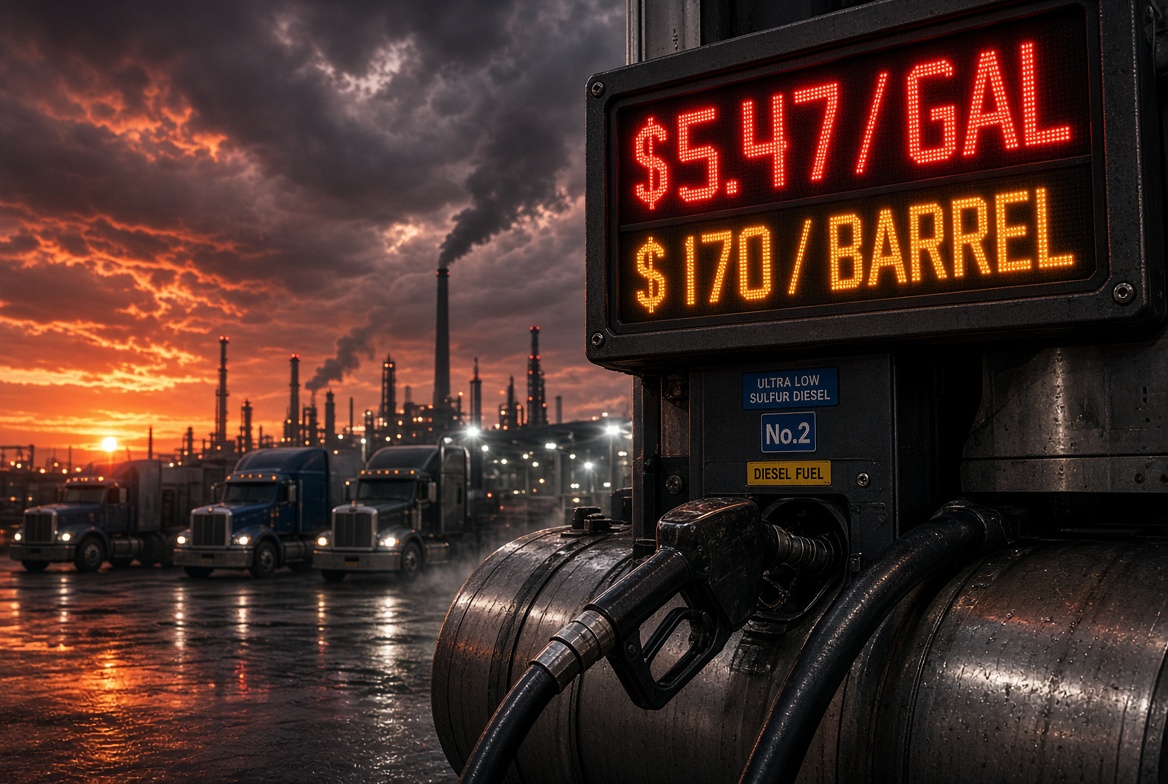
Brent crude hovering near $91 a barrel might look manageable on a trading screen. Jeff Currie, the veteran commodities strategist now at Carlyle Group, argues that focus is dangerously misplaced. “Nobody on the planet Earth consumes crude oil,” Currie told CNBC. “Refineries do. Everyone else consumes gasoline, diesel and jet fuel, and those markets look considerably uglier.”
European diesel was trading around $170 per barrel during his recent comments—nearly double Brent—while U.S. diesel crack spreads (the refining margin of diesel futures over WTI crude) smashed through $100 a barrel for the first time on record, hitting an intraday high of $102.20.
Gasoline prices in the U.S. are roughly 30% higher year-over-year; diesel is up about 46%. Retail U.S. diesel has been trading in the mid-$5 per gallon range recently.
This is not a classic crude shortage story. It is a refined-products crisis, and China played a central role in shifting the pain downstream.
China’s Role: Softening Crude While Tightening Products
A surge of crude supplies in late June and early July left roughly 100–120 million barrels effectively trapped inside the Strait of Hormuz amid ongoing disruptions. China responded by cutting refinery runs. That move helped keep crude prices from spiking further, but it reduced the volume of gasoline, diesel, and jet fuel entering global markets.
As Currie put it: “China did not solve the shortage. It moved it downstream.” Chinese refiners processed significantly less crude in the second quarter (runs down about 1.6 million barrels per day year-over-year in Q2, with June runs hitting multi-year lows). Product exports were sharply restricted earlier in the year to protect domestic supplies, though some easing has recently allowed modest increases.
The result is a classic dislocation: crude looks relatively contained while the fuels that power the real economy are in short supply.
Global Refined Products: Supply Constrained, Demand Sticky
Global refinery crude throughputs remain nearly 5 million barrels per day below year-earlier levels, according to the International Energy Agency’s August 2026 Oil Market Report. Middle East and Russian refining capacity has been hit hard by conflict-related damage and export restrictions. Russian diesel exports have been curtailed after Ukrainian attacks on refineries; Middle East product exports are disrupted. Diesel exports from Russia, the Middle East, and Asia were about 1.3 million bpd lower year-over-year in recent data—roughly 20% of global seaborne trade.
U.S. distillate inventories (diesel and heating oil) have fallen to their lowest levels for this time of year in three decades. American refiners are running hard and exporting record volumes of distillate (hitting 1.9 million bpd in early August) to fill global gaps, but that is drawing down domestic stocks further.
Demand for diesel is structurally sticky. It powers trucking, shipping, agriculture, construction, and industry. While high prices and supply-chain disruptions are forcing some demand destruction—IEA now sees overall global oil demand declining by 1.6 million bpd in 2026—the middle-distillate market has less seasonal flexibility than gasoline. Harvest season in the Northern Hemisphere and planting in the South add near-term pressure.
Crack spreads in Northwest Europe have also been extreme (around $90 recently versus a $24 average last year). The historical correlation between crude and product prices has broken down.
What Investors Should Watch
The opportunity is concentrated in refining, not necessarily upstream crude production. U.S. independent refiners (Valero, Marathon Petroleum, Phillips 66, HF Sinclair) have already seen strong share-price gains this year as margins expanded. High crack spreads reward those with available capacity and the ability to export.
Key indicators to monitor:
- Diesel and 3-2-1 crack spreads (products vs. crude).
- U.S. and European distillate inventory draws.
- Chinese refinery run rates and product export quotas.
- Forward curves for refined products (backwardation signals ongoing tightness).
- Any resolution—or further escalation—in the Strait of Hormuz and Russian refining attacks.
- Seasonal demand into winter heating-oil season.
History shows these extreme margins eventually mean-revert as refiners maximize runs and new supply (or demand destruction) arrives. Geopolitical premiums can reverse quickly. Still, the structural loss of refining capacity and depleted inventories suggest tightness may persist longer than a typical seasonal spike.
How Consumers Will Handle Higher Diesel Prices—and the Broader Impact
Diesel is the bloodstream of the physical economy. Higher prices flow directly into freight rates. Fuel often represents 20–25% of trucking operating costs. When diesel jumps, carriers raise fuel surcharges and base rates. Those costs are passed through supply chains to retailers and, ultimately, shoppers.
Expect higher prices for groceries, building materials, and almost anything moved by truck or ship. Agriculture is particularly exposed: farmers need diesel for tractors and harvesters right now. Producer prices have already been rising, and economists note that diesel price spikes historically explain a large share of variation in trucking cost indices. Inflationary pressure from energy is therefore more durable and economy-wide than a pure gasoline rally.
Consumers will handle it the way they always do under sustained energy shocks: by cutting discretionary spending, delaying big purchases, and feeling the pinch hardest on essentials. Smaller trucking fleets and owner-operators face margin compression or may park trucks, further tightening freight capacity. Larger shippers absorb some costs but eventually pass them on. Governments may face pressure for temporary relief measures, but strategic petroleum reserves primarily hold crude, not finished diesel.
The “illusion of abundance” that governments have long cultivated through reserve releases and verbal interventions is harder to maintain when the shortage sits in products rather than crude. Until refiners can fully ramp output or geopolitical constraints ease, the real energy crisis will continue to show up at the pump for commercial users and on the receipt for everyone else.The crude market may still look relatively calm. Downstream, the numbers already tell a different story.
As the title says, diesel is the next inflationary problem for the Trump Administration; it will only get worse until we get more refineries, or demand destruction kicks in.
- OilPrice.com – Jeff Currie: Forget $91 Brent, The Real Crisis Is $170 Diesel (Aug 18, 2026): https://oilprice.com/Latest-Energy-News/World-News/Jeff-Currie-Forget-91-Brent-The-Real-Crisis-Is-170-Diesel.html
- Related OilPrice.com coverage of Currie comments and refining margins.
- IEA Oil Market Report – August 2026: https://www.iea.org/reports/oil-market-report-august-2026
- Reuters – US diesel crack surpasses $100 a barrel (Aug 17, 2026): https://www.reuters.com/business/energy/us-diesel-crack-surpasses-100-barrel-first-time-supply-disruptions-2026-08-17/
- 24/7 Wall St. – Diesel Crack Just Broke $100 a Barrel: https://247wallst.com/investing/2026/08/18/diesel-crack-just-broke-100-a-barrel-for-the-first-time-ever-heres-what-it-means-for-your-grocery-bill/
- Dow Jones / TradingView analysis on global diesel supply competition (Aug 18, 2026).
- EIA weekly gasoline and diesel price data / FRED US Diesel Sales Price.
- AAA Fuel Prices national averages.
- Columbia SIPA / Center on Global Energy Policy – China’s oil import and refinery management analysis (Aug 2026).
- Reuters – China’s fuel exports data (Aug 18, 2026).
- Axios, Bloomberg, and other reporting on Russian export bans, Middle East disruptions, and inventory levels.
- Commercial Carrier Journal, RSM US, Transportation Energy Institute, and freight-index analyses on trucking cost pass-through and inflation effects (2026).
- Forbes, CNBC, and Motley Fool coverage of refining equities performance amid elevated crack spreads.
All data and quotes drawn from publicly reported market data, agency reports, and interviews as of mid-August 2026. Prices and inventory figures are subject to rapid change.