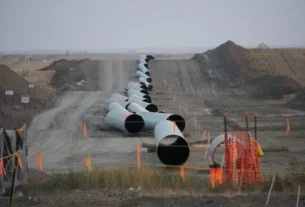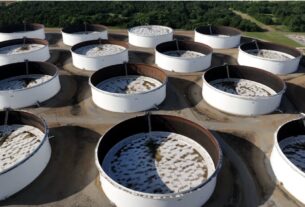
President Donald Trump is scheduled to sit down Tuesday afternoon, September 1, with executives from at least 10 U.S. fuel makers and distributors. The agenda is straightforward and politically urgent: persistently high gasoline and diesel prices, what the industry can do about them, and how to expand domestic refining capacity. We hope he looks for solutions rather than windfall profits taxes, like Democrats and Communists typically go first.
Invited companies span the industry, from integrated majors to independents. People familiar with the plans named Marathon Petroleum, Delek US Holdings, Chevron, PBF Energy, and Valero Energy among those expected. The White House had not publicly confirmed the session as of Friday.
The backdrop is a market that has been running hot for months. National regular gasoline averaged $4.08 a gallon on August 29, according to AAA, with diesel near $5.60. Prices remain about a dollar higher than at the February 28 start of the Iran war that disrupted flows through the Strait of Hormuz. August is on track to be the most expensive on record for that month.
Trump has pressed producers and refiners to do more to bring pump prices down after companies posted strong second-quarter earnings on wide crack spreads. The meeting gives both sides a chance to talk about market mechanics rather than slogans.
Refineries Have Been Running at Historic Utilization—and Maintenance Is Coming
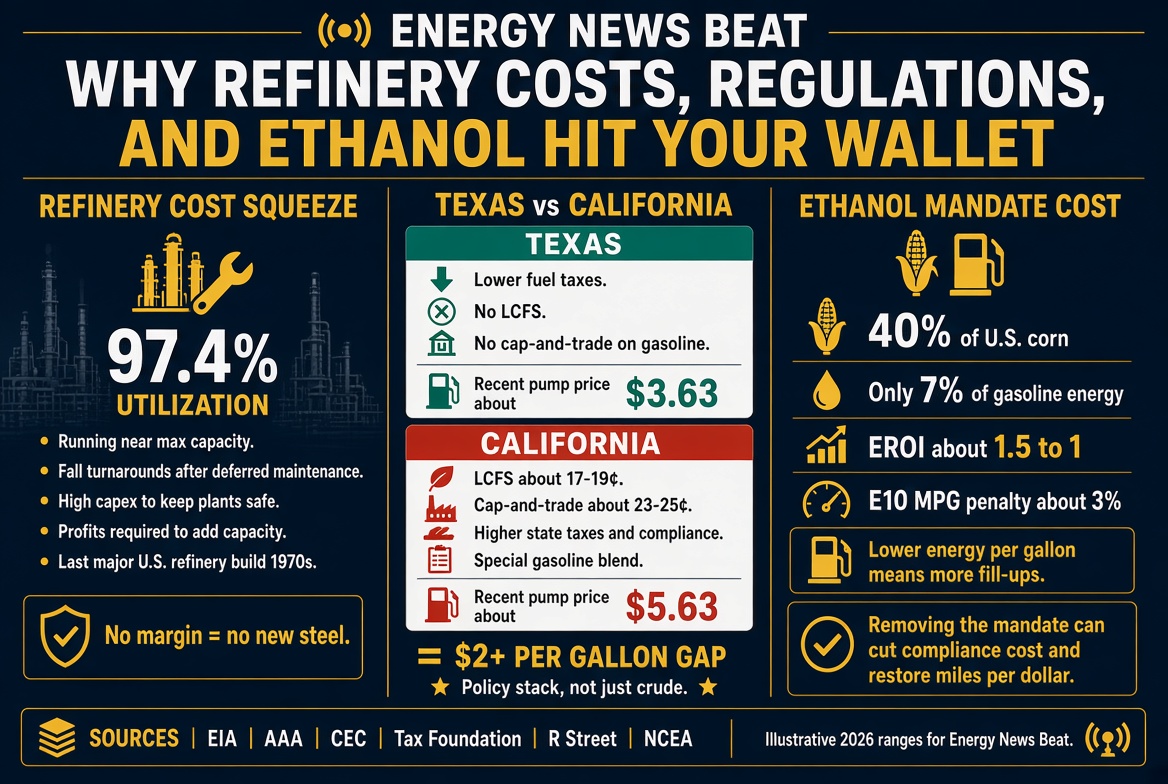
U.S. refiners have operated near the limit of operable capacity for the longest sustained stretch in more than 25 years. EIA data show utilization at 97.4 percent for the week ending August 21, after weeks above 96 percent. Throughput has averaged around 17 million barrels per day since the conflict began—well above the five-year average. Midwest and Rocky Mountain plants have at times run at or above 100 percent of rated capacity.
That performance filled a global gap created by war-related damage and outages in the Middle East and Russia. It also deferred a lot of work. Many operators postponed spring turnarounds to capture margins that at times exceeded $50 a barrel, roughly double the 10-year average. Planned inspections and unit overhauls were pushed into late 2026 and even 2027.
Fall is the traditional window after the summer driving season. Gulf Coast schedules already show major work starting in September: Valero FCC and CDU outages at Port Arthur and Corpus Christi East, a possible large FCC turnaround at Marathon’s Galveston Bay complex, and additional CDU and coker work at PBF Chalmette and ExxonMobil Baytown into October and November. Those units are not small. When they come down, product slates tighten. History is unkind to plants that run at 95-plus percent for months: after similar stretches in 1997–98, utilization dropped sharply as equipment failed and emergency maintenance piled up.
Refiners cannot print capacity. They can only run what they have, maintain it, and decide whether the returns justify new steel.
Profits Are Not Optional
If anyone expects new capacity, building or even expanding a refinery is a multi-billion-dollar, multi-year bet. Investors demand a return that covers permitting risk, construction inflation, environmental compliance, and the possibility that policy will later treat the plant as a stranded asset. Chevron’s CEO said years ago that the United States may never build another greenfield refinery because governments keep signaling they do not want the products. Existing operators have added barrels through “capacity creep” and brownfield upgrades—Beaumont, Port Arthur, Pascagoula—precisely because those projects are cheaper and faster than starting from dirt.
The last significant new U.S. refinery with meaningful downstream units dates to the 1970s. A handful of small facilities have opened since, but they do not replace the complex gasoline-and-diesel machines the country actually needs. Permitting, community opposition, overlapping federal and state rules, and boutique fuel specifications all raise the cost of entry. If margins collapse because Washington demands lower prices without removing the cost stack, the rational corporate response is to harvest cash, return it to shareholders, and stop investing. That is how capacity quietly disappears.The Tuesday meeting should treat profits as the prerequisite for more barrels, not as a political talking point.
Texas Versus California: Policy Is a Cost Center
Compare two energy states. Texas hosts the bulk of U.S. refining capacity, relatively predictable permitting, and no statewide carbon tax or cap-and-trade program on transportation fuels. California has the opposite: a unique gasoline blend, the Low Carbon Fuel Standard, cap-and-trade (often called cap-and-invest), aggressive air rules, and a political commitment to net-zero timelines that treat existing refineries as problems to be managed out of existence.
The price gap is not subtle. Recent AAA snapshots have shown California regular well above $5.60 a gallon while Texas sat in the mid-$3 range—sometimes a $2-plus difference on the same day. State analyses and industry estimates put LCFS and cap-and-trade costs in a range that has run from the high teens to more than 50 cents a gallon depending on credit prices and program tightening; combined with higher state taxes and compliance spending, the California-specific stack routinely adds well over a dollar a gallon versus a Gulf Coast barrel. Baker & O’Brien work has shown that a $100-per-ton carbon cost alone can add $3–$6 per barrel processed. Those costs do not vanish. They show up at the pump or they shut plants.
California has already lost or is scheduled to lose major capacity (Phillips 66 Los Angeles, Valero Benicia). The state then imports finished product from Asia—product that often rides the same Hormuz-exposed crude that the war disrupted. Net-zero rules and carbon pricing did not make California’s air cleaner in a vacuum; they made local refining uneconomic and transferred the emissions and the price risk offshore. Texas did not do that. That contrast belongs on the table Tuesday.
Ethanol Is a Cost, Not a Bargain
The Renewable Fuel Standard still forces roughly 10 percent ethanol into most gasoline. Corn ethanol now claims about 40 percent of the U.S. corn crop while displacing only about 10.5 percent of gasoline gallons and roughly 7 percent of the energy in the tank. Peer-reviewed and industry-adjacent estimates put its energy return on investment around 1.3:1 to 1.5:1. Gasoline’s EROI is several times higher. Ethanol also carries about one-third less energy per gallon, so E10 typically costs drivers about 3 percent in fuel economy; E15 adds another penalty.
R Street and other analyses have found that in most years ethanol costs more per unit of energy than gasoline once compliance and blending costs are counted. EPA’s own recent rulemaking math showed higher production costs for E15 versus E10 and a large negative “societal benefit” once transfer payments to producers are stripped out. Water use, land-use change, and food-price effects are additional externalities that do not appear on the pump sticker. The original energy-security case for the mandate has collapsed: the United States is a major oil and product exporter. What remains is a farm-state transfer program that raises the cost of a gallon and complicates refinery operations. Getting the mandate out of the way would free blending flexibility and remove a layer of cost that consumers never recoup in miles.What the Meeting Can Actually AccomplishTrump cannot order a refinery to run past safe utilization or cancel a turnaround that inspectors and insurers require. He can signal that federal policy will stop treating refining as a sunset industry. Concrete items worth putting on the table:
- Faster, clearer permitting for expansions and reliability projects.
- Relief from overlapping fuel specifications that fragment the market.
- A hard look at the RFS volumes and the ethanol blend wall.
- An end to mixed signals that tell companies to invest for decades while other agencies plan the phase-out of the same molecules.
- Recognition that California-style carbon pricing and net-zero rules are not free and should not be nationalized.
Refiners need durable margins if they are going to spend the next decade adding steel capacity rather than returning every extra dollar. Consumers need those barrels if they want prices that do not spike every time a tanker cannot transit the Strait of Hormuz or a Gulf Coast FCC comes down for six weeks. The two goals are the same.
Tuesday is a chance to say so out loud.
Appendix: Sources and Links
Meeting and market context
- Bloomberg / Yahoo Finance: Trump to Discuss High Fuel Prices With Oil Refiners Next Week — https://finance.yahoo.com/energy/articles/trump-discuss-high-fuel-prices-220707380.html
- Bloomberg original: https://www.bloomberg.com/news/articles/2026-08-28/trump-to-discuss-high-fuel-prices-with-oil-refiners-next-week
- Reuters: Trump to meet refiners, fuel retailers as Iran war boosts gas prices — https://www.usnews.com/news/top-news/articles/2026-08-27/trump-to-meet-refiners-fuel-retailers-as-iran-war-pressures-gas-prices-ahead-of-midterms-sources-say
- Reuters: US to announce steps to help refiners produce more fuel — https://www.reuters.com/business/energy/us-energy-chief-says-he-will-speak-refiners-about-boosting-output-2026-08-17/
Prices
- AAA Fuel Gauge / national averages — https://gasprices.aaa.com/
- AAA: Gas Prices Remain High as August Will Likely Set New Record — https://gasprices.aaa.com/gas-prices-remain-high-as-august-will-likely-set-new-record/
Utilization, throughput, and maintenance risk
- EIA weekly utilization table — https://www.eia.gov/dnav/pet/PET_PNP_WIUP_A_%28NA%29_YUP_PCT_W.htm
- Reuters commentary: US refiners face historic stress test — https://www.reuters.com/commentary/reuters-open-interest/us-refiners-face-historic-stress-test-global-crisis-looms-2026-08-24/
- Energy Intelligence: US Refinery Maintenance Looms Large for Product Markets — https://www.energyintel.com/000001a0-39e2-d101-afe0-b9f2c0530000
- ExecGraph 2026 Gulf Coast turnaround schedule — https://execgraphenergy.com/turnarounds/2026
- Energy News Beat: U.S. Refinery Utilization Hits 96.2% — https://energynewsbeat.co/downstream/u-s-refinery-utilization-hits-96-2-as-global-markets-tighten/
- IER: Strong Demand Keeps U.S. Refiners Operating at Near Capacity — https://www.instituteforenergyresearch.org/fossil-fuels/gas-and-oil/strong-demand-keeps-u-s-refiners-operating-at-near-capacity/
- EIA FAQ: When was the last refinery built in the United States? — https://www.eia.gov/tools/faqs/faq.php?id=29&t=9
Capacity, permitting, and investment
- World Oil / Bloomberg: The U.S. may never build a new refinery, Chevron CEO says — https://worldoil.com/news/2022/6/3/the-u-s-may-never-build-a-new-refinery-chevron-ceo-says
- OPIS: Lack of Funding, Capacity Expansions Dim Prospects for New U.S. Oil Refineries — https://www.opis.com/resources/energy-market-news-from-opis/lack-of-funding-capacity-expansions-dim-prospects-for-upstarts-to-build-new-u-s-oil-refineries/
- FactCheck.org (background on historic barriers) — https://www.factcheck.org/2008/05/us-oil-refining-capability/
Texas vs. California costs, LCFS, cap-and-trade
- Marketplace: Why gas prices are higher in California than in Texas — https://www.marketplace.org/story/2026/05/26/why-gas-prices-are-higher-in-california-than-in-texas
- Heritage Foundation: The Red-Blue Energy Divide — https://www.heritage.org/energy/commentary/the-red-blue-energy-divide-how-overregulation-inflates-prices
- Baker & O’Brien: Even Without a Carbon Tax, U.S. Refiners Feel Efforts to Cut Emissions — https://bakerobrien.com/article/over-the-hills-and-far-away-even-without-a-carbon-tax-u-s-refiners-feel-efforts-to-cut-emissions
- Tax Foundation: 2026 Gas Taxes by State — https://taxfoundation.org/data/all/state/gas-taxes-state/
- California Energy Commission page on gas prices and program fees — https://www.energy.ca.gov/programs-and-topics/topics/petroleum-fuels-transition/california-gas-prices-and-impacts-iran-war
- Civic Intelligence / USC Marshall discussion of California capacity loss and price projections — https://civicintelligence.news/economy/california-energy-collapse
- Breakthrough Journal: Time To Reset California’s Climate Leadership — https://www.breakthroughjournal.org/p/time-to-reset-californias-climate
Ethanol energy balance, costs, and RFS
- National Center for Energy Analytics: Ethanol as Fuel: A Bridge to Nowhere — https://energyanalytics.org/ethanol/
- R Street Institute: The Consumer Costs and Climate Impacts of the Renewable Fuel Standard — https://www.rstreet.org/research/the-consumer-costs-and-climate-impacts-of-the-rfs/
- R Street: Without Major Reforms, There’s No Excuse for Year-Round E15 — https://www.rstreet.org/commentary/without-major-reforms-theres-no-excuse-for-year-round-e15/
- Energy News Beat: Is It Time to End Ethanol? — https://energynewsbeat.co/biofuels/farm-bill-amendment-pits-big-refiners-against-smaller-operations-is-it-time-to-end-ethanol/
- The Cool Down / NCEA figures on land, water, and EROI — https://www.thecooldown.com/green-tech/corn-ethanol-fuel-policy-debate-social-media/
- Slow Boring: The dumb policy making groceries more expensive — https://www.slowboring.com/p/the-dumb-policy-making-groceries
Related Energy News Beat coverage
- Energy News Beat home — https://energynewsbeat.co/