ENB Pub Note: This article first ran on The Crude Truth Substack, and I agree with Rey Trevino’s viewpoints. I would also add that Bloomberg is reporting this morning that Venezuela is weighing the benefits of remaining in OPEC. Now that it is not selling oil to China at a huge discount, it will be making more money per barrel, and it is worth it to sell more. Same view that Iraq and the UAE have right now. Cash flow is critical to rebuilding energy infrastructure around the world to avoid choke points or to rebuild from the theft of socialism and poor leadership. One thought for our readers is how this would have a long-term impact on Canada. Their biggest mistake is following Mark Carney and his “New World Order”. He does not serve Canada.
_____________________________________________________________________________________________________________________
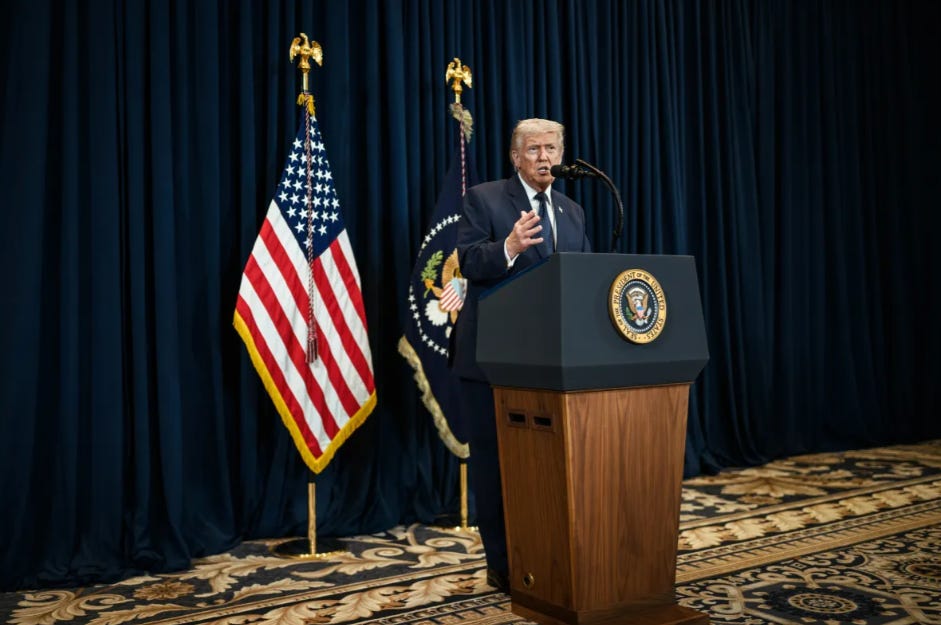
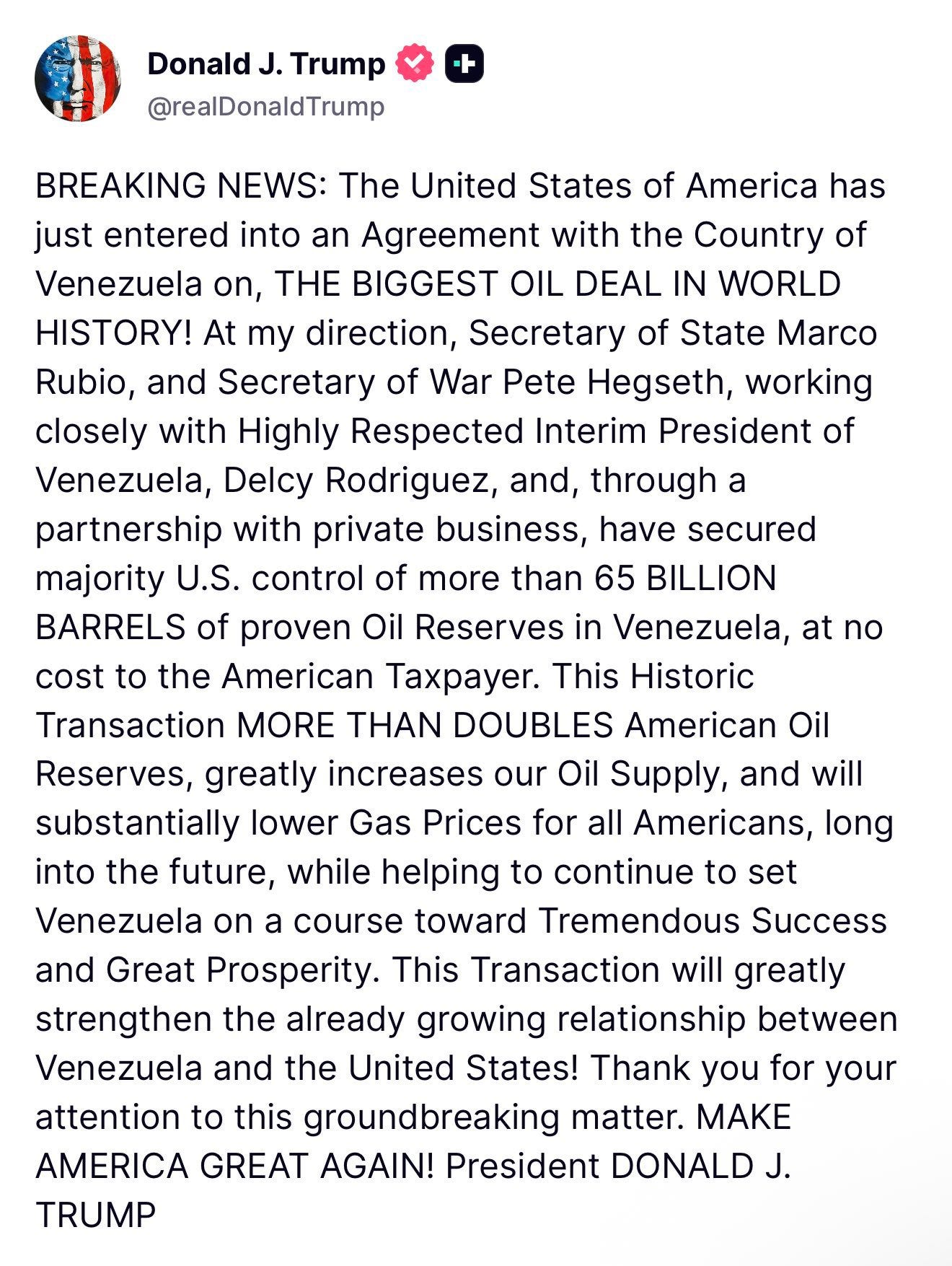
President Donald Trump announced Friday that the United States had struck what he called “THE BIGGEST OIL DEAL IN WORLD HISTORY” with Venezuela: majority U.S. control of more than 65 billion barrels of proven reserves, structured as a public-private partnership, at no cost to the American taxpayer.
The announcement lands eight months after U.S. forces captured Nicolás Maduro on January 3 and installed Delcy Rodríguez as interim president. It also lands in a market already remade by the Iran war, a depleted U.S. Strategic Petroleum Reserve, and the United Arab Emirates’ exit from OPEC on May 1.
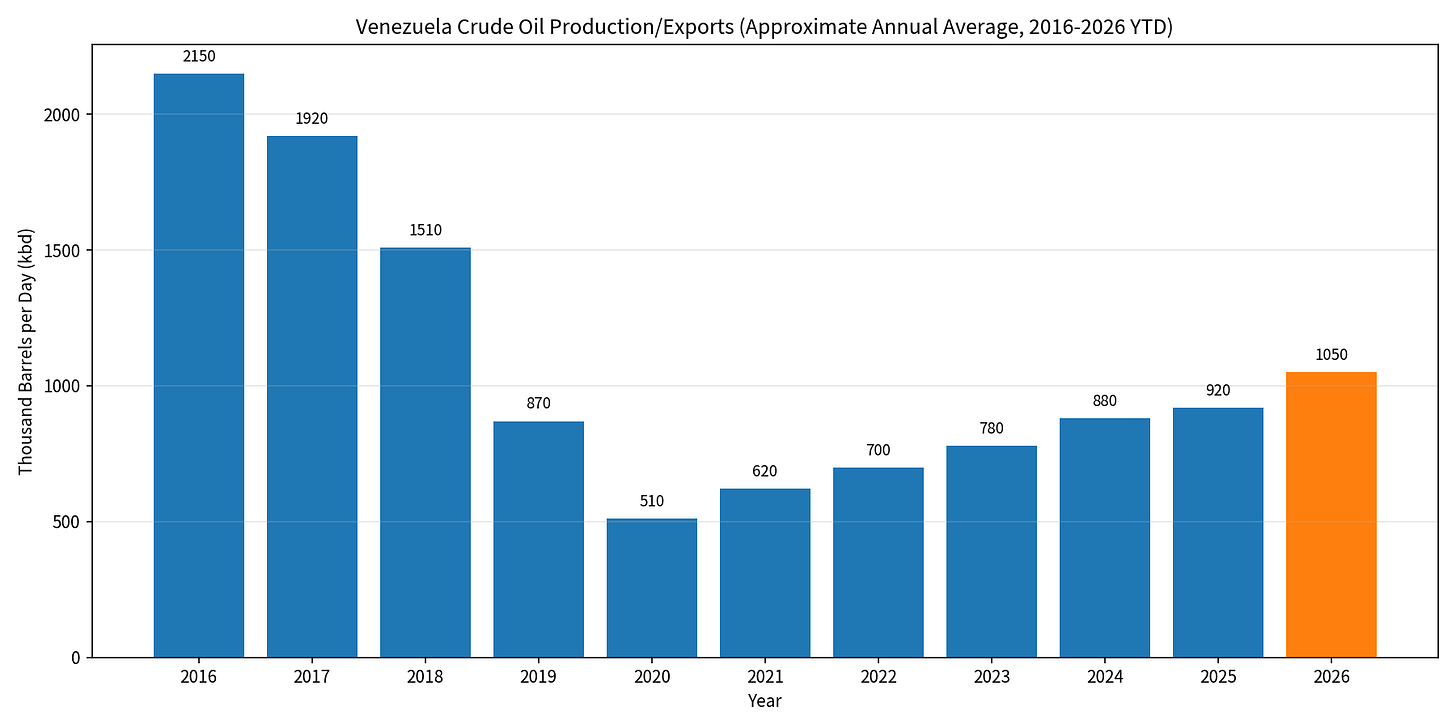
It has only been a few months, but the increase in production is making a difference for the Venezuelan People.
The question for oil markets is no longer whether Washington will try to remake Venezuelan production. It is whether OPEC can survive a founding member whose output is now aligned with U.S. offtake rights — and whether Iraq, chasing a doubling of output, stays inside the cartel or walks out to chase revenue.
The Announcement
On Friday evening, Trump posted on Truth Social that Secretary of State Marco Rubio and Defense Secretary Pete Hegseth, working with Rodríguez “and through a partnership with private business,” had secured majority U.S. control of more than 65 billion barrels of proven oil reserves. He said the transaction “MORE THAN DOUBLES American Oil Reserves, greatly increases our Oil Supply, and will substantially lower Gas Prices for all Americans.”
Rodríguez’s government confirmed the outlines. Caracas said the agreement covers development of 17 strategic fields with a proven potential of 65 billion barrels, more than $100 billion in investment, and an estimated $209 billion in tax revenue for the Venezuelan state. Rodríguez called the pact historic and said it would allow a significant increase in production with private operators.
U.S. officials speaking anonymously filled in the structure the White House did not put on paper. The deal creates a new private company or joint venture. Rodríguez granted that vehicle 100-year rights to the fields. The United States holds 55 percent of the effective output — a mix of equity in the holding company and a guaranteed offtake of crude at cost. Officials said that oil is intended for the Strategic Petroleum Reserve and U.S. military supply. The Pentagon’s Office of Strategic Capital has been discussed as the agency that would oversee financing.
This is not a cash purchase of reserves. It is an equity-and-offtake arrangement. “It’s not a purchase. They’re giving us equity,” one U.S. official told Axios. “It’s a type of corporate transaction where the U.S. has equity in the companies.”
Energy Secretary Chris Wright is scheduled to travel to Caracas next week. Several oil-and-gas executives are expected to follow to sign production contracts.
The Fields and the Companies
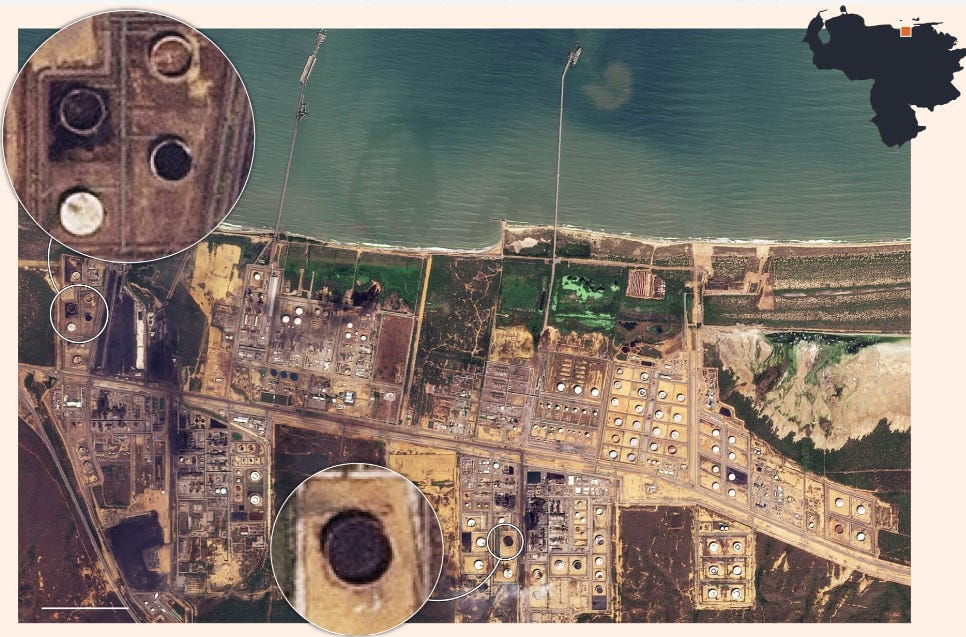
The 17 fields span the two basins that define Venezuelan oil: mature acreage around Lake Maracaibo and undeveloped and underdeveloped heavy-oil blocks in the Orinoco Belt. Some of the Maracaibo assets were recently operated under contracts signed during the Maduro years; some Orinoco blocks have little infrastructure at all.
Chevron is the only U.S. major still operating in Venezuela. It accounts for roughly a fifth of national output and is producing on the order of 250,000–260,000 barrels per day through joint ventures with PDVSA. Sources told Reuters and the Wall Street Journal that Chevron is close to migrating its existing ventures into Venezuela’s new legal framework and adding two heavy-oil fields, including expansion of the Petropiar project into the neighboring Ayacucho 8 block. A signing is expected as early as next week. Halliburton is in parallel talks to supply equipment and services.
North American Blue Energy Partners (NABEP), controlled by Venezuelan businessman Alejandro Betancourt, is the country’s second-largest private producer, with output variously estimated at 160,000–200,000 barrels per day from Lake Maracaibo and Orinoco assets. Bloomberg reported that the Pentagon has been in talks with Betancourt as a middleman on the 17-field package. Harry Sargeant III, a Florida energy investor who previously held a minority stake in NABEP through an offshore vehicle, sold that interest in August for about $300 million after pressure from Washington.
SLB (Schlumberger) and Hunt Oil have already signed agreements with PDVSA. Smaller U.S. independents have taken production-participation contracts under the hydrocarbons reform passed after Maduro’s removal. ExxonMobil and ConocoPhillips remain on the sidelines. Both are still pursuing compensation for assets expropriated in 2007 and have demanded fiscal and political terms the Rodríguez government has not yet locked in.
The unnamed “private operator” in the 17-field vehicle has not been identified in the official announcement. Reporting points to a structure that would sit above, or alongside, NABEP and incoming U.S. operators rather than replace Chevron’s existing joints.
How the Money Moves
There are two money systems, and they should not be confused.
First: the January 2026 sales regime. After Maduro’s capture, Trump announced that Venezuela would turn over 30–50 million barrels of sanctioned crude. The Department of Energy said proceeds would settle first in U.S.-controlled accounts at globally recognized banks, then be disbursed “for the benefit of the American people and the Venezuelan people at the discretion of the U.S. government.” Executive Order 14373, signed January 9, declared those funds sovereign property of Venezuela held in U.S. Treasury custody, shielded from private creditors. Early cargoes were marketed by Vitol and Trafigura. An initial $500 million sale was completed within days. Funds first sat in a Qatari account owned by Venezuela but controlled by Washington; Energy Secretary Wright later said proceeds now go to Treasury-managed accounts owned by PDVSA. Sales were described as continuing indefinitely.
Second: the August 28 investment regime. The $100 billion figure is private capital into the 17 fields and related infrastructure — wells, upgrading capacity, power, pipelines, and export terminals — not a U.S. appropriation. Washington’s claim of “no cost to the taxpayer” rests on that distinction: the United States takes equity and at-cost barrels; private companies put up the development money; Venezuela is promised tax and royalty streams estimated at $209 billion over the life of the concessions.
The 100-year term is the political-risk instrument. After two waves of nationalization (1976 and 2007), no major balance sheet will fund multi-decade Orinoco projects on a five-year license. A century-long concession, backed by U.S. offtake and a Pentagon-linked finance office, is designed to make the paper bankable.
Whether it is actually bankable is the open question. Much of the acreage lacks gathering systems, reliable electricity, and export capacity. Crime and theft of equipment remain severe. The Rodríguez government is an interim authority installed after a U.S. military operation, not a government elected under a settled constitution. Those facts will show up in the cost of capital even if the legal term is 100 years.
Is This a Stabilizing Force for New Investment?
In the narrow sense the administration intends: yes. Capital has already started to move. Chevron stayed through the Maduro years and is expanding. Independents signed production-participation contracts this year. Service companies (Halliburton, SLB) are negotiating equipment and data access. OFAC has issued a stack of amended general licenses authorizing oil-sector operations, diluent sales, and PDVSA-related transactions. Production has recovered from the mid-2025 trough and was running near 1.2 million barrels per day in July, with a rising share of exports going to U.S. Gulf Coast refiners configured for heavy sour crude.
In the broader sense: only if three conditions hold.
- Title and politics stay aligned. A 100-year concession granted by an interim president can be challenged by a future elected government, by Venezuelan courts, or by opposition figures who already object that Washington is locking up the national patrimony before a democratic transition.
- Cash actually reaches reconstruction. The January proceeds model gives Washington discretion over disbursement. That can prevent leakage to sanctioned networks. It can also become a political choke point if Caracas and Washington disagree on salaries, grid repairs, or who counts as a legitimate recipient.
- Majors return. Chevron plus NABEP plus independents can lift output. They cannot rebuild the Orinoco upgrading complex and the export system at the scale implied by 65 billion barrels without Exxon, ConocoPhillips, and the European majors that still treat 2007 as unfinished business.
If those conditions hold, the deal is a stabilizing force: long-dated title, U.S. offtake, and a legal framework that shifts operating risk onto private operators. If they do not, it is a large paper claim on barrels that stay in the ground.
What This Means for OPEC
OPEC is already smaller than it was in April.
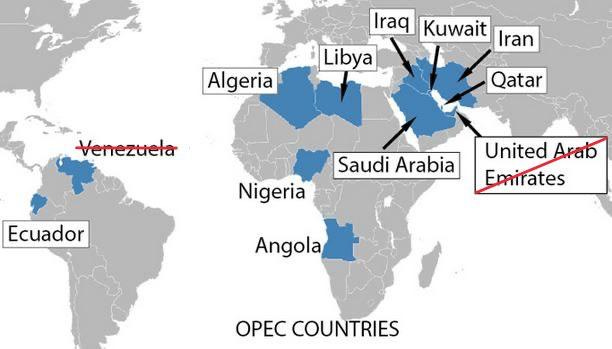
The UAE left. On April 28, Abu Dhabi announced it would exit OPEC and OPEC+ effective May 1, ending a membership that began in 1967. The official reason was a comprehensive review of production policy and capacity. The practical reason was a chronic quota grievance: capacity approaching 4.8–5.0 million barrels per day against a quota near 3.2 million, plus the Iran war, during which Iranian missiles and drones struck UAE territory and ADNOC facilities. Energy Minister Suhail Al Mazrouei said the UAE owes it to its investment partners to produce what markets require without restrictions. OPEC now has 11 members: Algeria, Congo, Equatorial Guinea, Gabon, Iran, Iraq, Kuwait, Libya, Nigeria, Saudi Arabia, and Venezuela.
Iraq wants to more than double output. Prime Minister Ali al-Zaidi said on August 21 that Iraq aims for 8–10 million barrels per day within six years. Earlier briefings set a 7-million-barrel target within three years. Pre-war output was about 4 million barrels per day. Oil is roughly 90 percent of government revenue. The disruption to Hormuz slashed exports and filled storage. Baghdad has sent the oil and finance ministers to Riyadh to seek a higher quota. OPEC+ commissioned Texas consultancy DeGolyer and MacNaughton to assess members’ maximum sustainable capacity; results are due at the end of September and will feed 2027 baselines.
In June, Iraqi officials floated the possibility of leaving if the quota did not rise. The oil ministry then walked that back, saying an exit was not official policy. The threat remains useful leverage. BP, TotalEnergies, ExxonMobil, and Chevron have all framed renewed Iraq work as long-cycle growth. A country that can add several million barrels with foreign capital has less reason to accept a ceiling written in Vienna.
Will OPEC allow the increase, or will Iraq be forced to leave?
OPEC will almost certainly grant some increase. After losing the UAE, Saudi Arabia cannot afford to lose another founding member and its second-largest producer. The capacity study gives Riyadh a technical fig leaf to raise Iraq’s baseline without looking as if the cartel simply surrendered.OPEC will almost certainly not allow a path to 8–10 million barrels per day inside the quota system. That volume would be a structural challenge to price management. Saudi Arabia’s remaining role as swing producer is already heavier without Abu Dhabi. A full Iraqi doubling would force Riyadh to cut more, or to abandon the pretense of coordinated supply.
The likely outcome is a compromise quota that Iraq accepts for 2027 and then exceeds in practice — the pattern Baghdad has used for years — unless the capacity review and the Saudi bilateral produce a number close enough to Iraq’s reconstruction math. If they do not, Iraq has a ready template: the UAE exit. Officials have already rehearsed the language.
Will Venezuela leave now that the United States holds majority effective ownership?
It is under active discussion. Bloomberg reported on August 27–28 that Venezuelan officials have considered quitting OPEC in conversations that included U.S. officials. No decision has been made. Venezuela produced about 1.16–1.25 million barrels per day in recent months and is already exempt from OPEC quotas because of the collapse of the last two decades. An exit would have little immediate barrel impact. The symbolic impact would be large: a founding member from 1960 walking away as Washington takes a 55 percent claim on a new private vehicle and at-cost offtake.
Logic points toward an eventual exit, even if Caracas stays for a transition period. OPEC membership is a production-policy commitment. The August deal is a production-policy commitment to Washington. Those two commitments conflict as soon as Venezuelan output rises enough to matter. The United States did not negotiate 100-year concessions and at-cost barrels so that a ministerial meeting in Vienna could instruct the joint venture to shut in. U.S. officials have also described a closer energy alliance with Caracas as a way to reduce OPEC’s influence.
Venezuela can remain a member on paper while ignoring quotas, as it has for years. That arrangement becomes harder to defend once U.S. equity and offtake are public and production is climbing. Leaving would let Rodríguez tell investors there is no cartel ceiling on the 17 fields. Staying would let her keep a seat at a table that still includes Saudi Arabia, Iraq, and Iran — useful if the U.S. relationship ever sours.
The Crude Truth’s read: Venezuela will not be forced out tomorrow. It will be pulled out by the same incentive that took the UAE out — the gap between what the ground can produce and what the cartel will allow. With the United States as controlling offtaker, that gap is now a feature of U.S. policy, not only Venezuelan ambition.
The Market Test
Trump’s claim that the deal more than doubles U.S. oil reserves treats 65 billion barrels of Venezuelan heavy oil as if they were already booked, produced, and fungible with light tight oil in the Lower 48. They are not. They are extra-heavy barrels that need diluent, upgraders, and years of capital. U.S. proved reserves are a different category of asset. The political sentence is doing work the reserve definition cannot.
What is real is the shift in who sets Venezuelan production policy. For sixty-six years that policy, at least formally, ran through OPEC. As of Friday night, it runs through a joint venture in which Washington holds a 55 percent effective output stake, a Pentagon finance office is in the mix, and private U.S. operators are being asked to put up $100 billion.OPEC has lost the UAE. It may lose Venezuela.
It is bargaining to keep Iraq. The cartel that was founded in Baghdad in 1960 by Iran, Iraq, Kuwait, Saudi Arabia, and Venezuela is being rewritten by Washington and Abu Dhabi at the same time.
For Investors, there is a solid partnership and greater security in investing in the huge amount of capital required to rebuild what decades of socialism have done to the oilfields and even the Venezuelan grid. I was on the Energy News Beat Podcast, and we talked about BYOB in College, but now it is BYOP, or Bring Your Own Power, to drill wells because the Venezuelan Grid is so bad that you can’t drill without your own power.
The barrels will decide which version of that story holds.
And That is the Crude Truth.
Check out our new website: https://pecos.energy/