Crude is still moving out of the U.S. Gulf Coast, but the bottleneck is no longer just barrels of oil. It is the world’s ability to turn those barrels into gasoline, diesel, and jet fuel—and to deliver the finished products where they are needed.
Labor Day weekend is supposed to mark the seasonal turn lower in driving demand. This year prices are moving the other way. Americans remain exposed to an unending fuel squeeze that began with Middle East disruptions and has been amplified by constrained global refining, low product inventories, and elevated physical delivery costs.
Record cracks, not just expensive crude
The U.S. Energy Information Administration noted on September 4 that elevated crack spreads and crude prices are both feeding pump prices. Since May, the New York Harbor gasoline crack has averaged about $1 per gallon higher than in 2025. Distillate cracks have been even stronger: the New York Harbor distillate crack has averaged 74 cents per gallon more than gasoline since March.
Market data show the stress is acute. The 3-2-1 crack spread has traded near record territory above $69 per barrel at times this year. U.S. diesel cracks have printed all-time highs above $100 per barrel, with ICE gasoil cracks also setting records. Jet fuel cracks have been similarly extreme. These are not typical seasonal moves. They reflect a global product-supply shock: refiners in Russia, China, and the Middle East have faced outages and yield disruptions, while U.S. plants have run near maximum utilization to fill the gap.
Physical delivery costs have added another layer. Shipping, pipeline constraints, and regional imbalances raise the landed cost of product even when Gulf Coast barrels are available. Limited Jones Act waivers have allowed some Gulf-to-coast shipments that would otherwise have been uneconomic, partially offsetting a 32 percent drop in U.S. gasoline imports versus the five-year average since March. Distillate inventories sat 14 percent below the five-year average in late August; gasoline inventories were 6 percent below.
U.S. refiners have shifted yields toward distillate and jet because those cracks are stronger. That helps global balances but leaves less gasoline for the domestic market. Gulf Coast crude continues to flow, and U.S. product exports have set records—distillate exports hit roughly 54 million barrels in August in one tally—but the binding constraint is refining capacity and logistics, not raw oil.
Demand has not vanished
U.S. liquid fuels consumption is projected by EIA at 20.6 million barrels per day in 2026 and 20.8 million b/d in 2027. Gasoline demand has been pressured by high prices and some demand destruction, yet it remains substantial. Jet fuel consumption is forecast near 1.72 million b/d in 2026 and 1.74 million b/d in 2027, with days of supply historically tight. Distillate demand stays supported by trucking, agriculture, and heating.
Globally, the Middle East conflict and economic headwinds have erased most of this year’s expected jet-fuel demand growth. Energy Intelligence estimates 2026 world jet demand up only about 0.5 percent to 7.8 million b/d after earlier projections of stronger growth. That still leaves a tight market when supply is impaired.
EIA’s August Short-Term Energy Outlook sees U.S. retail regular gasoline averaging $3.78 per gallon in 2026 and $3.29 in 2027, with Brent falling toward $69 per barrel next year as production recovers. Wholesale diesel and gasoline forecasts were revised higher in recent STEO updates. Those annual averages mask a painful present: current retail prices sit well above those yearly figures.
What drivers are paying this week
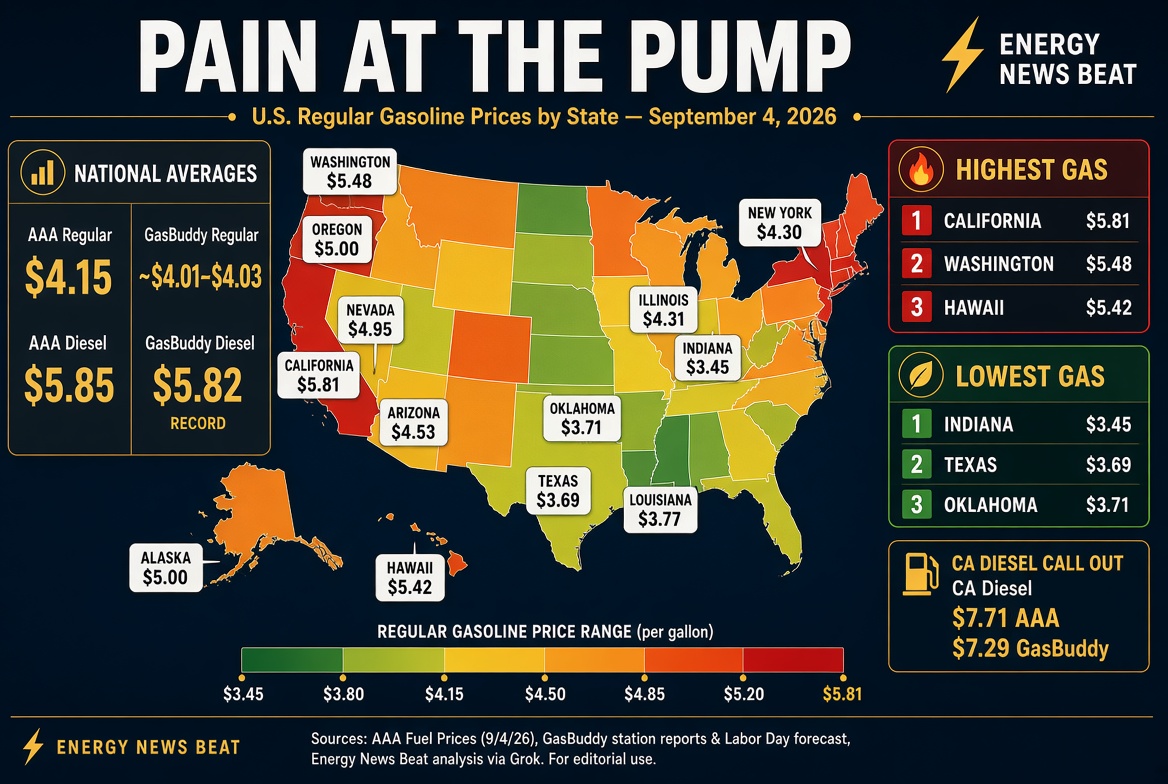
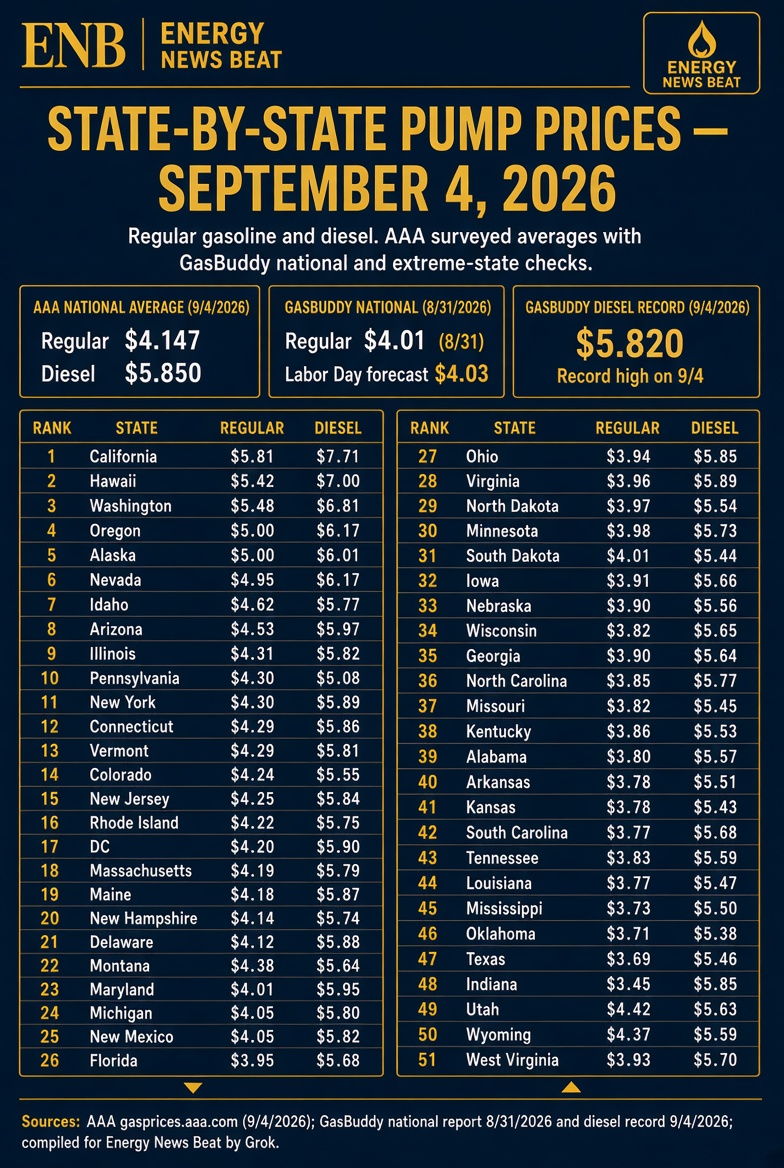
As of September 4, 2026, AAA put the national regular gasoline average at $4.1474 per gallon and diesel at $5.8500—a new daily record for diesel, just above the June 2022 high. GasBuddy data showed diesel at $5.820 the same day and projected Labor Day gasoline around $4.03, the highest Labor Day average on record in nominal terms. Year-ago comparisons are stark: gasoline is roughly 90 cents to a dollar higher; diesel is nearly $2 higher.
State-level AAA averages as of September 4 illustrate the spread:
- California: regular $5.8078, diesel $7.7094
- Hawaii: $5.4169 / $7.0041
- Washington: $5.4845 / $6.8105
- Oregon: $4.9951 / $6.1688
- Nevada: $4.9460 / $6.1726
- Alaska: $5.0044 / $6.0121
- Indiana (lowest regular): $3.4469 / diesel $5.8546
- Oklahoma (among lowest diesel): $3.7137 / $5.3833
- Texas: $3.6889 / $5.4639
- Louisiana: $3.7680 / $5.4669
West Coast and island markets remain the most expensive. Gulf and parts of the Midwest and South are cheaper on gasoline but still carry elevated diesel. Regional taxes, boutique fuel specs, and distance from Gulf refining capacity explain much of the gap.
The Jones Act waiver: a real-world experiment
In a September 3 Energy News Beat conversation, Cato Institute associate director Colin Grabow told Stu Turley and David Blackmon that the Trump administration’s Jones Act waiver has been a live demonstration of the law’s cost. The 1920 statute requires domestic waterborne cargo to move on U.S.-built, U.S.-flagged, majority U.S.-owned and U.S.-crewed vessels. Those ships are far more expensive to build and operate than foreign equivalents.
The waiver, issued in March 2026 and extended, allowed record domestic energy movements: Cato’s tracker and related reporting cite hundreds of voyages, tens of millions of barrels of crude, gasoline, diesel, jet fuel, and propane moving from the Gulf to California, the East Coast, and Puerto Rico—more volume in months than in some prior full years. Grabow and Cato colleagues argue the waiver prevented worse shortages (especially after California refinery issues) and saved consumers millions by substituting cheaper domestic barrels for overseas imports. An American Action Forum estimate put petroleum-product shipping-cost savings in a $100 million range over the waiver window, using per-barrel freight differentials.
Grabow has long argued the Jones Act shrinks the U.S. merchant fleet while raising delivered energy costs for PADDs that lack local refining. The waiver did not solve global refining tightness, but it reduced one layer of physical-delivery friction at a moment when every cent mattered.
How long could the pain last into 2027?
Analysts are not unified on a single end date, but the consensus ingredients are clear.EIA expects seasonal maintenance to cut U.S. crude runs in September–October, then a modest rebound as refiners chase still-elevated margins. Inventories are forecast to rebuild toward more normal levels into early 2027 if production recovers and demand stays contained. Brent is projected to average $69 in 2027 versus $87 in 2026 in the August STEO, with retail gasoline falling to $3.29. That implies relief relative to today’s $4-plus gasoline and $5.80-plus diesel—but not a return to 2025 prices.
Skeptical voices note that new global refining capacity additions are modest relative to lost or impaired capacity in the Middle East and Russia. U.S. plants are already running at mid-90s percent utilization; there is little spare hardware. Combined transport-fuel inventories have been projected toward multi-decade lows. Goldman Sachs and others have raised diesel-margin forecasts well into next year. A hurricane hitting the Gulf refining complex, another wave of turnarounds, or delayed Middle East recovery could keep cracks elevated deep into 2027.
Patrick De Haan of GasBuddy has repeatedly pointed to finite refining capacity as the structural issue: refiners cannot simply “make more” when they are already near max rates. Jet-fuel tightness and airline cost pressure add another demand-side floor. If geopolitical risk keeps product flows disrupted, the “unending” character of the crisis that Bloomberg described this week will extend well past winter.
The most likely path is gradual easing through late 2026 and 2027 as crude production recovers and some refining comes back online—provided no new major outage hits the Gulf or remaining Middle East capacity. Even then, diesel and jet may stay structurally tighter than gasoline. Consumers should not plan on $3 gasoline as a 2027 baseline until inventories actually rebuild and cracks normalize.
Oil is still flowing through the Gulf. The pain at the pump is now a refining-and-logistics story. Until global product capacity catches up with demand and delivery costs fall, that pain has a long tail.
At Energy News Beat, we Make Appendices Great Again.
Appendix: Sources and links
- Bloomberg, “Americans Are Out of Places to Hide From an Unending Fuel Crisis” / related briefing, Sept. 4, 2026: https://www.bloomberg.com/news/articles/2026-09-04/americans-are-out-of-places-to-hide-from-an-unending-fuel-crisis?srnd=phx-industries-energy and https://www.bloomberg.com/news/newsletters/2026-09-04/americans-are-running-out-of-places-to-hide-from-the-fuel-crisis
- Energy News Beat interview, “The Jones Act – Its Impact on Downstream with Colin Grabow, Cato Institute,” Sept. 3, 2026: https://energynewsbeat.com/conversations-in-energy-with-stu-turley/the-jones-act-its-impact-on-downstream-with-colin-grabow-cato-institute/
- EIA Today in Energy, “Elevated crack spreads and crude oil prices contribute to higher prices at the pump,” Sept. 4, 2026: https://www.eia.gov/todayinenergy/detail.php?id=68104
- EIA Short-Term Energy Outlook (August 11, 2026 release): https://www.eia.gov/outlooks/steo and related tables/pdfs
- AAA Fuel Prices, national and state averages as of Sept. 4, 2026: https://gasprices.aaa.com/ and https://gasprices.aaa.com/state-gas-price-averages/
- GasBuddy national and Labor Day commentary / diesel record reports, late August–Sept. 4, 2026
- Cato Institute Jones Act Waiver Tracker and Colin Grabow commentary: https://www.cato.org/jones-act-waiver-tracker and related Cato at Liberty posts
- American Action Forum, “The Jones Act Petroleum Waiver: Assessing Flows and Cost Savings”: https://www.americanactionforum.org/insight/the-jones-act-petroleum-waiver-assessing-flows-and-cost-savings/
- Energy Intelligence on jet-fuel demand, Sept. 3, 2026
- S&P Global / Platts reporting on Gulf Coast ULSD and diesel cracks
- Additional analyst and inventory context from EIA STEO archives, Energy News Beat diesel-crack reporting, and industry notes cited above.