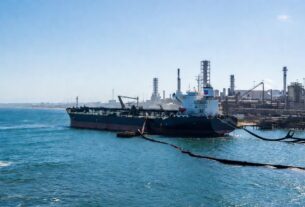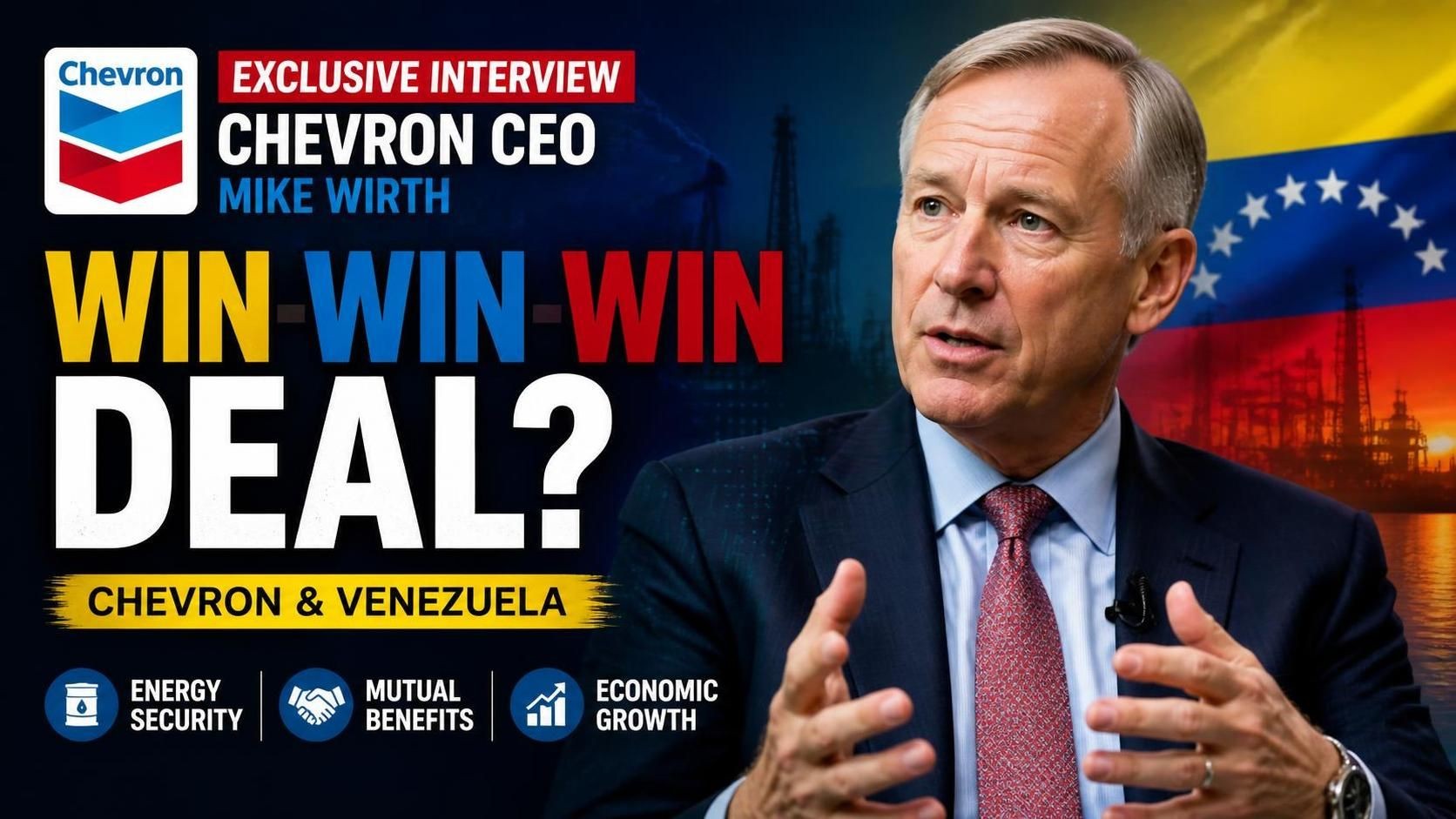
The September 2, 2026 sit-down with Tyler Kendall came the same day Chevron announced updated joint-venture agreements with PDVSA. The company will invest more than $7 billion over five years across three existing ventures, add acreage in the Orinoco Belt’s Carabobo area, and target more than 600,000 barrels per day of production—more than triple the level from the year before President Trump took office and more than double recent output of roughly 250,000–280,000 bpd. All-in costs are projected below $20 per barrel. Chevron’s overall capital-spending guidance to investors is unchanged.
Wirth emphasized Chevron’s century-long presence, the condition of existing facilities and people, and the change in commercial, fiscal, and legal terms that made the projects competitive. He cited stronger investor protections, including dispute-resolution provisions and stability around taxes and royalties, as critical after earlier experiences in which contract terms shifted. The investment is funded inside the joint ventures with PDVSA and does not require Chevron to raise its company-wide capex outlook.
The announcement is separate from a broader U.S.-Venezuela government arrangement involving other fields and a U.S. equity stake. Energy Secretary Chris Wright has described a pathway toward Venezuelan output of 1.5 million bpd next year and more than 2 million bpd by the end of the decade.

How analysts see the impact on Chevron
Wall Street generally treats the deal as incremental and disciplined rather than transformative for Chevron’s balance sheet. Motley Fool noted the $7 billion equates to about $1.4 billion a year—less than 10 percent of Chevron’s $18–21 billion annual capex range—and sits alongside high-margin growth in the Permian, Guyana (via Hess), and the Bakken. Sub-$20 costs support margins even if oil prices weaken. The firm called it a win for both the company and shareholders if execution holds.
Seeking Alpha contributors described CVX as attractively valued, with the Venezuela expansion supporting long-term cash flow without stretching the capital program. Reuters and others highlighted that Chevron is the only major U.S. producer with a continuous on-the-ground position, giving it a first-mover advantage after other companies exited years ago. Earlier in 2026, some analysts had been more cautious about the pace of any Venezuelan revival because of infrastructure decay, history of contract changes, and the capital required to restore peak output. The new legal terms and existing operations appear to have lowered that hurdle for Chevron specifically.
Shares reacted modestly higher on the news, consistent with a low-single-digit percentage of Chevron’s overall production and cash-flow profile.
Venezuela
For the host country, the immediate benefits are capital, jobs, and a signal that terms have improved enough to attract a major Western operator. Production growth from Chevron’s ventures (already up 15 percent year-to-date in some reports) plus new Carabobo acreage adds volume in a country whose output had collapsed from 3-plus million bpd decades ago to roughly 1.1–1.2 million bpd recently. Higher volumes generate export revenue, employment, and activity in a sector that still dominates the economy. Broader success, however, still depends on political durability, infrastructure repair, access to rigs and diluent, and whether other companies follow Chevron’s lead. Several analysts have noted that restoring historic capacity would require tens of billions of dollars and many years.
U.S. consumers and refiners
Venezuelan heavy, sour crude is a preferred feedstock for complex Gulf Coast refineries that convert it into gasoline, diesel, and jet fuel. Chevron already ships much of its Venezuelan output to those plants. Additional barrels increase the pool of suitable crude, which can ease feedstock costs and, over time, put downward pressure on product prices. A Chevron refining executive said earlier in 2026 that Venezuelan cargoes were already helping hold U.S. pump prices lower than they otherwise would have been amid other supply disruptions.
The effect should not be overstated in the near term. Analysts at OilPrice and elsewhere point out that refining capacity and crack spreads—not crude availability—are currently the tighter constraint, especially for diesel. An extra 300,000 bpd from Chevron over five years is meaningful for Venezuela and for specific U.S. refiners but is a modest slice of global supply. Wright and others have argued that a larger Venezuelan revival would eventually help U.S. consumers; the Chevron increment is one early, low-cost piece of that story.
Investors
For Chevron shareholders, the deal is presented as high-return, low-incremental-risk growth inside an existing footprint and an unchanged capital framework. Legal protections and fiscal competitiveness address the two historic objections. Risks that remain include execution (bringing in rigs, engineering, supply chains), political continuity in Caracas, and oil-price volatility. Most published analyst notes treat the announcement as supportive of the existing thesis—disciplined capital allocation plus advantaged barrels—rather than a reason to re-rate the stock dramatically on its own.
Wirth’s “win-win-win” line is the company’s official framing. Independent coverage largely agrees that the economics and legal terms look better than they did under prior rules, that Chevron is uniquely positioned to execute, and that U.S. refiners and Venezuelan output both stand to gain if the projects deliver. The open questions are speed, scale beyond Chevron, and whether the new framework holds.
Watch the interview: Chevron CEO Wirth on Investing $7 Billion in Venezuela
At Energy News Beat, we Make Appendices Great Again.
Appendix: Sources and Links
- Bloomberg Television: Chevron CEO Wirth on Investing $7 Billion in Venezuela – https://youtu.be/SwnsJdf8YK0
- Bloomberg: Watch Chevron CEO Wirth on Investing $7 Billion in Venezuela – https://www.bloomberg.com/news/videos/2026-09-02/chevron-ceo-wirth-on-investing-7-billion-in-venezuela-video
- Chevron press release / Business Wire summary: Chevron Expands Position in Venezuela – https://finance.yahoo.com/energy/articles/chevron-expands-position-venezuela-101500395.html
- Reuters: Chevron expands Venezuela presence with $7 billion plan – https://www.reuters.com/business/energy/chevron-expands-venezuela-position-plans-7-billion-investment-2026-09-02/
- Financial Times: Chevron to double Venezuela oil production with $7bn pledge – https://www.ft.com/content/a76721db-36e1-4198-aad8-8c90137aace9
- CNBC: Watch CNBC’s full interview with Chevron CEO Mike Wirth – https://www.cnbc.com/video/2026/09/02/watch-cnbcs-full-interview-with-chevron-ceo-mike-wirth.html
Analyst and market commentary
- Motley Fool: Chevron Just Committed $7 Billion to Venezuela. Here’s What It Means for CVX Stock – https://www.fool.com/investing/2026/09/02/chevron-just-committed-7-billion-to-venezuela-heres-what-it-means-for-cvx-stock/
- Seeking Alpha: Chevron Stock Is A Bargain Amid Venezuela Deal – https://seekingalpha.com/article/4942600-chevron-stock-bargain-amid-venezuela-deal
- Seeking Alpha: Chevron: Unclear Venezuela Opportunity, But Strong Fundamentals – https://seekingalpha.com/article/4942432-chevron-unclear-venezuela-opportunity-but-strong-fundamentals-and-technicals
- Morningstar / MarketWatch: Chevron outlines $7 billion plan to expand in Venezuela – https://www.morningstar.com/news/marketwatch/2026090286/chevron-outlines-7-billion-plan-to-expand-in-venezuela
- TipRanks / earlier positioning notes on Chevron in Venezuela
Consumer, refining, and production impact
- CBS News / Chevron refining comments on Venezuelan crude and U.S. prices – https://www.cbsnews.com/news/chevron-refinery-venezuelan-oil/
- OilPrice.com: Venezuelan Crude Will Eventually Lower US Gas Prices – https://oilprice.com/Energy/Energy-General/Venezuelan-Crude-Will-Eventually-Lower-US-Gas-Prices-Chevron-Exec.html
- OilPrice.com: Why More Venezuelan Oil Won’t Solve America’s Gasoline Problem – https://oilprice.com/Energy/Energy-General/Why-More-Venezuelan-Oil-Wont-Solve-Americas-Gasoline-Problem.html
- Al Jazeera: The US is gobbling up Venezuelan oil, but will it lower fuel prices? – https://www.aljazeera.com/news/2026/9/2/the-us-is-gobbling-up-venezuelan-oil-but-will-it-lower-fuel-prices
- EIA import data referenced in multiple reports; U.S. Energy Secretary Chris Wright comments via Bloomberg, CNBC, and Reuters coverage of September 2 events
Broader context (post-January 2026 developments)
- Wall Street Journal: Chevron’s Dilemma in Venezuela (earlier 2026 caution) – https://www.wsj.com/business/energy-oil/chevrons-dilemma-in-venezuela-support-trumps-vision-without-losing-money-2fa61d66
- CNBC: Market sees Chevron the big Venezuela winner – https://www.cnbc.com/2026/01/05/market-sees-chevron-the-big-venezuela-winner-but-oil-majors-face-a-long-road.html
- Council on Foreign Relations and Rystad Energy estimates on capital and timeline for Venezuelan recovery (cited across 2026 coverage)
Additional Bloomberg Talks and Open Interest segments from September 2, 2026, featuring Wirth and Wright provide supporting video and transcript material. All production, cost, and capex figures are drawn from company statements and contemporaneous reporting dated September 2–3, 2026.