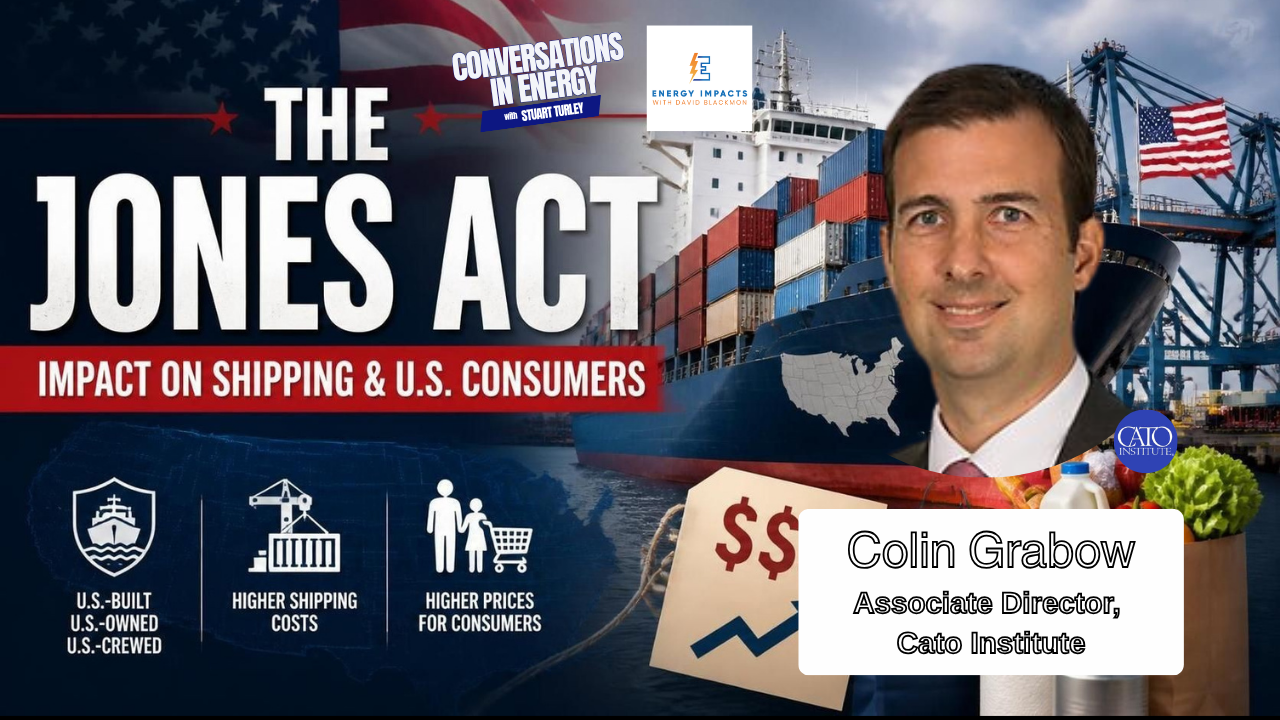
This is a Joint Podcast with David Blackmon, and Stu Turley on both podcast platforms.
The Jones Act: America’s Self-Inflicted Economic Wound
What was intended as a national security measure has instead become an economic anchor, artificially inflating shipping costs and forcing states to import energy from overseas rather than from nearby domestic sources. With the Trump administration’s recent suspension of the Jones Act,
Grabow presents compelling data showing that in just six months, more energy has been shipped domestically than in any single year over the past 25 years—a real-world experiment that validates decades of economic arguments against the law. The conversation reveals a troubling paradox: while the U.S. claims the Jones Act protects national security, American ships are regularly sent to Chinese shipyards for repairs, and the law has shrunk the merchant marine fleet from 257 ships in 1980 to just 92 today. Through concrete examples ranging from California’s refinery crisis to Puerto Rico’s energy shortages, this episode exposes how protectionist policies meant to help American workers and shipyards have instead harmed consumers, reduced economic efficiency, and undermined the very security they claim to protect.
Check out the Cato Institute Jones Act Tracker: https://www.cato.org/jones-act-waiver-tracker#key-findings
Connect with Colin Grabow on LinkedIn: https://www.linkedin.com/in/colingrabow/
Ad-Free for our Substack Subscribers

1. The Jones Act: Definition & Overview
2. Impact of the Jones Act Waiver on Energy Supply
- California’s refinery crisis: With refineries shutting down, the waiver enabled tankers to transport crude oil from Gulf Coast refineries through the Panama Canal to California—preventing a major supply crisis
- Record-breaking shipments: In just 6 months, more crude oil, gasoline, and jet fuel were shipped than in any single year over the past 25 years
- Cost savings: The waiver has saved consumers millions by enabling efficient domestic shipping

3. Economic Inefficiency & Cost to Consumers
- U.S.-built tankers cost $210-240 million vs. $52-53 million in Asia
- Operating costs for U.S. ships are $8.5 million more per year than foreign-flagged vessels
- This forces states like California and New England to import energy from overseas rather than from nearby U.S. sources
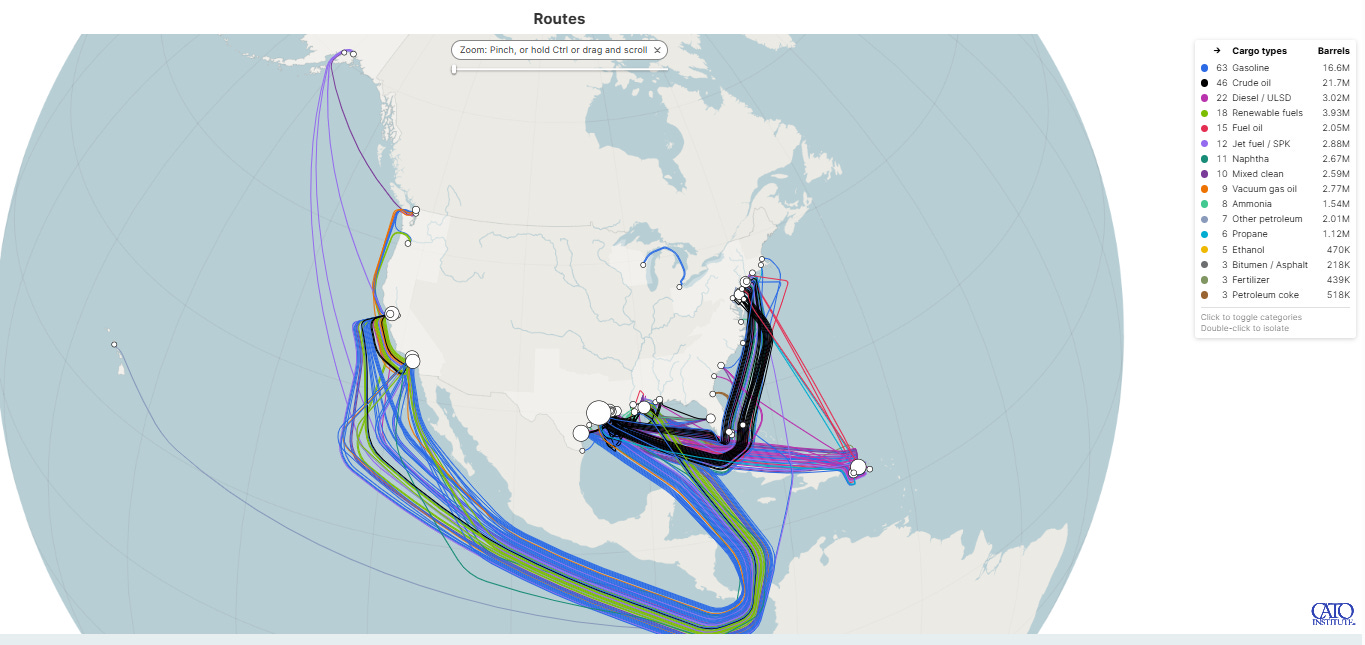
- Look at the Jones Act Tracker below and notice the huge black lines from the US Gulf Coast to California, and especially back east.
- The Trump Administration waivers have saved the consumer market on gasoline, jet fuel, diesel, and other products millions upon millions of dollars.
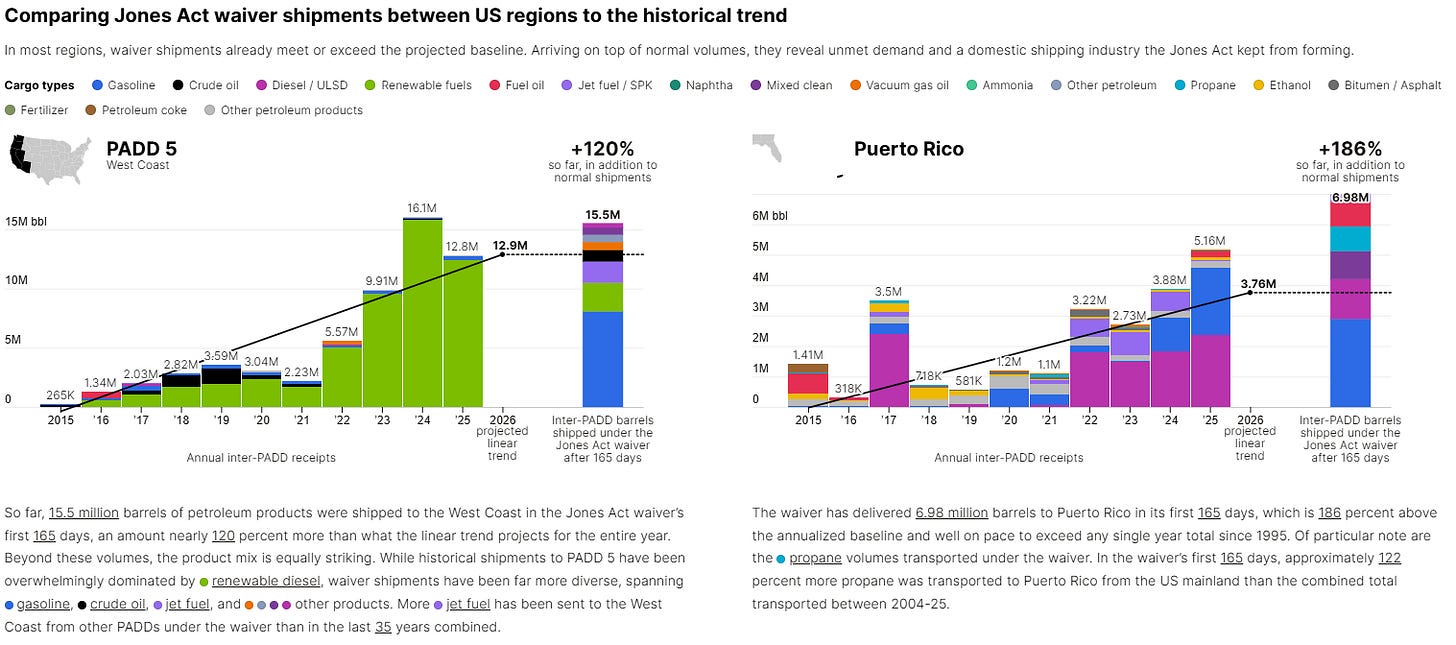
The graphic below really highlights California under the PADD 5 and Puerto Rico.
California would have seen a huge impact on its prices already without the waiver.
4. National Security Paradoxes
- The U.S. exports LNG globally but can’t ship it domestically to states like New York and Massachusetts
- Puerto Rico and Hawaii are forced to import energy from foreign sources despite U.S. production capacity
- U.S. military builds warships in allied countries (Turkey, Japan, South Korea, Finland), yet commercial ships must be U.S.-built
- American ships are regularly sent to Chinese shipyards for repairs and maintenance
5. Merchant Marine Fleet Decline
- The fleet has shrunk from 257 ships in 1980 to just 92 today
- U.S. shipyards produce only 2.6 ships per year on average vs. 40+ per year in South Korea
- The law hasn’t created jobs—it’s reduced them
6. Regional Energy Crises & Solutions
- California: 8+ million barrels of crude, 2.4 million barrels of diesel, 1.8 million barrels of jet fuel
- Puerto Rico: Record propane shipments (2.89 million barrels in 6 months vs. historical averages)
- New England: LNG and propane imports that were previously impossible
- Mid-Atlantic: 12 million barrels of crude shipped to refineries
7. Political & Lobbying Obstacles
- Concentrated benefits vs. dispersed costs: Shipyard owners and operators lobby heavily to maintain the law, while consumers bear the costs
- Congressional gridlock: Previous reform efforts (2006-2007) failed despite support from the U.S. Chamber of Commerce and API
- State interests: Louisiana opposes changes due to port economy dependence
8. Hypocrisy & Contradictions
- Refineries in New York were buying Russian oil because it was cheaper than Texas oil due to Jones Act shipping costs
- The U.S. is the world’s leading LNG exporter but can’t ship it domestically
- Companies advocating for the Jones Act for “national security” send their ships to China for repairs
9. Potential Solutions & Reform
- Allow Americans to buy foreign-built ships (aligning with policy for airlines and trucking)
- Restrict to allied shipyards (NATO countries, Japan, South Korea)
- Implement a second registry (like Norway’s international registry)
- Use direct subsidies instead of protectionism for national security needs
10. Data-Driven Evidence & Future Research
- 241 voyages, 190 unique vessels, 65 million barrels shipped
- Plans to update 2018 and 2019 research papers on the Jones Act’s economic and national security impacts
- The waiver serves as a real-world experiment validating free-market predictions
Overall Theme: The podcast argues that the Jones Act is a self-inflicted economic wound that harms consumers, reduces shipping efficiency, contradicts national security claims, and fails to maintain a competitive merchant marine—and that the current waiver proves reform is both necessary and beneficial.
I want to hear from you.
The weaponization of the U.S. Dollar by prior Presidents has created the potential for the U.S. to get a taste of its own policies back on it. I can see a situation in which China could impose sanctions on U.S. products and ban tankers. Where would that leave us in the global market if we were unable to export our products?
The odds are low, but by the raw definition, Dominance means you can’t be hindered, and I see the opportunity for others to hinder the United States’ energy dominance movement.
The looming Diesel crisis will persist through 2027 and will be an inflationary component that neither the Fed nor the U.S. Treasury will be able to address. This is an energy, supply, and government overreach problem that started decades ago.
We need to get rid of biofuels, as they take more energy to make than we get from them, and with the looming food shortage, we need to protect our farms, farmers, and grow food, not subsidies.
Thanks to Collin Grabow at the Cato Institute for his leadership on this great project and for discussing it to benefit Americans.
Hat tip to David for a great job. Check out David Blackmon’s work on Substack:

At Energy News Beat, we Make Appendices Great Again.

A shout-out to Steve Reese and the Reese Energy Consulting group for sponsoring the Podcast https://reeseenergyconsulting.com/.
Data2 if you have any business systems, can you trust A? Well, they have the patent on validation. . https://data2.zoholandingpage.com/energy
And we have WellDatabase rolling, and we use their tools for the Energy News Beat weekly Rig Reports: https://welldatabase.com/
Also entering Sponsor Rey Trevino, Pecos Operating https://pecos.energy/