However, it only captures part of the story. It does not fully capture system-level costs, weather extremes in places like Germany, consumer price outcomes in the West, or end-of-life realities.
Those gaps matter when the claim is that firm renewables are already cheaper than new fossil generation and insulated from fuel shocks.
Renewable Wind, Solar, and Storage need to be renamed, as they are not truly renewable without subsidies and price-fixing. If we were to call them what they have behaved like, it would be a parasitic, money-wealth transfer energy scheme. But that won’t get into the mainstream media. So if we called them renewable fuel energy sources, or just plain wind, solar, and storage. But the key point is that we need to realign the Levelized Cost of Electricity to the Levelized Cost of Energy. You can’t have wind, solar, and storage without fossil fuels.
None of the reports include land reclamation, recycling costs, or practices regarding how wind turbine blades are becoming a toxic problem, and less than 1% of solar panels in the U.S. are recycled. 99% of them, it seems, are thrown into landfills or shipped overseas. We have covered on the Energy News Beat Podcast that there is, for the United States Wind Turbine fleet, about an $ 89 billion liability starting to come due in the next few years.
In 100% of the world’s grids, costs go up for consumers when wind, solar, and storage are integrated at scale. We firmly believe that wind, solar, and storage have their place, and under current technology, that is at the edge or off-grid support. As Stu Turley, Energy News Beat Podcast host, has written and spoken on the podcast, he has a combination of backup power, including wind, solar, storage, and a mix of gas and gasoline generators. Consumers need to prepare for rolling blackouts and natural disasters.
The International Renewable Energy Agency report 24/7 Renewables: The Economics of Firm Solar and Wind (May 2026) argues that co-located solar PV or onshore wind plus battery energy storage can deliver round-the-clock electricity at costs competitive with, or below, new coal and gas in high-resource regions. Firm solar-plus-storage LCOEs are put at roughly $54–82/MWh in 2025 at good sites (down from over $100/MWh in 2020), with further drops projected. China sets the floor; selected sites in Brazil, India, Oman, South Africa and Australia look competitive by 2030.
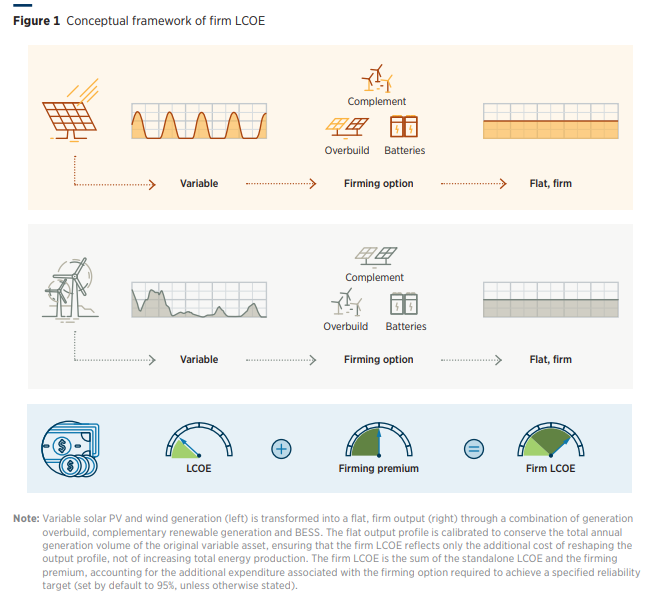
Hybrid solar-plus-wind reduces the firming premium because generation profiles complement each other. Al Dhafra in the UAE is cited as a real project delivering 1 GW firm at an estimated ~$70/MWh.
IRENA is transparent about limits. The metric is project-level, not a full power-system model. Reliability is an energy-based annual matching score (default 95 percent of a flat hourly profile), not grid adequacy or security against outages. Storage is modeled as four-hour lithium-ion only. Profiles use a single 2019 weather year. The flat output is a modeling proxy for data-center or industrial offtake contracts, described as a conservative upper-bound backstop rather than how real grids should run. Long-duration storage, geothermal, hydro and interconnection sit outside the model. WACC is assumed to be 5 percent in real terms for OECD countries and China, and 7.5 percent elsewhere; economic life is 20 years with no explicit battery replacement. Hardware costs are far lower in China than in the United States or Europe.
Those caveats are not small when the results are used to claim a fundamental shift.
What the numbers look like on the ground in the West
Hardware LCOE for new solar and wind is advertised as low. Consumer and industrial bills in high-penetration Western systems are not. Germany, a leader in wind and solar deployment, has among the highest household electricity prices in the G20 and the EU—typically in the mid-30s euro cents per kWh in 2026 (roughly $0.37–0.40/kWh range including taxes and levies), well above the U.S. average and far above China or much of Asia. A large share of the German bill is network charges, remaining policy costs, and taxes rather than wholesale energy. Wholesale prices can go negative on sunny/windy days and spike when they do not. Ireland, the UK, Belgium and Denmark show similar patterns.
Correlation is not simple causation. Gas price shocks after 2022, carbon pricing, nuclear and coal phase-outs, interconnection constraints and policy levies all play roles. Still, as variable renewable shares rose, so did the need for backup capacity, grid reinforcement and flexibility. Those costs are frequently socialized onto bills rather than fully paid by the variable generators. Negative wholesale prices are a signal of oversupply at certain hours, not proof that the average delivered kWh to industry or households is cheap. IEA and national data show EU wholesale and industrial prices remaining structurally higher than in the United States and China.
Energy-intensive industry has felt it. Chemical, steel, aluminum, fertilizer and paper producers in Germany and the wider EU have cut output, delayed investment or relocated capacity, citing electricity and gas costs that are often double U.S. levels and well above Chinese ones. Plant closures and job losses in these sectors are documented; some analyses describe selective deindustrialization rather than a complete collapse. High electricity prices also slow electrification of heat and industry—the opposite of the intended transition. Policy responses now include capacity markets, redesign of contracts for difference, and industrial support packages, which themselves add complexity and cost.
Germany’s wind is not consistent
IRENA notes that wind firming is generally more expensive than solar firming because of multi-day low-generation events. Germany illustrates why. Onshore wind capacity factors have historically averaged in the high teens to low-20s percent with large inter-annual and seasonal swings. Combined wind-plus-solar “Dunkelflaute” (dark doldrums) events—periods when both produce very little—are regular, not rare.
A 2026 Uniper analysis of 2016–2025 data defined Dunkelflaute as at least 10 consecutive hours below 10 percent of installed wind-plus-solar capacity. It found 1,435 such events, or more often than every three days on average, lasting 12.9 hours on average. 24-hour events occur almost monthly; three-day events occur about twice a year; events longer than five days occur every three-and-a-half years on average. 2023 included a 161-hour stretch. Other studies using different thresholds and longer reanalysis records confirm that multi-day low-output periods, especially in winter, are a structural feature. Four-hour batteries handle the daily solar cycle; they do not bridge week-long winter lulls without massive overbuild or other firm resources. IRENA’s single-year weather assumption and project-level framing understate this for mid-latitude systems.
Land, reclamation and “renewable” materials
Wind and solar require substantial land. Direct turbine or panel footprints can be modest; spacing, access roads, setbacks, and transmission corridors are not. Lifecycle land-use intensity is higher than nuclear or many fossil plants when spacing is counted; wind can coexist with agriculture, which reduces the effective conflict. Reclamation after decommissioning is technically feasible and often required by permit or lease, but practices vary by jurisdiction and are less standardized than decades of oil-and-gas plugging rules. Concrete foundations and soil disturbance remain. Mining for copper, silver, silicon, rare earths, lithium, and other materials is land- and water-intensive upstream of the “renewable” plant.
End-of-life is the sharper gap. Roughly 85–90 percent of a wind turbine’s mass (steel, copper, concrete) is recyclable with existing markets. Blades—glass- or carbon-fiber thermoset composites—are the problem. They have been landfilled or used as cement-kiln fuel in many places; dedicated recycling is scaling but remains expensive relative to landfill in some regions. New recyclable resins and mechanical/chemical processes exist; volumes of retiring blades are rising toward tens of thousands of tonnes per year in Europe alone. Solar modules are theoretically ~90–95 percent recyclable by mass (mostly glass and aluminum). In the United States, a large share of retired panels still goes to landfill because recovery economics for silicon and silver are thin and logistics costly; Europe’s WEEE rules produce higher collection and reported recycling rates. The first large waste wave is only now arriving. Utility-scale battery recycling is improving (high recovery of nickel, cobalt, copper; lithium catching up) but current recycled material still covers only a small fraction of new production; collection and processing infrastructure lag the build-out.
Oil and gas are not a clean contrast. Millions of unplugged or orphaned wells exist in the United States and elsewhere. Plugging and surface reclamation typically cost tens of thousands of dollars per well (medians often $20,000–$76,000, with long tails into six or seven figures). Bonding and financial assurance have frequently been inadequate; bankruptcies transfer liabilities to states and taxpayers. Federal and provincial programs have spent billions and still face backlogs. The industry has decades of operational experience plugging wells as a normal cost of doing business, plus established (if imperfectly enforced) regulations. That history is longer than the current wind/solar/storage fleet’s first retirement cycle. Neither sector fully internalizes every externality today.
Subsidies, grid services and the “renewable” label
Solar, wind and storage have received substantial policy support: feed-in tariffs, premiums, tax credits, renewable portfolio standards, contracts-for-difference and priority dispatch. Many of those costs appear on consumer bills as levies or are absorbed in higher network charges. Integration studies show profile, balancing, and adequacy costs that rise with penetration and depend on existing flexible capacity. Capacity markets and ancillary-service payments are expanding precisely because energy-only markets undervalue reliability when variable resources dominate. If wind, solar and storage were required to procure or pay for their own firming, inertia, voltage support and multi-day backup at full cost, their delivered economics would look different from standalone LCOE or even IRENA’s project Firm LCOE. In high-quality desert or plains sites with cheap capital and manufacturing, they can still compete. In cloudy, low-wind, high-cost-of-capital, constrained-grid jurisdictions, they often do not without continued support.
“Renewable” is a useful shorthand for low operating emissions and no fuel combustion at the plant. It is not a complete description of a materials-intensive, land-using, weather-dependent system whose waste streams and grid impacts are still being internalized. Charging these technologies for the resiliency they require—through market design rather than implicit socialization—would make the economics more transparent. In some locations they would remain competitive; in others the gap versus firm low-carbon options (nuclear, geothermal, hydro, gas with CCS where applicable) would widen. IRENA’s report is a serious contribution on project costs in favorable conditions. It does not close the debate on what Western consumers and industry actually pay, how often the wind fails in Germany, or whether current recycling and reclamation rates justify the unqualified “renewable” label at scale.
There truly needs to be a realignment of payouts to energy sources on the United States Grid. Payment needs to be bundled with grid resiliency. Solar and wind need to be priced together with storage as a unit operating together. Once the transmission lines, land reclamation, and recycling costs are included in the upfront prices of a project, we will get closer to seeing the true cost of wind, solar, and storage.
Calling them renewable under current technology is just marketing, with cracks forming on the horizen. If you disagree with this article or have an energy expert, please get in touch with the podcast, and we would love to visit with you.
Appendix: Sources
IRENA report and related
- IRENA, 24/7 Renewables: The Economics of Firm Solar and Wind, May 2026: https://www.irena.org/Publications/2026/May/24-7-renewables-The-economics-of-firm-solar-and-wind
- Full PDF: https://www.irena.org/-/media/Files/IRENA/Agency/Publication/2026/May/IRENA_TEC_24-7_renewables_2026.pdf
Electricity prices and markets
- Electricity cost by country comparisons: https://electricitycostcalc.com/kwh-cost-by-country.html
- Germany household prices and EU rankings: https://www.euronews.com/2026/06/01/germany-is-a-leader-in-renewables-so-why-does-it-have-one-of-the-highest-eu-electricity-pr
- IEA Electricity 2026 prices chapter: https://www.iea.org/reports/electricity-2026/prices
- BDEW German price components: referenced in quarterly reports (bdew.de)
- Energy-Charts Germany wholesale: https://www.energy-charts.info
Deindustrialization and industrial energy costs
- CRU Group on EU energy policy and industry: https://www.crugroup.com/en/communities/thought-leadership/2026/is-eu-energy-policy-undermining-its-own-industrial-base-1/
- Reuters on Europe’s industrial energy costs: https://www.reuters.com/commentary/reuters-open-interest/europe-makes-trillion-euro-bet-revive-its-battered-industry-2026-07-31/
- ECB blog on electricity prices and jobs: https://www.ecb.europa.eu/press/blog/date/2025/html/ecb.blog20250505~86c88d726c.en.html
Germany wind and Dunkelflaute
- Uniper short study on Dunkelflauten (2016–2025): https://www.uniper.energy/news/uniper-short-study-dunkelflauten-are-normal–not-the-exception
- Related PDF summaries via uniper.energy
- Academic work on low-wind events: https://iopscience.iop.org/article/10.1088/1748-9326/ab91e9
Recycling and end-of-life
- DOE wind turbine recycling assessment: https://www.energy.gov/eere/wind/wind-turbine-recycling
- IEA Wind Task 45 blade recycling: https://iea-wind.org/annual-report-2025-task-45/
- Solar panel recycling vs landfill (US context): https://energiesmedia.com/solar-panel-recycling-arithmetic-landfill-share/U
- IEA-PVPS module recycling update: https://iea-pvps.org/key-topics/t12-advances-module-recycling-3rd-edition-2026/
- Battery recycling rates and market: various 2025–2026 industry reports cited in searches
Oil and gas orphaned wells and plugging
- Environmental Science & Technology decommissioning cost study: https://pubs.acs.org/doi/10.1021/acs.est.1c02234
- RMI orphaned wells explainer: https://rmi.org/technical-explainer-orphaned-oil-and-gas-well-carbon-credits/
- Taxpayers for Common Sense FAQ: https://www.taxpayer.net/energy-natural-resources/orphaned-wells-and-oil-and-gas-bonding-faq/
Land use
- IISD renewable energy land management: https://www.iisd.org/system/files/2025-11/renewable-energy-land-management.pdf
- Our World in Data land use per energy source: https://ourworldindata.org/land-use-per-energy-source
Subsidies and integration costs
- European Commission renewable support schemes: https://energy.ec.europa.eu/topics/renewable-energy/financing/support-schemes-renewable-energy_en
- Nature Energy review of VRE integration costs: https://www.nature.com/articles/s41560-020-00695-4
- IEA integrating solar and wind: related IEA publications
Additional contemporaneous coverage of the IRENA report appears in pv-magazine, windfair and Financial Times pieces from May 2026. All figures and characterizations above are drawn from the cited public sources and the IRENA annexes on methodology, CAPEX, OPEX and financing.