Physical tightness, high product cracks, and China’s selective rebound in buying are supporting prices, but inventories, China’s still-subdued import volumes, and the existing backwardation already price in a good deal of risk.
What the OilPrice article and related reporting show
The Sept. 7 OilPrice piece (and the overlapping Bloomberg coverage it draws on) reports that American, Canadian, South American, and African grades have strengthened as China and other Asian refiners look beyond disrupted Middle East barrels. Congo’s Djeno was offered at a $20/bbl premium to ICE Brent (up from $15 two weeks earlier). China is taking more African, American/Latin, and Russian ESPO grades after Iranian supply dried up under the U.S. blockade.
Chinese seaborne imports ticked up to roughly 7.1–7.3 million b/d in August from July’s weaker level and June’s decade-low, but that remains well below the 11–12 million b/d pre-conflict pace. Beijing is restocking selectively and capturing refining margins after easing some fuel-export restrictions; it still holds very large prior inventories (~1.4 billion barrels cited in earlier reporting). Small independent refiners that relied on cheap Iranian/Venezuelan barrels have been hit hardest.
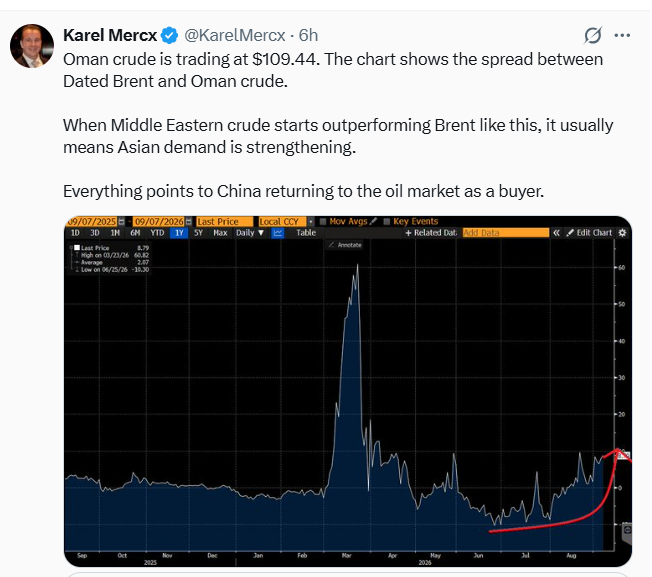
That matches the user’s point: China is the swing buyer. When it steps back in, non-Middle East grades tighten and differentials blow out. It is not, however, a full return to pre-war buying.
Current prices and this week’s analyst views
As of Sept. 7, 2026:
- WTI futures: roughly $92–$93 (intraday highs near $93.3).
- WTI spot: around $90–$91.
- Brent: around $97.
Technical pictures from FXStreet and others: bullish above the 100-day SMA (~$85) and 50% Fibonacci of the earlier decline. Immediate resistance sits near $91.73 (61.8% Fib), then $98.48 (78.6%), with a larger swing high zone near $107. Support is ~$87 and the 100-day SMA. RSI is not extreme. Geopolitics (weekend tanker strikes, Hormuz confrontations) is keeping a risk premium in the market.
Short-term forecasts this week:
- Some models (LiteFinance) allow a weekly range with a high near $102 if volatility spikes.
- Others see $90–$95 as the more probable band, with $100 as a later test if Hormuz risk escalates further or China buying accelerates.
- Longer-term bank/analyst views earlier in the year had already been cut toward the $70s–$80s for late 2026 on eventual oversupply, but the current physical tightness and product shortages keep the near-term bias higher.
Bottom line on $100 this week: Possible on a headline spike, but not the base case. The market would need a clearer new supply shock or a much larger China restocking wave. Resistance clusters just below $100.
Crack spreads, product shortages, and why physical is tight
Diesel/heating-oil cracks reached record levels (U.S. diesel crack above $106/bbl in early September after first breaking $100 in August). The 3-2-1 crack (two gasoline + one distillate vs. three crude) has been running $60+ and recently higher; one live calculation on Sept. 7 put the WTI-based 3-2-1 near $64. Gasoline cracks are also elevated but less extreme than diesel.
U.S. distillate inventories remain ~14% below the five-year average. That, plus constrained Middle East product flows and high bunker/heating-fuel demand, is why refiners will pay up for prompt barrels even when paper WTI is “only” in the low $90s. High cracks give refiners a strong incentive to run hard and hunt for crude—exactly the dynamic China is using.
Paper vs. physical: when futures catch up to barrels going into a refinery
The curve is in backwardation (front-month prices higher than later-dated contracts). That is the market’s way of saying prompt physical oil is scarce and valuable now. Steep backwardation:
- Rewards holding or delivering physical barrels immediately.
- Punishes storing oil (negative roll/carry).
- Means paper (NYMEX WTI futures) already embeds a tightness premium, but physical cargoes and regional grades often trade at even larger differentials to the benchmark.
“Paper catching up to physical” in this environment usually means:
- Front-month futures rising toward the high physical/prompt prices refiners are actually paying.
- Or the curve steepening further if inventories keep drawing and Hormuz risk stays elevated.
Refiners typically buy physical cargoes (or use futures + basis swaps) for delivery 1–3 months out. When physical is tight, they pay the prompt premium; the futures market then adjusts. Watch the WTI calendar spreads (e.g., Oct–Dec or front vs. six-month) and physical differentials (WTI Midland, WCS, African grades, ESPO) for signs the paper market is lagging or leading.
Next EIA Weekly Petroleum Status Report is due Thursday, Sept. 10 (delayed by the holiday). Last week: crude draw of 4.45 million barrels (to 424.5 million, near the five-year average), gasoline draw, distillates still tight. A larger-than-expected distillate draw would support the “physical leading paper” story.
What consumers and investors should watch
ConsumersDiesel, heating oil, and bunker prices will stay elevated as long as cracks remain extreme. Retail diesel has already been near multi-month highs.
Gasoline is high but less stretched than middle distillates. Further crude rallies or winter demand will pass through.
Watch for any China product-export surge (they have been increasing light/middle distillate shipments to capture margins), which could ease Asian tightness but not immediately U.S. heating-oil markets.
Investors
- Geopolitical headlines (Hormuz tanker traffic, further U.S.–Iran strikes) remain the biggest near-term swing factor.
- China customs/import data and refiners’ run rates.
- EIA inventories (especially distillates and Cushing stocks), OPEC Monthly Oil Market Report, IEA updates.
- Curve structure: if backwardation flattens, it signals easing physical tightness.
- Refining equities have already benefited from record cracks; crude-price upside is more leveraged to supply shocks than to the current crack environment.
A move over $100 is possible later in September if China buying accelerates and Hormuz flows stay constrained, but this week’s setup points to testing resistance in the mid-to-high $90s first.
At Energy News Beat, we Make Appendices Great Again.
Appendix: sources and links
- OilPrice: American and African Crudes Soar as China’s Oil Imports Rebound — https://oilprice.com/Latest-Energy-News/World-News/American-and-African-Crudes-Soar-as-Chinas-Oil-Imports-Rebound.html
- Bloomberg (via OilPrice/related): China Oil Demand Revival Spurs Price Spikes From Congo to Brazil — https://www.bloomberg.com/news/articles/2026-09-07/china-oil-demand-revival-spurs-price-spikes-from-congo-to-brazil
- Reuters: China’s crude oil imports stayed weak in August — https://www.reuters.com/commentary/reuters-open-interest/chinas-crude-oil-imports-stayed-weak-august-can-this-continue-2026-09-07/
- FXStreet WTI forecast (Sept. 7) — https://www.fxstreet.com/news/wti-price-forecast-bulls-retain-control-above-9050-near-july-high-amid-iran-tensions-202609070527
- LiteFinance weekly/monthly forecasts — https://www.litefinance.org/blog/analysts-opinions/oil-price-prediction-forecast/daily-and-weekly/
- Traders Union WTI short-term forecast — https://tradersunion.com/currencies/forecast/wti-crude-oil/daily-and-weekly/
- FXEmpire technicals — https://www.fxempire.com/forecasts/article/crude-oil-forecast-wti-brent-bulls-target-key-breakouts-1624961
- Diesel crack record (Bloomberg/TT News) — https://www.ttnews.com/articles/diesel-crack-spread-record
- Live 3-2-1 crack calculation — https://www.oilpriceapi.com/crack-spread
- EIA Weekly Petroleum Status Report schedule and latest highlights — https://www.eia.gov/petroleum/supply/weekly/
- CME Group on backwardation — https://www.cmegroup.com/insights/economic-research/2026/how-backwardation-generates-positive-roll-returns-in-energy.html
- Additional China/import context: OilPrice “How China Became the Ultimate Swing Oil Buyer” — https://oilprice.com/Energy/Crude-Oil/How-China-Became-the-Ultimate-Swing-Oil-Buyer.html
- Price snapshots: Investing.com WTI historical, GuruFocus, MarketWatch CL.1
All figures are as reported on or around Sept. 7, 2026, and can move quickly with headlines.