Chinese refiners are stepping back into the crude market while flooding product markets with extra gasoline and diesel, just as the rest of the world is running short of both barrels and refining capacity. August data show crude imports rising 6.2% from July to 8.93 million barrels per day, while refined product exports jumped 29% month-on-month to 6 million tons.
The rebound follows a June collapse to a decade-low 7.1 million bpd, when high prices and constrained Middle East supply prompted Beijing to lean on its massive pre-war stockpiles of roughly 1.4 billion barrels. Imports remain 23.4% below year-ago levels, but the direction has changed. Refiners have diversified away from the most disrupted Gulf grades, increasing purchases of Russian ESPO and even Argentine crude, while authorities eased export restrictions so plants could capture elevated crack spreads.
Emma Li of Vortexa told Reuters the month-on-month crude increase “is in line with the surge in fuel exports in August and continued strong exports in September.” Those extra Chinese barrels of diesel and gasoline are arriving in a market with almost no spare refining capacity left.
No spare refining and inventories near historic lows
Commodity veteran Jeff Currie put the situation bluntly on Tuesday: “We’re in a critical situation right now — there’s no easy fix to a lack of refinery capacity, a lack of strategic reserves and products, and now-depleted crude reserves.” A partial normalization could come from China restarting idle units, he said, “but a return to full normalization is unlikely any time soon.”
The numbers back him up. S&P Global estimates global refinery runs were 7.5 million bpd lower in July than a year earlier. Millions of barrels of capacity remain offline in the Middle East, Russia (hit by Ukrainian drone strikes), and parts of Asia. Outside those constrained regions, much of the remaining complex is already running at or near multi-decade highs. U.S. utilization recently hit 98%. Diesel cracks in the U.S. Gulf have exceeded $100 per barrel.
Commercial crude and product stocks in the OECD sit well below five-year averages. The U.S. Strategic Petroleum Reserve has fallen to levels last seen in the early 1980s. Global observed inventories have been drawn down by hundreds of millions of barrels since the Middle East conflict began in late February. China itself has drawn at times but still holds a large cushion that allowed it to pause buying when prices spiked. That cushion is now being used more selectively as Beijing restocks and exports product.
A world of choke points
The shortage is not only about missing barrels. It is about the routes those barrels must travel.
Weather has slammed two critical inland and canal arteries. El Niño-driven drought has forced the Panama Canal Authority to cut daily transits to 32 ships from mid-September, with further reductions possible if rains stay below average. Auction prices for slots have soared into the millions of dollars as U.S. refined products and LPG try to reach Asia after Hormuz disruptions.
On Europe’s Rhine, water levels at the key Kaub gauge have hit historic lows — at one point just 6–8 cm — forcing barges to sail at 20% of normal load. Fuel deliveries to Switzerland and western Germany have been rerouted to rail and road at sharply higher cost.
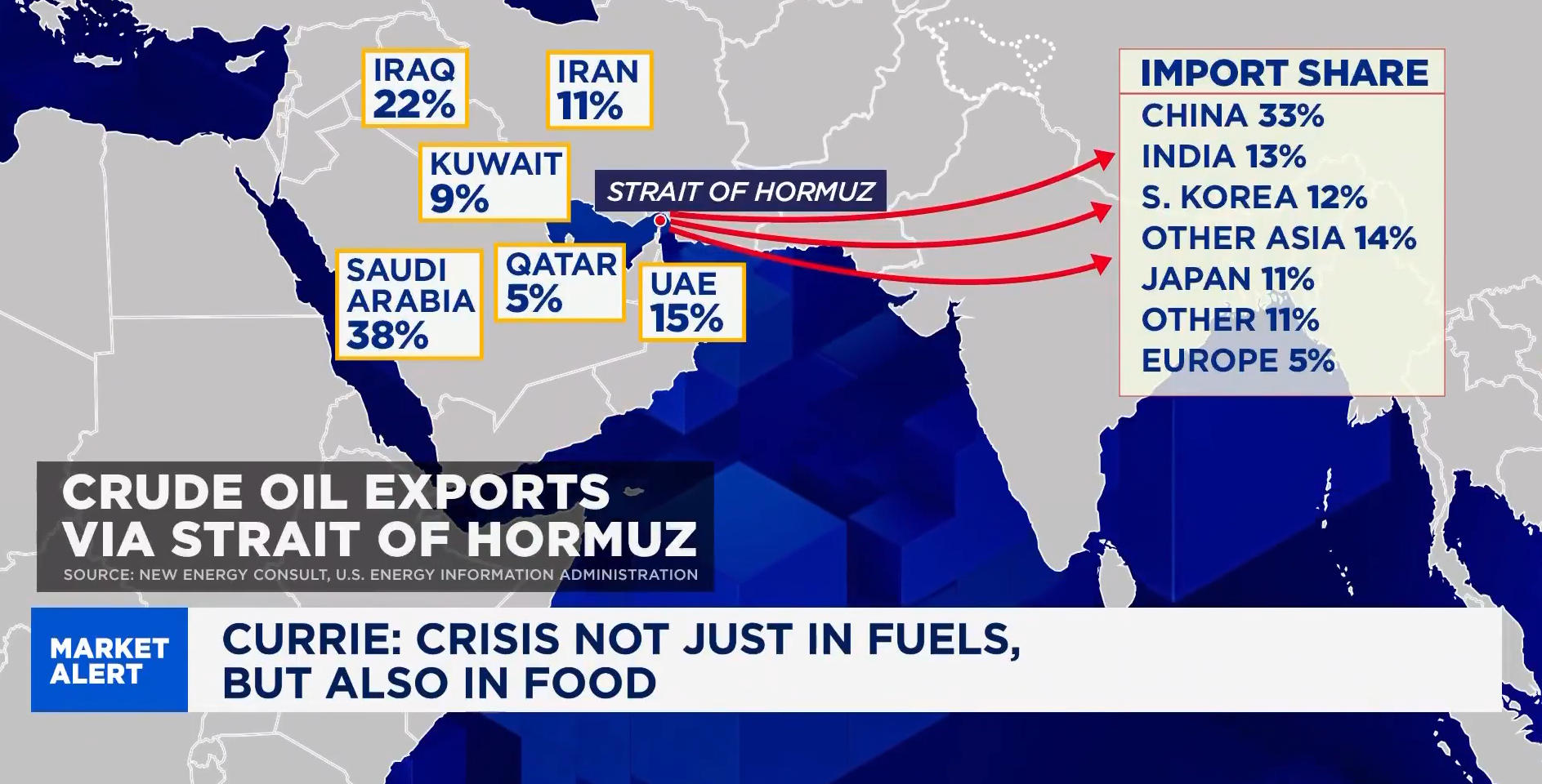
Geopolitical choke points are even tighter. Traffic through the Strait of Hormuz remains a fraction of pre-war levels after months of closure, blockades, and tit-for-tat strikes. The Bab el-Mandeb has seen Houthi attacks and a partial blockade. In the Black Sea, Russian and Ukrainian strikes on ports, terminals, and merchant vessels have repeatedly halted grain and product movements, compounding a food-and-fuel crisis. Currie listed them together: “Chokepoints from the Red Sea to the Black Sea grain corridor, the Rhine River, the Russian interior, the Panama Canal — weather, war and policymaking — have combined to create a crisis that has no easy way out.”
Product prices, not crude, are the inflation story
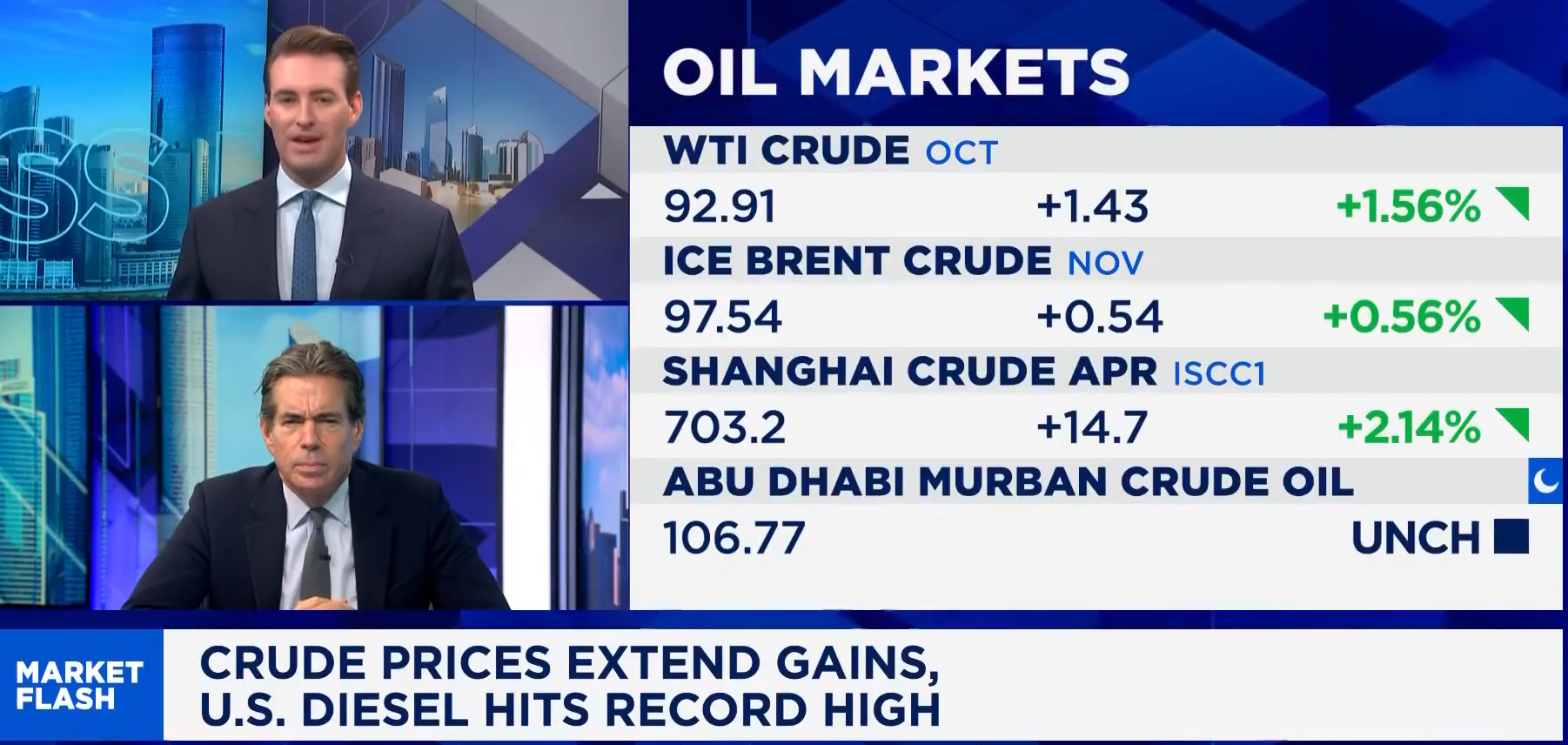
The market remains obsessed with the crude price. Consumers and businesses pay for gasoline, diesel, and jet fuel. U.S. retail diesel has set new all-time records near $5.85–$5.90 a gallon. Regular gasoline hit a Labor Day weekend record above $4.15 a gallon. European diesel cracks and pump prices have similarly exploded. Those costs feed directly into trucking, farming, construction, and food prices — and therefore into headline CPI.
Currie noted copper also printed all-time highs and that “all other commodities are dirt and diesel.” Ukrainian strikes on Black Sea grain corridors plus weather-damaged harvests have already lifted wheat and corn. The energy crisis, he said, “has arrived and it’s showing in the product prices, not in crude.”Jack Prandelli summarized the Chinese data simply: imports recovering slowly, product exports offering some relief to markets strained by conflicts in Ukraine and the Middle East. That relief is real but modest against the scale of missing refining capacity.
What analysts see for the rest of 2026 and 2027
Forecasts have swung with every headline on Hormuz traffic and cease-fire talks. The EIA’s August Short-Term Energy Outlook sees Brent averaging around $85–$87 in 2026 before falling to $69 in 2027 as inventories rebuild and most shut-in production returns. U.S. retail gasoline is projected at $3.78 a gallon this year and $3.29 next year; diesel remains elevated at $4.85 then $4.07. Wholesale diesel and gasoline forecasts were raised in August because Middle East disruptions were assumed to persist longer.
Goldman Sachs recently lifted its December 2026 and 2027 forecasts by $5 a barrel, citing prolonged Middle East shipping risks; it now sees Brent at $85 in December 2026 and $80 in 2027. Morgan Stanley and UBS earlier cut forecasts on hopes of faster Hormuz recovery and a 2027 surplus. S&P Global and others warn that even if crude flows resume, damaged Gulf and Russian refineries will keep product markets tight well into 2027. One trader told The National that “refining capacity will not come back so soon.”
The consensus that has emerged is uncomfortable: crude may find a ceiling if more Gulf barrels return, but gasoline and especially diesel look structurally tight until new capacity is built or damaged plants are repaired — a multi-year process.
Normalization, as Currie said, still looks quite far down the road. China is doing what a rational large refiner with spare units and export quotas would do: buy crude when it can, run hard, and sell product into the widest cracks the market has seen in years. The rest of the world is discovering how little spare capacity exists once several choke points fail at once.
As we talked about on the Energy News Beat podcast, diesel will be the inflation-impacting problem for the Trump Administration that the Fed cannot do anything about. It also points out that the Fed has no path forward and actually is a worthless financial institution.
At Energy News Beat, we Make Appendices Great Again.
- OilPrice.com: China’s Crude Buying Rebounds as Fuel Exports Jump 29% — https://oilprice.com/Latest-Energy-News/World-News/Chinas-Crude-Buying-Rebounds-as-Fuel-Exports-Jump-29.html
- Jeff Currie /
@CommodMkt
post and CNBC interview — https://x.com/CommodMkt/status/2097233803676733522
- Jack Prandelli /
@jackprandelli
post — https://x.com/jackprandelli/status/2097243557304177016
- EIA Short-Term Energy Outlook (August 2026) — https://www.eia.gov/outlooks/steo
- S&P Global / Rigzone on global refining spare capacity — https://www.rigzone.com/news/global_refining_system_has_little_spare_room_left-13-aug-2026-184369-article/
- The National: Global refining crunch to keep fuel prices high into 2027 — https://www.thenationalnews.com/business/energy/2026/09/03/global-refining-crunch-to-keep-fuel-prices-high-into-2027/
- Goldman Sachs forecast revision — https://www.miningweekly.com/print-version/goldman-sachs-raises-oil-price-forecasts-on-prolonged-mideast-shipping-risks-2026-09-08
- Morgan Stanley forecast — https://www.reuters.com/business/energy/morgan-stanley-cuts-brent-price-view-hormuz-flows-recover-flags-2027-surplus-2026-06-30/
- AAA / WSJ / CNBC diesel and gasoline price reports, September 2026
- Panama Canal transit cuts — Al Jazeera, FT, Splash247, September 2026 coverage
- Rhine low-water reports — Freight Perspectives, Swissinfo, Reuters, August–September 2026
- Black Sea grain and product corridor disruptions — Reuters, Ag Bull Trading reports, July–August 2026
- Strait of Hormuz and Bab el-Mandeb traffic data — Kpler, Windward, Jerusalem Post, September 2026
- China inventory estimates — Reuters/Clyde Russell columns, Kpler, Vortexa, OilPrice.com August 2026 pieces
- Additional refining commentary: Politico, Gulf News, Price Group Energy Report