American oil executives have spent months warning that a prolonged disruption of the Strait of Hormuz would eventually produce a fuel crisis rather than a simple crude shortage. They now say that moment has arrived.
Commercial inventories of gasoline, diesel, and jet fuel have been drawn down for more than six months. Strategic crude reserves have limited remaining flexibility. Last week’s attacks that shut Saudi Arabia’s East-West pipeline—the kingdom’s main Hormuz bypass—stranded an estimated 2.5 million barrels per day from an already tight market. Chevron CEO Mike Wirth and peers at ExxonMobil, Phillips 66, Marathon Petroleum, and others describe a system that has exhausted its buffers.
The constraint is not primarily a lack of crude molecules. It is global refining capacity.
Refining, Not Crude, Is the Binding Constraint
ExxonMobil CEO Darren Woods has been blunt: pump prices are being set by the supply and demand of refined products, not crude. “I’ve never seen the available capacity relative to demand as low as it is today,” he said. “It’s going to take a while for the industry to climb its way out of that hole.”
Woods estimated that the Hormuz disruption, combined with Chinese export limits and Ukrainian attacks on Russian refineries, had taken at least 5 million barrels per day of refining capacity offline earlier in the year. Phillips 66 executives later put the figure higher—roughly 7 million bpd offline in Asia and the Middle East plus another 1.4 million bpd in Russia. Global refinery throughput in recent months has run 4–5 million bpd below year-earlier levels, according to the International Energy Agency.
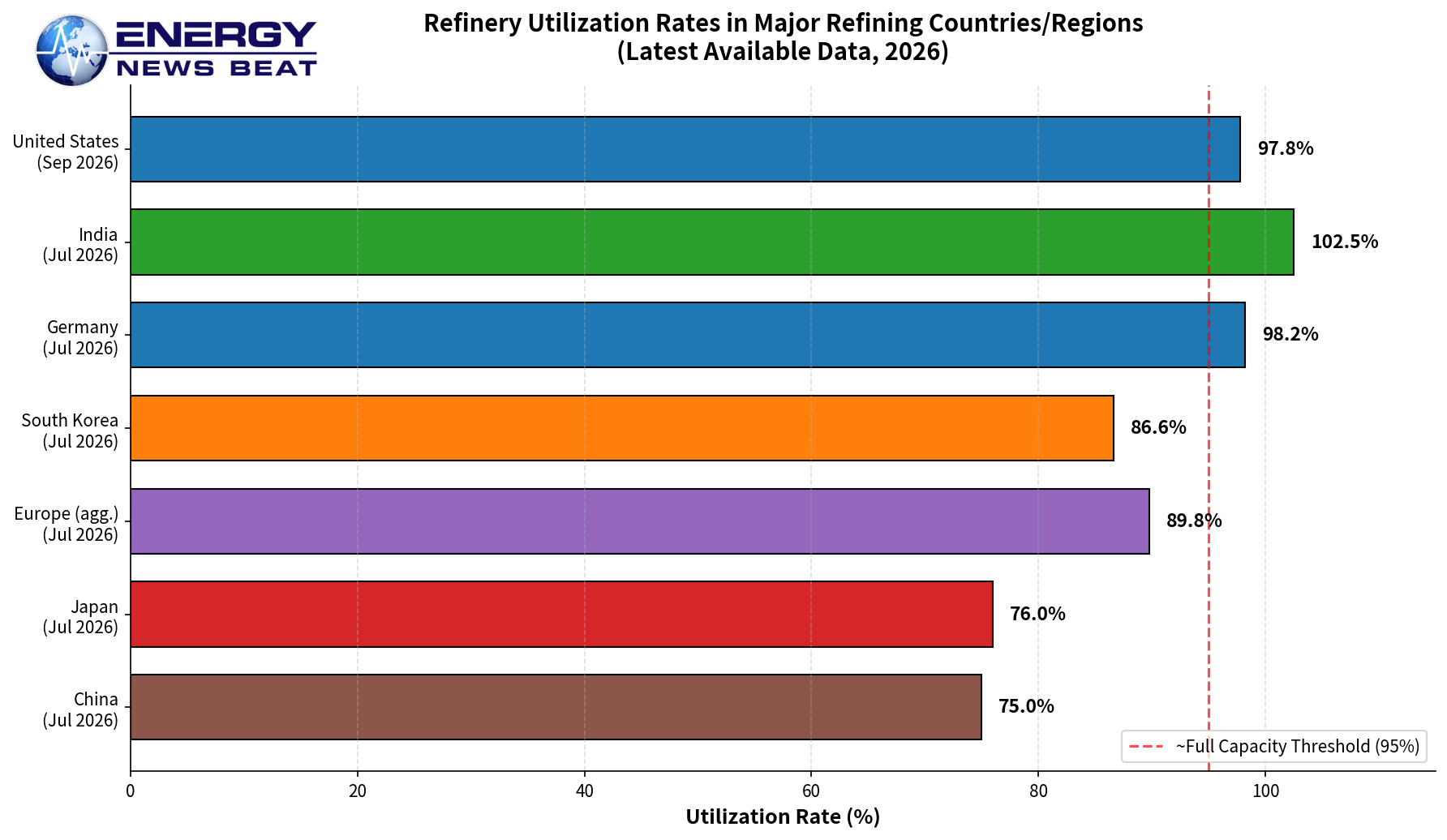
U.S. plants have been the world’s refinery of last resort. Utilization has held above 95 percent for months, reaching 97.6–97.8 percent in early September 2026, with the Midwest and Rocky Mountain regions exceeding 100 percent of operable capacity in some weeks. That is among the highest sustained rates in a quarter-century. Shell has reported running above nameplate capacity. Chevron’s U.S. crude-unit utilization exceeded 97 percent. Refiners deferred spring maintenance to capture record crack spreads—the 3-2-1 margin hit all-time highs near $70 per barrel.
Those rates cannot be sustained indefinitely without raising the risk of unplanned outages. Fall turnaround season now looms over a system already running hot.
This is why even fresh attacks on Saudi infrastructure have not produced an even larger crude-price spike. Additional barrels that cannot be processed simply add to inventories or force discounts. Product markets (diesel especially) remain the tighter constraint. U.S. diesel has traded at record levels above $6 per gallon while crude futures, though elevated above $100, have not fully tracked the product tightness.
Saudi Arabia’s Cash-Flow Bind
Saudi output fell to around 6 million barrels per day in August, the lowest in decades, as Hormuz flows stayed restricted and the East-West pipeline was later knocked offline. The kingdom had been moving 4–5 million bpd west via that pipeline to the Red Sea. With that route closed and Houthi pressure on the Bab el-Mandeb, remaining export options are limited.
Very large crude carriers loading in the Arabian Gulf have commanded record freight rates—benchmark earnings reaching $800,000 per day on the Gulf-to-Asia route in September, more than ten times pre-crisis levels. War-risk premiums and possible corridor fees compound the cost.
To generate cash flow, Saudi Arabia and other Gulf producers whose barrels must transit Hormuz have had to offer steep discounts. Crudes that can only leave through the strait have traded at large discounts to grades that can load outside it (for example, via UAE pipelines to Fujairah). Basrah Medium has been offered at discounts exceeding $40 per barrel to Murban in some assessments. Saudi official selling prices to Asia were slashed earlier in the summer by the largest monthly amounts in decades, at times moving Arab Light to a discount versus Dubai/Oman. Those discounts reflect both freight costs and the difficulty of finding buyers who can actually refine the incremental crude.
Some oil is still moving through Hormuz at reduced volumes—estimates have hovered around half of pre-war levels at times—but the combination of high tanker costs, insurance, and risk means the kingdom may have to “sneak” barrels out at whatever netback it can obtain simply to keep revenue flowing.
Global Refinery Utilization and the Outlook
Pre-crisis OPEC and IEA outlooks already pointed to tightening utilization as capacity additions lagged demand in some regions. The wars have accelerated that tightness. Operating plants in the United States, India (often above 100 percent), and parts of Europe have run hard. Middle Eastern and Russian plants have suffered direct damage or feedstock and export constraints. Chinese runs have been more moderate amid export controls. Latin American and African utilization remains structurally lower.
The result is a two-speed market: refiners that are still running enjoy exceptional margins; the global product balance stays tight. Inventories of gasoline and diesel remain seasonally low. Winter heating-oil demand will add another layer of pressure.
Investors have noticed. U.S. independent refiners such as Valero, Marathon Petroleum, and Phillips 66 have seen shares more than double in 2026 on the back of those cracks. The squeeze is expected to persist well into 2027 because lost refining capacity cannot be replaced quickly.
Investors Look Beyond the Chokepoints
At the same time, capital is rotating toward barrels that never have to pass Hormuz, Bab el-Mandeb, or the Red Sea. Family offices, hedge funds, and commodity traders are buying U.S. shale assets precisely because they sit outside those geopolitical choke points.
Gunvor has been in talks for Haynesville gas assets. Ken Griffin’s Citadel has acquired and bid on Eagle Ford and other onshore production. Vitol has repeatedly bought and sold Permian-related positions. Devon-Coterra and Shell-ARC deals illustrate the broader M&A wave. Wood Mackenzie recorded a two-year high in oil-and-gas transaction spending in the first half of 2026. Bank of America energy bankers describe family-office interest in pipelines and export terminals as a “structural shift,” not a cyclical trade, supported by both geopolitical risk and AI-driven power demand.
Permian, Eagle Ford, Haynesville, and increasingly Canadian Montney barrels reach Gulf Coast refineries and export terminals without crossing the world’s most contested waterways. Those assets also offer faster cycle times than conventional megaprojects. Investors are paying for security of supply as much as for the commodity itself.
The fuel crisis executives describe is therefore a refining and logistics crisis first. Crude can still move—sometimes at a discount and at enormous freight cost—but turning it into diesel, gasoline, and jet fuel at scale is the harder problem. That reality is already visible in the relative performance of refiners versus some upstream names and in the premium being placed on production located far from the Strait of Hormuz.
Making Appendices Great Again
Appendix: Sources and Links
- Wall Street Journal, “Oil Executives Say the Great Fuel Crisis Is Here,” Sept. 14, 2026: https://www.wsj.com/business/energy-oil/oil-executives-say-the-great-fuel-crisis-is-here-b6b32030
- Politico, “Oil industry warns refining limits could keep energy prices high,” July 31, 2026: https://www.politico.com/news/2026/07/31/oil-refining-limits-prices-high-01020385
- OilPrice.com, “Why Oil Majors Don’t Want to Build New U.S. Refineries,” Sept. 3, 2026: https://oilprice.com/Energy/Crude-Oil/Why-Oil-Majors-Dont-Want-to-Build-New-US-Refineries.html
- OilPrice.com, “Global Fuel Squeeze Triggers U.S. Refiners Stocks Rally,” Sept. 14, 2026: https://oilprice.com/Energy/Crude-Oil/Global-Fuel-Squeeze-Triggers-US-Refiners-Stocks-Rally.html
- OilPrice.com, “Wealthy Investors Flock To Oil & Gas Assets Amid Energy Crisis,” Sept. 14, 2026: https://oilprice.com/Energy/Energy-General/Wealthy-Investors-Flock-To-Oil-Gas-Assets-Amid-Energy-Crisis.html
- Reuters, “Houthis strike Saudi targets anew as talks over Strait of Hormuz stall,” Sept. 15, 2026: https://www.reuters.com/world/middle-east/houthis-strike-saudi-targets-anew-talks-over-strait-hormuz-stall-2026-09-15/
- Reuters commentary on location-based crude pricing and Hormuz discounts, Sept. 14, 2026
- Seatrade Maritime, “Hormuz security fears feed sky-high large tanker rates,” Sept. 14, 2026: https://www.seatrade-maritime.com/tankers/hormuz-security-fears-feed-sky-high-large-tanker-rates
- EIA weekly petroleum data and refinery utilization series (latest available September 2026 releases)
- IEA Oil Market Report, August/September 2026 editions
- Atlantic Council, “No quick fixes for the squeeze on refined products,” Sept. 9, 2026: https://www.atlanticcouncil.org/blogs/energysource/no-quick-fixes-for-the-squeeze-on-refined-products/
- Additional reporting from CNN Business, FT, Bloomberg via secondary summaries, CNBC, and company earnings transcripts cited in the above articles.