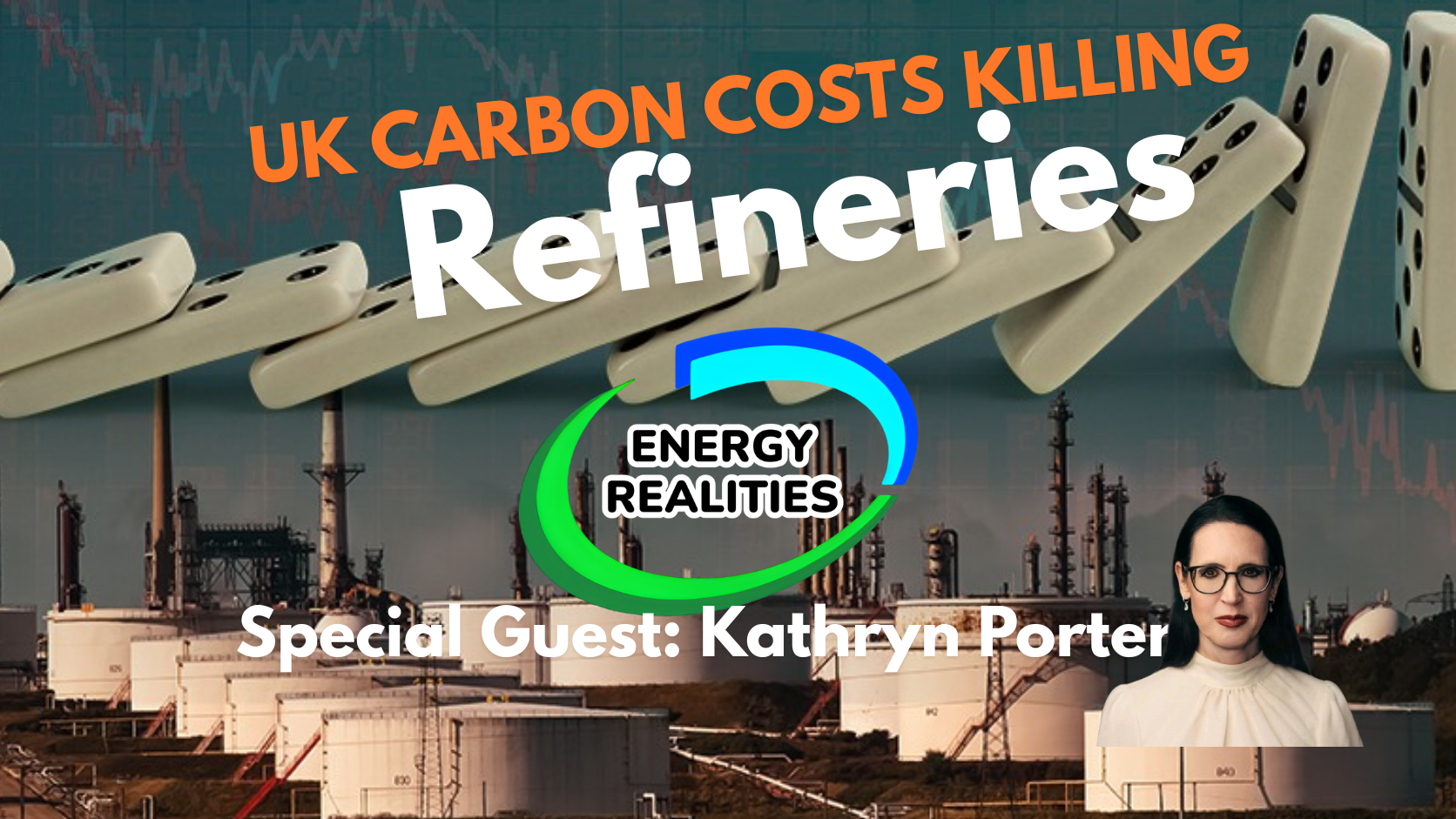
UK Carbon Cost Killing Refineries Special Guest Kathryn Porter

Carbon Capture Carbon Credit Carbon Tax Climate Crisis CO2 & GHG Diesel Downstream ENB Publisher Picks Energy Realities Energy Realities Podcast Energy Regulations Energy Storage Energy Transition International News Net Zero Regulations Top News UK

With Dr. Tammy Nemeth, David Blackmon and Stu Turley, this was a wild discussion.

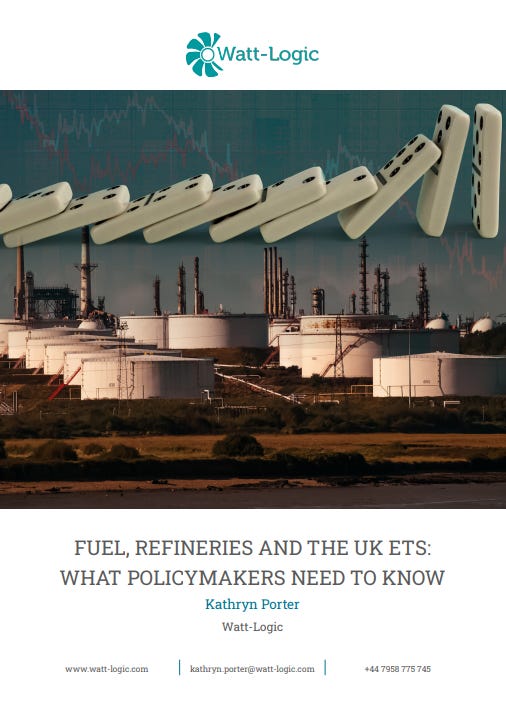
In this episode of the Energy Realities podcast, host Stu Turley sits down with Kathryn Porter, energy consultant at Watt-Logic, alongside panelists David Blackmon and Dr. Tammy Nemeth to discuss a critical threat to UK energy security: the collapse of the nation’s refining capacity. Drawing from Porter’s report “Fuel Refineries and the UK ETS: What Policy Makers Need to Know,” the conversation exposes how well-intentioned carbon pricing policies are systematically destroying the refinery sector while failing to deliver meaningful decarbonization.

With the UK down to just four refineries and facing dangerous import dependency for diesel and jet fuel, the panel examines the perverse consequences of current energy policy—from inflated fuel costs and deindustrialization to the uncomfortable reality that Western nations are outsourcing pollution to countries with weaker environmental protections.

This episode challenges the dominant green energy narrative and asks hard questions about whether current policies are actually making us safer, cleaner, or more prosperous.

With the UK’s horrific energy policies and the Net Zero crowds in Blue and Rhino states, the United States is not far behind the UK’s potential fiscal and energy collapse. Make no mistake, consumers need to prepare for rolling blackouts. As the Energy Bad Boys have been reporting – there is a reason that Blue states have a 38% energy costs

UK Carbon Cost Killing Refineries - Special Guest Kathryn Porter

1. UK Refinery Crisis & Carbon Pricing

The central focus is how UK carbon pricing policies are destroying the refinery sector. The UK has only 4 remaining refineries (down from many more), and they’re struggling to compete with newer facilities globally. Carbon pricing acts like a tax on refineries without incentivizing actual decarbonization, while other sectors like power generation can pass these costs to consumers.

2. Carbon Border Adjustment Mechanism (CBAM)

Discussion of the EU/UK’s proposed carbon border tax on imports. Refineries are notably excluded from CBAM despite being heavily impacted by carbon costs—a contradiction that reveals the policy’s true inflationary effects if applied broadly.

3. Energy Dependency & Import Exposure

The UK is increasingly dependent on imported diesel and jet fuel because domestic refineries can’t compete. This creates vulnerability to global price shocks and reduces energy security, particularly concerning given geopolitical tensions (e.g., Hormuz strait disruptions).

4. Perverse Environmental Outcomes

The obsession with CO₂ reduction is driving counterproductive policies: offshoring heavy industry to countries with weaker environmental standards, creating more pollution overall, and requiring slave labor in mining operations for renewable energy materials.

5. UK Gas Market Misconceptions

Energy Secretary claims UK pays “global gas prices,” but 97% of North Sea gas goes directly into the British grid. Increased North Sea production could materially lower prices by displacing expensive LNG imports.

6. Deindustrialization & Economic Decline

UK is de-industrializing at an alarming rate due to high energy costs and regulatory burden. This drives demand destruction not through electrification, but through loss of manufacturing capacity.

7. Government Policy Failures

Criticism of policymakers’ refusal to engage with evidence, preference for “sound bite” narratives over complex reality, and the resulting regulatory dysfunction (exemplified by HS2 project delays and costs).

8. Broader Sustainability Issues

Argument for holistic environmental thinking rather than narrow CO₂ focus—local production should be preferred to reduce shipping emissions, and all environmental impacts (not just carbon) should be considered.


The full report is quite alarming.

Share


Connect with Kathryn on LinkedIn here: https://www.linkedin.com/in/kathrynporter26/

Watt-Logic web site: https://watt-logic.com/2026/08/31/refineries-report-says-abolish-the-ets/

Download report – https://watt-logic.com/wp-content/uploads/2026/08/Refinery-report-FINAL.pdf

Stu Turley on The Energy News Beat Substack:

Energy News Beat

At The Intersection of Energy and Finance – By Sandstone Group
By Stu Turley

For David Blackmon

David Blackmon’s Energy Additions

There is no ‘Energy Transition’ taking place. Instead, what is taking place is the most massive addition of energy in all its forms in the history of mankind. Learn all about this energy addition and the public policies that drive it here.

For Tammy Nemeth

The Nemeth Report’s Substack

The Nemeth Report delivers sharp, evidence-based analysis on energy, environment, and climate policy. Dr. Tammy Nemeth challenges net-zero ideology, green energy myths, and selective environmental activism with realism and common sense.
Tagged