Hat tip to the Daily Caller and Simon August, Energy Reporter
Data centers are powering the AI revolution—but who’s paying the bill? In this episode of Energy News Beat, host Stu Turley digs into a $29.4 billion question that’s about to hit your electricity bill. Federal regulators just rejected most of PJM’s plan to make data centers bring their own power, and the consequences are staggering. Your electric bill could jump by $26.87 in June 2025, and that’s just the beginning.
With capacity costs up 46% over four auctions, Americans are waking up to a hard truth: energy dominance means little if grandma in Ohio can’t keep the lights on at a fair price. In this episode, we break down the data center crisis, explore why the U.S. is losing refinery capacity at an alarming rate, examine the geopolitical stakes of the Russia-Ukraine diesel deal, and ask the tough questions about America’s energy future. Buckle up—this is the energy story nobody’s talking about, and it’s already on your power bill.

1. Data Center Power Costs & Grid Impact (Primary Focus)
- FERC rejected most of PJM’s plan to require data centers to bring their own power
- Data center loads added 29.4 billion to capacity costs across four auctions (46% of total costs)
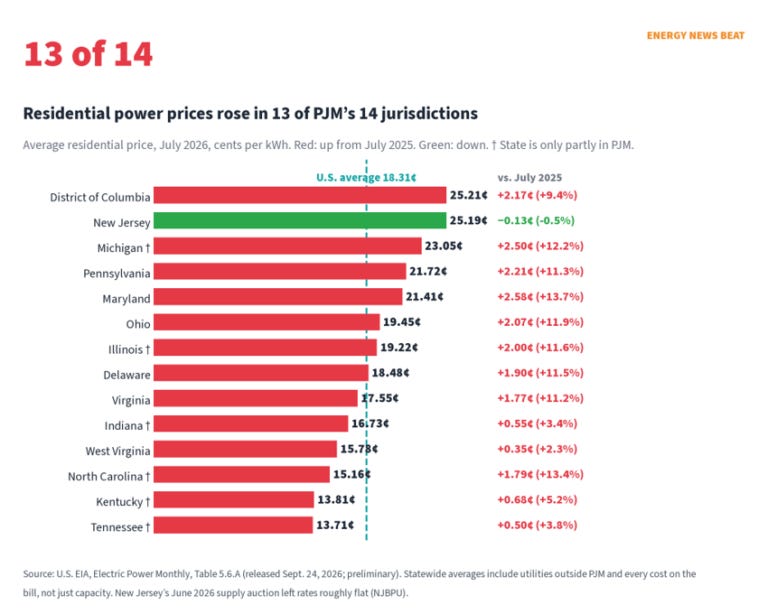
- Electricity bills are rising significantly (e.g., $26.87 increase in New Jersey in June 2025)
- Public opinion: 84% concerned about data center impact on energy prices; 73% support requiring data centers to bring their own power
- The host advocates for “BYOP” (Bring Your Own Power) as the solution
- I am for Data Centers Done Right.
Data Centers need to be done right, and this is very concerning.
The demand behind it
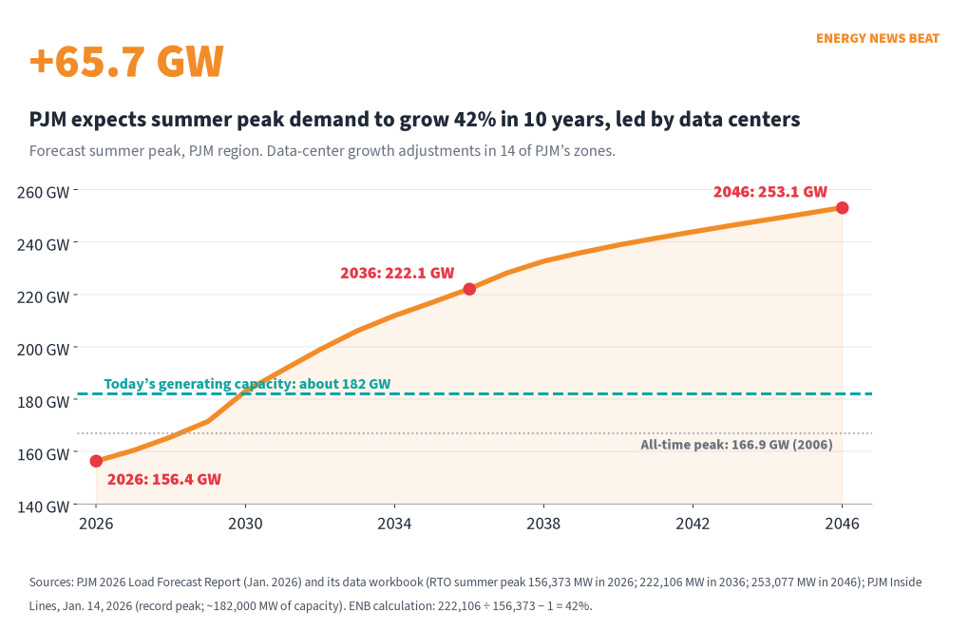
As of PJM notice posted Oct. 12; no newer notice as of 7:00 a.m. CT Oct. 13
The squeeze is not theoretical. For today, Tuesday, PJM issued a Maximum Generation Alert and a Load Management Alert, extended a capacity advisory through Oct. 14, and said it had received an emergency order from DOE. It blamed unusually warm weather and planned fall maintenance (PJM Inside Lines; ENB).
Bringing your own power is already happening without a tariff rule. On Oct. 6, Google and Constellation announced 890 MW of nuclear uprates at 11 PJM units, more than $4.3 billion, with the first expected by 2028 (Google/Constellation).
How consumers and investors see it
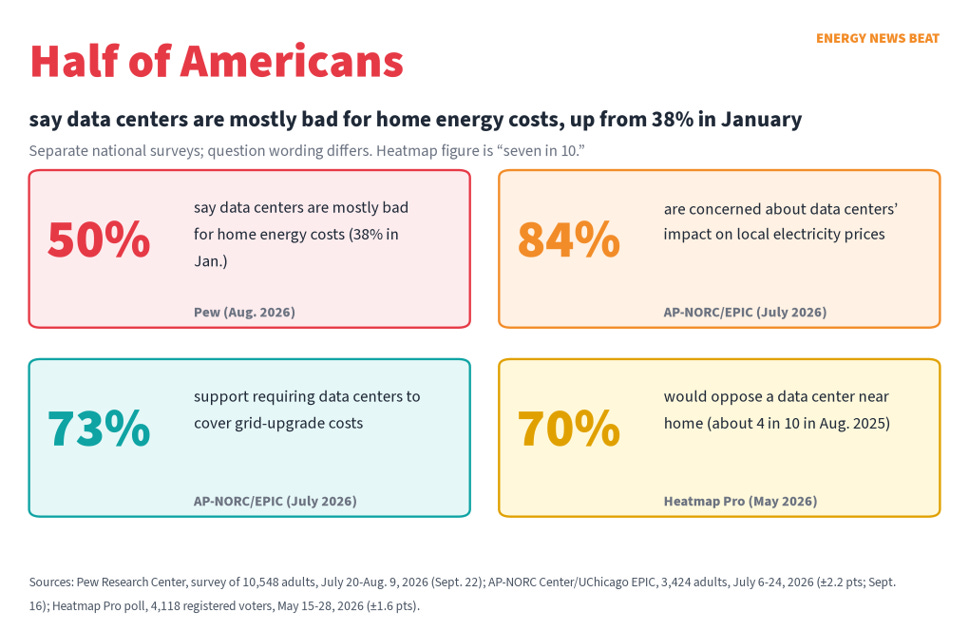
Consumer advocates have been blunt. New Jersey’s Rate Counsel called last year’s increase “over $20.00 per month” (NJBPU). Maryland’s People’s Counsel ties the summer jump to “the capacity market impacts of data centers” (OPC). Consumer advocates in the FERC case pushed for access to the registry data (FERC order).
2. China’s Oil Market Activity & Inventory
- China buying more seaborne crude (approaching 12 million barrels per day)
- Sourcing from Malaysia and Singapore due to cheaper tanker rates
- Implications for global oil markets
3. Hurricane Impact on Gulf Oil & Gas Operations
- 1.46 million barrels per day shut in (71% of Gulf output)
- 1.26 million cubic feet per day of natural gas shut in (59%)
- Personnel evacuated from 129 of 371 platforms
- Refineries faced less disruption than expected
4. Russia-Ukraine Diesel Deal & Sanctions
- Controversy over whether the deal breaks 2020 law
- Diesel prices up 71% since announcement
- Discussion of sanctions hypocrisy (EU buying from Russia during war)
- Host advocates for ending the war and changing Ukrainian leadership
- Simon from the Daily Caller had a great take on this and had several great quotes.

Asked whether Russian diesel would meaningfully lower U.S. prices, Stuart Turley, president and CEO of Sandstone Group, told the DCNF, “No, but it is a help because it gets President Putin to the table.” He called the question “the tip of the iceberg of the entire problem.”
“There’s only two ways diesel and gasoline prices can come down,” Turley said. “One, demand destruction. Number two, … more refineries. It takes decades to build refineries.”
Turley told the DCNF in a statement that the administration should instead use the Defense Production Act to expand U.S. refining, saying the law “is the right tool, and now is the time.”
“Use it as a checkbook and a referee, not a press release,” he added.
He also urged a wider Jones Act waiver, which he called “critical to keeping prices from skyrocketing,” especially on the East and West Coasts.
“High diesel prices is the inflationary impact to the United States economy that the U.S. Treasury nor the Fed can impact,” Turley told the DCNF in an interview, adding, “Buckle up. We’re in for a rough ride.”
The Kremlin said after Putin and Trump spoke Friday that “the Russian side reaffirmed its readiness to supply oil and oil products to the American and world markets.”

5. California’s High-Speed Rail Crisis
- Funding gap and hidden timelines
- Bakersfield segment reduced from 171 to 162 miles, budgeted at $35.7 billion
- Comparison to Morocco’s successful bullet train project
- Criticism of regulatory overreach
- This was a lot of fun as this article really hit a nerve in Sacramento, and there were lots of people reading it.
- It is Horiffic to think that it is easier to do business in Morroco than California.
The Morocco Contrast: SNCF Left California for a “Less Politically Dysfunctional” Environment
Energy News Beat previously highlighted a stark contrast. France’s SNCF, involved in early California planning in the 2000s, withdrew around 2011 after frustration with political interference, route changes driven by local interests, high costs, and over-engineering. Project manager Dan McNamara told The New York Times (October 2022): “There were so many things that went wrong. SNCF was very angry. They told the state they were leaving for North Africa, which was less politically dysfunctional. They went to Morocco and helped them build a rail system.”
In Morocco, SNCF provided design, construction, and operational expertise for the Al Boraq line—Africa’s first high-speed rail. The roughly 350 km Tangier–Rabat–Casablanca corridor opened in November 2018 after about a decade of work. It cut Tangier–Casablanca travel times from roughly five hours to about 2 hours 10 minutes at speeds up to 320 km/h. Costs were among the lowest globally for high-speed rail, on the order of €9 million per kilometer (or roughly $15 million per mile in some analyses). While not perfectly on the original schedule or budget, the project was completed successfully and has operated reliably. Morocco is now expanding its network further, including toward Marrakech, with international contractors and financing.
California’s economy is more than 20 times larger than Morocco’s, yet the first Central Valley segment alone is projected at more than $200 million per mile in some estimates—orders of magnitude higher than Morocco’s. California’s full Phase 1 scope has been estimated as high as $231 billion (or an “optimized” $126 billion), with full service potentially not until around 2040. Voters approved Prop 1A in 2008 for a $33–45 billion system with San Francisco–Los Angeles service in under 2 hours 40 minutes by 2020. Billions have been spent; no high-speed passenger service exists.
6. Saudi Arabia & Houthi Attacks
- Trump joining Saudi campaign against Houthis
- Saudi pipeline attacks and rapid rebuilds
- Saudi Arabia’s role in maintaining oil market stability
7. U.S. Refining Capacity Crisis
- U.S. lost 54% of red state refineries (from 300 to 130 total)
- Blue states lost 64% of refineries due to net zero policies
- Texas and Louisiana hold 50% of total refining capacity
- Call for using Defense Production Act to expand refineries
8. Strategic Energy Independence
- Importance of electrical generation for energy dominance
- Need for nuclear energy expansion
- Backup power and preparedness for consumers
- Criticism of net zero policies as wealth transfer
Here are the links to all of the articles in the podcast.
2.Trump’s Diesel Deal With Putin Runs Into The Ban Congress Passed On Russian Energy
3.Chinese Refiners to Slow Inventory Drawdowns as Imports Pick Up: What It Means for the Oil Market
4.U.S. Gulf of America Oil and Gas Activities in Response to Hurricane Isaias
9.Is Geologic Thermal Energy Storage (GeoTES) the Holy Grail of Energy for Data Centers?
10.Should the Trump Administration Use the Defense Production Act to Expand Refineries and Pipelines?
We would also like to give our sponsors a shout-out.
Check out the World’s Greatest Podcast Show Notes at EnergyNewsBeat.co or EnergyNewsBeat.com, and the Energy News Beat Substack at:

At The Intersection of Energy and Finance – By Sandstone Group
A shout-out to Steve Reese and the Reese Energy Consulting group for sponsoring the Podcast https://reeseenergyconsulting.com/.
Data2 if you have any business systems, can you trust A? Well, they have the patent on validation. . https://data2.zoholandingpage.com/energy
And we have WellDatabase rolling, and we use their tools for the Energy News Beat weekly Rig Reports: https://welldatabase.com/
Also entering Sponsor Rey Trevino, Pecos Operating https://pecos.energy/