

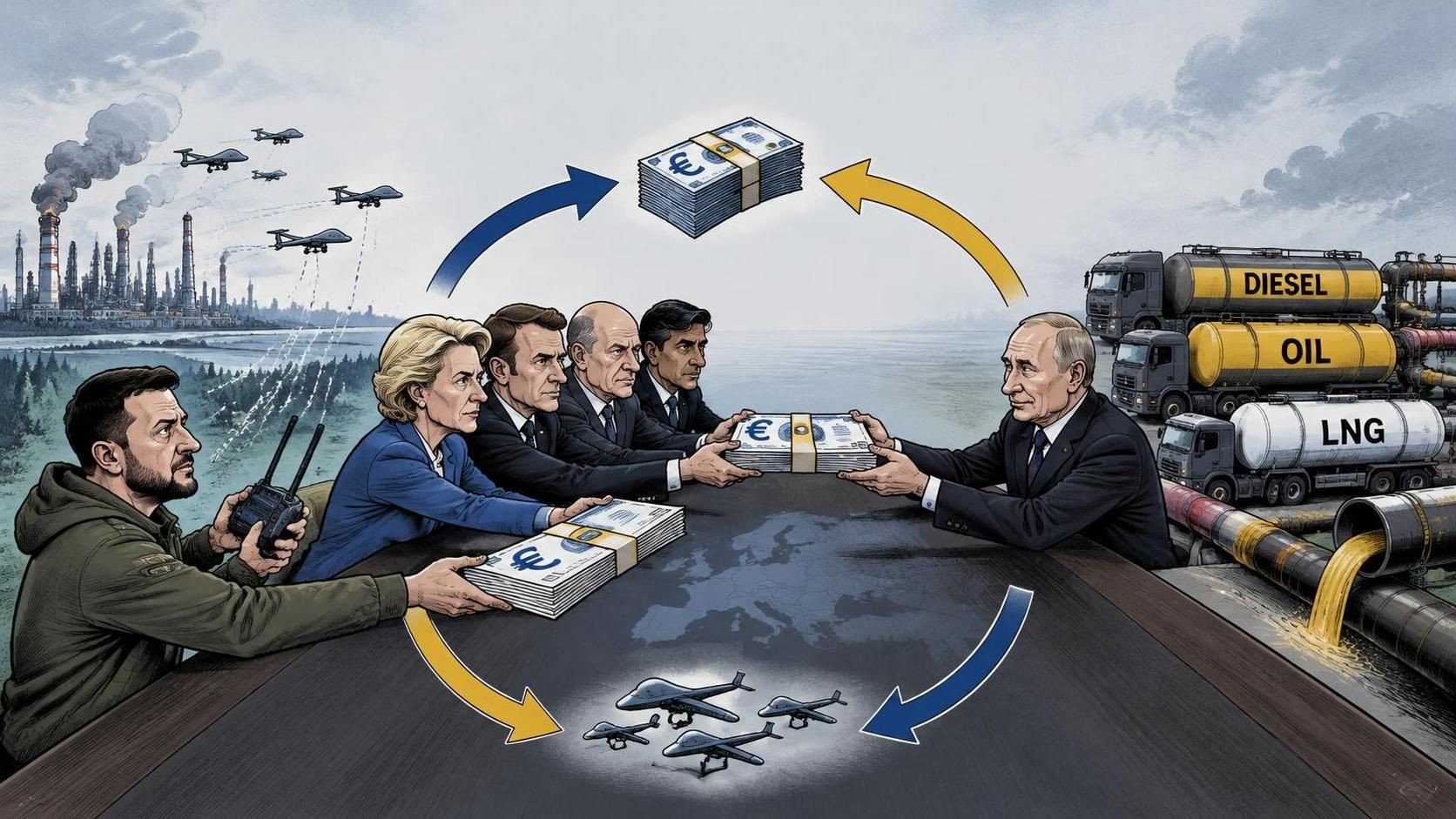
The comparison holds for 2022 and for the war as a whole. It does not hold for 2023 through 2026, or for the United Kingdom. Hungary and Slovakia are still paying.
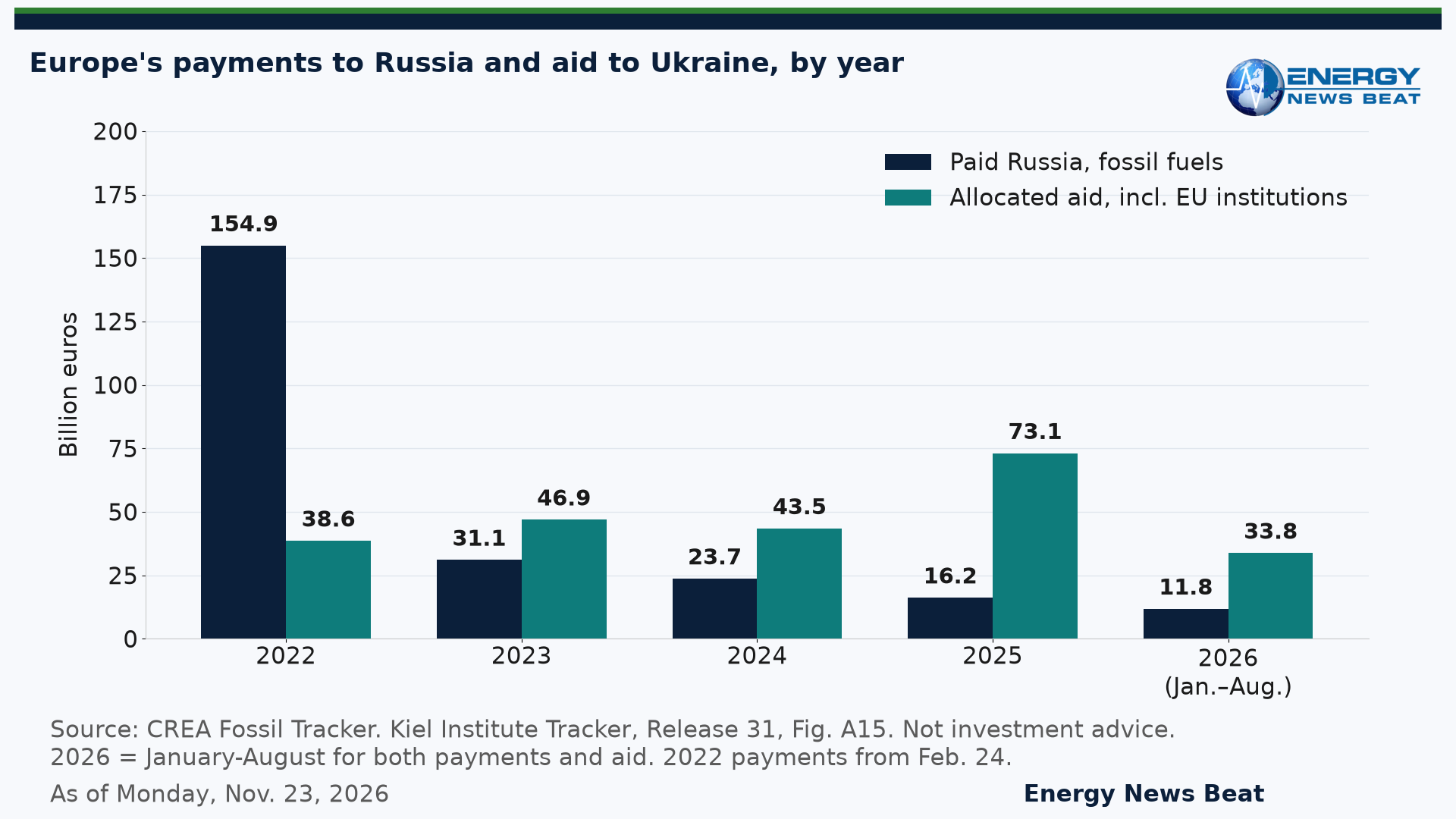
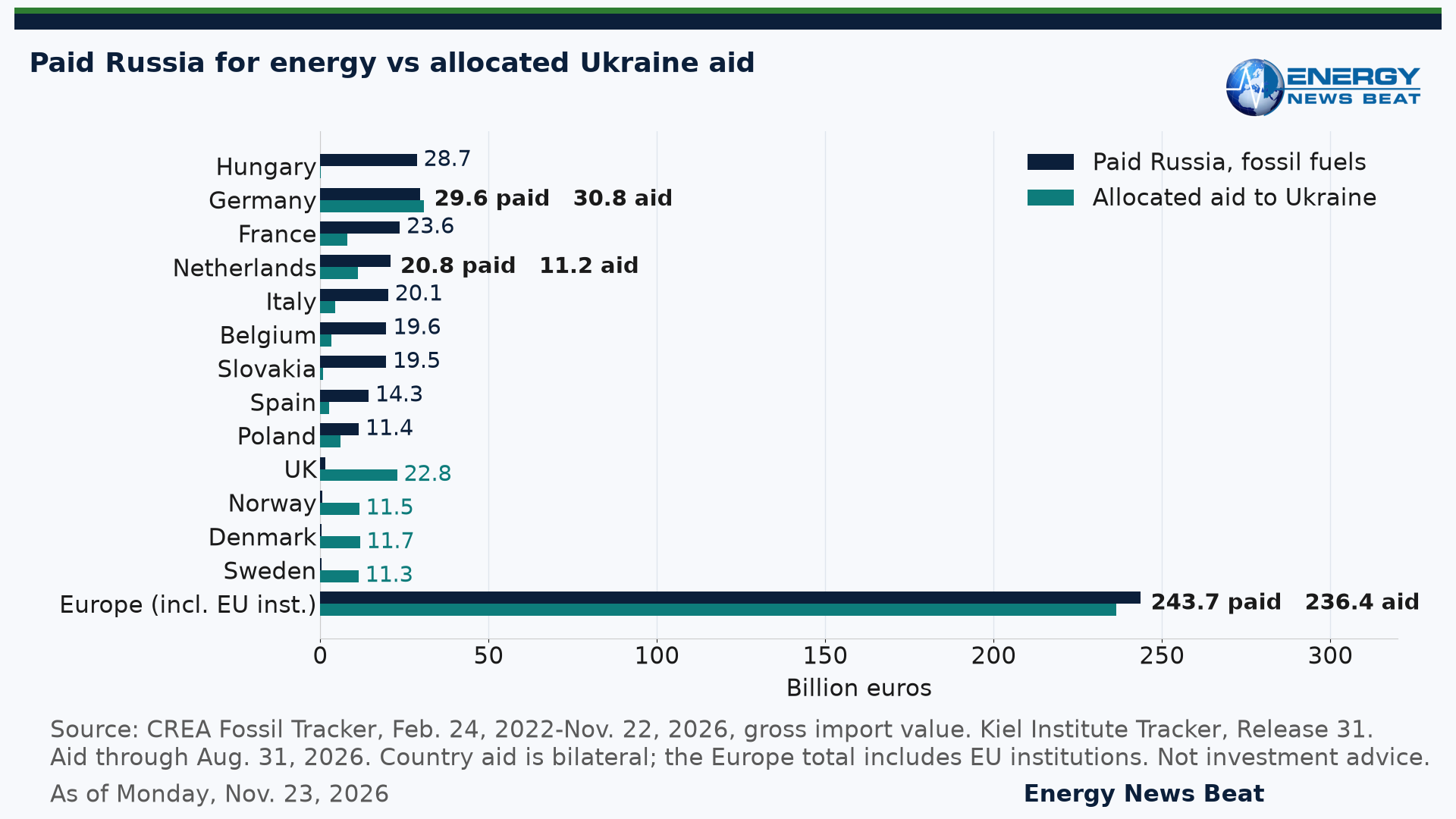
Europe, including the United Kingdom, has paid Russia €243.7 billion for fossil fuels since the full-scale invasion of Ukraine began on Feb. 24, 2022, according to the Centre for Research on Energy and Clean Air. That is about equal to the €236.4 billion Europe has allocated in aid to Ukraine through Aug. 31, 2026, according to Release 31 of the Kiel Institute’s Ukraine Support Tracker — 103% of allocated aid, and 59% of the €415.2 billion Europe has committed. Through Aug. 31, 2026, the last day of the aid window, Europe paid €237.8 billion, equal to 101% of allocated aid.
The political line is that Europe paid for both sides of the war. The data support that line for 2022, when Europe paid Russia €154.9 billion, equal to about four times the €38.6 billion it allocated in aid that year. They also support it for the war as a whole, just barely. They do not support it for 2023 through 2026, when aid ran higher than payments each year, or for the United Kingdom.
These payment figures are CREA’s estimates of gross import value at the destination, not cash received by Russia’s treasury. Kiel’s “allocated” aid is money delivered or specified for delivery. It mixes grants, loans, and weapons, and it stops in August.
The 2022 test, and what changed after it
In 2022, Europe was still Russia’s largest energy customer. CREA estimates it paid €154.9 billion from Feb. 24 through year-end, 48% of Russia’s fossil-fuel export revenue that year. After the EU embargoes, Europe’s payments fell to €31.1 billion in 2023, €23.7 billion in 2024, €16.2 billion in 2025, and €17.8 billion in 2026 through Nov. 22. Kiel’s yearly path shows Europe allocating €46.9 billion in 2023, €43.5 billion in 2024, €73.1 billion in 2025 — a year that includes the one-off G7 loans backed by profits on frozen Russian assets — and €33.8 billion in the first eight months of 2026. Payments were 66% of aid in 2023, 55% in 2024, 22% in 2025, and 35% in January through August 2026, the months Kiel’s data cover (€11.8 billion paid against €33.8 billion allocated).
A comparison published Nov. 23 said the EU had paid Russia more than €238 billion for fossil fuels through Oct. 9, a figure that matches CREA exactly (€238.1 billion). The same piece put Germany’s payments at about €35 billion. That number covers all imports, not energy alone; Destatis data shown by Statista put German imports from Russia at €33.1 billion in 2021 and €1.8 billion in 2024. CREA’s energy-only figure for Germany is €29.6 billion, of which €28.9 billion was paid in 2022. CREA records no direct German fossil-fuel purchases in 2025 or 2026. Germany has allocated €30.8 billion in bilateral aid, so “about as much” holds only on that narrow aid measure. Germany’s bilateral commitments are €54.3 billion, and €98.2 billion including its share of EU aid.
A figure reported by European Pravda puts EU payments at about €197 billion for March 2022 to July 2026, against CREA’s €231.0 billion for the same window.
Who still pays, and who does not
Hungary has paid Russia €28.7 billion since Feb. 24, 2022, and has allocated €0.05 billion in bilateral aid — about 530 times as much paid as given. Even counting Hungary’s share of EU aid, its payments are about 26 times the €1.11 billion it has committed, including that share. Slovakia has paid €19.5 billion and allocated €0.75 billion. In 2026 through Nov. 22, Hungary paid €4.38 billion, mostly pipeline gas and Druzhba crude, and Slovakia paid €2.97 billion on the same two routes.
France, Belgium, Spain, and the Netherlands are still paying for Russian LNG in 2026. France paid €3.64 billion for LNG in 2026 through Nov. 22. Belgium and Spain each paid €1.79 billion. Belgium imported no Russian LNG in August through October, then paid €133 million in November 1–22; the Netherlands shows €0 in November. The EU remains the largest buyer of Russian LNG (47%) and pipeline gas (33%), CREA’s October analysis found, even though Europe as a whole accounted for only 9.1% of Russia’s fossil-fuel export revenue in 2026 through Nov. 22. China accounted for 39%, India 22%, and Türkiye 9.5%.
The United Kingdom is the clear counterexample. It paid Russia €1.52 billion directly, all in 2022. CREA estimated a further €1.9 billion of products made from Russian crude arrived via Indian and Turkish refineries from December 2022 through May 2026, out of €4.4 billion of products from those refineries. CREA counted two more cargoes under a diesel and jet-fuel exemption that runs to Jan. 1, 2027: jet fuel worth about €63 million in June and a 64,000-tonne jet-fuel cargo worth €48 million in August. Added together, that is about €3.5 billion, roughly 15% of the UK’s €22.8 billion in allocated aid.
What Russia’s treasury collected, and what it spends on the military
Oil-and-gas revenue is smaller than the import bills, and it has been shrinking as a share of the federal budget. A Federation Council review put 2022 oil-and-gas revenue at RUB 11.59 trillion, 41.6% of federal revenue. Reuters, citing the Finance Ministry, reported RUB 8.82 trillion in 2023 and RUB 11.13 trillion in 2024. We calculate those were about 30% of federal revenue in each year. In 2025, the ministry’s preliminary execution put oil-and-gas revenue at RUB 8.48 trillion, 22.7% of the RUB 37.28 trillion in total revenue it reported, and, Reuters reported, the lowest oil-and-gas take since 2020. For January through October 2026, oil-and-gas revenue was RUB 6.44 trillion, down 14% from a year earlier, news services reported, citing the ministry.
Military spending has gone the other way. SIPRI put Russia’s total military spending, a broader measure than the “national defence” budget chapter, at $86.4 billion in 2022 and $109 billion in 2023, in older fact sheets, and at $149 billion in 2024. Its April 2026 fact sheet said Russia “increased its military spending by 5.9 per cent in 2025 to an estimated $190 billion, or 7.5 per cent of its GDP.” SIPRI’s Julian Cooper, writing on Oct. 14, 2026 about the draft 2027–29 budget, said actual 2026 military spending may reach about RUB 17 trillion. At the Bank of Russia’s official euro rate used here, that is about €188 billion. On that estimate, Europe’s €17.8 billion of 2026 payments through Nov. 22 is equal to about 34 days of Russian military spending — an arithmetic comparison, not a finding that those payments paid for the army. The 2027 draft raises the “national defence” chapter to RUB 17.1 trillion, 35.2% of planned spending.
The bill is increasingly a U.S. LNG bill
The gas Europe burns now arrives increasingly as LNG, much of it from the United States. The United States supplied 60% of the EU’s LNG imports in January 2026, up from 53% a year earlier, Reuters reported, citing Kpler. Kpler expected the U.S. share to be about 65% for 2026. The IEA, also reported by Reuters, expected record European LNG imports this year.
The EU ban on Russian LNG under long-term contracts starts Jan. 1, 2027. Rabobank says the ban removes about 15 million tonnes a year of supply and deepens reliance on U.S. LNG. This article does not measure any effect on U.S. household gas prices or on Henry Hub.
The Consumer View and the Investor View
The Consumer View. A payment to Russia for a cargo of gas is not the same thing as a weapon delivered to Ukraine, and a loan is not the same thing as a grant. For families in Europe, the practical question is what they will pay for heat and power after Jan. 1, 2027, when Russian LNG leaves the eligible supply and more of the replacement arrives from the United States. This is not investment advice.
The Investor View. Russia’s oil-and-gas share of federal revenue has fallen, while planned defence spending has not. Europe’s remaining purchases are a small slice of Russia’s export revenue in 2026; China and India are the large buyers now. The January 2027 LNG ban is a known supply change, not a surprise. This is not investment advice.
Timeline
Dates below are from named reports and official trackers. Payment figures are CREA estimates. Aid figures are Kiel Institute allocations, including EU institutions, unless noted as bilateral.
Feb. 24, 2022. Russia launches its full-scale invasion of Ukraine. CREA’s fossil-fuel payment series starts on this day.
2022 (from Feb. 24). Europe pays Russia €154.9 billion for fossil fuels, 48% of Russia’s fossil export revenue, and allocates €38.6 billion in aid to Ukraine.
Dec. 5, 2022, and January 2023. The United Kingdom’s ban on Russian oil takes effect, followed by its LNG ban. Direct UK payments cease after €1.52 billion, all in 2022.
2023–2025. Europe’s payments fall to €31.1 billion, €23.7 billion, and €16.2 billion. Allocated aid is €46.9 billion, €43.5 billion, and €73.1 billion. The 2025 aid total includes the one-off G7 ERA loans.
Jan. 2026. The United States supplies 60% of EU LNG imports, up from 53% a year earlier, Reuters reports, citing Kpler.
Jan. 21, 2026. The EU ban on oil products made from Russian crude takes effect. CREA later still counts some high-risk cargoes at EU ports.
Aug. 31, 2026. Kiel Institute Release 31’s aid window ends. Europe, including EU institutions, has allocated €236.4 billion and committed €415.2 billion.
October 2026. CREA says Russia’s fossil export revenue was €754 million a day, the highest month since December 2022. China and India set monthly records; the EU was third. The EU was still the largest buyer of Russian LNG and pipeline gas.
Nov. 22, 2026. CREA’s latest day in the figures used here. Europe has paid Russia €243.7 billion since Feb. 24, 2022, including €17.8 billion in 2026.
Nov. 26–27, 2026. A special European Council is due to consider additional 2027 financing for Ukraine. Kiel says Ukraine faces a gap of about €70 billion in 2027, and that an additional €45 billion EU loan is on the agenda. The existing Ukraine Support Loan is €90 billion for 2026–27.
Jan. 1, 2027. The EU ban on Russian LNG under long-term contracts takes effect. Rabobank estimates it removes about 15 million tonnes a year of supply.
Caveats
CREA figures are model estimates and are revised over time. A figure reported by European Pravda puts EU payments at about €197 billion for March 2022 to July 2026, against CREA’s €231.0 billion for the same window. The two main windows do not match: Kiel’s Release 31 stops at Aug. 31, 2026; CREA runs through Nov. 22, 2026. Yearly aid figures come from Kiel’s cumulative series, which ends at €235.9 billion, slightly below the €236.4 billion country-summary total used for the war-long comparison. Aid figures are nominal and mix grants, loans, and in-kind military aid. Part of the EU aid, including the G7 ERA loans, is repaid from profits on immobilized Russian assets or is repayable if Ukraine receives reparations. Some pipeline-gas attribution, including TurkStream transit, depends on CREA’s model. UK tanker insurance and the shadow fleet were not quantified. SIPRI’s 2022 and 2023 dollar figures come from older fact sheets and may have been revised; SIPRI marks Russian figures as estimates. The 2023 and 2024 oil-and-gas shares of federal revenue are our calculations. This article is not investment advice. As of Monday, Nov. 23, 2026
Stu’s Take
Europe, including the United Kingdom, paid Russia €243.7 billion for fossil fuels from Feb. 24, 2022, through Nov. 22, 2026, according to the Centre for Research on Energy and Clean Air. That is equal to 103% of the €236.4 billion Europe allocated in aid to Ukraine through Aug. 31, 2026, according to the Kiel Institute’s Ukraine Support Tracker, Release 31. In 2022, Europe paid €154.9 billion, compared with €38.6 billion in allocated aid. From 2023 through 2026, aid ran higher than payments each year. The United Kingdom paid €1.52 billion directly, all in 2022; about €3.5 billion by our count from CREA’s figures, including products made from Russian crude, against €22.8 billion in allocated aid. Hungary paid €28.7 billion and has allocated €0.05 billion in bilateral aid. Russia’s oil and gas tax revenue was RUB 8.48 trillion in 2025, the Finance Ministry said, and SIPRI put 2025 military spending at about $190 billion.
Political Hypocrisy runs parallel with Energy Hypocrisy in the European Union.
Sources
Primary and named secondary sources used in this article. Fossil-fuel payment figures are CREA estimates of gross import value at the destination, default pricing scenario, from Feb. 24, 2022, through Nov. 22, 2026. Aid figures are from the Kiel Institute Ukraine Support Tracker, Release 31, covering Jan. 24, 2022, through Aug. 31, 2026. Source dates and access are Monday, Nov. 23, 2026, unless a source carries an earlier date.
- Centre for Research on Energy and Clean Air, Russia Fossil Tracker, data through Nov. 22, 2026, default pricing scenario, current as of a Nov. 23, 2026 download. https://energyandcleanair.org/russia-fossil-tracker/
- CREA, “October 2026 — Monthly analysis of Russian fossil fuel exports and sanctions,” including EU shares of Russian LNG (47%) and pipeline gas (33%), October export revenue of €754 million a day, and China and India monthly records. https://energyandcleanair.org/october-2026-monthly-analysis-of-russian-fossil-fuel-exports-and-sanctions/
- CREA, “May 2026 — Monthly analysis of Russian fossil fuel exports and sanctions,” estimating €1.9 billion of UK imports of products made from Russian crude from December 2022 through May 2026, out of €4.4 billion of products from Indian and Turkish refineries. https://energyandcleanair.org/may-2026-monthly-analysis-of-russian-fossil-fuel-exports-and-sanctions/
- CREA, “June 2026 — Monthly analysis of Russian fossil fuel exports and sanctions,” counting the UK’s first post-exemption cargo, jet fuel worth about €63 million, unloaded in June 2026. https://energyandcleanair.org/june-2026-monthly-analysis-of-russian-fossil-fuel-exports-and-sanctions/
- CREA, “August 2026 — Monthly analysis of Russian fossil fuel exports and sanctions,” counting the UK’s second post-exemption shipment, a 64,000-tonne jet-fuel cargo worth €48 million, under a diesel and jet-fuel exemption running to Jan. 1, 2027. https://energyandcleanair.org/august-2026-monthly-analysis-of-russian-fossil-fuel-exports-and-sanctions/
- Kiel Institute for the World Economy, Ukraine Support Tracker, Release 31, dataset published October 2026, update of Oct. 8, 2026, covering aid from Jan. 24, 2022, through Aug. 31, 2026. Country Summary (€) and Fig. A15. https://www.ifw-kiel.de/topics/war-against-ukraine/ukraine-support-tracker/
- Nathanael Frey, Paolo Lini, Federico Mellace, Taro Nishikawa, and Christoph Trebesch, Kiel Policy Brief 222, “Ukraine’s Aid Squeeze: The European Union as the Last Big Donor,” Nov. 20, 2026, including the €90 billion Ukraine Support Loan, the ~€45 billion loan on the Nov. 26–27 agenda, the ~€70 billion 2027 gap, ERA loans almost fully disbursed, and Ukraine Facility disbursements about €9 billion behind schedule as of October 2026. https://www.ifw-kiel.de/fileadmin/Dateiverwaltung/IfW-Publications/fis-import/f24b2c9a-3341-486e-b343-3b218c222c27-KPB_222.pdf
- Antonio Graceffo, The Gateway Pundit, “Germany Paid Russia About as Much for Imports as It Gave Ukraine in Bilateral Aid, Yet European Leaders Criticized Trump’s Russian Diesel Deal,” Nov. 23, 2026. The EU €238 billion figure matches CREA through Oct. 9; the Germany ~€35 billion figure is all-goods trade, not energy only. https://www.thegatewaypundit.com/2026/11/germany-paid-russia-about-as-much-imports-as/
- Statista, German foreign trade with Russia, citing Destatis, used to check the all-goods comparison. https://de.statista.com/infografik/34623/volumen-des-deutschen-aussenhandels-mit-russland
- European Pravda / European integration, “EU has paid Russia US$209bn for energy since March 2022,” Oct. 13, 2026, citing an unnamed EU source: €197 billion, March 2022–July 2026. CREA’s EU figure for the same months is €231.0 billion. https://www.eurointegration.com.ua/eng/news/2026/10/13/7247577/
- Reuters, “US share of Europe’s LNG imports increased to 60% in January,” Jan. 30, 2026, citing Kpler; Kpler expected about 65% for 2026. https://www.reuters.com/business/energy/us-share-europes-lng-imports-increased-60-january-2026-01-30/
- Reuters, “Europe set for record LNG imports in 2026, IEA says,” Jan. 23, 2026. https://www.reuters.com/business/energy/europe-set-record-lng-imports-2026-iea-says-2026-01-23/
- Rabobank, via FXStreet, “Natural gas: Russian LNG ban deepens Europe’s reliance on US,” Nov. 19, 2026, estimating the 2027 ban removes about 15 million tonnes a year of supply. https://www.fxstreet.com/news/natural-gas-russian-lng-ban-deepens-europes-reliance-on-us-rabobank-202611191326
- Reuters, “Russia’s oil and gas budget revenue down 24% in 2023,” Jan. 11, 2024, citing the Finance Ministry: RUB 8.822 trillion. https://www.reuters.com/business/energy/russias-oil-gas-budget-revenue-down-24-2023-2024-01-11/
- Reuters, “Russian oil and gas revenues jump 26% in 2024 to $108 bln,” Jan. 13, 2025, citing the Finance Ministry: RUB 11.13 trillion. https://www.reuters.com/business/energy/russian-oil-gas-revenues-jump-26-2024-108-bln-2025-01-13/
- Reuters, “Russia’s oil and gas budget revenue falls 24% to lowest since 2020,” Jan. 15, 2026, citing the Finance Ministry. https://www.reuters.com/business/energy/russias-oil-gas-budget-revenue-falls-24-lowest-since-2020-2026-01-15/
- Russian Ministry of Finance, preliminary 2025 federal budget execution, Jan. 19, 2026: oil-and-gas revenue RUB 8.477 trillion of RUB 37.284 trillion in total revenue. https://minfin.gov.ru/ru/press-center/?id_4=40166-predvaritelnaya_otsenka_ispolneniya_federalnogo_byudzheta_za_2025_god
- Federation Council of the Russian Federation, review of the 2022 budget execution law: oil-and-gas revenue RUB 11.586 trillion, 41.6% of federal revenue. http://budget.council.gov.ru/activity/legislation/resolutions_law/146927/
- Times of India, citing ministry figures, “Russia’s oil and gas tax revenue rises 9.3% in October,” Nov. 5, 2026, and Anadolu Agency on the same monthly release: January–October 2026 oil-and-gas revenue RUB 6.44 trillion, down 14% year on year. https://timesofindia.indiatimes.com/business/international-business/russias-oil-and-gas-tax-revenue-rises-9-3-in-october-amid-iran-war-driven-price-surge/articleshow/135569889.cms
- SIPRI fact sheet on world military expenditure, April 2023, putting Russia’s 2022 military spending at $86.4 billion. Later SIPRI releases may have revised this figure. https://www.sipri.org/sites/default/files/2023-04/2304_fs_milex_2022.pdf
- SIPRI fact sheet on world military expenditure, April 2024, putting Russia’s 2023 military spending at $109 billion. Later SIPRI releases may have revised this figure. https://www.sipri.org/sites/default/files/2024-04/2404_fs_milex_2023.pdf
- SIPRI fact sheet, “Trends in World Military Expenditure, 2025,” April 2026: “Russia increased its military spending by 5.9 per cent in 2025 to an estimated $190 billion, or 7.5 per cent of its GDP.” https://www.sipri.org/sites/default/files/2026-04/2604_milex_2025.pdf
- Julian Cooper, SIPRI, “Military spending in Russia’s draft federal budget for 2027 to 2029,” Oct. 14, 2026, suggesting 2026 actual military spending may reach about RUB 17 trillion, and discussing the 2027 draft. https://www.sipri.org/commentary/topical-backgrounder/2026/military-spending-russias-draft-federal-budget-2027-2029
- bne IntelliNews, “Russia’s 2027 budget lifts defence spending 41% as oil’s share of revenue falls to 16%,” Oct. 30, 2026. https://www.intellinews.com/russia-s-2027-budget-lifts-defence-spending-41-as-oil-s-share-of-revenue-falls-to-16-480392/
- Russia Ledger, compilation of budget laws and SIPRI military-spending figures. https://russialedger.com/en/defence/
Key Excerpts
CREA Russia Fossil Tracker, default pricing, through Nov. 22, 2026. Europe, defined here as the EU-27 plus the United Kingdom, Norway, Switzerland, and Iceland, paid an estimated €243.7 billion for Russian fossil fuels from Feb. 24, 2022, through Nov. 22, 2026. Of that, €154.9 billion was in 2022. The EU-27 total through Nov. 22 was €241.6 billion. Through Oct. 9, 2026, the EU figure was €238.1 billion.
Kiel Institute Ukraine Support Tracker, Release 31, Jan. 24, 2022–Aug. 31, 2026. Europe’s bilateral allocations were €136.6 billion. EU institutions (Commission and Council) allocated €99.8 billion and committed €190.4 billion. Europe including EU institutions allocated €236.4 billion and committed €415.2 billion. The United Kingdom allocated €22.8 billion and committed €33.9 billion. Germany allocated €30.8 billion bilaterally, committed €54.3 billion, and €98.2 billion including its EU share. Hungary allocated €0.05 billion bilaterally and committed €1.11 billion including its EU share.
CREA, October 2026 monthly analysis. In October 2026, Russia’s fossil-fuel export revenues were €754 million a day, the highest month since December 2022. China (€10.7 billion) and India (€6.4 billion) made their highest monthly purchases in the data; the EU was third at €2.2 billion. The EU remained the largest buyer of Russian LNG, 47%, and of pipeline gas, 33%.
CREA, May, June, and August 2026 monthly analyses, on the United Kingdom. Between December 2022 and May 2026, CREA estimated the UK imported €4.4 billion of oil products from refineries in India and Türkiye that processed Russian crude, of which about €1.9 billion was derived from Russian crude. In June 2026, the UK unloaded its first post-exemption cargo, jet fuel worth about €63 million. In August 2026, a second shipment, a 64,000-tonne jet-fuel cargo worth €48 million, was unloaded at the Isle of Grain from India’s Jamnagar refinery, under an exemption running to Jan. 1, 2027.
Russian Ministry of Finance, preliminary 2025 budget execution. Oil-and-gas revenue in 2025 was RUB 8.477 trillion, down 23.8% from RUB 11.131 trillion in 2024, and 22.7% of the RUB 37.284 trillion in total federal revenue the ministry reported.
Julian Cooper, SIPRI, Oct. 14, 2026. The evidence available to date suggests that total military spending in 2026 will be significantly larger than the budgeted total, perhaps reaching about 17 trillion roubles—in which case the military spending planned for 2027 could be less than this year’s spending in real terms.
Reuters, Jan. 30, 2026, citing Kpler. The United States supplied 60% of the EU’s LNG this month, up from 53% in January 2025. Kpler expected the U.S. share to be around 65% of Europe’s total LNG in 2026.
Rabobank, via FXStreet, Nov. 19, 2026. The EU’s Russian LNG ban at the start of 2027 is set to remove roughly 15 million tons of annual supply from Europe’s eligible import pool. The U.S. is the most likely source of much of that replacement supply.
Data Tables
Table A, the selected-country comparison, appears in the article. Table B lists all 31 European countries in the CREA and Kiel totals, plus memo rows that are not in the Europe total. Table C is Europe’s payments and allocated aid by year. Table D is Russia’s oil-and-gas federal revenue and military spending, as sourced.
Table B. All 31 European countries in the Europe total, plus memo rows
| Country | Paid (€bn) | 2022 | 2026 YTD | Alloc. aid (€bn) | Commit. bilateral | Commit. incl. EU share | Paid ÷ alloc. |
| Germany | 29.6 | 28.94 | 0.00 | 30.84 | 54.25 | 98.23 | 0.96x |
| Hungary | 28.67 | 10.35 | 4.38 | 0.05 | 0.05 | 1.11 | 530.1x |
| France | 23.6 | 12.05 | 3.64 | 7.91 | 10.34 | 47.55 | 2.98x |
| Netherlands | 20.77 | 17.66 | 0.78 | 11.2 | 23.49 | 32.69 | 1.85x |
| Italy | 20.14 | 16.82 | 0.27 | 4.31 | 4.35 | 30.61 | 4.68x |
| Belgium | 19.61 | 10.43 | 1.79 | 3.30 | 4.81 | 12.19 | 5.95x |
| Slovakia | 19.51 | 6.09 | 2.97 | 0.75 | 0.74 | 1.44 | 25.9x |
| Spain | 14.32 | 6.16 | 1.79 | 2.61 | 4.77 | 22.2 | 5.48x |
| Poland | 11.4 | 9.68 | 0.19 | 5.89 | 6.43 | 14.12 | 1.94x |
| Bulgaria | 10.46 | 5.31 | 0.97 | 0.26 | 0.26 | 1.17 | 41.0x |
| Austria | 10.41 | 6.51 | 0.14 | 0.26 | 0.31 | 5.88 | 40.0x |
| Czechia | 8.90 | 3.93 | 0.07 | 0.64 | 0.89 | 2.52 | 13.9x |
| Greece | 6.74 | 5.10 | 0.19 | 0.17 | 0.17 | 2.77 | 40.0x |
| Romania | 6.41 | 4.68 | 0.40 | 0.54 | 0.54 | 3.73 | 11.9x |
| Latvia | 2.30 | 2.11 | 0.00 | 0.73 | 0.84 | 1.28 | 3.16x |
| Croatia | 1.94 | 1.32 | 0.04 | 0.37 | 0.38 | 1.17 | 5.18x |
| Estonia | 1.81 | 1.80 | 0.00 | 0.96 | 1.22 | 1.65 | 1.87x |
| Slovenia | 1.65 | 1.24 | 0.02 | 0.19 | 0.19 | 0.91 | 8.89x |
| United Kingdom | 1.52 | 1.52 | 0.00 | 22.8 | 33.85 | 33.85 | 0.07x |
| Finland | 1.18 | 1.12 | 0.00 | 3.80 | 4.37 | 8.00 | 0.31x |
| Portugal | 0.87 | 0.33 | 0.13 | 0.39 | 0.66 | 3.79 | 2.26x |
| Norway | 0.48 | 0.46 | 0.00 | 11.53 | 31.73 | 31.73 | 0.04x |
| Lithuania | 0.45 | 0.43 | 0.00 | 1.49 | 1.63 | 2.33 | 0.30x |
| Denmark | 0.38 | 0.38 | 0.00 | 11.74 | 12.17 | 16.62 | 0.03x |
| Sweden | 0.27 | 0.23 | 0.00 | 11.33 | 19.34 | 25.79 | 0.02x |
| Cyprus | 0.16 | 0.14 | 0.00 | 0.00 | 0.00 | 0.35 | — |
| Switzerland | 0.06 | 0.06 | 0.00 | 1.45 | 5.80 | 5.80 | 0.04x |
| Malta | 0.05 | 0.02 | 0.00 | 0.00 | 0.00 | 0.18 | — |
| Ireland | 0.02 | 0.02 | 0.00 | 0.64 | 0.51 | 4.21 | 0.03x |
| Luxembourg | 0.00 | 0.00 | 0.00 | 0.38 | 0.58 | 1.19 | 0.00x |
| Iceland | 0.00 | 0.00 | 0.00 | 0.10 | 0.11 | 0.11 | 0.00x |
| Europe, bilateral only | 243.70 | 154.89 | 17.77 | 136.63 | 224.81 | 415.18 | 1.78x |
| EU institutions | — | — | — | 99.77 | 190.37 | — | — |
| Europe + EU institutions | 243.70 | 154.89 | 17.77 | 236.4 | 415.18 | — | 1.03x |
| Türkiye (memo) | 139.44 | 28.39 | 18.59 | 0.07 | 0.07 | — | — |
| Serbia (memo) | 4.92 | 1.35 | 0.86 | — | — | — | — |
| Moldova (memo) | 4.20 | 1.20 | 0.59 | — | — | — | — |
| North Macedonia (memo) | 0.54 | 0.12 | 0.09 | — | — | — | — |
Memo rows for Türkiye, Serbia, Moldova, and North Macedonia are not in the Europe total. Commitments including EU share must not be summed with EU institutions, because that double counts. Payments are CREA; aid is Kiel Release 31. Not investment advice.
Table C. Europe’s payments to Russia and allocated aid to Ukraine, by year
| Year | Europe paid Russia (€bn) | Europe aid allocated (€bn) | Paid as % of aid | Europe share of Russia’s fossil exports |
| 2022 | 154.9 | 38.6 | 401% | 48.0% |
| 2023 | 31.1 | 46.9 | 66% | 12.7% |
| 2024 | 23.7 | 43.5 | 55% | 10.0% |
| 2025 | 16.2 | 73.1 | 22% | 8.4% |
| 2026 (Jan.–Aug.) | 11.8 | 33.8 | 35% | 8.3% |
2026 is January–August for both payments and aid. Europe’s 2026 payments through Nov. 22 were €17.8 billion. 2022 payments start Feb. 24. Aid is Kiel Fig. A15, Europe including EU institutions. Payments are CREA. Not investment advice.
Table D. Russia’s oil-and-gas federal revenue and military spending
| Year | Oil & gas federal revenue | Share of federal revenue | Military spending (SIPRI or estimate) | Source |
| 2022 | RUB 11.59 trillion | 41.6% | $86.4 billion (SIPRI, April 2023 fact sheet) | Federation Council; SIPRI |
| 2023 | RUB 8.82 trillion | About 30% (our calculation) | $109 billion (April 2024 fact sheet) | Reuters, citing MinFin; SIPRI |
| 2024 | RUB 11.13 trillion | About 30% (our calculation) | $149 billion | Reuters, citing MinFin; SIPRI |
| 2025 | RUB 8.48 trillion | 22.7% of RUB 37.28 trillion | $190 billion (7.5% of GDP) | MinFin preliminary execution; SIPRI April 2026 fact sheet |
| 2026 YTD / est. | RUB 6.44 trillion, Jan.–Oct., −14% y/y | — | Perhaps about RUB 17 trillion, Cooper / SIPRI | MinFin via news reports; SIPRI Oct. 14, 2026 |
Oil-and-gas figures are federal budget revenue, not export values. The 2023 and 2024 shares are our calculations. The 2025 share is calculated from totals in the ministry’s preliminary execution report. SIPRI military spending is a broader measure than the ‘national defence’ budget chapter. The 2022 and 2023 dollar figures come from older fact sheets and may have been revised; SIPRI marks Russian figures as estimates. Not investment advice.
Background
CREA prices fossil-fuel flows at the destination and covers crude, oil products, pipeline gas, LNG, and coal. Those figures are gross import values, not the taxes Russia collects. Kiel’s allocations are aid delivered or specified for delivery; commitments are pledges. Kiel Policy Brief 222, published Nov. 20, 2026, describes the EU as Ukraine’s last large budget-support donor, with the one-off G7 ERA loans — about $50 billion, repaid from profits on immobilized Russian assets — almost fully disbursed. The Ukraine Support Loan agreed in December 2025 is €90 billion for 2026–27, of which €30 billion is budget support and €60 billion is defence; Ukraine generally repays only if it receives reparations or settlement payments from Russia. A special European Council on Nov. 26–27, 2026, is due to consider additional 2027 financing. Kiel says Ukraine faces a gap of about €70 billion in 2027 and that an additional €45 billion EU loan is on the agenda. As of October 2026, disbursements on the Ukraine Facility were about €9 billion behind the planned schedule.
