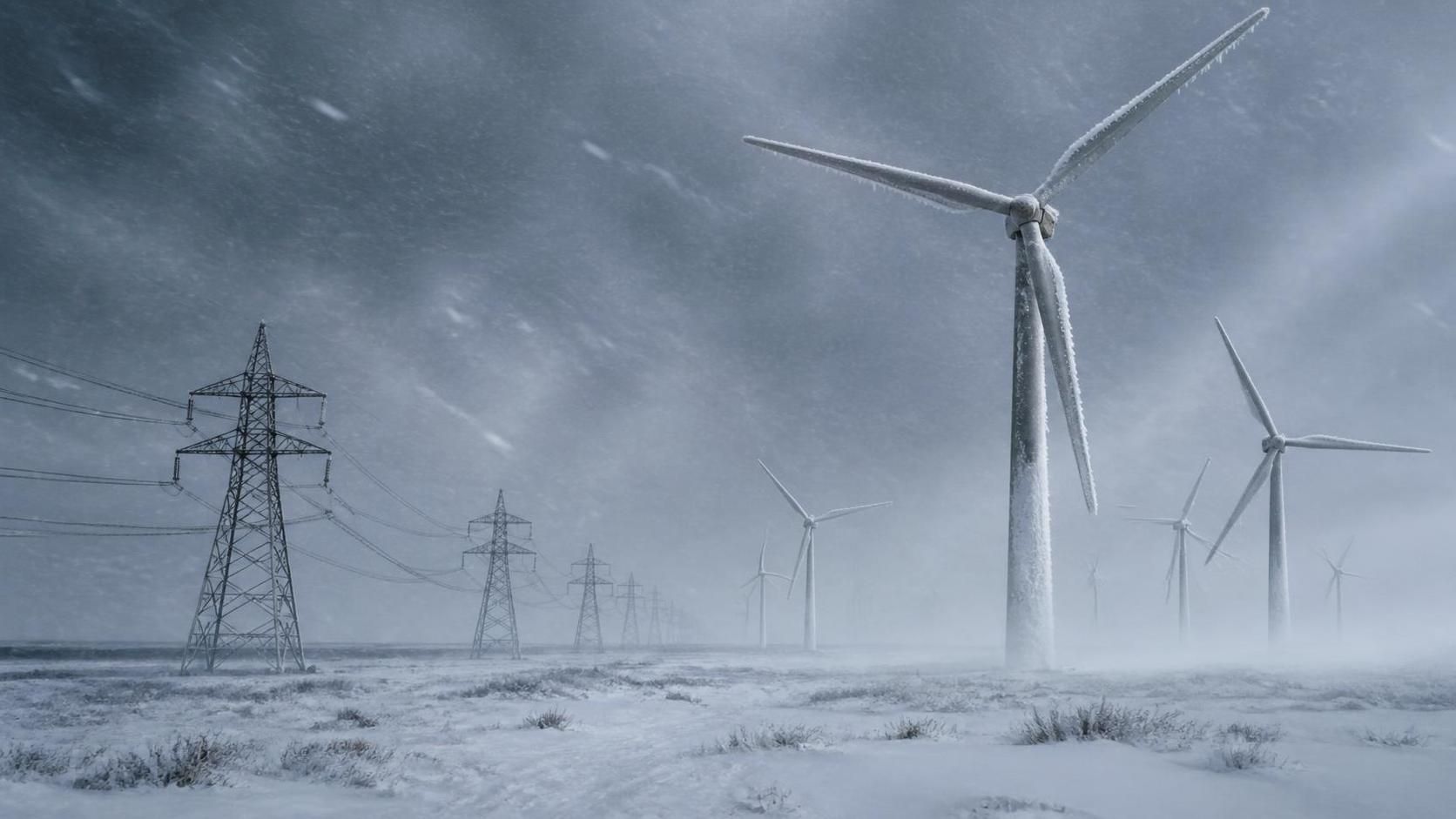
Energy News Beat — The question is no longer whether Winter Storm Uri was a one-off. The question is whether the United States is still pricing electricity as if kilowatt-hours were interchangeable, when what grids actually sell is energy that shows up when people need it.
A widely circulated Electroverse post this weekend put the Texas story back in front of millions of viewers: the largest wind fleet in America, billions in subsidies, then a historic cold snap, collapsing output, a buckling grid, and a human cost measured in the hundreds of lives.
The video is blunt. The data underneath it is more complicated — and more useful.
Uri was not a morality play about one fuel. It was a systems failure. Natural gas plants accounted for the largest share of megawatts forced offline. Wind lost a huge number of units to icing and low output. Coal and even nuclear took hits. Frozen wellheads and processing plants cut gas supply. Load-shed then cut power to parts of the gas system itself. ERCOT had to dump roughly 20,000 MW of firm load — the largest controlled load-shed event in U.S. history — to keep the whole interconnection from going dark. More than 4.5 million Texans lost power. Official reviews attributed at least 210 deaths; later tallies and analyses put the number higher. Economic losses ran into the tens of billions.
Texas had nameplate capacity. It did not have winterized, fuel-secure, dispatchable capability at the scale the weather demanded. That distinction — capacity versus reliability — is the lesson the rest of the country still refuses to price.baigroupllc.com
What ERCOT Actually Fixed — and What It Still Has to Fix
Give Texas credit. After Uri, the Legislature, the Public Utility Commission, and ERCOT did more operational work than most grids have done after a near-collapse.
The first wave was physical and operational:
- Mandatory weatherization and inspections. ERCOT has completed thousands of generation and transmission inspections since December 2021 — well above PUC minimums — and tightened requirements by region and by past performance. Subsequent winter storms showed far fewer weather-related forced outages.
- Firm Fuel Supply Service, so participating generators hold on-site fuel for multi-day events.
New ancillary products, including ERCOT Contingency Reserve Service (ECRS), to buy faster reserves. - Market design changes aimed at price signals, reserve posture, and keeping thermal units available instead of chasing only the cheapest energy in ordinary hours.
- Batteries. Storage in ERCOT jumped by multiple gigawatts after 2021. Short-duration batteries do not replace a week of ice, but they have flattened the “peakiest peaks,” cut some emergency appeals, and given operators a tool they did not have in 2021.
Transmission. Hundreds of miles added or upgraded, with a Strategic Transmission Expansion Plan pointing toward thousands of miles of 765-kV extra-high-voltage lines.
Real-Time Co-optimization Plus Batteries (RTC+B), implemented in December 2025 — the biggest nodal-market upgrade since 2010 — to co-optimize energy, reserves, and battery dispatch in real time.
The results are not theoretical. Winter Storm Elliott in 2022 and Winter Storm Fern in January 2026 did not produce Uri-scale, systemwide blackouts. Reserves stayed healthier. Prices stayed under the revised caps. ERCOT and the PUC now say the grid has broken demand records in heat and cold without a repeat of 2021.
That is real progress. It is not the end of the story.
Independent analysis still warns that a repeat of Uri-level cold, with today’s load, could force load shedding. Batteries measured in two-to-four-hour blocks cannot carry a multi-day freeze. Gas additions still do more work than storage in those scenarios. Demand is exploding — data centers, manufacturing, electrification — and ERCOT has been among the fastest-growing grids in the country. The Texas Energy Fund and interconnection process are supposed to bring more dispatchable megawatts; first units are only now arriving. Retirements of thermal plants remain a live reliability risk if they outrun firm replacements.
Uri taught Texas to winterize what it already had. The next crisis will test whether Texas — and every other grid — built enough firm energy for a system that is adding load faster than it is adding reliability.Stop Calling It Replacement. It Is Energy Addition.
On Energy News Beat, we have said this for years: the United States is not swapping fossil fuels for wind and solar the way a homeowner swaps a furnace. We are in an energy addition. Total demand is rising. Wind and solar are being stacked on top of the system. Gas, coal, and nuclear still carry the hours when the weather does not cooperate. The only energy source civilization has fully retired is whale oil. Everything else is still here.
That is why the standard Levelized Cost of Electricity — plant-level dollars per megawatt-hour at the fence line — has become a policy weapon instead of an engineering tool. Lazard, IRENA, and agency charts can show cheap unsubsidized wind and solar on paper. Those charts, by their own footnotes, leave out bulk transmission, local distribution, reliability and reserve-margin costs, ancillary services, balancing, congestion, interconnection upgrades, curtailment, and the backup fleet that has to sit ready when the resource is not there.
That is not a “cost of electricity.” It is a cost of electrons in favorable hours.
What households and factories buy is energy services: heat, cooling, computation, industrial heat, and lights through a polar vortex and a heat dome.
Energy News Beat has argued for a shift from LCOE to a Levelized Cost of Energy — more precisely a Levelized Full System Cost of Energy (LFSCOE) or resiliency-adjusted system cost — that prices: firming and backup generation storage duration that matches the actual drought (hours vs. days vs. weeks) transmission and congestion inertia, frequency response, and voltage support weatherization and fuel security the cost of lost load when the model is wrong
Until that number is the one legislatures, PUCs, and ISOs use, “cheap renewables” will keep winning press releases while ratepayers fund the hidden system around them. We have called the old metric what it behaves like in politics: a Liars Cost of Energy. The fix is not to ban wind and solar. The fix is to stop letting them externalize reliability onto gas plants, ratepayers, and, in the worst hours, people sitting in the dark.
A new pricing paradigm has to treat grid resiliency as a product, not a residual. Capacity that can run for 72 hours on stored or dual fuel is not the same product as a midday solar block. Markets that pay them as if they were the same will keep getting the Texas 2021 outcome: lots of nameplate, not enough winter.
The Price Map Does Not Lie: Compare Texas to the Most Expensive States
Look at residential rates in the latest EIA-based snapshots for 2026. The U.S. average sits near 18.4¢/kWh. Texas is typically around 16.4¢ — below the national average. The most expensive jurisdictions are not the ones with the most oil wells. They are Hawaii, California, and a belt of Northeastern states.
Approximate residential range in recent 2026 EIA-derived rankings:
|
Jurisdiction
|
Residential rate (¢/kWh)
|
vs. Texas (~16.4¢)
|
|---|---|---|
|
Hawaii
|
~52
|
~3× Texas
|
|
California
|
~33
|
~2× Texas
|
|
New York
|
~30
|
~80% higher
|
|
Rhode Island / Massachusetts / Maine
|
~28–30
|
~70–80% higher
|
|
Connecticut / New Hampshire / Alaska
|
~27–28
|
~65–70% higher
|
|
Texas
|
~16.4
|
—
|
|
Idaho / Utah / Oklahoma
|
~12–13
|
cheaper than Texas
|
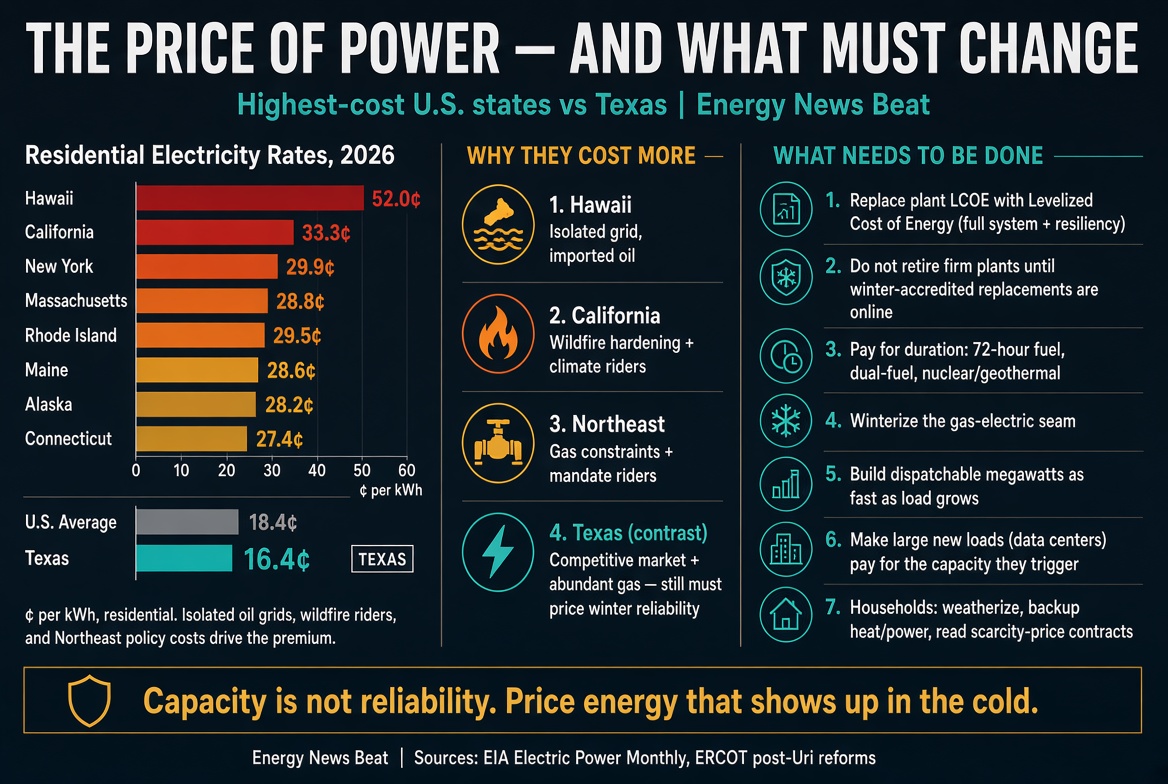
Why they cost more is not a mystery.
Hawaii is an isolated, oil-heavy island system. Fuel has to be shipped in. There is no mainland wholesale market to lean on. Geography plus petroleum baseload is a structural penalty.
California layers policy on top of physics. Wildfire mitigation, liability, and hardening now consume a large slice of utility revenue requirements — on the order of several cents per kWh by some estimates. Climate riders, interconnection queues, and a generation mix that still needs gas on the evenings and in heat waves sit on an investor-owned-utility rate base that has been recovering disaster costs for years. Californians have long paid a premium; since 2019 the increase has been among the steepest in the country.
The Northeast (Massachusetts, New York, Connecticut, Rhode Island, Maine, New Hampshire) is pipeline-constrained in winter, gas-dependent at the margin, loaded with policy riders (clean-energy mandates, nuclear support, capacity-market uplift), and sitting on older urban wires. When ISO-NE or NYISO has to procure winter reliability, the bill does not stay in the wholesale market. It shows up in default service and delivery charges. Data-center load is now amplifying capacity prices in parts of the Mid-Atlantic as well.
Texas is not cheap because it rejected wind and solar. ERCOT built the biggest wind fleet in America and then a solar-and-battery boom on top of it. Texas is cheaper because it still has abundant gas, a competitive energy-only market that historically punished overbuilding of expensive firming and (after Uri) started paying more for reliability products, and a political culture that has not yet fully socialized wildfire-scale climate riders into every kWh. The warning from Uri is that “cheap on average” is not the same as “secure in the tail.” California and New England show the opposite failure mode: very expensive and still tight when weather and gas deliverability line up against you.
If the rest of the country copies California’s cost stack and Texas’s pre-2021 weatherization culture, ratepayers will get the worst of both: high bills and rolling blackouts.
What Lawmakers Should Do Before the Next Rolling Outages
The grids were not “rolled out” as a single national machine. They were assembled as regional markets with different resource mixes, then asked to absorb subsidized intermittent capacity, plant retirements, and now AI-scale load without a common reliability currency. NERC’s multi-year assessments have flagged elevated risk in multiple regions during extreme heat and cold as dispatchable capacity retires faster than equivalent firm replacements arrive.
A practical agenda, not a culture war:
- Write full-system cost into statute and PUC practice. Require LFSCOE / resiliency-adjusted cost — not plant LCOE — in integrated resource plans, renewable portfolio scoring, and subsidy cost-benefit tests. If a resource needs four hours of batteries plus a gas fleet, that package is the cost.
- Do not retire firm capacity until accredited replacement is in the ground and tested in winter. Accreditation must use effective load-carrying capability in the actual season of risk, not nameplate.
- Pay for duration. Markets should differentiate 2-hour batteries, 48-hour dual-fuel, and nuclear/geothermal baseload. Texas’s Firm Fuel Supply Service and the Texas Energy Fund are imperfect models; they at least admit that fuel in a tank is a reliability attribute.
- Winterize the gas-electric seam. Uri was a coupled failure. Critical gas production, processing, and compression should be treated as critical electric load, with dual-fuel and on-site power where the physics requires it.
- Build dispatchable megawatts on a wartime clock for load growth. Permitting reform for gas, nuclear (including existing uprates and SMRs), and geothermal is a reliability policy, not a climate sideshow. Transmission matters; so does inertia. Synchronous condensers and retained thermal units are not nostalgia. They are grid physics.
- Stop pretending average annual renewable penetration equals resource adequacy. A grid that is “clean” at 2 p.m. in April can still fail at 8 p.m. in January.
- Allocate big new loads honestly. Data centers should pay for the network and capacity they trigger, not hide inside residential rates.
Texas proved reforms can move the needle in five years. It also proved that waiting for a disaster to discover missing weatherization is how people die.
What Consumers Can Do While the Politics Catch Up
Households should not have to become mini-utilities. Until markets price resiliency, they effectively are.
- Weatherize the house first. Uri killed people through cold houses, not through a shortage of op-eds.
- Keep a non-electric heat option where codes and safety allow, and carbon-monoxide detectors if you use combustion.
- A portable generator or a home battery with a transfer switch is insurance, not a lifestyle brand. Prioritize well pumps, medical devices, and heat.
- If you are on a competitive retailer in ERCOT or another choice market, read the contract for scarcity pricing. “Cheap” plans in normal weather are how families met $9,000/MWh in 2021.
- Demand response and time-of-use rates can cut bills; they do not replace firm supply during a multi-day freeze.
- Ask state representatives a single question: What is our accredited winter reserve after the next 5 GW of thermal retirements and the next 5 GW of data-center load? If they answer with a renewable percentage, they are not answering.
Preparedness is not panic. It is what you do when the official metric still pretends a frozen turbine and a winterized combined-cycle plant produce the same product.
The Choice in Front of the Country
Electroverse is right about the human ending of Uri and right that a grid sold as “clean and limitless” was one cold snap from collapse. Official reports are right that gas failures, not wind alone, supplied the largest block of missing megawatts. Both things can be true because the real failure was conceptual: policymakers optimized for cheap energy in average hours and treated reliability as someone else’s line item.
ERCOT has spent five years putting weatherization, fuel security, batteries, and market software back into the model. Other states have spent those same years stacking policy riders onto rates while retiring the plants that show up at 2 a.m. in January.
We can learn from Texas. Learning means redefining cost as the cost of energy that works, pricing resiliency in the open, adding firm supply as fast as we add load, and stopping the fantasy that we have replaced the fossil system when we have only layered weather-dependent capacity on top of it.
The next blackouts will not be a surprise. They will be a spreadsheet that excludes the cold from the levelized cost.
We have several podcasts lined up, including the CEO of Jackery and Doomber, and will keep you posted as we get them scheduled. There are shortages looming; don’t take our word for it- just look at the major warnings from our great utility companies and the cyberattacks that are increasing.
Appendix: Sources and Links
Primary X post
- Electroverse, “Texas built the largest wind fleet…” (Aug. 29, 2026): https://x.com/Electroversenet/status/2093790795241300263
Winter Storm Uri / 2021 blackout
- FERC, Final Report on February 2021 Freeze: https://www.ferc.gov/news-events/news/final-report-february-2021-freeze-underscores-winterization-recommendations
- POWER Magazine, ERCOT generator outage list: https://www.powermag.com/ercot-lists-generators-forced-offline-during-texas-extreme-cold-event/
- Texas RE, 2021 Assessment of Reliability Performance: https://www.texasre.org/Documents/Reliability%20Services/Events%20Analysis/2021%20Assessment%20of%20Reliability%20Performance.pdf
- ScienceDirect, “Cascading risks: Understanding the 2021 winter blackout in Texas”: https://www.sciencedirect.com/science/article/pii/S2214629621001997
- Environment America, Texas Freeze timeline: https://environmentamerica.org/texas/center/articles/the-texas-freeze-timeline-of-events/
- UND EERC / related Uri analysis PDF: https://pcor.undeerc.org/media/1hsh0ko2/kcc-mjn-texaswinteruri-nov22-doe.pdf
- Texas Public Policy Foundation, “Pushed to the Brink”: https://www.texaspolicy.com/wp-content/uploads/2022/08/2022-08-RR-LP-PushedtoBrinkElectricGridCrisis-BennettTahuahuaNasi.pdf
ERCOT reforms and post-2021 reliability
- ERCOT 2025 Annual Report: https://www.ercot.com/files/docs/2026/03/19/2025-ERCOT-Annual-Report-Final-Single-Pages-March-19-2026.pdf
- ERCOT 2024 State of the Grid: https://www.ercot.com/files/docs/2025/03/14/ERCOT-2024-State-of-the-Grid.pdf
- ERCOT assessments vs. DOE/NERC/Texas RE (Sept. 2025): https://www.ercot.com/files/docs/2025/09/15/14-ERCOT-Assessments-and-Recommendations-in-Response-to-DOE-NERC-and-Texas-RE-Grid-Reports.pdf
- ERCOT 2024 Grid Reliability and Resiliency Assessment: https://www.ercot.com/files/docs/2025/01/28/2024_Grid_Reliability_and_Resiliency_Assessment_Results_January_2025_RPG.pdf
- S&P Global, “Taming the Wild West: ERCOT market changes improve reliability”: https://www.spglobal.com/market-intelligence/en/news-insights/research/taming-the-wild-west-ercot-market-changes-improve-reliability
- Baker Institute, investments, reliability, Uri-level residual risk: https://www.bakerinstitute.org/research/how-investments-can-boost-ercot-reliability-and-cut-emissions
- PUC/ERCOT five-year anniversary statements (PDF): https://cbsaustin.com/resources/pdf/39c0d050-8fa9-4152-88fd-bd58f746f5f8-ERCOTPUCStatementsFiveYearAnniversary.pdf
- Focus Daily News, PUCT Phase One blueprint closeout: https://www.focusdailynews.com/puct-closes-phase-one-of-blueprint-for-grid-reliability-improvement-projects/
- Houston Public Media, five years after the blackouts: https://www.houstonpublicmedia.org/articles/infrastructure/2026/02/13/543232/texas-power-electricity-2021-winter-storm-ercot/
- Utility Dive, “Reliability risk isn’t just about capacity anymore”: https://www.utilitydive.com/news/winter-texas-reliability-risk-capacity-ercot/811748/
- S&P Global, weatherization and winter risk: https://www.spglobal.com/energy/en/news-research/latest-news/electric-power/120324-weatherization-warm-winter-may-cut-texas-grid-reliability-risk-executives
- Potomac Economics, 2024 State of the Market (ERCOT): https://www.potomaceconomics.com/wp-content/uploads/2025/05/2024-SoM-Report-Revision-Jul2025.pdf
- Texas Consumer Association / resilience report exec summary: https://www.texasce.org/wp-content/uploads/2025/05/Resilience-in-the-Balance-Report-Executive-Summary-2024.pdf
- Utility Dive, Texas storage savings: https://www.utilitydive.com/news/texas-ercot-storage-deployment-saved-at-least-750m-since-2023-acp/735122/
- Utility Dive, Oncor $3B resiliency plan: https://www.utilitydive.com/news/texas-puc-approves-3-billion-oncor-system-resiliency-plan/733165/
Electricity prices by state
- EIA Electric Power Monthly (prices): https://www.eia.gov/electricity/monthly/
- EIA Table 5.6.B YTD prices: https://www.eia.gov/electricity/monthly/epm_table_grapher.php?t=epmt_5_06_b
- StateRates, May 2026 rates: https://staterates.org/
- CostToRunIt, May 2026 rankings: https://costtorunit.com/electricity-rates-by-state
- Price of Electricity rankings: https://www.priceofelectricity.com/electricity-cost
- RateWatt state comparison: https://ratewatt.com/states
- ElectricityRatePerKWh: https://electricityrateperkwh.com/
- Canary Media, drivers of high bills: https://www.canarymedia.com/articles/utilities/whats-behind-your-sky-high-power-bill
- EnergyBot, California rates: https://www.energybot.com/electricity-rates/california/
- Columbia SIPA CGEP, load growth and prices: https://www.energypolicy.columbia.edu/publications/the-effects-of-load-growth-on-electricity-prices-in-the-united-states-a-literature-review/
- Just the News / Center Square, policy and price patterns: https://justthenews.com/nation/states/center-square/report-energy-prices-higher-blue-states-due-policies
- Fox Business, high/low price states: https://www.foxbusiness.com/politics/states-where-americans-pay-most-least-electricity
LCOE, system cost, energy addition
- Energy News Beat, “The Redefining of Levelized Cost of Energy Needs to Be Implemented…”: https://energynewsbeat.co/electrical-generation/the-redefining-of-levelized-cost-of-energy-needs-to-be-implemented-to-lower-energy-prices/
- Pecos Operating / ENB, “We Need to Redefine the Levelised Cost of Energy Models”: https://pecosoperating.com/we-need-to-redefine-the-levelised-cost-of-energy-models-david-turver-says-they-are-junk/
- Always On Energy Research, winning the LCOE debate / AO-LCOE: https://www.aoenergy.org/were-winning-the-debate-over-levelized-cost-of-energy/
- Energy Central, reliability-adjusted reconstruction of Lazard LCOE+ v19: https://www.energycentral.com/energy-biz/post/the-reliability-gap-reconstructing-lazard-s-lcoe-v19-0-data-to-price-3Gds1CtAoPqM6uI
- Lazard 2026 LCOE+ release: https://www.lazard.com/news-announcements/lazard-releases-2026-levelized-cost-of-energyplus-report-pr
- EIA LCOE/LACE methodology: https://www.eia.gov/outlooks/aeo/electricity_generation/pdf/LCOE_methodology.pdf
- NCEA, batteries and the grid (Lesser/Rolling): related 2026 PDF via web files cited in research
- Energy News Beat Substack, “How Can the U.S. Grid Go to Wind and Solar Only?”: https://theenergynewsbeat.substack.com/p/how-can-the-us-grid-go-to-wind-and
- RealClearEnergy, declining capacity value of wind/solar: https://www.realclearenergy.org/articles/2025/10/23/the_more_wind_and_solar_we_add_the_less_they_deliver_1142829.html
- Mackinac Center, wind/solar vs. growth and NERC risk: https://www.mackinac.org/blog/2025/wind-and-solar-are-at-odds-with-growth
- Texas Policy, federal energy subsidies 2010–19 (cited in X replies): https://www.texaspolicy.com/wp-content/uploads/2020/04/Bennett-LP-Federal-Energy-Subsidies.pdf
Broader grid-risk context
- Energy News Beat Substack, “Is an 18-Month Blackout on the Horizon?”: https://theenergynewsbeat.substack.com/p/is-an-18-month-blackout-on-the-horizon
- Energy Innovation, grid reliability during the clean-energy transition: https://energyinnovation.org/wp-content/uploads/Grid-Reliability-During-the-Clean-Energy-Transition.pdf
Article prepared for the Energy News Beat Channel. Figures on retail rates move monthly with EIA releases; use the latest Electric Power Monthly tables for publication updates.