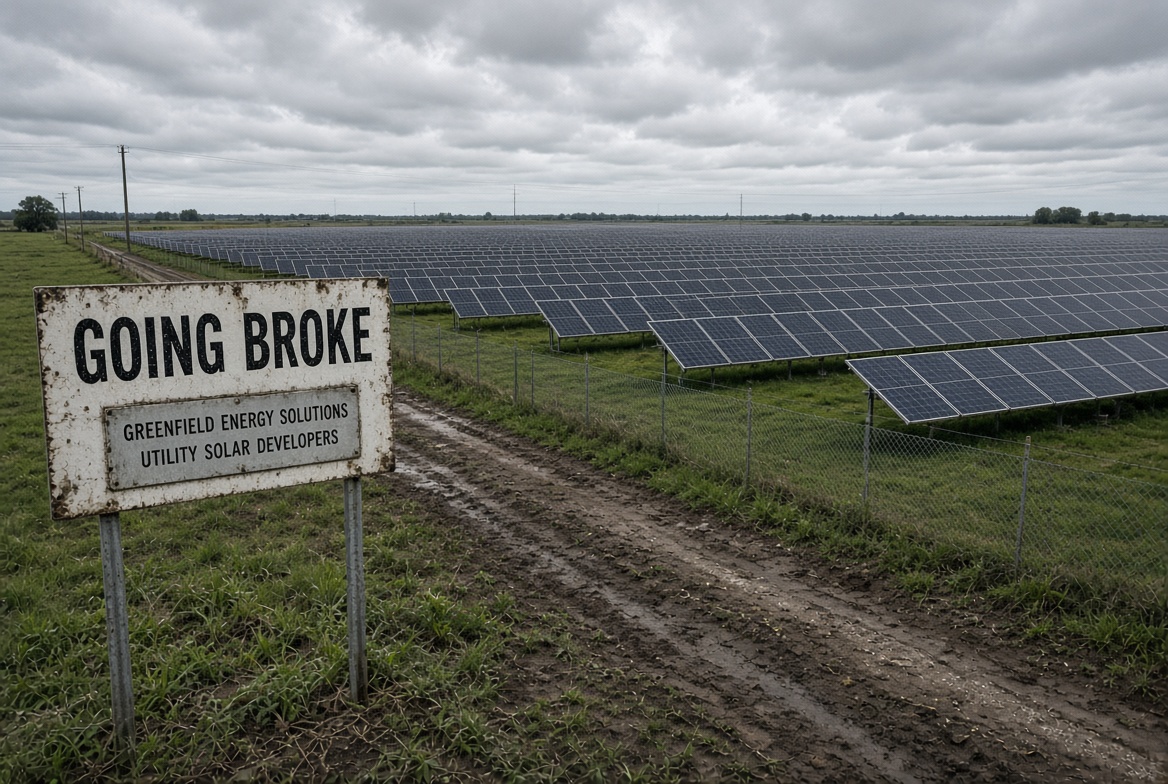
Hamburg-based Enerparc AG, one of Europe’s largest independent solar park owners, filed for insolvency at the Hamburg Local Court. On September 7, 2026, the court appointed restructuring attorney Stefan Denkhaus of BRL as provisional insolvency administrator. Operations at the parks are continuing while administrators try to stabilize the group.
Enerparc reports about 5.5 GW of installed capacity, of which only 3.8 GW is connected to the grid, across more than 500 parks. The company employs a few hundred people and had just announced up to €1 billion in financing in March 2026. Provisional administrator Denkhaus later said group liabilities are about €3 billion, most of it project finance. A separate project-level financing for solar-plus-storage failed at the end of June. After negotiations collapsed, Enerparc could no longer meet obligations on ordered deliveries. An investor process is expected. Sister-company filings remain possible.
That is the company-level story. The system-level story is larger.
The boom created its own insolvency machine
Germany has added wind and solar faster than grids, storage, and firm capacity can absorb. Renewables accounted for a record share of German electricity consumption in the first half of 2026—around 58 percent in mid-year reporting, with full-year 2025 generation already near 57 percent renewable. Solar generation has surged; in 2025, solar overtook lignite as a source of generation. The official target remains 80 percent renewable electricity by 2030.
Capacity growth has outrun grid expansion. Projects wait for connections. When the sun and wind arrive together, operators face curtailment. When they arrive in excess of demand, day-ahead prices go negative. Capture rates for solar have collapsed as midday oversupply becomes structural. New plants under the Solarspitzengesetz receive no compensation in negative-price intervals. Merchant and quasi-merchant economics that looked bankable during the 2022–23 price spike no longer do.
Enerparc is the largest independent solar operator to hit the wall. It is not the first. German wind and solar developer SoWiTec filed earlier in 2026, citing excessive debt. Bloomberg reports BayWa r.e. and ABO Energy have entered restructuring. The pattern is consistent: developers leveraged for a growth trajectory the grid and the wholesale market cannot support at the old returns.
Germany’s mix after nuclear and coal
The last German nuclear plants closed in April 2023. Nuclear’s share of generation went from double digits a decade ago to zero. Coal is still material—lignite and hard coal together were still around one-fifth of generation in 2025—but the legal coal exit remains 2038, with political pressure and market conditions pulling plants off earlier. Gas has filled part of the firm-power gap. Destatis and AGEB figures show gas’s generation share rising as nuclear vanished and coal declined.
That sequence matters for industry. Nuclear and coal were dispatchable, high-capacity-factor sources located near load. Wind is strongest in the north. Solar peaks at noon. Industry needs power at 8 a.m. on a still, gray January morning. Closing firm plants before replacement firm capacity, long-duration storage, and north-south transmission were in place raised the cost of reliability.
Analyses of the nuclear exit have estimated that keeping the last reactors would have cut fossil generation, reduced gas import dependence, and lowered power prices materially. One widely cited strategy note put 2024 electricity prices nearly 25 percent higher than they would have been with a continued nuclear fleet. German industrial power prices remain a multiple of U.S. and Chinese levels. Energy-intensive output has contracted sharply since 2021. Steel, chemicals, foundries, and auto supply chains have cut production, closed lines, or moved load abroad. That is not a weather event. It is a location-cost event.
Germany is now auctioning new gas plants and designing a capacity mechanism because the system still needs firm megawatts. The Energiewende did not abolish the need for dispatchable capacity. It postponed paying for it in a transparent way, then discovered the bill in wholesale spikes, grid fees, and industrial attrition.
What this means for German consumers
Households do not buy Enerparc’s parks. They buy a bundled product: energy, networks, taxes, levies, and the cost of keeping the lights on when the parks are dark.
Average household prices remain among the highest in Europe. BDEW’s August 2026 analysis put the household average near 37.0 ct/kWh. Other trackers still show mid-30s to high-30s depending on tariff vintage; basic supply is higher. Grid fees are a large slice—on the order of a quarter of the bill—even after a €6.5 billion federal subsidy for transmission charges in 2026. Taxes, levies, and VAT remain heavy. Wholesale prices can be low or negative at noon in May and still leave the retail bill high because networks, backup, and policy costs do not vanish with the spot price.
Consumers in the regions hosting large ground-mount fleets feel a second-order effect. Local grids must be reinforced. Redispatch and curtailment costs are socialized. Negative prices do not automatically mean cheap household power unless the customer has a smart meter and a dynamic tariff—and even then, the fixed and network components dominate. If distressed operators sell parks, cut capex, or delay storage, the generation still exists, but the promised “cheap solar” does not show up as a structural cut in the all-in industrial or household price.
For industry in the same market, the message is sharper. A solar fleet that cannot finance itself without cheap debt, subsidies, or high capture prices is not a substitute for baseload. Factories that need 8,000 hours of firm power cannot run on a resource with a German capacity factor near 11 percent and declining market value at the hours it produces most.
LCOE was never the right scoreboard
Levelized cost of electricity compares a plant’s lifetime costs to its lifetime kilowatt-hours as if every kilowatt-hour were equally valuable and as if the rest of the system were free. That was a tolerable shortcut when the grid was almost entirely dispatchable. It is a misleading metric at high wind and solar penetration.
What LCOE leaves out is now the main event:
- Profile and cannibalization costs. Solar’s market value falls as more solar is added. Midday power is abundant and cheap; evening and winter power is scarce and expensive.
- Balancing and backup. Gas plants, remaining coal, imports, and eventually hydrogen-ready units must sit ready for Dunkelflaute. Those plants need revenue when idle.
- Transmission and distribution. North-to-south corridors, substations, and inverter-heavy grids are not free. Germany’s connection queues and the gap between Enerparc’s 5.5 GW installed and 3.8 GW connected are the physical proof.
- Curtailment. Energy that is built but not delivered still carries capital cost.
- Inertia, voltage, and frequency services. Inverter resources do not automatically provide the stability services synchronous machines provided as a byproduct.
System-LCOE and full-system cost studies for Germany have shown integration costs rising steeply with penetration. Wind and solar can look cheapest at the plant gate and expensive at the system boundary. If policymakers want a level playing field, the correction is straightforward: stop treating intermittency as an externality dumped on the grid and on taxpayers. Charge wind and solar for the firming, network, and resiliency services they require. End production subsidies and hidden socializations. Let nuclear, gas with carbon costs, hydro, storage, and demand response compete on delivered, reliable megawatt-hours—not on a spreadsheet that assumes the rest of the fleet will always be there to clean up.
That is not an argument against solar. It is an argument against costing solar as if it were a coal plant with better press.
The German power market is part of the problem
Germany’s market design still pays energy more readily than adequacy. Negative prices are a feature of a system that incentivized energy volume faster than flexibility. Feed-in rules, auction floors that have been competed down to a few euro cents, and delayed exposure of older plants to real-time prices all encouraged build-out into a congested, low-value slice of the load curve.
The result is a split screen. On one screen, record renewable shares and press releases about 80 percent by 2030. On the other, insolvent developers, €3 billion in project debt at a single solar platform, industrial electricity several times U.S. levels, and a government writing checks for grid fees and industrial power relief because the “cheap” electrons did not produce a cheap system.A market that socializes grid upgrades, curtailment, and capacity adequacy while privatizing the upside of subsidized build-out will keep producing this outcome. Diversified developers may survive at thinner margins, as Boston Consulting Group’s Jens Burchardt noted. That is not the same as a sustainable industrial power system.
oilprice.com
Enerparc’s parks will keep generating. The administrator will look for a buyer. The deeper question for Berlin is whether the next 100 GW of solar is an asset or a claim on everyone else’s reliability. Until LCOE is replaced with a full-system cost test, and until wind and solar pay for the grid resiliency they consume, Germany will keep adding nameplate capacity and subtracting industrial optionality.
The bankruptcy is a company event. The causes are policy.
Check out the World’s Greatest Podcast Show Notes at EnergyNewsBeat.co or EnergyNewsBeat.com.
Appendix: Sources and links
Bankruptcy and company
- OilPrice / Tsvetana Paraskova, “Europe’s Biggest Independent Solar Operator Just Went Bankrupt,” Sept. 17, 2026: https://oilprice.com/Latest-Energy-News/World-News/Europes-Biggest-Independent-Solar-Operator-Just-Went-Bankrupt.html
- ENERPARC AG official notice: https://www.enerparc.de/en/company/newsroom/news-detail/solar-park-owner-enerparc-ag-files-for-insolvency
- Bloomberg, “Germany’s Green Power Boom Leaves Developers Fighting to Survive,” Sept. 17, 2026: https://www.bloomberg.com/news/articles/2026-09-17/germany-s-green-power-boom-leaves-developers-fighting-to-survive
- pv magazine Global, “Enerparc files for insolvency,” Sept. 8, 2026: https://www.pv-magazine.com/2026/09/08/enerparc-files-for-insolvency/
- pv magazine Deutschland on failed storage financing and €3 billion liabilities, Sept. 15, 2026: https://www.pv-magazine.de/2026/09/15/gescheiterte-finanzierung-loeste-enerparc-insolvenz-aus-investorenprozess-soll-bald-starten/
- SolarQuarter, ENERPARC insolvency, Sept. 8, 2026: https://solarquarter.com/2026/09/08/enerparc-ag-files-for-insolvency-operations-of-5-5-gw-solar-portfolio-continue/
- TaiyangNews: https://taiyangnews.info/business/enerparc-files-for-insolvency
- NDR / tagesschau: https://www.ndr.de/nachrichten/hamburg/solarenergie-enerparc-in-der-hamburger-hafencity-ist-insolvent,kurzehh-4264.html
- FAZ: https://www.faz.net/aktuell/wirtschaft/unternehmen/solarparkbetreiber-enerparc-ag-ist-insolvent-201206220.html
- SoWiTec insolvency (PV-Tech, cited in OilPrice): https://www.pv-tech.org/sowitec-announces-insolvency-due-to-excessive-debt/
Energy mix, nuclear, coal
- Destatis / AGEB gross electricity generation table: https://www.destatis.de/DE/Themen/Branchen-Unternehmen/Energie/Erzeugung/Tabellen/bruttostromerzeugung.html
- Carbon Brief analysis, wind and solar vs. fossil fuels in 2025: https://www.carbonbrief.org/analysis-wind-and-solar-power-overtake-fossil-fuels-in-germany-for-first-time-ever
- Clean Energy Wire coal-exit tracker: https://www.cleanenergywire.org/news/driven-markets-germanys-coal-exit-remains-track-amid-energy-crisis
- Clean Energy Wire CLEW guide / policies: https://www.cleanenergywire.org/factsheets/clew-guide-germany-still-track-2030-climate-targets
- NDR Strommix: https://www.ndr.de/nachrichten/info/Strommix-Deutschland-Wie-ist-der-Anteil-erneuerbarer-Energien,strommix102.html
- Umweltbundesamt plant statistics: https://www.umweltbundesamt.de/daten/umweltzustand-trends/energie/kraftwerke-konventionelle-erneuerbare
- BBC on coal phase-out debate, June 2026: https://www.bbc.co.uk/news/articles/cy04ykxrj5eo
- POLITICO on nuclear debate and household prices: https://www.politico.eu/article/germany-berlin-nuclear-is-over-the-debate-isnt/
Industry and prices
- Morningstar / MarketWatch on nuclear-exit price impact (Cembalest / JPM): https://www.morningstar.com/news/marketwatch/2026030945/the-cost-of-germanys-long-and-painful-nuclear-regret
- NYT on German industrial energy costs, March 2026: https://www.nytimes.com/2026/03/13/business/energy-environment/iran-energy-costs-germany-factories.html
- Etalytics industrial electricity price series: https://etalytics.com/resources/blog/how-has-the-industrial-electricity-price-in-germany-developed
- BDEW Strompreisanalyse, August 2026: https://www.bdew.de/media/documents/BDEW_Strompreisanalyse_082026.pdf
- Clean Energy Wire household price factsheet: https://www.cleanenergywire.org/factsheets/what-german-households-pay-electricity
- LichtBlick current household prices, Sept. 2026: https://www.lichtblick.de/wissen/zuhause/aktueller-strompreis-pro-kwh/
- Netztransparenz grid fees 2026 and €6.5 billion subsidy: https://www.netztransparenz.de/en/About-us/Grid-fees
Negative prices, capture rates, market design
- Energy-Charts (Fraunhofer ISE): https://www.energy-charts.info
- pv magazine Deutschland on negative prices and curtailment incentives: https://www.pv-magazine.de/2026/09/10/studie-mehr-anreize-fuer-die-abregelung-von-photovoltaik-und-windkraft-in-zeiten-negativer-boersenstrompreise-notwendig/
- IER on reduced German renewable subsidies: https://www.instituteforenergyresearch.org/international-issues/germany-is-reducing-its-subsidization-of-renewables/
- Germany solar PV market note on capture-rate collapse: https://www.efinancialmodels.com/downloads/germany-solar-pv-market-study-20262031-638173/
LCOE and system costs
- Clintel / Energy Bad Boys on LCOE limits and firming costs: https://clintel.org/winning-the-war-on-lcoe-wind-and-solar-were-never-the-cheapest-power-sources/
- hostile.eco, “The Full System Cost of Wind: What Germany’s Energiewende Actually Shows”: https://hostile.eco/analysis/wind-system-costs-germany-energiewende/
- Thunder Said Energy on renewable-heavy grid system costs: https://thundersaidenergy.com/downloads/renewable-heavy-grids-total-system-costs/
- Irlam / Levelized Full System Costs of Electricity (ScienceDirect / archived discussion): https://archive.md/2025.02.16-084321/https://www.sciencedirect.com/science/article/abs/pii/S0360544222018035
- Fraunhofer ISE LCOE study (plant-level, including PV-plus-battery ranges): https://www.ise.fraunhofer.de/en/press-media/press-releases/2024/photovoltaic-plants-with-battery-cheaper-than-conventional-power-plants.html
Related OilPrice context
- OilPrice renewables share piece cited in the Enerparc article: https://oilprice.com/Latest-Energy-News/World-News/Renewables-Hit-Record-58-Share-of-Germanys-Power-Consumption.html