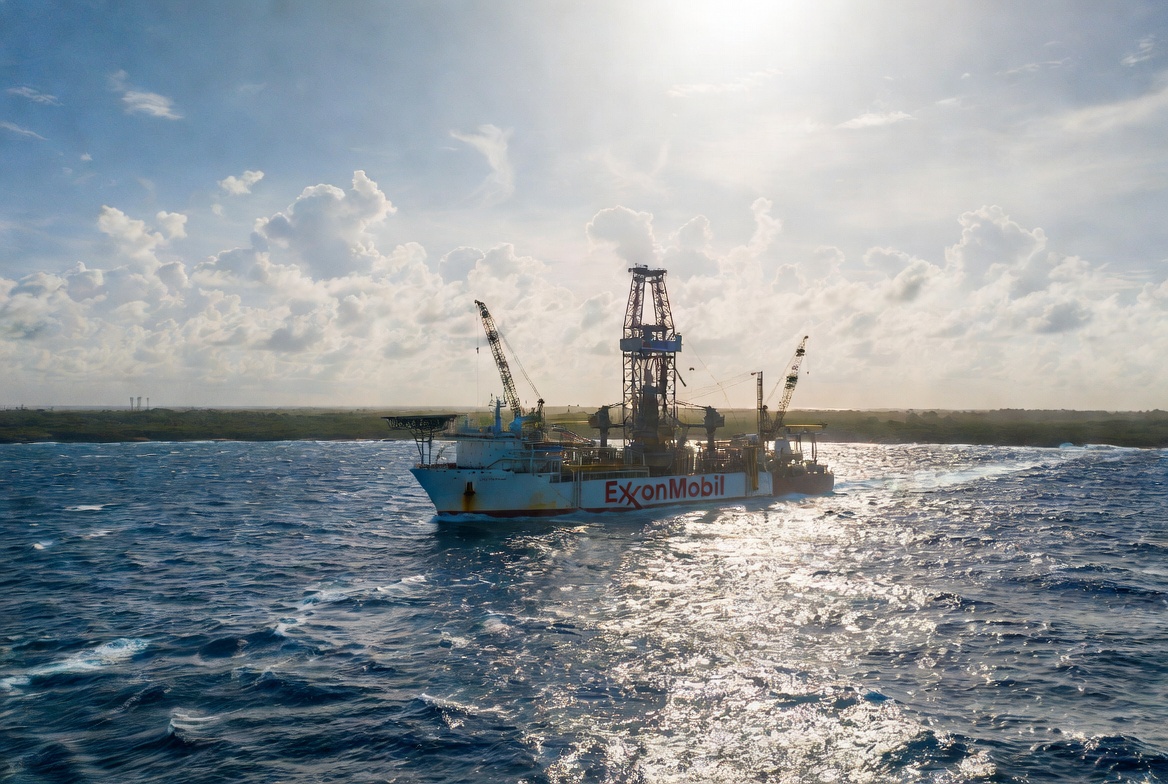
ExxonMobil’s massive offshore operations in Guyana are delivering blockbuster returns, even as global oil markets navigate geopolitical turbulence. The U.S. supermajor, operator of the world-renowned Stabroek Block, is riding a wave of record production, ultra-low breakeven costs, and newfound regional stability following Venezuela’s political restructuring. As highlighted in recent market analysis, the consortium’s cost-recovery phase is nearing its end, setting the stage for even stronger cash flows while Guyana’s economy undergoes one of the most dramatic transformations in modern history.
Record Production from the Stabroek Block
ExxonMobil Guyana Limited operates the Stabroek Block with a 45% working interest. Its partners are Chevron (30%, via its 2025 acquisition of Hess) and CNOOC Petroleum Guyana Limited (25%). Since first oil in December 2019, the block has delivered explosive growth. Production reached a milestone of 900,000 barrels per day (bpd) in November 2025 and climbed further to an average of 918,000 bpd in February 2026 across four producing developments: Liza Phase 1 and 2, Payara, and Yellowtail.
The ramp-up continues. The Uaru project (250,000 bpd capacity) is expected online later in 2026, followed by Whiptail in 2027 and Hammerhead (150,000 bpd) in 2029. ExxonMobil and partners have sanctioned seven projects with a combined capacity exceeding 1.5 million bpd, targeting 1.7 million bpd by 2030. The block holds an estimated 11 billion barrels of oil equivalent in discovered resources.
Breakeven costs remain among the industry’s lowest at $25–35 per barrel, delivering exceptional margins even at moderate oil prices. The consortium currently recovers exploration and development costs by retaining approximately 75% of production, with Guyana receiving a 12.5% share of “profit oil” plus a 2% royalty. Full cost recovery is expected in 2026, at which point Guyana’s profit-oil share jumps to 50% — dramatically boosting government revenues while still leaving substantial upside for ExxonMobil and partners.
Venezuelan Restructuring Stabilizes ExxonMobil’s Investments
For years, Venezuelan President Nicolás Maduro’s aggressive claims to the Essequibo region — which encompasses much of Guyana’s offshore oil wealth — created uncertainty. In 2025, Venezuelan naval vessels approached ExxonMobil’s floating production facilities, and threats of nationalization loomed.
U.S. intervention in early 2026 changed the equation. Maduro was removed from power, paving the way for regulatory and political changes in Venezuela. The move effectively paused Venezuela’s territorial ambitions, reducing immediate risk to Guyana’s operations and allowing ExxonMobil to accelerate development without the shadow of expropriation or military disruption.
ExxonMobil executives have since expressed optimism about the broader region, noting improved operating conditions in Guyana and even exploring selective re-entry into Venezuela under new, investor-friendly frameworks. The stabilization has been a clear tailwind for ExxonMobil’s Guyana investments, securing billions in committed capital and protecting one of the company’s highest-return growth engines.
Oil Boom Transforms Guyana’s Economy
Guyana’s oil windfall has rewritten the nation’s economic story. Once one of South America’s poorest countries, Guyana has seen its GDP quadruple since first oil, reaching approximately $27.5 billion by 2024. Annual growth rates have been extraordinary: 63% in 2022, 33% in 2023, 43% in 2024, and a projected 16.2% in 2026. Oil and gas now account for roughly 75%+ of GDP, with production exceeding 900,000 bpd from a population of just over 800,000 people — more oil per capita than any other nation.
Government oil revenues are surging. In 2025 alone, Guyana received tens of millions of barrels directly, and the impending profit-oil flip plus higher prices are forecast to deliver roughly $4.3 billion in 2026 revenues — a 67% increase year-over-year from price effects alone. While the non-oil economy is also expanding rapidly, the sector remains heavily dependent on oil revenues, prompting ongoing efforts to build institutions capable of managing the windfall sustainably.
Other Players in the Oil Fields
The Stabroek Block consortium remains the dominant force, but the broader Guyanese offshore is attracting interest. Chevron’s entry via Hess strengthens U.S. major involvement, while CNOOC’s 25% stake brings Chinese capital and technical expertise. Additional blocks (Canje and others) are under exploration, though Stabroek continues to deliver the lion’s share of production and reserves. No other operators have yet matched ExxonMobil’s scale or success offshore Guyana.
Outlook for Investors and U.S. Consumers
For investors: Guyana represents one of ExxonMobil’s premier growth stories — high-volume, low-cost, and now geopolitically more secure. With cost recovery flipping and production still ramping, the asset is expected to generate tens of billions in net profit over the coming decade. The Atlantic location provides a structural premium in a world repricing geopolitical risk, and the consortium’s track record of rapid, efficient development enhances Exxon’s negotiating power globally.
For U.S. consumers: Guyana’s light, sweet Liza crude is flowing steadily into Western Hemisphere supply chains. Roughly one-third of exports head to the United States, with the balance primarily to Europe. In 2025, the U.S. imported an average of 208,000 bpd from Guyana. As production climbs toward 1.7 million bpd by 2030, this Atlantic-sourced oil enhances U.S. energy security, reduces reliance on Middle East supply routes, and helps stabilize global prices by adding reliable, non-OPEC barrels close to Gulf Coast refineries.
Where Guyana’s Oil Gets Sold
Guyana produces no domestic refined products and exports nearly all its crude. Key destinations include:Europe (60–66% of cargoes): Netherlands, Spain, and other refiners prize the low-sulfur Liza crude.
United States: Significant and growing share (approximately 20–33% in recent years).
Latin America/Caribbean: Including Panama (a major transshipment hub), Brazil, the Bahamas, and Aruba.
Smaller volumes to Asia and other markets.
Major buyers route cargoes through efficient Atlantic shipping lanes, giving Guyana a logistical edge over more distant producers.
The Bottom Line
ExxonMobil’s position in Guyana is not just profitable — it is strategically transformative. Record production, an imminent cost-recovery windfall, and a stabilized regional environment following Venezuela’s restructuring have positioned the Stabroek Block as a cornerstone of Exxon’s upstream portfolio. For Guyana, the oil boom has delivered unprecedented wealth and growth. For investors and U.S. consumers alike, it means reliable supply, attractive returns, and greater energy security in an uncertain world.
The structural bull case remains intact: low breakeven, Atlantic access, and barrels that matter.
- ExxonMobil Guyana official releases and project overview: https://corporate.exxonmobil.com/locations/guyana/news-releases/11122025-daily-oil-production-hits-900000-barrels-in-guyanas-stabroek-block
- OilNOW reporting on Stabroek production (Feb 2026): https://oilnow.gy/featured/stabroek-output-climbs-further-to-918000-b-d-in-february/
- Reuters on Guyana economic growth and Venezuela impact: https://www.reuters.com/business/energy/guyanas-oil-growth-potential-rises-venezuela-tensions-set-ease-2026-02-17/
- OilPrice.com analysis of Guyana’s energy security contribution: https://oilprice.com/Energy/Energy-General/Guyanas-Oil-Boom-Will-Boost-Energy-Security-in-the-Americas.html
- PPPESCP on Guyana’s GDP transformation: https://pppescp.com/2026/05/26/guyana-how-oil-created-the-worlds-fastest-growing-economy/
- Forbes on Guyana crude export destinations: https://www.forbes.com/sites/gauravsharma/2025/03/12/guyanas-buoyant-oil-exports-find-eager-buyers-in-europe/
- Original X post by
@jackprandelli
(May 30, 2026): https://x.com/jackprandelli/status/2060868717068640355
- Additional context from Energy Analytics Institute, CNBC, and Bloomberg on Venezuela developments and Exxon positioning.
All data current as of late May 2026. Oil markets and geopolitics evolve rapidly; investors should conduct their own due diligence.