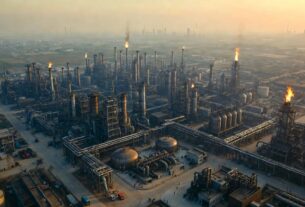
The European Commission has just proposed handing out billions more in free carbon emission permits to European industry under its flagship Emissions Trading System (ETS). According to Bloomberg, the updated benchmark values for 2026–2030 would deliver roughly €4 billion ($4.7 billion) worth of additional free allowances to manufacturers covered by the cap-and-trade program.
The official line? It’s about addressing “declining competitiveness” and easing pressure from governments and heavy industry. In plain English: the EU is tweaking the rules to give businesses a break because the carbon market it created is making it too expensive to produce steel, chemicals, cement, paper, and aluminum in Europe.
But here’s the question no one in Brussels seems willing to ask out loud: Why did Europe build an entire architecture of carbon taxes, carbon credits, and carbon markets that requires constant government handouts just to keep factories from closing?
This isn’t about “appeasing businesses.” It’s about the predictable — and in many cases, warned-about — consequences of policies that treat energy-intensive industry as a problem to be regulated out of existence rather than the backbone of a modern economy.
The Real Story Behind the Free Permits
The EU ETS, launched in 2005, was sold as the world’s most sophisticated tool to price carbon and drive decarbonization. Polluters pay for allowances; the cap tightens every year; markets supposedly deliver the cheapest cuts. Free allocations were always framed as a temporary shield against “carbon leakage” — the risk that factories would simply pack up and move to China, India, or the U.S., where emissions rules were looser.
Fast-forward two decades. Free permits still cover around 90% of industrial emissions in many sectors. And now, instead of phasing them out cleanly, Brussels is expanding the giveaway by including indirect emissions in the benchmark calculations. Reuters reports this move could save companies €4 billion in CO₂ costs over the next few years.
Why the sudden generosity? Because energy-intensive industries have been bleeding capacity and jobs for years. Aluminum production in the EU has plummeted from 4.5 million metric tons to 2.7 million over the past 15 years. Steel, chemicals, fertilizers, and refining have seen similar pressure. Germany and France have openly warned that high carbon prices, combined with sky-high energy costs from the renewables transition, are accelerating deindustrialization rather than decarbonization.
The Draghi report on European competitiveness, the Clean Industrial Deal, and repeated joint statements from industry groups like CEFIC all sound the same alarm: without relief, Europe risks irreversible loss of its industrial base.
Carbon Markets as Deindustrialization Policy?
The deeper issue isn’t whether free credits should be adjusted. It’s why the underlying system was designed to impose escalating compliance costs on the very sectors that provide high-wage jobs, supply chains, and energy security — while global emissions continue to rise elsewhere.
Critics have long pointed out that the ETS has produced carbon leakage, not elimination. Industrial emissions inside the EU have fallen far more slowly than power-sector emissions precisely because of the generous free-allocation regime. Meanwhile, production (and the associated emissions) has shifted to unregulated jurisdictions. Studies show that for comparable rises in emission intensity, EU output drops more sharply than in non-ETS countries, and multinationals have clear incentives to outsource high-carbon intermediates.
The phase-out of free allowances — mandated to reach zero by 2034 for CBAM-covered sectors — was always going to hit hardest exactly when the carbon price is highest. CBAM (the Carbon Border Adjustment Mechanism) was supposed to be the fix, slapping a carbon tariff on imports. But as industry groups have repeatedly warned, the combination of ETS tightening + CBAM rollout risks inflicting lasting damage on competitiveness without guaranteeing lower global emissions.
Europe’s own data tells the tale: energy-intensive industries have shed roughly 1.5 million jobs since 2008, with another ~200,000 losses reported in 2025 alone. Production in some sectors is down as much as 40% versus 2018 levels. This isn’t market failure. It’s a policy failure dressed up as climate leadership.
The Real Questions Policymakers Should Be Asking
Instead of celebrating another round of free credits as “support for industry,” European leaders should confront the uncomfortable truth:
Why tie industrial survival to an artificial carbon price that no major competitor fully replicates?
Why design a system where the “solution” to competitiveness erosion is perpetual government allocation of credits — effectively turning Brussels into the central planner of who gets to emit and who doesn’t?
Why pursue net-zero timelines that force the phase-out of these protections at the exact moment when energy costs are already structurally higher in Europe than in the U.S. or Asia?
The carbon market isn’t a neutral pricing mechanism. It’s an industrial policy tool — one that has demonstrably contributed to higher costs, lower output, and the offshoring of emissions and jobs. The latest €4 billion sweetener is simply damage control for a policy framework that was never designed to preserve Europe’s manufacturing heartland.
Energy News Beat has covered this pattern for years: ambitious climate targets meet economic reality, and the result is a patchwork of subsidies, exemptions, and last-minute relief packages. The pattern is clear. The outcome is deindustrialization by design.
Europe can decarbonize without deindustrializing — but not if it treats carbon markets as sacred and industry as the problem to be solved.
Make note that the States that follow the EU and UK path of Carbon Taxes and Carbon markets are following the same playbook. A Wealth transfer.
Appendix: Links and Sources
- Bloomberg: “EU Proposes Changes to Free Emission Permits to Appease Industry” (May 11, 2026) – https://www.bloomberg.com/news/articles/2026-05-11/eu-proposes-changes-to-free-emission-permits-to-appease-industry
- Reuters: “EU to give industries more free CO2 permits, document shows” (May 4, 2026) – https://www.reuters.com/sustainability/boards-policy-regulation/eu-give-industries-more-free-co2-permits-document-shows-2026-05-04/
- Euractiv: “Brussels bows to industry demands for more free CO2 permits” (April 30, 2026)
- European Commission ETS pages and benchmark revision documents (linked via Bloomberg)
- Additional context from Institut Montaigne, Bruegel, Carbon Market Watch, and industry statements (CEFIC, Orgalim) on competitiveness and leakage risks
- ECB working paper on ETS costs/benefits and carbon leakage (2023 analysis)
Energy News Beat delivers the why behind the energy headlines. Subscribe for daily stand-ups and in-depth analysis.