


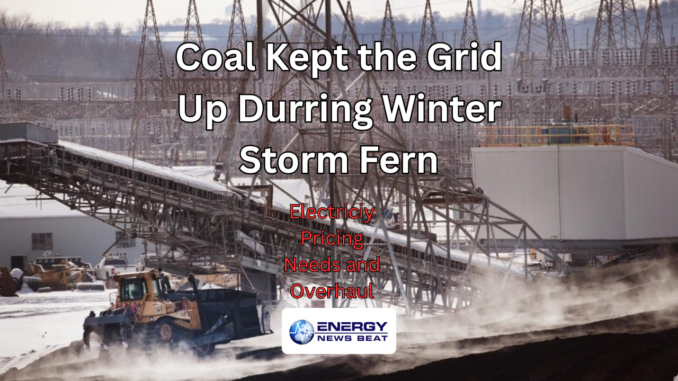
In the midst of Winter Storm Fern, which battered much of the United States in early February 2026 with extreme cold, heavy snow, and ice, coal-fired power plants emerged as the unsung heroes of grid reliability. As wind turbines iced over, solar panels were blanketed in snow, and natural gas supplies faced disruptions from freeze-offs and price spikes, coal generation surged to meet soaring demand. Output from coal plants jumped from about 70 gigawatt-hours per day to roughly 130 during the storm’s peak, providing up to 40% of electricity in the Midcontinent Independent System Operator (MISO) region and around 25% in PJM Interconnection.
This performance underscored coal’s role as a dependable backbone for the grid, thanks to on-site fuel stockpiles that shielded it from supply chain vulnerabilities.
Hats off to the dedicated operators of these coal facilities and to U.S. Energy Secretary Chris Wright, whose proactive measures—including emergency orders to prevent premature plant closures and investments in modernization—helped sustain the coal industry and ensure grid stability.
Wright’s actions, such as renewing orders for plants like Michigan’s J.H. Campbell to remain operational, likely saved lives by keeping power flowing to millions amid the deadly weather.
As Wright noted, coal delivered 20 times more electricity than solar and batteries during peak demand, highlighting its irreplaceable value in emergencies.
The Storm’s Impact and Coal’s Crucial Contribution
Winter Storm Fern pushed the U.S. power grid to its limits, with demand spiking as temperatures plummeted. In MISO and PJM, coal carried a substantial load, helping avert widespread blackouts that could have affected hospitals, emergency services, and households.
Federal interventions, including Department of Energy emergency orders under Section 202(c), allowed coal plants to ramp up output beyond normal limits for reliability.
Investments in winterization following events like Winter Storm Uri paid dividends, enabling coal to respond steadily.In contrast, renewables faced challenges: wind output declined due to icing and curtailments, solar generation dropped from snow and short daylight, and hydropower was limited by frozen waterways.
Natural gas prices soared above $30 per MMBtu in constrained areas, exacerbating volatility.
Coal’s stable fuel costs provided price certainty for consumers during the crisis.
The Bigger Picture: Electricity Pricing and Renewable Priorities
This event spotlights a fundamental issue in U.S. electricity markets: how power is priced and dispatched. In wholesale markets, renewables like wind and solar often have near-zero marginal costs (no fuel expenses), allowing them to be dispatched first under merit-order systems.
This priority forces baseload sources like coal and natural gas to cycle on and off, increasing wear and operational costs without compensation for their resilience during extremes.
Renewables aren’t charged for the grid’s need for backup during low-output periods, shifting those costs to consumers via higher rates or reliability risks.
Regions retiring coal prematurely have seen elevated prices and greater exposure to fuel volatility.
Overall, U.S. electricity prices have risen nearly 30% since 2010, driven by factors like additional transmission lines for wind and solar and system upgrades, though renewables’ low costs have helped mitigate some increases in certain areas. But those small savings are negated when you look at the additional costs of coal and natural gas turbine repairs. The bottom line, costs rise in Blue States with the additional regularity and tax burdens, as well as when wind and solar are attached to any grid.
Leveling the Playing Field for Grid Resilience
To achieve true fairness, electricity markets must incorporate full lifecycle costs, including resilience. The levelized cost of electricity (LCOE) for renewables is often lower—onshore wind at $0.034/kWh and solar PV at $0.043/kWh versus coal at $71-$173/MWh and gas at $48-$109/MWh—but this metric overlooks intermittency and backup needs.
Including grid resilience pushes renewables’ effective costs higher without mandatory storage.
Wind and solar projects should integrate storage to qualify for grid priority or incentives. States like New York have set targets, expanding to 6,000 MW of storage by 2030, with funds for paired solar-storage systems.
Mandates could ensure renewables contribute to 24/7 reliability, reducing cycling burdens on fossil fuels.
Land use is another disparity: Coal and natural gas plants occupy smaller footprints (about 1-2 acres per MW) compared to wind (up to 70 acres per MW) and solar (5-10 acres per MW), preserving farmland and minimizing habitat disruption.
End-of-life management adds costs—solar panels, wind turbines, and batteries generate millions of tons of waste by 2030, with recycling often uneconomical (e.g., $20-$24 per solar panel).
Coal and gas infrastructure, with longer lifespans (40-60 years vs. 20-30 for renewables), faces fewer disposal challenges.
Emissions reductions further favor coal’s evolution: U.S. coal CO2 emissions have dropped over 20% since 2005, thanks to scrubbers, efficiency gains, and shifts to gas/renewables.
Modern scrubbers have slashed SO2 and NOx by 90% in many plants.
Recommendations for a Balanced Energy Future
Policymakers should: Mandate Integrated Storage: Require new wind/solar projects to include batteries for firm capacity, as in New York’s roadmap.
Adopt Full Cost Accounting: Revise LCOE to include resilience, land reclamation, and end-of-life recycling, potentially adding $10-$20/MWh to renewables.
Incentivize Coal Upgrades: Fund scrubbers and carbon capture to extend coal’s life, as in DOE’s $175 million modernization program.
Promote Hybrid Systems: Encourage co-located renewables with gas for reliability, balancing intermittency. Here is the catch. The additional maintenance to the gas turbines should be paid for by the wind and solar projects. The millions of dollars spent on additional wear and tear on natural gas turbines come from being shut down to allow wind and solar on the grid. Those costs are passed on to consumers, and nobody is pointing this out.
Address Waste Streams: Develop national standards for recycling solar panels (projected 78 million tons by 2050) and turbine blades.
These steps would foster a resilient grid without prematurely phasing out proven sources.
Investor Opportunities in Coal and Natural Gas
For investors eyeing resilient energy plays, focus on companies with strong fundamentals amid rising demand.
Coal Stocks:
Peabody Energy (BTU): A leading thermal and met coal producer, benefiting from stable contracts and modernization. Zacks estimates 909% EPS growth in 2026; dividend yield 0.98%.
Warrior Met Coal (HCC): Premium met coal exporter with low costs. Expected to gain from global steel demand.
Ramaco Resources (METC): High-quality met coal with growth potential in a challenging market.
Natural Gas Stocks:
Cheniere Energy (LNG): Largest U.S. LNG exporter, poised for demand from AI data centers and exports. Market cap $47B; yield 0.96%.
EQT Corporation (EQT): Top Appalachian producer with low-cost assets. Yield 1.39%; strong growth from acquisitions.
Kinder Morgan (KMI): Pipeline giant with stable cash flows. Yield 3.64%; 2026 EBITDA guidance at $8.7B.
These firms offer exposure to reliable energy amid the transition, with dividends cushioning volatility. Stuart Turley will be covering this on the Energy News Beat Stand Up later today.
Sources: marketwise.com, nasdaq.com, realclearwire.com
Get your CEO on the podcast: https://sandstoneassetmgmt.com/media/
Is oil and gas right for your portfolio? https://sandstoneassetmgmt.com/invest-in-oil-and-gas/




Be the first to comment