

Irina Slav did a great job today leading the discussion, and it was interesting with the great comments from the live audience.
Irina had a great point about the new Ford’s ability to shut down or allow you to use your own car due to heightened stress. This is not good, and I will not be buying a car with those capabilities. I highly recommend subscribing to her Substack.
“ So if you have an accident and you really need to go to the hospital urgently and you’re not in a stable psychological state because you just had an accident, you can’t do it because your car wouldn’t let you. “
Irina Slav, Energy Writer, OilPrice.com, Substack
1. Amsterdam’s Advertising Ban & Climate Activism
The hosts discuss Amsterdam’s controversial ban on public advertising for meat, cruises, air travel, and petrol cars as part of net-zero efforts. They debate the effectiveness of such measures, noting that meat ads represent only 0.1% of advertising spend, and question whether advertising actually influences consumer behavior. The conversation touches on broader climate activism movements and their expansion to other cities and countries.
2. Venezuela Oil & ExxonMobil’s Investment Reversal
A significant shift in ExxonMobil’s stance on Venezuela is analyzed. After initially calling Venezuela “uninvestable” in January, the company announced interest in investing there by May. The hosts discuss how changing political conditions make Venezuela’s massive oil reserves attractive again, and explore potential offshore development adjacent to Guyana operations.
3. Guyana’s Oil Boom & Economic Growth
Guyana is highlighted as an emerging oil powerhouse, with production expected to reach 2.5 million barrels per day by 2030. The discussion covers the country’s rapid economic growth, infrastructure development (converting coal plants to natural gas, building wind and solar), and the importance of ensuring wealth benefits the population through sovereign wealth funds.
4. UAE’s OPEC Withdrawal & Geopolitical Implications
The UAE’s departure from OPEC is analyzed in detail, with a discussion of its desire to pump more oil before demand destruction occurs. The hosts explore geopolitical consequences, including the UAE’s withdrawal of funds from Pakistan’s central bank and Saudi Arabia’s subsequent intervention, suggesting tensions over Pakistan’s alignment with Iran.
5. Pipeline Projects: Keystone Light & Canadian Exports
Trump’s authorization of the Bridger pipeline expansion (550,000 barrels/day capacity) is discussed as a way to utilize existing infrastructure and boost Canadian crude exports to the US. The conversation covers permitting challenges, environmental litigation, and the trade-offs of increased reliance on US markets.
6. Oil Price Forecasts & Market Scenarios
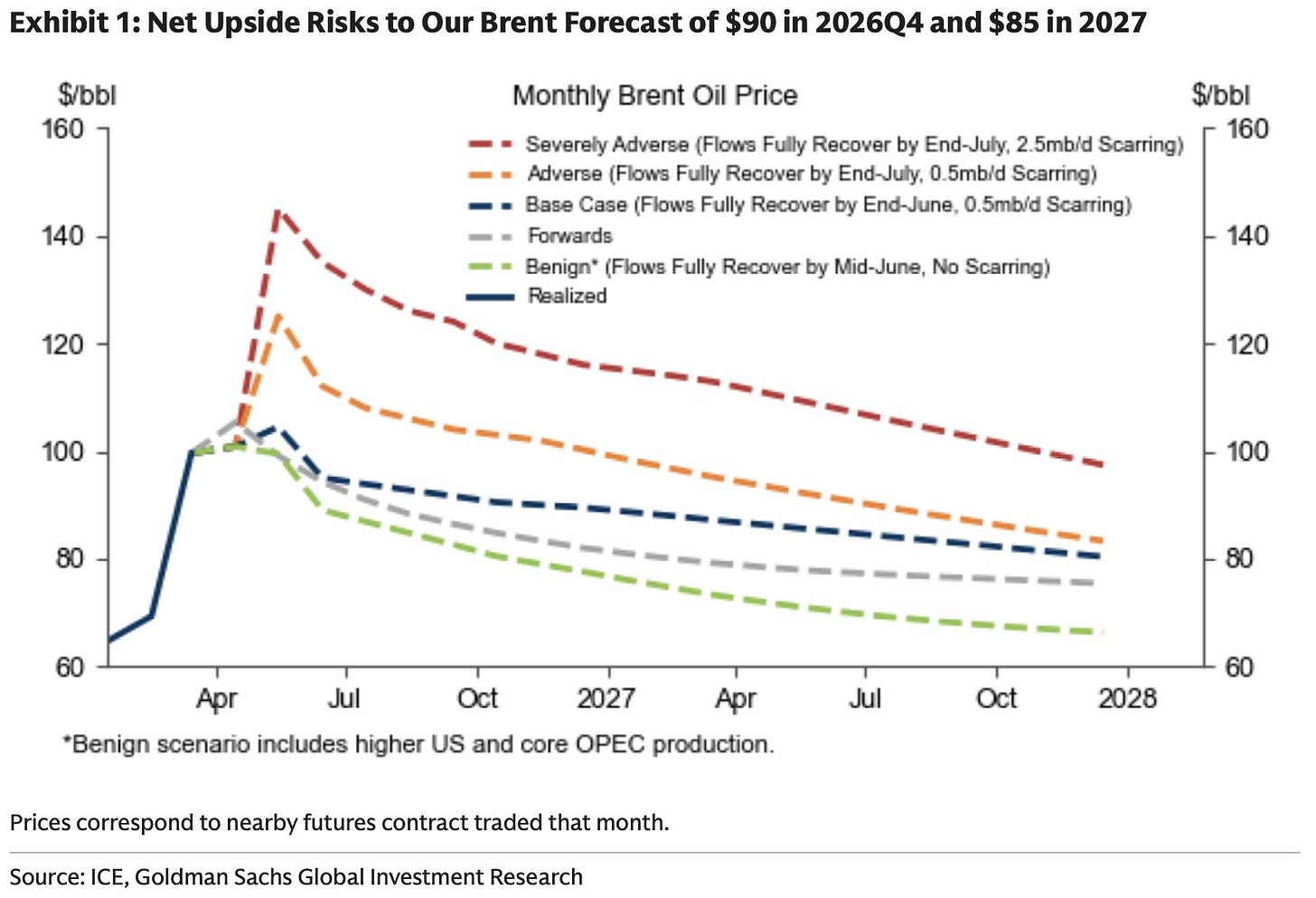
Goldman Sachs’ five scenarios for oil prices are examined, ranging from $60 to $150 per barrel through 2028. The hosts debate the realism of these forecasts, the impact of Iranian low-pressure oil fields, and the critical assumption that Hormuz Strait flows resume by July.
7. Energy Security vs. Net Zero Policies
A central theme is the bifurcation of global energy policy: countries pursuing energy security and domestic drilling (experiencing GDP growth) versus those following net-zero policies (facing economic challenges). The UK, EU, and California are criticized for regulatory overreach, while China is noted as playing both sides—promoting net zero while expanding coal and natural gas.
8. Renewable Energy Challenges & Sustainability Questions
The hosts challenge the sustainability narrative of wind and solar, citing a $10 billion investment yielding only 3% energy gain globally. They discuss blade disposal liabilities ($89 billion for US wind farms), maintenance costs, and the reality that renewable infrastructure doesn’t last as long as promised.
9. UK & EU Regulatory Alignment Post-Brexit
Despite Brexit, the UK is aligning regulations with the EU, including bans on air-vented tumble dryers and discussions of enhanced strategic cooperation. The hosts question why the UK is essentially rejoining EU frameworks through the back door.
10. Canada’s Potential EU Membership & Sovereignty Concerns
A surprising discussion emerges about Canada potentially joining the EU, with Mark Carney and EU officials discussing “enhanced strategic cooperation.” The hosts express concern about Canada surrendering sovereignty to Brussels bureaucracy.
11. North Sea Oil Infrastructure at Risk
The UK’s scheduled phase-out of the 40s pipeline system (which carries 23% of UK liquids) by 2035 (possibly 2028) is highlighted as a policy-driven infrastructure crisis rather than a geological one. The UK is leading the world in bad energy policies.
12. Shell’s Montney Play Investment & LNG Export Challenges
Shell’s $15 billion acquisition of Arc Resources for Montney assets is discussed, along with challenges in building export infrastructure like the Prince Rupert Gas Trunk Line, which faces environmental litigation.
13. US Military Presence & Geopolitical Shifts
The hosts discuss Trump’s potential reduction of US military bases abroad, particularly in Germany, and the economic implications for local communities. The question of who fills the power vacuum when the US withdraws is raised.

David hits it out of the park with a key issue for the Net Zero energy policies.
“ I looked it up, then Grock tells me that that That the Netherlands percentage of global man-caused CO2 emissions is three-tenths of one percent of global emissions. “
David Blackmon, Forbes, Daily Caller, Energy Absurdities Substack Author
David’s point is very impactful when you look at the money and control around Net Zero and Energy policies. Like the Netherlands, California is following Net Zero and has a rounding-error impact on the world’s CO2 output, but it is willing to sacrifice the United States’ energy security by staging the potential economic disaster of its management of California’s oil and gas industry.
“ And I think when you take a look at the Strait of Hormuz impact on the world, I think the world is going to wake up and realize that energy security starts at home. “
Stu Turley, Energy News Beat Podcast Host
Buckle up, the world is on edge, and we are bifurcating into two different paths. One path will follow Net Zero, deindustrialization, and fiscal decline. The other will follow Energy Security and fiscal prosparity.
We have our work cut out for us, and we need to get involved locally. The next big push is going to be water and communities.
Thanks to all of our great subscribers, patrons, and sponsors! Tomorrow will be the Energy News Beat Stand Up. Thursday is Doomberg, and Friday is Jon Brewton on AI and Nuclear!

For David Blackmon

For Tammy Nemeth

For Irina Slav

ld with Irina Slav, Dr. Tammy Nemeth, and David Blackmon