

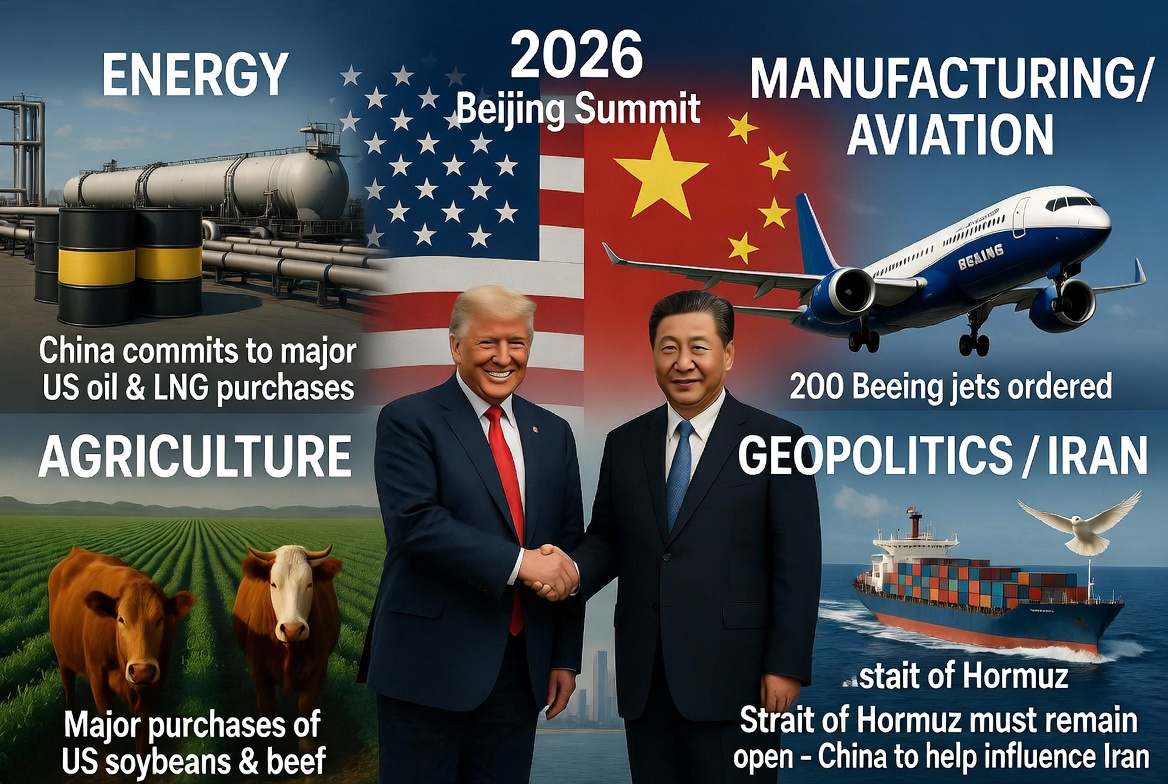
President Donald Trump’s two-day summit with Chinese President Xi Jinping in Beijing (May 14-15, 2026) delivered a mix of tangible trade deliverables and diplomatic signaling on the Iran war—framed against a backdrop of disrupted global energy flows through the Strait of Hormuz. While no sweeping new trade war truce or grand bargain emerged, both sides touted “fantastic trade deals,” an extension of last October’s détente, and a new oversight mechanism to prevent past failures.
The meetings produced concrete purchase commitments in agriculture, energy, and aviation, alongside broad agreement on keeping the Strait of Hormuz open. Analysts describe the outcome as “managed stability” rather than a breakthrough, with modest wins for U.S. exporters and short-term relief for global energy markets.
Below is a sector-by-sector breakdown of the key announcements, followed by winners/losers and the geopolitical ripple effects on the Iran conflict.
Key Trade Announcements
Energy
Energy emerged as one of the clearest areas of alignment. China signaled a strong interest in buying more U.S. oil and liquefied natural gas (LNG) to diversify away from Middle Eastern supplies disrupted by the Iran war. Trump stated that Xi committed to increased purchases of U.S. energy products, including oil and LNG, reviving a trade flow that had largely halted under prior tariffs (previously worth billions annually).
Both leaders explicitly agreed that “the Strait of Hormuz must remain open to restore energy flows through the critical waterway,” with Xi opposing any militarization or tolling. China also expressed a strategic goal of reducing reliance on Iranian and other Middle Eastern crude through greater U.S. imports.
This represents an “easiest bilateral win” for energy trade, per S&P Global analysts, and could help stabilize U.S. export volumes amid global price volatility.
Agriculture
China is committed to ramping up purchases of U.S. agricultural goods, with a focus on soybeans and beef. U.S. officials highlighted “double-digit billions” in expected ag buys, including renewed import licenses for hundreds of U.S. beef plants (which had lapsed during the prior trade war). Trump and his team emphasized these purchases as a direct boost for American farmers ahead of the midterm elections.
The deals build on Phase One-style commitments but include a new enforcement layer (see below).
Manufacturing / Aviation
A headline manufacturing win came in commercial aviation: Xi agreed to purchase 200 Boeing jets—exceeding the U.S. request of 150—marking China’s first major order of U.S.-made commercial aircraft in nearly a decade. This is expected to support thousands of American manufacturing jobs.
Broader manufacturing access was discussed under expanded market access for U.S. businesses and increased Chinese investment into American industries, though specifics beyond aviation remained light.
Cross-Cutting Mechanism
To ensure follow-through (addressing China’s past shortfalls on purchase commitments), the two sides announced a bilateral “Board of Trade” comprising senior officials to oversee implementation and resolve commercial differences. Some reporting also floated a parallel “Board of Investment.” Tariffs remain under the existing truce, with expectations of continued extension.
Rare earths and fentanyl precursor curbs were also on the agenda but yielded no new public breakthroughs.
Winners and Losers
Winners U.S. Farmers & Agriculture Sector: Soybean and beef producers stand to gain the most immediate relief from new Chinese demand.
Boeing & U.S. Aviation Manufacturing: The 200-jet order provides a major backlog boost and political win for Trump.
U.S. Energy Exporters (Oil & LNG): Renewed Chinese purchases could offset some global market uncertainty and support “energy dominance” goals.
Trump Administration: Tangible deals and the optics of a “great” personal relationship with Xi deliver short-term political wins amid domestic pressure over the Iran war.
Global Energy Markets (Short-Term): Diplomatic language on the Strait of Hormuz offers hope for de-escalation and lower volatility.
Losers (or Limited Gains) Expectations for Structural Change: Critics note the deals are mostly transactional purchase pledges rather than deep reforms to China’s market access or subsidies.
Iran: Beijing’s willingness to buy more U.S. energy and publicly oppose Hormuz disruption indirectly pressures Tehran, though China stopped short of aggressive enforcement.
Hardliners on Both Sides: U.S. hawks seeking tougher tech/export controls and Chinese nationalists wary of concessions saw their maximalist goals sidelined in favor of stability.
Broader Indo-Pacific Allies: Some partners (e.g., those concerned about Taiwan) worry about any perceived U.S. softening in exchange for economic wins.
Overall, China appears to have secured relational stability and tariff predictability at relatively low cost, while the U.S. walked away with headline-grabbing purchase commitments.
Impacts on the Iranian War and China’s Potential Influence on Iran
The Iran conflict loomed large despite the trade focus. The U.S.-led strikes and Iranian closure of the Strait of Hormuz have triggered a global energy crisis, spiking prices and hurting both economies. Trump pressed Xi to leverage China’s position as Iran’s largest oil customer.
Key Outcomes on Iran: Xi reportedly offered to help “broker peace” and reopen the Strait of Hormuz.
Both sides agreed the waterway “must remain open” and free of militarization or tolls.
Xi assured Trump that China would not provide military equipment to Iran.
Both reaffirmed that Iran must never obtain nuclear weapons.
China’s pivot toward greater U.S. energy imports is framed as a deliberate move to reduce future dependence on Iranian/Middle Eastern crude.
Analysts caution that these are largely diplomatic statements rather than binding commitments. China has historically been reluctant to pressure Iran publicly, and Beijing continues to benefit from discounted Iranian oil. However, the Hormuz agreement and energy diversification pledges represent a modest diplomatic victory for Trump and could open the door for quieter Chinese influence on Tehran.
Longer-term, if China follows through on U.S. energy purchases and withholds military support, it could accelerate a negotiated end to the conflict—benefiting global oil flows and U.S. exporters alike. Failure to deliver, however, risks renewed friction.
Bottom Line for Energy Markets
The summit delivers incremental positives for U.S. energy and ag exports while injecting cautious optimism into oil markets via the Hormuz language. Real impact will depend on implementation via the new Board of Trade and whether China actually leans on Iran. For now, the relationship is stabilized—but the underlying tensions (Taiwan, tech, Iran) remain.
- CNBC: “Five takeaways from the Trump-Xi summit in Beijing so far” (May 14, 2026) – https://www.cnbc.com/2026/05/14/trump-xi-summit-beijing-takeaway-taiwan-trade-iran-war-strategic-relations-.html
- CSIS: “Trump-Xi Summit in Beijing: Managing the World’s Most Important Relationship” – https://www.csis.org/analysis/trump-xi-summit-beijing-managing-worlds-most-important-relationship
- AP News: Live updates and summit coverage (May 14-15, 2026) – https://apnews.com/article/trump-xi-china-summit-trade-tariffs-2eee658298ba8f064fe232e8832bd2ea
- Reuters, S&P Global, The Hill, Bloomberg (referenced via search aggregates), and additional reporting from CNN, BBC, and Axios on specific deals and Iran discussions.
Energy News Beat will continue monitoring the implementation of these commitments and their market effects.