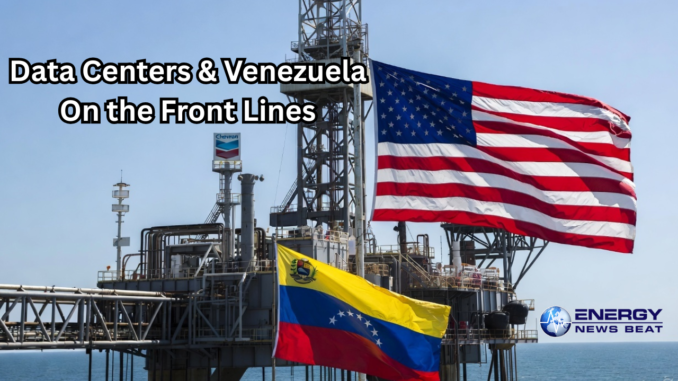
David Blackmon stops by to talk about his Forbes Article and the Geopolitical Issues we face.
Today on the Energy News Beat, Stand up Stu Turley and David Blackmon talk about the critical issues around Data Centers, Venezuela, Chevron, and how investors would react.
With an oil platform in the Caspian Sea hit by Ukrainian drones, another Russian Tanker hit, and the U.S. boards a tanker loaded with Venezuelan oil, you can’t buy this kind of entertainment. Years ago, oil would have spiked to $20, and today it’s going down.
1. The data center boom and its impact on power grids, especially in the PJM region of the northeastern United States. The transcript discusses how the rapid growth of data centers is straining power grids and causing utility rates to rise.
2. Chevron’s operations in Venezuela and the complex geopolitical situation there, including the enforcement of US sanctions and the potential for regime change.
3. Innovative solutions to power data centers, such as the supersonic engine developed by Boom Supersonic, that can be used to power AI data centers.
4. Concerns about a potential “bubble” in the data center industry due to the rapid growth and large investments.
5. Partnerships between energy companies and data center operators, such as Exxon’s deal with NextEra to develop a gigawatt-scale data center.
6. The importance of developing domestic rare earth refining capabilities in North America to reduce reliance on China.
7. The boom in US solar installations is driven by the impending expiration of tax credits and concerns about the sustainability of this growth.
8. Ongoing mergers and acquisitions in the natural gas sector, as companies seek to gain economies of scale.
00;00 Introduction Data Centers
01:20 PJM Grid Growth in West Virginia
04:26 Chevron and Venezuela on the Front Lines
08:41 Symphonic Supersonic new gas turbine for data centers
12:58 Exxon is working with NextEra to develop a Gigawatt Data Center
16:00 US Solar is setting up for a crash
23:41 Exxon and Chevron Charts
Want to get your story in front of our massive audience? Get a media Kit Here. Please help us help you grow your business in Energy. https://energynewsbeat.co/request-media-kit/
1.Datacenter Boom Drives Rapid Power Grid Innovation
3.Innovation from Symphony Supersonic Engine for AI Data Centers is a Game Changer in Nat Gas Turbines
4.Data Center Boom Drives Rapid Power Grid Innovation. But Is A Bubble Looming?
5.ExxonMobil Working with NextEra to Develop Gigawatt Data Center for Hyperscaler
6.M&A Deal Brings Home the First Heavy Rare Earth Refinery
7.U.S. Solar Installations Go Through the Roof as Developers Sprint to Secure Tax Credits

Full Transcript:
Stu Turley, ENB Podcast Host [00:00:03] Data centers and Venezuela on the front lines of what’s going on in the world. Hang on, buckle up. We’ve got a great one for you on the Energy Newsbeat Daily Standup. Hello, everybody. Welcome to the Energy Newsbeat Daily Stand Up. Data Center Boom drives rapid growth and innovation. This is a fantastic story from David Blackman. I’ll tell you what, this is on Forbes. Go out and check Forbes. David Blackman out there writes the booming data center industry to drive power demand growth across the United States, forcing utility rates rapidly upward upwards as grid managers struggle to maintain reliability amid increasing tight capacity. The dynamic is especially acute in the PJM region in the northeastern United States. Let me just call a friend. Hey, speaking of that friend, David Blackman, author on Forbes. How are you this morning? Man, I’m great. How are you doing? This is a heck of an article. When you sit back and take a look at it, where what were you thinking when you wrote this?
David Blackmon, Forbes Author, Podcast Host [00:01:20] Well, y you know, what’s happening is the PJM grid is being particularly hard hit because it that region is being inundated with dozens of new data center projects. PJM encompasses Virginia, Northern Virginia, Maryland, the area around Washington, DC, where all the three-letter agencies are building out their new human surveillance data centers, you know, so they can adopt AI to spy on us. And that’s causing a big drain on the grid. Unfortunately these states are and PJM grid managers haven’t implemented a requirement that you know these new data centers provide their own behind the meter generation. So most of them are just at least initially linking up to the grid and and draining power generation from from ordinary consumers. So the market gets tight on supply, prices go up unsurprisingly, and household consumers end up footing most of the bill. It’s it’s a difficult thing. So so these grid managers are are having to resort to some unorthodox strategies to kind of deal with this. You know, you know, involving, you know, placing tariffs when when a data center draws more than than contractually agreed to and things like that that try to keep the lights on for in everybody’s homes and air conditioners up and our eaters, I guess in this season up and running. It’s a difficult situation. You know, we we kind of have a diff different situation in Texas because the legislature, the Texas legislature actually had foresight on this thanks to Lieutenant Governor Dan Patrick and his staff, who Patrick is one of the most unappreciated, underappreciated statewide officials in Texas. You know, he’s very outspoken and very conservative, so the media hates him and they’re they never give him credit for anything. But it was his office that drove the legislature, the the bill that requires new data centers to build their own behind the meter capacity and provide their own power. And and so the ERCOT grids getting hit a little bit because Texas is just a I mean a booming place right now with data centers and all sorts of other industrial growth. But it’s not in the kind of emergency situation that PJM is and that some other regional grids are probably going to experience as the data center industry kind of starts to spread out into other parts of the country. It’s been heavily focused in that Northeast region, you know, because for a variety of factors, but you know, mainly because it’s close to the seat of government. But but that’s going to change. It’s going to spread all across the country and state legislatures need to follow the Texas example if they want to keep their grid stable.
Stu Turley, ENB Podcast Host [00:04:26] Oh, I I couldn’t agree more, but I’ll tell you what, data centers need to be built on top of where the power or the energy source is, as opposed to putting in all the transmission lines. That’s why there’s been a 230% increase back east because of the data centers that you mentioned to keep an eye on us. Let’s go to the next story, David. Chevron on the front lines of Venezuela conflict and in talks with the Trump administration. David, do you remember you and I are both old enough that three years ago when a tanker was seized or blown up in the Red Sea, $20 spike in oil, we today, as of this morning, we are filming this on 1211. We had a platform, the Luke Oil platform in the Caspian Sea was bombed by Ukraine. Another tanker was hit by two drones from Ukraine. We had the US board and seize a tanker from Venezuela that was bound for China, and you can’t buy this kind of entertainment, but when you take a look at how Venezuela is on the front lines here in the volatile landscape of the ge energy politics, Chevron Corporation stands as a pivotal player in Venezuela’s ongoing crisis. The only US major still operating in the sanctioned nation, Sevron is navigating a complex web of political tensions. I’ll tell you what, you sit back and take a look, they are really poised to really pop in and say, wait a minute, this could be a a big deal. As we scroll for our podcast listeners, I have a video on X of from Energy Headline Cool Cat of this is a little different from Somali pirates going and seizing a ship. You see a helicopter and you see our great SEAL team jumping out there. Here’s where David this story really starts alluding to, and that is sanctions don’t work as intended until they’re enforced. I think we’re just now seeing enforcer enforcement rolling in.
David Blackmon, Forbes Author, Podcast Host [00:06:46] Yeah, you know, you I mean, governments always try to enforce sanctions via diplomatic means. That doesn’t always work, obviously. In fact, it seldom works, as we talk about on on our Monday podcast and Arenaslav is talked about for a long time too. And so, you know, with Venezuela they’re they’re obviously resorting to more forcible means to implement the sanctions. Chevron, of course, is the lone big producer of oil now in Venezuela. Petavisa is essentially become a non-entity under the Maduro regime. It’s such a shame, tragedy what’s happened to that country. You know, and it all goes back to two thousand and I believe is six or seven when Maduro, no Maduro’s predecessor, Hugo Chavez nationalized and the industry and confiscated everyone’s assets. Chevron was able to retain a foothold in that country, but everybody else left and has been able to s you know resume its production activities to some extent anyway, for the past few years. And this tanker was no doubt carrying all that Chevron produced, so you know, they’ve got a problem here. But there’s a reason why, folks, thirty percent of US naval assets are amassed in the Caribbean Sea and off the west coast of of South America, Northwest Coast. And you know, there’s gonna be a regime change in Venezuela soon. I guess the Trump administration continues to hope they can negotiate Chavez, I mean Maduro out of there. But he doesn’t seem inclined to leave unless they’re they’re willing to let him take about 200 million dollars with him so he can, you know, live the lifestyle to which he has become accustomed.
Stu Turley, ENB Podcast Host [00:08:41] You can’t beat this kind of entertainment. Let’s roll to the next story, David. When you sit back and take a look, what is gonna get us through the data center kind of a thing? I found this story really, really interesting. Innovation from symphonic supersonic engine for AI data centers is a game changer in net gas turbines and a bold pivot that bridges aerospace innovation with escalating demands of AI. David, for us Oklahoma State guys in Abilene, that’s artificial intelligence. Boom supersonic has unveiled superpower, a 42 megawatt natural gas turbine engineered specifically for powering data AI data centers. I’ve reached out to him to try to get him on the podcast, and he has got a very cool Blake Shoal. I’m not gonna play his voice while we sit here and watch it. But David, this is the kind of innovation that we are gonna actually need in order because there’s a five year wait, you know, for some of these new gas turbines. He’s taking a supersonic engine that he’s been working on for a few years, and he’s turned around, thrown a Stargate a Star Link from Elon. So these bad dogs could be put right on top of a oil well, excuse me, a natural gas well, and you’re off and running, man. This is pretty this is cool.
David Blackmon, Forbes Author, Podcast Host [00:10:13] Yeah, and you know, it’s the kind of innovative solution these these developers have to to go to because wind and solar can’t fit the bill, right? They have to be up ninety nine point nine nine nine, up and running percent of the time. And wind and solar can give ’em maybe eight hours a day if they have backup batteries. And so that just that dog doesn’t hunt for for these data centers. And so they have to go to natural gas somehow. If you can’t get the big turbines, you stream together several of these and you’re in business.
Stu Turley, ENB Podcast Host [00:10:44] You bet. But you know, the odds of me getting Blake Shoal on the podcast are probably very light, but hey, I’ve I’ve I’ve had a few other folks get on the try. Gotta try. Let’s go to this next one. Data center boom drives rapid power grid innovation, but is a bubble looming. David, I want to ask your opinion on the explosive growth. You know, I sit here and I look at my day trading practice, and I’m now starting up. You sit back and kind of go, the area called data center alley, we just talked about in a minute. You talk about other assets. When we talk about data centers, everybody’s sitting there going, when are we gonna make our money back? The oil and gas industry has made it done a great job taking in and giving money back to investors. Oil and gas learned their lesson. Give money back to investors, you get more money. It’s kind of like Pavlov’s dog, except with money, right? And so now when you sit back and take a look at look at the projection growth on this chart, this was from SP Global, and then you take a look at what SP Global also said was is it real or are they actually occupied? And I thought SP Global did an outstanding job on this. It’s a great, great company for this kind of data. And when you sit back and take a look, wait a minute, are they actually building these things out for profits? Who’s gonna pay for it is and how is it gonna do? I mean, what are your thoughts on that? I mean, optimism abounds with investments around $450 billion over five years, including $300 billion in debt. Trillions more are forecasted. And you have Jamie Diamond putting in trillions of dollars. Is this a potential bubble? Is my question.
David Blackmon, Forbes Author, Podcast Host [00:12:35] Well we better all hope not. I mean, you talked about I mean if the Bear Stearns was too big to fail back in two thousand and eight, think about Nvidia, which is what, a three trillion dollar company now. You know, the world can’t afford for for this boom to be a bubble. And if it if it should pop, then we’re all in trouble.
Stu Turley, ENB Podcast Host [00:12:58] Yep. All right. Hey, let’s go to the next story. Hey, I’ll tell you what, this one I enjoyed. Exxon working with Next Era for to develop gigawatt data center for hyperscaler. David, this one really points out that you you take a look at partnership of EMP operators, Chevron’s doing it, but Liberty Energy started this three years ago. They were ahead of the curve getting into the data center and energy power system. When you take a look
David Blackmon, Forbes Author, Podcast Host [00:13:28] Who was Liberty Energy CEO at the time?
Stu Turley, ENB Podcast Host [00:13:31] I believe that was our great Chris Wright. When I I when I interviewed Ron Gussick, the the CEO that replaced Chris Wright, he is he is spot on. They are then leveling out their cash flows instead of having to rely on oil and gas markets like this, they level it out and go, we’d rather be a power company. Well, Liberty Energy is a great way to do it. So when you take a look at ExxonMobil copying Liberty Energy or Chevron copying that business model, what a compliment.
David Blackmon, Forbes Author, Podcast Host [00:14:08] Yep. Yeah. And Exxon and Chevron both are are getting into this in a big way. And it’s gonna be and we saw yesterday Exxon introduced a new five year strategic plan and they’re really emphasizing this part of the business now over the low carbon solutions that they had been emphasizing for the last five years. So this is the trend of the future.
Stu Turley, ENB Podcast Host [00:14:30] You bet. And as behind the I’m sold on behind the meter, and I’m I really applaud Texas for making sure that you know we try to keep our data centers out of here. Hey, I love this MA deal. MA deal brings home the first heavy rare earth refinery. When you sit back and take a look and a groundbreaking move, North America’s energy and critical mineral centers, RE alloys has emerged with black’s black box stocks, which is BLBX, paving the way for content first commercial heavy scale rail rare earth refinery. I’m all in. We need all the stuff we can do here and get rid of China’s dependency on them.
David Blackmon, Forbes Author, Podcast Host [00:15:14] Yeah, and compliments again go to who? The Trump administration and Chris Wright for for paving the way on this, having the vision to to proceed to to ensure these kinds of deals get made. I’ll never forget the day in June twenty twenty one when Joe Biden promised a whole of government effort to do exactly this kind of thing. And for the following four years his administration did zero.
Stu Turley, ENB Podcast Host [00:15:39] Yep. In summary, this MA deal isn’t just corporate transaction, it’s a strategic pivot toward self sufficiency. I kinda like that. Boy, the guy that wrote that’s a smart cookie. Okay. Hey, David.
David Blackmon, Forbes Author, Podcast Host [00:15:56] It wasn’t me, it was you, not not me.
Stu Turley, ENB Podcast Host [00:16:00] I gotta pat myself on the back once in a while. Hey, US solar installations go through the roof as developers sprint to secure tax credits. Oh my goodness, the tax credits are drying up. And boy, they are letting this thing in here. The U.S. Solar industry is experiencing an unprecedented boom with installations surging in 2025 as developers race against the clock to capitalize on expiring tax credits, and they have to only install two or whatever the number is. This is disgusting. The frenzy is driven by the looming deadlines of the investment of the tax credit, the ITC, and the production tax credits, the PTC under the federal legislation, which mandates projects begin a construction by July 4th, 2026. And so you had the left-leaning green energy camp going, yay, look at all the solar that’s going in. But people are forgetting, David, that the war started with Westinghouse and Tesla. When you sit back and take a look, AC versus DC, you take a look at the asynchronous the can the turbine type methodology of the grid, which has been built on for over a hundred years, or direct current that you have to transform. Wind and solar’s DC. You gotta then put a transformer in there, and that is a problem. You lose power when you put it into a DC to AC. And I never thought that I my one of my favorite bands, D A C D C would actually be one of my talking points on a podcast. So
David Blackmon, Forbes Author, Podcast Host [00:17:42] Just just one comment on this. This this boom in solar right now, between now and and July twenty twenty six, is setting solar up for a Great Depression once those tax credits expire. So it’s gonna stop.
Stu Turley, ENB Podcast Host [00:17:57] Yep. And the second part of that is you and I have talked about this. We have an eighty nine billion dollar liability hanging out there for the wind turbines alone for land reclamation. Yeah.
David Blackmon, Forbes Author, Podcast Host [00:18:10] Yeah.
Stu Turley, ENB Podcast Host [00:18:10] Yeah. That’s that’s to start. Okay. Let’s go to the last one here. And when we sit back, Ontario to buy gas assets from quantum’s HG for two point eight billion. How many more mergers, David, do you think are gonna be rolling in? The significant move in the natural gas sector, Antaro resources, the New York Stock Exchange AR has announced its agreement to acquire upstream natural gas production assets from HG Energy in a portfolio of Quantum Capital Group for two point eight billion. I think we’re gonna see some more MA deals coming around the corner.
David Blackmon, Forbes Author, Podcast Host [00:18:49] Yeah, there’s still some to be done out there. You know, the the pickings are getting pretty slim. You know the big corporate mergers have probably kind of run their course unless somebody wants to try to bite off a Devon Energy or an EOG resources. But you these kind of mid-range deals like this one, you know, two to five billion dollar kinds of deals, there’s still those opportunities out there and we’ll continue to see them because economies of scale are so critical to be profitability in these shale formations, and you’re just gonna have to get fewer companies with bigger footprints to to keep them going.
Stu Turley, ENB Podcast Host [00:19:27] Hey, let’s take a moment here and recognize our sponsor. I want to give a shout out to Reese Energy Consulting. If you’re in the midstream space, boy, you really need to get your molecules checked. That almost sounds like a really good marketing slogan. I gotta call Steve and say, hey, yeah, go to Reese Energy Consulting.com and get your molecules checked. But hey, let’s go to the markets here. Let me also bring up my next screen here, and that would be this one. And when we take a look at the markets, I’m having a heck of a lot of fun when you take a look at the Nasdaq. Everything’s coming up this morning from our cotton picking Fed speaking yesterday. That was absolutely a hoot. I vote all those in favor, get rid of the Fed.
David Blackmon, Forbes Author, Podcast Host [00:20:19] Oh well yeah, or at least if you can’t do that, get a new leader.
Stu Turley, ENB Podcast Host [00:20:23] Oh my goodness. He if he could stab President Trump in the in the throat, he would. I mean, this he did it unbelievable. That we’ll just leave that alone. But let’s take a look at some of the graphs here. And you take a look at the market timing. This this one is for all of the the I use a Vector Vest for my day trading and taking a look at this, they have some outstanding. You take a look at all the petroleum or drilling in the stocks, and this is taking a look at how the market is going and how it is responding to this. But let’s take a look at this next one here. And I’ve got it. This one, this is the overall market as we’re looking at right now, and we’re seeing that it is going down as we’re oh now we’re going up. It’s basically taking a look at it. Day trading is actually very entertaining as I learn how to chew on my fingernails going through and do doing some day trading. But let’s take a look at Chevron stock. Here is three month chart. Oh, thanks. Why did you do that? Okay, take a look at a one month chart here. We’re now seeing that whenever the red crosses the green and you take a look at how it’s rolling over here on the right hand side, David. This is now approaching a buy. And I guarantee you that you’re going to start seeing Chevron when the looking of the volume, let’s take a look at the earnings per share. I would question whether or not to take a look at the earnings per share on this one. I always look for looking at the red crossing the green and looking at the earnings per share as its graph is going up. Chevron, I would not, I do not give investment advice. Please check with your investment advisor, but I’m just showing you what I do. This is for entertainment purposes only. And when you take a look, let’s take a look at Xon Exxon. I was looking at Exxon. Here is a wonderful difference. And you take a look at that, look at the earning per share ratio. Look at this chart. I’d be jumping on this one. So I just wanted to bring this up to folks as we’re taking a look at the finances. And now I want to add this to the mix here, David. And that is let’s take a look at this. First gold, then copper, now watch energy. Gold is still going up. You take a look at the world markets as it’s rolling around a flush. Russia’s now got they bought thirty million ton I have to go fact check myself on that. Take a look at the copper, take a look at where oil’s going. Where do you think oil is going in the next bit?
David Blackmon, Forbes Author, Podcast Host [00:23:27] Well, it’s interesting. I mean, now that the IEA has begun the process of unwinding its massive global glut projections, i I I suspect y energy stocks may start trending upward pretty quickly.
Stu Turley, ENB Podcast Host [00:23:41] You got it. That’s why I’m tracking them. And I I like showing folks the difference between earnings per share is critical with market timing. And as we take a look at this, let’s go ahead and roll over here. Nat gas was 448 this morning at the time we’re recording this or 448.5 and light crude was 57. I can’t believe that we are at 57 bucks with all the geopolitical stuff going on, and you got Brent at 6237. Drill Baby Drill is not, I don’t understand how we’re still producing more. Last week we hit some new all-time highs in the US, but this can’t keep on going. And where’s the glut is got to be a fantastic commercial? I’m gonna be going over to Fort Worth and come by your house. I wanna hire somebody so that you and I could do a screen. Do you remember that commercial of where’s the beef? The old ladies in the car and they’re driving. The Wendy’s commercial, where’s the beef? You and I are gonna be in the back, and let’s have somebody driving us around, Michael Tanner, and have us drive around and you and I can go, where’s the glut? You know, we we could try to, hey, we could go to California and go to Gavin Newsom’s house and say, Hey, wait a minute. Now that the pipelines are gonna be closing this month, they’re gonna be putting all the oil drilled in California on tankers. I’m on trucks. Trucks and trains, baby. Trucks and trains, baby. I hope that they’re legally driving in the state, Gavin Newsome.
David Blackmon, Forbes Author, Podcast Host [00:25:22] It’s such an idiotic situation. I mean, think how much the carbon footprint of moving oil in California is gonna increase once that pipeline shuts down. I mean, trucks and trains run on diesel. It’s just it’s the most counterproductive set of policies in in America today, what Gavin Newsom has done with energy in California.
Stu Turley, ENB Podcast Host [00:25:45] That man, and I’ll tell you, I gotta you know, Katie Grimes, the interview that I did with Katie Gri Katie and she was the editor in chief at the California Globe, and then Mike Umbro love those guys. They’re out there just absolutely on the front lines. And I I couldn’t stand to live in California. I I prefer living
David Blackmon, Forbes Author, Podcast Host [00:26:06] I don’t know how people do it, honestly.
Stu Turley, ENB Podcast Host [00:26:08] I I do not know it. Well, how do people find you, David?
David Blackmon, Forbes Author, Podcast Host [00:26:12] Oh, it’s so simple. Just go out to Substack and and well actually just Google David Blackman at Substack and it all just materializes like magic. Everything I write ends up getting linked or recopied there. And so you want to follow me, that’s the place. It’s the clearing.
Stu Turley, ENB Podcast Host [00:26:32] Yeah. All right. So with that brilliant insight on David Blackman, my name’s Two Trolley, President C of the Sandstone Group. Thank you. Go to energynewsbeat.co forward slash invest and then find out if oil and gas is good for your if you’ve got your stock portfolio already ready to go and you already know that you’ve made a lot of money and you’re willing in New York or California and you’re ready to pay a lot of taxes, go there first. With that. Have a great day, folks. We’ll talk to you all soon.