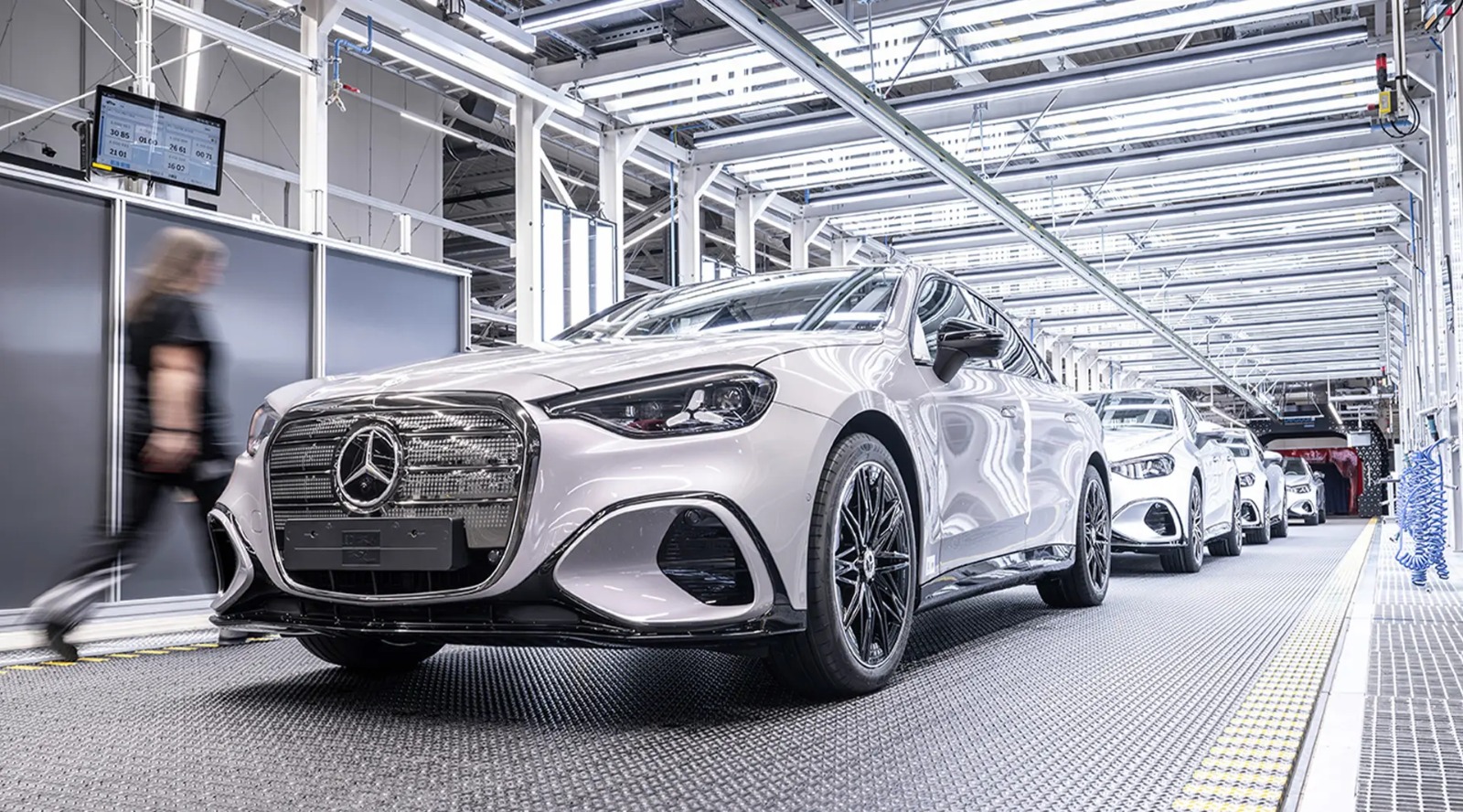
Mercedes-Benz is no longer talking about “transformation.” It is talking about survival in Germany.
WirtschaftsWoche, citing three people familiar with the talks, reports that Mercedes wants about €800 million in German labor-cost savings — roughly $911 million at current rates. Options on the table include longer hours without extra pay, cuts to holiday and Christmas bonuses, and the elimination of special payments. Management has already told workers that producing in Germany has become too expensive. If the targets are not met, two German plants — one assembly site and one powertrain site — could close. Mercedes declined to comment on the talks.
This is not an isolated labor spat. It is what a high-cost energy system plus a forced EV transition plus a flood of cheaper Chinese vehicles looks like when it finally hits a luxury brand that used to set the terms of the market.
Germany Became Too Expensive — On Purpose
Production chief Michael Schiebe told a works meeting in Sindelfingen that German production is not competitive by international standards, especially on labor. The company still says it wants to keep German sites and jobs. The condition is higher productivity and a lower cost per hour. The works council’s answer has been blunt: not on these terms.
The wage gap is real. Eurostat-linked reporting puts German industrial labor costs around €49.50 an hour versus €15.60 in Hungary. Mercedes has already doubled annual capacity at Kecskemét, Hungary, to about 400,000 vehicles, making it the company’s largest European plant. Factor costs there have been cited at roughly 70 percent below German levels. The company has also said it wants the share of production in lower-cost countries to rise from 15 percent in 2024 toward 30 percent by 2027.
Labor is the visible fight. Energy is the structural one.
IEA data for 2025 show EU electricity prices for energy-intensive industry still averaging more than twice U.S. levels and nearly 50 percent above China. That gap did not close after the 2022 spike. It became the new baseline. German energy-intensive output — chemicals, metals, glass, paper, ceramics — fell 15.2 percent from February 2022 to March 2026. Total industry fell 9.5 percent. Those sectors lost about 53,200 jobs.
That is the industrial base that supplies steel, chemicals, glass, electronics, and precision parts to car plants. When those plants shrink, auto assembly does not stay an island of prosperity. Volkswagen is in a historic overhaul. BMW is cutting thousands of jobs. Mercedes is now asking German workers to work more for the same money so two plants do not disappear. The pattern is the same: high power prices, carbon costs, grid charges, and a regulatory timetable that assumed Europe could price carbon first and still keep the factories.
Chinese EVs Did Not Wait for Europe to Finish Its Transition
While German plants argue over Christmas bonuses, Chinese brands have rewritten the European showroom.
Dataforce figures compiled across multiple reports show Chinese-brand market share in the broader European market (EU + UK + EFTA, definitions vary slightly by source) rising from about 0.5 percent in 2021 to 9.5 percent by mid-2026. Monthly prints have gone higher: about 9.8 percent in April, 10.9 percent in June, 11.2 percent in July, and a record 11.7 percent in August 2026, when Chinese brands registered 97,639 cars out of 835,409. That is roughly a twenty-fold increase in five years. European brands’ combined share in one Dataforce-based tally fell from about 71.9 percent to 64.7 percent over the same span.
The surge is not even. It is concentrated where price and hybrids matter:
- Germany: still low single digits — around 2 percent in 2025 in one Inovev cut, about 4.1 percent in a later Dataforce-based German figure. Home-market loyalty and dealer networks still blunt the attack.
- United Kingdom: around 11 percent in 2025.
- Spain and Italy: around 9 percent in 2025. Southern Europe and parts of Eastern Europe are the open door.
- Norway: nearly 14 percent, in a market that is already almost all-electric.
- Poland: about 8.2 percent, much of it combustion and hybrid product that dodges the EU’s China EV tariffs.
Inside the groups, BYD, Chery (Omoda, Jaecoo and related badges), SAIC’s MG, Geely (including Volvo and Polestar in some tallies), and Leapmotor account for most of the volume. After eight months of 2026, Chinese brands were already above 900,000 European registrations in one Dataforce tally. BYD alone passed 232,600. Chinese plug-in hybrids have been the tariff workaround: PHEV imports from China jumped after Brussels put countervailing duties on battery-electric cars in 2024. Chinese brands have taken a mid-teens share of Europe’s BEV segment in some months and close to 30 percent of the PHEV segment.
The cars are cheaper — on the order of €10,000 less than comparable European models in some reports, and about 21 percent cheaper on average in one Transport & Environment summary of made-in-China products. Europe mandated the EV shift. China built the scale, the batteries, and the export machine. Chinese firms supplied about 60 percent of global electric-car sales in 2025. Chinese electric-car exports more than doubled to over 2.5 million. Europe is buying the result.
That is the competitive vise around Mercedes. Premium pricing still works in the S-Class bay. It does not protect volume models when a BYD Seal U or Atto 2 PHEV undercuts the monthly payment and the energy bill at the factory is already twice the American rate.
Can a Weakened Factory Floor Re-Arm Europe?
Brussels and national capitals now want a defense surge. EU member-state defense spending rose from about €218 billion in 2021 to a projected €392 billion in 2025. Germany is steering most new orders to European firms. Rheinmetall’s order book has exploded. The EU’s €150 billion SAFE facility is meant to finance joint procurement with a European-content rule. Artillery-shell output has been lifted from a pre-war trickle toward two million rounds a year with help from earlier EU programs. New ammo and vehicle lines are opening in Poland, Romania, Lithuania, Hungary, and the Baltics.
That is not “nothing.” It is also not a restored industrial superpower.
Orders are rising faster than output. In Germany, the six-month average of domestic defense orders roughly doubled into early 2026 while industrial production barely moved. Lead times for air-defense systems still run to years. Europe is short an estimated 150,000 to 200,000 skilled defense-industrial workers — chemists for propellant, precision machinists, electronics specialists. Those are the same trades that energy-intensive shutdowns and auto downsizing are dispersing.
Tanks, shells, trucks, and missiles do not float free of the civilian base. They need steel, chemicals, forgings, bearings, wiring harnesses, and the machine-tool culture that lived inside Baden-Württemberg and North Rhine-Westphalia. That culture is exactly what high power prices and the EV crash diet are thinning. Europe can write checks. It cannot instantly re-create the plants it spent a decade making uncompetitive, then ask the remaining workforce to work 40 hours for 35 hours’ pay so Mercedes can match a BYD invoice.
Is the EU “too far gone”?
Not for a partial rearmament. Money, political will, and Eastern European greenfield plants can produce more 155 mm shells and more wheeled vehicles than in 2021. High-end air power, munitions depth, and a full-spectrum defense industrial base still lean on the United States. The civilian manufacturing core that would make a long war or a real strategic autonomy possible is smaller, older, and more expensive than it was before Net Zero collided with the loss of Russian pipeline gas.
Mercedes asking for €800 million in German labor givebacks is the bill arriving at the badge that once meant the factory system still worked. Energy costs set the floor. Chinese EVs set the price. Labor is what is left to squeeze. The plants that close will not be available later when someone in Brussels decides Europe also needs to build tanks at scale.
Making Appendices Great Again
Check out the World’s Greatest Podcast Show Notes at EnergyNewsBeat.co or EnergyNewsBeat.com.
Appendix: Sources and links
- Reuters, “Mercedes aims to cut €800 million in labour costs in Germany, WiWo reports,” Sept. 24, 2026: https://www.reuters.com/business/mercedes-aims-save-800-million-labour-costs-germany-wiwo-reports-2026-09-24/
- Reuters, “Mercedes says German production not competitive, two plants under threat,” Sept. 22, 2026: https://www.reuters.com/business/world-at-work/mercedes-says-german-production-not-competitive-two-plants-under-threat-2026-09-22/
- Automotive News / Reuters, Mercedes labor-cost cuts: https://www.autonews.com/mercedes-benz/ane-mercedes-labor-cost-cuts-0924/
- X post,
@CEObrandingnews
, Sept. 24, 2026: https://x.com/CEObrandingnews/status/2103144929882972464
- Carscoops, Hungary vs Germany production costs: https://www.carscoops.com/2026/07/mercedes-hungary-production/
- Börse Express (German-language detail on hours, bonuses, Kecskemét): https://www.boerse-express.com/news/articles/mercedes-benz-aktie-800-millionen-kostenabbau-in-deutschland-948661
Energy costs and industrial output
- IEA, Electricity 2026 — Prices: https://www.iea.org/reports/electricity-2026/prices
- IEA chart, industrial electricity prices 2019–2025: https://www.iea.org/data-and-statistics/charts/estimated-final-electricity-price-for-large-industrial-customers-in-energy-intensive-industries-2019-2025
- Destatis, energy-intensive industry −15.2% Feb. 2022–Mar. 2026: https://www.destatis.de/DE/Presse/Pressemitteilungen/2026/05/PD26_N032_42.html
- Clean Energy Wire summary of Destatis: https://www.cleanenergywire.org/news/energy-intensive-industries-germany-see-15-percent-production-fall-start-ukraine-war
- Reuters commentary on Europe’s industrial revival bet and energy-price gap: https://www.reuters.com/commentary/reuters-open-interest/europe-makes-trillion-euro-bet-revive-its-battered-industry-2026-07-31/
- Energy News Beat prior analysis: https://energynewsbeat.co/manufacturing/europes-industrial-death-spiral-due-to-net-zero-energy-may-not-be-recoverable/
Chinese EV and brand market share in Europe
- Gasgoo, Chinese share from 0.5% (2021) toward ~10% by spring 2026: https://autonews.gasgoo.com/articles/news/europe-builds-higher-trade-walls-yet-chinese-car-sales-surge-2070442820857774081
- Reuters, country-level Chinese share (Norway, UK, Spain, Italy, Germany, Poland): https://www.reuters.com/business/autos-transportation/where-chinese-automakers-have-gained-most-ground-europe-2026-02-11/
- Automotive News, Chinese brands 11.7% in August 2026: https://www.autonews.com/retail/sales/ane-chinese-sales-august-8-months-0922/
- autoevolution, August 2026 Dataforce tally: https://www.autoevolution.com/news/chinese-automakers-hit-record-market-share-in-europe-as-lawmakers-discuss-tariff-policy-276022.html
- The Guardian, Chinese hybrid and PHEV surge after EV tariffs: https://www.theguardian.com/business/2026/sep/24/eu-sales-chinese-hybrid-cars-rocket
- IEA Global EV Outlook 2026: https://www.iea.org/reports/global-ev-outlook-2026/executive-summary
- Transport & Environment, Chinese OEMs in the EU (June 2026 summary PDF): https://uploads.transportenvironment.org/production/files/Chinese-OEMs-in-EU-Summary.pdf
- newmobility.news, July share 11.2% and 2030 forecasts: https://newmobility.news/en/2026/08/25/chinese-brands-hit-record-market-share-in-europe-targeting-30-by-2030/
- Euronews, Chinese share doubling into early 2026: https://www.euronews.com/business/2026/05/27/chinese-carmakers-double-eu-market-share-as-evs-drive-sales-growth
EU production geography and European brand positions
- ICCT, passenger-car production in the EU: https://theicct.org/publication/passenger-car-production-and-electrification-in-the-eu-sept26/
- NYT, German auto industry under pressure: https://www.nytimes.com/2026/07/31/business/germany-mercedes-bmw-volkswagen.html
Rearmament vs. industrial capacity
- Defense Market, “The Industrial Gap Behind Europe’s Rearmament Numbers”: https://defensemarket.com/the-industrial-gap-behind-europes-rearmament-numbers/
- CEPA, “A Defense Production Plan for Europe”: https://cepa.org/article/a-defense-production-plan-for-europe/
- AdriaDefense, eastward shift of NATO industrial capacity: https://www.adriadefense.com/the-eastward-shift-how-central-europe-became-natos-new-industrial-backbone/
- The Objective (labor shortage in European defense factories): https://theobjective.com/tecnologia/2026-06-02/rearme-europeo-dinero-personal-fabricas/
- SIEPS policy analysis on SAFE and defense spending path: https://sieps.se/media/rjknqfwq/2026_4epa.pdf
- IISS, The Defence of Europe in a New Era (Sept. 2026 dossier): https://www.iiss.org/globalassets/media-library—content–migration/files/publications—free-files/strategic-dossier/pds-2026/complete-file/iiss_the-defence-of-europe-in-a-new-era-an-assessment_16092026.pdf
Figures on Chinese share vary by whether Volvo/Polestar/Geely, Leapmotor-Stellantis, and the UK/EFTA are counted as “Chinese.” The direction is not in dispute: from a rounding error in 2021 to a double-digit monthly share in 2026. Currency conversion in the Reuters labor-cost story used $1 = €0.8785.